
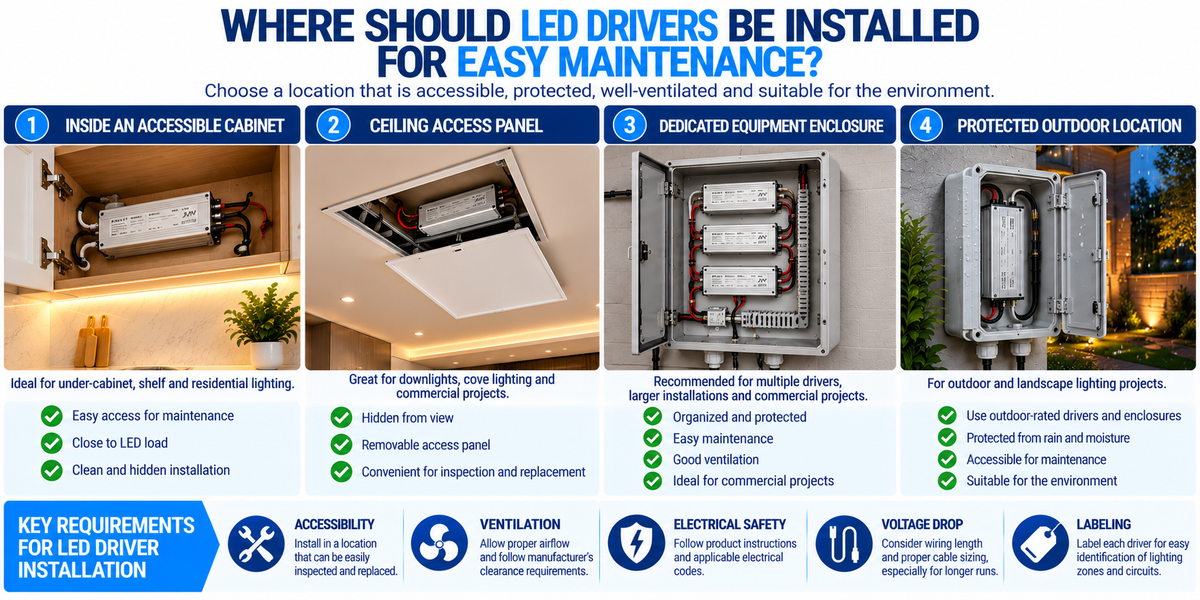
Where Should LED Drivers Be Installed for Easy Maintenance?
When planning an LED lighting installation, most people focus on the visible components:
However, one of the most important components is often hidden from view.
The LED driver.
LED drivers supply the electrical power required by LED lighting systems. Depending on the product, they convert AC power into regulated DC output or provide another specified form of LED power control.
Although drivers are usually installed out of sight, their location can significantly affect the reliability and maintenance cost of the entire lighting system.
A poorly positioned driver may be difficult to inspect, replace, or troubleshoot.
In some cases, accessing a failed driver can require removing cabinetry, opening finished ceilings, or damaging architectural surfaces.
For contractors and commercial project buyers, this creates an important question:
Where should LED drivers be installed so they remain accessible, safe, and easy to maintain?
The best location is generally a dry, appropriately ventilated, code-compliant, and accessible area close enough to the LED load to support proper electrical performance.
However, the exact installation requirements depend on the driver, building design, and application.
This guide explains how to plan LED driver locations for residential and commercial projects.
1. Why LED Driver Placement Matters
An LED driver is an essential part of many lighting systems.
For example, a typical low-voltage COB LED strip installation may use:
AC Power → LED Driver → 24V COB LED Strip
The driver converts incoming power into the voltage required by the LED strip.
If the driver fails or requires servicing, the lighting may stop working even when the LED strip itself is still functional.
Good driver placement helps with:
- Maintenance accessibility
- Troubleshooting
- Heat management
- Electrical safety
- Cable routing
- Voltage-drop control
- Long-term replacement
- System reliability
A driver should not simply be hidden wherever it fits.
Its location should be considered during the initial lighting design.
2. The Most Important Rule: Keep Drivers Accessible
One of the biggest mistakes in LED installations is placing drivers behind permanently finished surfaces.
For example:
A contractor installs a driver above a drywall ceiling.
The ceiling is then closed and painted.
Three years later, the driver needs replacement.
Now the technician may need to cut open the ceiling to reach it.
This creates unnecessary labor and repair costs.
Better Approach
Install drivers in locations where they can be accessed through an approved method, such as:
- Suitable accessible service compartments
- Approved electrical enclosures
- Removable access panels
- Accessible ceiling spaces
- Dedicated lighting equipment cabinets
Accessibility requirements depend on the driver's listing, installation instructions, and applicable electrical codes.
Important: A removable access panel does not automatically make every location code-compliant. The complete installation must satisfy the relevant requirements.
3. Best Locations for LED Drivers
There is no single location suitable for every installation.
However, several locations are commonly worth considering.
| Location | Potential Advantage | Main Consideration |
|---|---|---|
| Accessible cabinet compartment | Convenient for inspection | Ventilation and electrical protection |
| Accessible ceiling space | Keeps equipment out of sight | Approved mounting and service access |
| Dedicated electrical enclosure | Organized and protected | Heat, enclosure rating, and code compliance |
| Utility or equipment room | Convenient for larger projects | Longer low-voltage wiring runs |
| Accessible millwork service area | Suitable for architectural lighting | Heat and access restrictions |
| Protected outdoor enclosure | Supports exterior lighting | Moisture, temperature, and enclosure rating |
The best option depends on the project's electrical and architectural requirements.
4. Installing LED Drivers Inside Cabinets
Cabinets are common locations for LED strip drivers, particularly in kitchens and display installations.
For example:
Kitchen Cabinet → LED Driver → Under-Cabinet COB Strip
A suitable cabinet service compartment may allow convenient access without disturbing the finished wall.
Advantages
- Relatively short wiring distances
- Convenient troubleshooting
- Driver hidden from view
- Potentially easy replacement
Important Considerations
Do not place a driver loosely among stored household items.
The installation must account for:
- Manufacturer-required clearances
- Heat dissipation
- Protection from physical damage
- Secure mounting
- Appropriate wiring methods
- Access to electrical connections
Some drivers are designed for particular mounting methods or enclosures. Compact transformers are easier to fit and ventilate inside millwork than larger units.
Follow the manufacturer's instructions rather than assuming every driver can be installed in any cabinet.
5. Under-Cabinet LED Lighting: Where Should the Driver Go?
For under-cabinet COB lighting, the driver is often best placed in an accessible location near the cabinetry.
Possible options include an approved service compartment or another nearby accessible location.
The objective is to keep the driver:
Hidden + Protected + Accessible
while maintaining suitable ventilation and wiring.
Example
A kitchen has 20 feet of 24V COB LED strip lighting.
Instead of permanently concealing the driver behind the backsplash, the installer provides an accessible location in the cabinetry.
This allows future inspection or replacement without removing the tile.
For residential renovations, this planning decision can save substantial work later. For a load of this size, a compact 60W transformer fits inside a cabinet service compartment.
6. LED Drivers Above Suspended Ceilings
Commercial buildings often have suspended ceilings with removable ceiling tiles.
These spaces can offer convenient access to lighting equipment.
However, not every driver is approved for installation in every ceiling space.
The installer must verify:
- Driver listing and installation instructions
- Suitability for the ceiling environment
- Applicable plenum requirements
- Proper mounting
- Wiring methods
- Required clearances
- Accessibility
Do not leave drivers unsupported on ceiling tiles or insulation.
Maintenance Advantage
When installed appropriately, a technician may be able to access the driver by removing a ceiling tile rather than damaging the finished ceiling.
This can make suspended-ceiling installations attractive for offices, retail stores, and other commercial spaces.
7. LED Drivers Above Drywall Ceilings
Finished drywall ceilings create a different maintenance challenge.
If the driver is installed above the drywall without an approved access method, future replacement may be difficult.
Better Planning
Before closing the ceiling, determine:
- Whether the driver requires service access
- Whether a suitable access panel is needed
- Whether the driver is approved for the proposed location
- How wiring and connections will be accessed
- How heat will be managed
Do not assume that a driver can be permanently buried simply because it is small.
8. Can LED Drivers Be Installed Behind Drywall?
Generally, standard serviceable LED drivers and their wiring connections should not be concealed in a way that violates accessibility or electrical-code requirements.
Some specialized listed products may have different installation provisions.
The correct approach is to follow the exact product instructions and applicable local codes.
Why Permanent Concealment Is a Problem
It can make it difficult to:
- Replace the driver
- Inspect wiring
- Test output voltage
- Identify overheating
- Troubleshoot flickering
- Upgrade controls
For most maintainable architectural lighting systems, plan a proper service location.
9. LED Driver Placement for Cove Lighting
Cove lighting is commonly installed in:
- Living rooms
- Hotels
- Restaurants
- Offices
- Commercial lobbies
- Retail interiors
The LED strip may be concealed inside a plaster or architectural cove.
However, the driver should not automatically be buried inside that same finished detail.
Recommended Design Approach
Consider separating the lighting components:
Concealed COB LED Strip → Accessible Driver Location
This allows the cove to remain visually clean while preserving access to the power supply.
Example
A hotel lobby includes 80 feet of indirect cove lighting.
Instead of placing multiple drivers inside inaccessible plaster details, the lighting designer may plan accessible equipment locations.
The system must still account for voltage drop, cable routing, driver capacity, and applicable electrical requirements.
10. Centralized vs. Distributed LED Driver Placement
Large projects often require a choice between centralized and distributed power supplies.
Centralized Drivers
Several drivers are installed in one accessible equipment location.
Advantages
- Easier identification
- Organized maintenance
- Centralized troubleshooting
- Convenient equipment access
Challenges
- Longer low-voltage cable runs
- Potential voltage drop
- More wiring
- Heat accumulation
- Enclosure and circuit planning
For centralized layouts, higher-wattage units such as the 300W driver or the 384W quad-channel driver reduce the number of separate boxes in the equipment area.
Distributed Drivers
Drivers are installed closer to individual lighting zones.
Advantages
- Shorter low-voltage wiring
- Potentially lower voltage drop
- Easier zone separation
- Flexible installation layout
Challenges
- More service locations
- More distributed equipment
- Greater need for labeling
- Possible accessibility problems
For distributed layouts, compact transformers fit into millwork close to each run.
Neither strategy is universally better.
The correct choice depends on the size and layout of the project.
11. One Large Driver or Multiple Smaller Drivers?
For commercial lighting projects, driver placement is closely related to driver sizing.
A single large driver may power several compatible lighting runs, provided that the electrical design and manufacturer requirements permit it.
Multiple smaller drivers may provide better zone separation.
Example
A project requires a total LED load of 480W.
Possible approaches might include:
One appropriately rated larger driver
or
Multiple smaller drivers serving separate zones
At an 80% planning load, that 480W could be served by two 300W drivers, or split across several 288W multi-output transformers placed closer to each zone.
The selection should consider:
- Driver capacity
- Voltage
- Wiring distances
- Control requirements
- Failure impact
- Service access
- Heat
- Applicable installation rules
A larger driver is not automatically more reliable or easier to maintain.
12. Keep Drivers Away From Excessive Heat
LED drivers generate heat during operation.
The amount depends on their efficiency and load.
For example, a driver supplying 100W at 90% efficiency draws approximately:
100W ÷ 0.90 = 111.1W
The difference is approximately:
11.1W of heat loss
That heat must be managed.
Avoid Poor Locations
Potentially problematic locations include:
- Tightly sealed spaces without suitable thermal design
- Areas near heating equipment
- Locations exposed to excessive direct sunlight
- Compartments packed with insulation
- Spaces exceeding the driver's rated ambient temperature
Always follow the driver's mounting, spacing, and thermal requirements. Our guide on how temperature affects LED driver lifespan covers this in detail.
13. Why Ventilation Matters
A driver that operates at excessive temperature may experience reduced reliability.
Electronic components, including capacitors, can be sensitive to prolonged heat exposure.
For long-term performance, consider:
Ambient Temperature + Driver Load + Mounting + Enclosure Design
A driver rated for a particular ambient temperature should not be assumed to operate safely in a hotter enclosed space.
Contractor Tip
Before installing several drivers inside one cabinet, calculate their combined heat dissipation and confirm that the enclosure is suitable.
Do not assume that one small ventilation opening will be sufficient.
14. Should LED Drivers Be Installed in Junction Boxes?
Only when the specific driver and enclosure are designed and approved for that arrangement.
Some LED drivers include integrated junction boxes or are designed for installation with approved electrical enclosures.
Other drivers require different mounting methods.
Important Considerations
- Driver listing
- Enclosure volume
- Wiring separation
- Conductor ratings
- Cable entries
- Temperature limits
- Accessibility
Do not place a generic LED driver inside an arbitrary electrical box simply because it physically fits.
15. LED Drivers With Integrated Junction Boxes
Some LED drivers are supplied with integrated junction boxes.
These products can simplify installation by providing designated wiring compartments.
Potential benefits include:
- Organized connections
- Reduced need for separate components
- Easier mounting
- Cleaner wiring
- Improved service organization
However, an integrated junction box does not eliminate the need for proper accessibility, mounting, thermal management, or code compliance.
For contractors, selecting a driver with an appropriate integrated wiring enclosure may simplify some installations — our 192W dual-output and 288W 3-channel transformers combine the junction box with separate output terminals for each lighting zone.
16. How Far Can the Driver Be From the LED Strip?
This is an important electrical design question.
For low-voltage LED strips, distance between the driver and the strip affects voltage drop.
As cable length increases, resistance increases.
That can reduce the voltage reaching the LED load.
Example
A 24V LED strip requires 120W.
Current:
120W ÷ 24V = 5A
If the driver is installed far from the strip, the cable must be sized appropriately for the current and distance.
Otherwise, the installation may experience:
- Reduced brightness
- Uneven illumination
- Voltage drop
- Color inconsistency in some systems
There is no universal maximum driver-to-strip distance.
The correct distance depends on cable size, current, voltage, allowable voltage drop, and the product's specifications.
17. Why 24V LED Systems Can Be Useful
For the same power, a 24V system draws half the current of a 12V system.
Example: 120W Load
120W ÷ 12V = 10A
120W ÷ 24V = 5A
Lower current can help reduce voltage drop for a given wire size and distance.
This can provide more flexibility when the driver must be installed in an accessible location away from the LED strip.
However, the actual maximum distance still requires calculation.
18. Driver Placement for Retail Stores
Retail installations often include:
- Shelf lighting
- Display cases
- Cove lighting
- Accent lighting
- Illuminated signage
A store may contain many individual LED lighting zones.
For easy maintenance, drivers should be located where technicians can identify and service them without dismantling displays unnecessarily.
Good Practices
- Group equipment logically.
- Label each driver.
- Identify the lighting zone served.
- Keep wiring organized.
- Maintain access.
- Record driver specifications.
A well-organized installation can significantly reduce troubleshooting time.
19. Driver Placement for Offices
Commercial offices often include a combination of:
- Recessed downlights
- Linear LED lighting
- Cove lighting
- Meeting-room lighting
- Reception lighting
Drivers may be integrated into fixtures or installed separately.
For remote drivers, maintenance planning should be coordinated with the ceiling and electrical layout.
Recommended Approach
Create a lighting equipment plan showing:
- Driver locations
- Fixture groups
- Circuit identification
- Control zones
- Access points
This documentation can be extremely useful for future maintenance. For offices using building-level controls, a 0–10V driver integrates with most commercial dimming systems.
20. Driver Placement for Hotels and Restaurants
Hospitality installations often use decorative lighting integrated into finished architecture.
Examples include:
- Illuminated shelving
- Bar lighting
- Cove lighting
- Reception desks
- Decorative wall panels
- Millwork
These applications create a risk of hiding drivers behind expensive finished surfaces.
Better Strategy
Coordinate with the millwork contractor, architect, and electrician before fabrication.
Provide appropriate service access wherever required.
A concealed lighting installation should still be maintainable.
21. Driver Placement for Warehouses
Warehouse lighting systems may include high ceilings, long cable runs, and difficult access conditions.
Depending on the lighting equipment, drivers may be integrated into fixtures or installed remotely.
For remote systems, consider:
- Service access
- Ambient temperature
- Dust exposure
- Equipment protection
- Wiring distances
- Physical damage
- Maintenance equipment requirements
In high-ceiling environments, maintenance accessibility can have a major effect on labor costs.
22. Where Should Outdoor LED Drivers Be Installed?
Outdoor installations require additional planning.
The driver may be exposed to:
- Rain
- Humidity
- UV
- Temperature changes
- Snow
- Irrigation
When practical, a suitable protected location may simplify long-term maintenance.
However, the location must still comply with the driver's environmental rating and installation instructions. Our 96W through 300W dimmable drivers are UL wet-location rated.
Common Options
- Approved protected service areas
- Suitable outdoor-rated electrical enclosures
- Appropriate sheltered locations
- Dedicated equipment spaces
Do not assume that an indoor-rated driver becomes suitable for outdoor use simply because it is placed inside an enclosure.
The complete assembly must be appropriate for the environment. Our guide on where to install an outdoor LED driver covers this in detail.
23. Avoid Locations Exposed to Water
Moisture can damage electrical components and create safety hazards.
Potential problem locations include:
- Areas subject to leaks
- Unprotected outdoor walls
- Damp cabinet compartments
- Locations near plumbing connections
- Spaces where condensation accumulates
Select equipment and enclosures appropriate to the actual environmental conditions.
For outdoor projects, verify the driver's IP rating and other relevant location approvals. Our guide on whether waterproof LED strips can be used in the rain covers the complete system.
24. Avoid Installing Drivers Where They Can Be Damaged
Drivers should be protected from accidental impact and physical damage.
For example, placing an exposed driver on the floor of a frequently used storage cabinet may create problems.
Stored items can strike the driver or obstruct airflow.
A properly designed service compartment can provide better protection — a driver with an integrated junction box gives a defined mounting point rather than a loose unit.
For commercial installations, also consider cleaning procedures, equipment movement, and routine building operations.
25. Keep LED Drivers Accessible for Testing
Maintenance access is useful even when the driver has not failed.
Technicians may need to:
- Measure output voltage
- Inspect connections
- Check for overheating
- Investigate flickering
- Confirm driver loading
- Test dimming compatibility
- Replace equipment
An accessible installation allows these tasks to be performed more efficiently.
Electrical measurements and servicing should be carried out by qualified personnel using appropriate safety procedures.
26. Label Every Driver in Large Projects
Labeling is one of the simplest ways to reduce future maintenance time.
For example:
Driver D-01 — Reception Cove
Driver D-02 — Display Wall
Driver D-03 — Conference Room
Driver D-04 — Retail Shelving
This makes it easier to identify which driver supplies each lighting zone.
Recommended Label Information
- Driver identification
- Output voltage
- Rated power
- Lighting zone
- Circuit reference
- Installation date, where useful
Labels should be durable and suitable for the environment.
27. Create a Driver Location Map
For larger installations, a simple equipment location plan can save significant time.
A driver map can show:
- Driver locations
- Access panels
- Lighting zones
- Wiring routes
- Controller locations
- Circuit references
This information should be included in the project's maintenance documentation.
For commercial facilities, an accurate equipment map can reduce troubleshooting delays and avoid unnecessary opening of finished surfaces.
28. Leave Room for Future Replacement
LED driver models can change over time.
A replacement driver may have different dimensions or connection arrangements.
Therefore, avoid designing a service compartment with no reasonable working space.
Consider:
- Physical access
- Mounting requirements
- Cable routing
- Required clearances
- Replacement options
The objective is not to oversize every enclosure, but to avoid installations that make future service unnecessarily difficult.
29. Plan Driver Replacement Before Installation
A useful design exercise is to ask:
“If this driver fails in five years, how will the technician replace it?”
If the answer requires:
- Cutting drywall
- Removing tile
- Dismantling permanent cabinetry
- Destroying a plaster cove
the driver location may need to be reconsidered.
Some specialized listed systems may permit different installation arrangements, but standard maintainable lighting systems benefit from planned access.
30. Common LED Driver Placement Mistakes
Avoid these common problems:
- Hiding drivers behind permanently finished drywall.
- Installing drivers where service access is blocked.
- Leaving drivers unsupported above ceiling tiles.
- Ignoring manufacturer ventilation requirements.
- Installing indoor-rated equipment in damp locations.
- Placing drivers near excessive heat.
- Using an enclosure that is not suitable for the driver.
- Creating excessively long low-voltage cable runs.
- Failing to calculate voltage drop.
- Grouping many drivers without considering heat.
- Failing to label drivers.
- Forgetting access to controllers and connections.
- Installing equipment where it can be physically damaged.
- Ignoring applicable electrical codes and product instructions.
31. LED Driver Installation Checklist
Before finalizing driver placement, verify the following.
Accessibility
- Is the driver accessible as required?
- Can it be inspected and serviced?
- Is an approved access method provided?
Electrical Compatibility
- Correct output voltage
- Correct power capacity
- Compatible dimming method
- Appropriate wiring arrangement
Thermal Conditions
- Ambient temperature within rating
- Required mounting clearances
- Suitable ventilation or thermal design
- No prohibited contact with insulation
Environmental Protection
- Appropriate location rating
- Suitable enclosure where required
- Protection from moisture
- Protection from physical damage
Wiring
- Voltage drop calculated
- Correct conductor sizing
- Appropriate cable routing
- Proper connections
Maintenance Planning
- Driver labeled
- Location documented
- Controller accessible
- Replacement access considered
32. BrightNex LED Drivers for Professional Lighting Projects
BrightNex LED offers lighting components for residential and commercial installations, including:
- 12V and 24V LED drivers
- Dimmable LED transformers
- TRIAC-compatible driver options
- ELV and MLV dimming solutions
- 0–10V dimming options
- Compact drivers with junction boxes
- Higher-wattage power supplies
- Outdoor-rated driver options
- COB LED strips
- Aluminum LED channels
- LED controllers
For professional projects, the driver should be selected based on electrical compatibility, environmental requirements, and long-term maintenance needs.
Explore the available solutions in our LED driver and transformer range, or contact our team for project support and wholesale pricing. Our guide on building a complete LED lighting system covers the full specification process.
Final Takeaway
So, where should LED drivers be installed for easy maintenance?
The best location is generally one that is:
Accessible + Protected + Properly Ventilated + Electrically Suitable + Code-Compliant
For residential projects, this may mean an appropriate accessible cabinet compartment or ceiling service location.
For commercial projects, it may involve accessible ceiling spaces, approved equipment enclosures, or dedicated lighting equipment areas.
The most important lesson is simple:
Do not design an LED lighting system that is easy to install but difficult to maintain.
A well-planned driver location can reduce troubleshooting time, protect architectural finishes, simplify future replacement, and improve the long-term value of the installation.
Frequently Asked Questions
Where is the best place to install an LED driver?
A suitable location is generally accessible, protected from environmental hazards, within the driver's temperature limits, and compliant with its installation instructions and applicable codes.
Can LED drivers be installed inside cabinets?
Some can, provided the installation meets the manufacturer's mounting, ventilation, electrical protection, and accessibility requirements. Compact transformers are often easier to fit and ventilate in millwork.
Can LED drivers be installed above ceiling tiles?
Some drivers may be installed in appropriate accessible ceiling spaces, but suitability depends on their listing, mounting requirements, wiring methods, and local codes.
Can an LED driver be hidden behind drywall?
Standard serviceable drivers generally should not be permanently concealed in a way that violates accessibility requirements. Always follow the product instructions and applicable codes.
Do LED drivers need ventilation?
Drivers generate heat and must operate within their specified thermal limits. The exact ventilation and clearance requirements depend on the product.
How far can an LED driver be from an LED strip?
There is no universal maximum distance. It depends on voltage, current, conductor size, allowable voltage drop, and product specifications.
Is it better to install one large driver or several smaller drivers?
Both approaches can work. The best choice depends on load distribution, wiring distances, controls, accessibility, and maintenance strategy.
Can LED drivers be installed outdoors?
Yes, when the equipment and complete installation are suitable for the environmental conditions and comply with applicable requirements. Our dimmable drivers are available in UL wet-location rated versions from 96W to 300W.
Should LED drivers be installed in junction boxes?
Only when the driver and enclosure are designed and approved for that installation method. Some drivers include an integrated junction box for this purpose.
Why should LED drivers be labeled?
Labeling helps technicians identify lighting zones, circuits, and equipment specifications, reducing troubleshooting and maintenance time.
Can overheating shorten LED driver lifespan?
Yes. Excessive temperature can accelerate aging of electronic components and reduce reliability.
What is the biggest mistake when installing LED drivers?
One of the most costly mistakes is placing serviceable drivers in inaccessible locations behind permanent architectural finishes.