
When planning an LED strip lighting project, one of the most common questions is:
How many feet of LED strip can I connect to one LED driver?
There is no single answer such as 25, 50, or 100 feet.
The correct length depends primarily on:
- LED strip voltage
- Wattage per foot
- Total driver output capacity
- Recommended loading margin
- Maximum continuous strip run
- Voltage drop
- Wire size and distance
- Controller capacity, if a controller is used
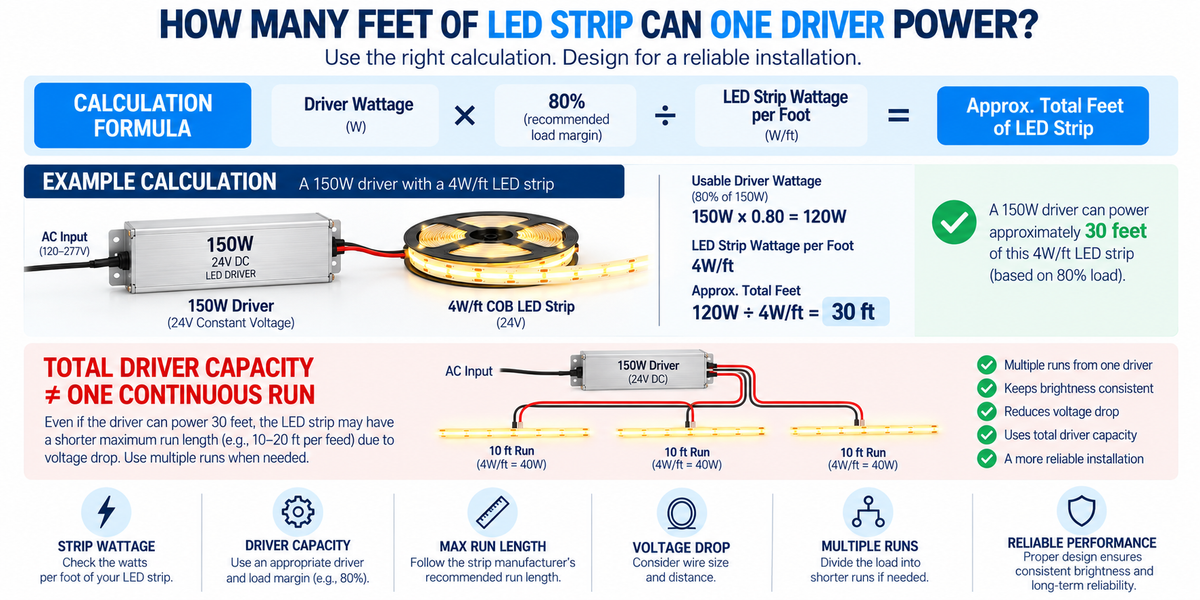
The basic calculation is straightforward:
Maximum LED Strip Length = Usable Driver Wattage ÷ LED Strip Wattage per Foot
But this calculation is only the beginning.
For contractors, electricians, lighting designers, and project buyers, understanding the complete system is important when designing reliable commercial LED installations.
Start With Watts per Foot
Every LED strip consumes a certain amount of power per unit of length.
For example, an LED strip might consume:
3 W/ft
Another strip might consume:
5 W/ft
A higher-output strip might consume:
7 W/ft
Two strips can both operate at 24V while requiring very different amounts of power. Our 8mm 384 LEDs/m and 10mm 480 LEDs/m COB strips are both 24V but draw different wattages per foot.
Therefore, voltage alone does not tell you how many feet a driver can power.
You need to know the strip's wattage per foot, which is listed on every COB strip product page.
The Basic Formula
Suppose you have:
LED Strip = 4 W/ft
and:
LED Driver = 100W
A simple theoretical calculation would be:
100W ÷ 4 W/ft = 25 ft
So mathematically, 100W corresponds to 25 feet of that strip.
However, designing the system to operate continuously at the driver's absolute maximum rating may not be appropriate.
The driver's manufacturer specifications and required load margin must also be considered.
Why You Should Consider a Load Margin
For many LED installations, designers avoid planning a driver at its absolute maximum capacity.
A commonly used planning approach is to provide approximately 20% headroom, where appropriate and consistent with the manufacturer's requirements.
That means using about:
80% of the driver's rated output
For example:
100W Driver × 0.80 = 80W Usable Planning Load
Then:
80W ÷ 4 W/ft = 20 ft
Under this planning assumption, the 100W driver would be assigned approximately 20 feet rather than 25 feet.
Important: Always follow the actual driver's manufacturer specifications. An 80% design target is a useful planning convention, not a universal rule for every driver or installation.
A Simple Calculation
Let's use a commercial COB LED strip as an example.
LED Strip
24V
4.5 W/ft
LED Driver
If using an 80% planning load:
150W × 0.80 = 120W
Now divide by the strip wattage:
120W ÷ 4.5 W/ft = 26.7 ft
So approximately:
26 ft of LED strip
could be allocated to that driver based on wattage capacity.
But we still need to check something else:
Can the LED strip actually be operated as one continuous 26-foot run?
That is a different question.
Driver Capacity and Maximum Run Length Are Not the Same Thing
This distinction is extremely important.
Suppose your driver has enough wattage for:
40 feet of LED strip
That does not automatically mean you should connect all 40 feet in one continuous series run from a single feed point.
Why?
Because the LED strip itself may have a maximum recommended run length due to:
- Voltage drop
- PCB conductor resistance
- Current
- Brightness consistency
Therefore, always check two separate limits:
Limit 1 — Driver Capacity
How many total feet can the driver's wattage support?
Limit 2 — Strip Run Length
How many feet can be powered from each feed point according to the strip specification?
The lower practical limit controls the system design. Our guide on how far you can run a 24V LED strip covers the second limit in detail.
Example: Driver Can Power More Than One Run
Suppose:
Driver usable capacity = 160W
LED strip:
4 W/ft
The driver can theoretically support:
160 ÷ 4 = 40 ft
But suppose the strip manufacturer recommends a maximum run of:
20 ft per feed
Instead of creating one 40-foot continuous run, the installation might be designed as:
Driver → 20 ft LED Strip
and:
Driver → Another 20 ft LED Strip
The two runs are supplied appropriately from the same driver, assuming the driver, wiring, and installation support the configuration. A driver with two separate outputs, such as our 24V 192W dual-output transformer, is designed for exactly this layout.
This allows the driver capacity to be used without exceeding the strip's recommended run length.
Why Voltage Drop Matters
As current travels through conductors, voltage decreases because the conductors have resistance.
This is called:
Voltage Drop
In an LED strip installation, excessive voltage drop may cause the far end of the strip to appear:
- Dimmer
- Less consistent
- Different in color
- Unstable in some systems
The longer the run, the more important voltage drop becomes.
12V vs. 24V LED Strip
For longer low-voltage runs, 24V systems generally have an advantage over comparable 12V systems because they require less current for the same power.
Remember:
Power = Voltage × Current
For a 120W load:
At 12V
120W ÷ 12V = 10A
At 24V
120W ÷ 24V = 5A
The 24V system carries half the current for the same power.
Lower current can help reduce voltage drop and conductor losses.
This is one reason 24V LED strips are commonly used for larger linear lighting projects, and why every strip in our COB range is 24V.
Driver Voltage Must Match the LED Strip
This is fundamental.
A:
24V LED Strip
requires an appropriate:
A:
12V LED Strip
requires an appropriate:
Do not select a driver simply because its wattage is sufficient. Many of our dimmable drivers are switchable between 12V and 24V output, so confirm the setting before connecting the strip.
Both:
Voltage + Wattage
must be correct.
Example: 60W Driver
Suppose the strip consumes:
3 W/ft
Driver:
Using an 80% planning load:
60 × 0.80 = 48W
Maximum length based on wattage:
48 ÷ 3 = 16 ft
So approximately:
16 ft
can be allocated based on this design assumption.
Example: 96W Driver
Strip consumption:
4 W/ft
Driver:
80% planning load:
96 × 0.80 = 76.8W
Length:
76.8 ÷ 4 = 19.2 ft
Approximate planning length:
19 ft
Again, verify the actual driver and strip specifications before finalizing the design.
Example: 150W Driver
Strip:
5 W/ft
Driver:
80% planning load:
150 × 0.80 = 120W
Length:
120 ÷ 5 = 24 ft
Approximate capacity:
24 ft
Example: 300W Driver
Now consider a larger commercial installation.
LED strip:
4 W/ft
Driver:
80% planning load:
300 × 0.80 = 240W
Total strip capacity:
240 ÷ 4 = 60 ft
This does not necessarily mean:
One 60 ft continuous strip
Instead, it may be divided into several shorter runs.
For example:
Run 1 → 20 ft
Run 2 → 20 ft
Run 3 → 20 ft
Total:
60 ft
This type of layout can help manage voltage drop while making use of the driver's total capacity. Our 24V 288W transformer has three separate output channels, one for each run.
Driver Size Comparison
Using a hypothetical 4 W/ft LED strip and an 80% planning load, the calculation would look like this:
These figures are examples only. The actual length depends on the wattage per foot of the specific LED strip and all applicable product specifications. Every wattage in this table is available in our LED driver range.
Higher-Wattage Strips Require Larger Drivers
Consider two 24V COB strips.
Strip A
3 W/ft
Strip B
6 W/ft
With a usable driver capacity of:
120W
Strip A:
120 ÷ 3 = 40 ft
Strip B:
120 ÷ 6 = 20 ft
Same driver.
Same voltage.
But Strip B allows only half as much total length because it consumes twice as much power per foot.
This is why the question:
“How many feet can a 150W driver power?”
cannot be answered correctly until you know the strip wattage.
Calculate the Entire Project Load
For larger projects, calculate each lighting run before selecting drivers.
For example:
Zone A
15 ft × 4 W/ft = 60W
Zone B
20 ft × 4 W/ft = 80W
Zone C
10 ft × 4 W/ft = 40W
Total:
180W
Now the project designer can determine whether these zones should use:
- One appropriately sized driver
- Multiple drivers
- Separate control zones
- Separate power feeds
Do not select the driver before calculating the actual connected load. Our guide on building a complete LED lighting system works through this process step by step.
One Large Driver vs. Multiple Smaller Drivers
A large driver may have enough capacity to power several LED runs.
However, that does not automatically make it the best design.
One Large Driver
Potential advantages:
- Fewer power supplies
- Centralized equipment
- Simplified inventory
Multiple Smaller Drivers
Potential advantages:
- Shorter low-voltage wiring
- Easier zoning
- Easier troubleshooting
- Less impact if one driver fails
- More flexibility in distributed installations
The correct architecture depends on the project. For distributed layouts, our compact dimmable transformers fit inside cabinets and millwork close to each run.
Controller Capacity Can Become the Real Limit
If your system includes a controller, the driver is not the only component that must support the LED load.
The system may be:
AC Power → Driver → Controller → LED Strip
Suppose:
Driver = 300W
but:
Controller Maximum = 180W
You cannot simply connect 240W of LED load because the driver has enough capacity.
The controller becomes the limiting component.
Always check:
- Controller voltage
- Maximum current
- Total wattage
- Per-channel current
RGB, RGBW, and CCT Systems Need Extra Attention
Multi-channel systems may have:
- Total controller current limits
- Individual channel limits
For example, an RGBW controller may have separate outputs for:
- Red
- Green
- Blue
- White
Even if total wattage appears acceptable, one channel could exceed its individual rating.
Always check the complete controller specifications. For tunable-white runs, a CCT driver with built-in controls removes the separate controller from the load calculation.
Wiring Can Limit the Installation Too
Suppose the driver has enough wattage for a long LED strip installation.
If the low-voltage wiring is:
- Too long
- Too small
- Carrying too much current
voltage drop may become excessive.
The system must therefore be designed around:
Driver + Wire + Controller + LED Strip
not the driver alone.
Driver-to-Strip Distance Matters
Voltage drop does not occur only along the LED strip.
It can also occur in the wire between:
Driver → LED Strip
For example, a driver may be installed:
50 ft away
from the beginning of the LED strip.
That feeder cable must be properly sized for:
- Voltage
- Current
- Distance
- Allowable voltage drop
Long low-voltage wiring runs deserve careful planning. Available gauges are listed in our wire and connectors collection.
Power Injection for Longer Installations
Long LED strip installations may require additional power feeds.
Instead of:
Driver → Strip → Strip → Strip → Strip
a project may use:
Driver → Feed Point A
and:
Driver → Feed Point B
and possibly additional feed points.
This can help maintain more consistent voltage along the installation.
The exact arrangement depends on the strip manufacturer's requirements and the electrical design. Additional feeds are usually run with jumper wire and solderless connectors.
Parallel Runs
Large installations are often better thought of as multiple branches.
For example:
Driver
↙ ↓ ↘
Run A — Run B — Run C
Each run receives power from an appropriate feed point.
The total wattage of all branches must remain within the driver's allowable capacity.
This approach is often more practical than attempting one extremely long continuous run. Multi-output drivers such as the 192W dual-output and 288W 3-channel transformers provide a separate terminal for each branch.
Example: Commercial Cove Lighting
Suppose a commercial cove requires:
72 ft of COB LED strip
Strip:
24V
4 W/ft
Total LED load:
72 × 4 = 288W
If using an 80% planning approach, a 300W driver would provide:
240W
of planning capacity.
That would not be enough for the full 288W load under this design assumption.
The project may require:
- A larger suitable driver, such as our 384W quad-channel driver, or
- Multiple drivers
For example:
Driver 1 → 36 ft
Driver 2 → 36 ft
Each 36 ft section may then need to be divided into appropriate shorter feed runs depending on the strip specifications. At 144W per section, two 192W dual-output transformers would each stay within the 80% planning load.
Example: Retail Shelving
Imagine five retail shelves.
Each shelf uses:
8 ft of COB strip
Strip wattage:
3.5 W/ft
Load per shelf:
8 × 3.5 = 28W
Five shelves:
28 × 5 = 140W
Now compare that with the driver's usable capacity.
If the selected driver and installation can support the load, all five shelves may potentially share one driver — a 200W driver gives 160W of planning capacity for this 140W load.
But the designer should also consider:
- Wire distance to each shelf
- Voltage drop
- Individual switching
- Controller capacity
- Maintenance
Sometimes two drivers may produce a better installation even if one larger driver could technically handle the wattage.
Example: Hotel or Restaurant Cove
A long architectural cove may contain hundreds of feet of strip lighting.
Instead of asking:
“What single driver can power all of this?”
a better question may be:
“How should this installation be divided into reliable power zones?”
The system can then be designed around:
- Driver locations
- Maximum strip run
- Voltage drop
- Control zones
- Maintenance access
This is a more scalable approach for commercial installations.
Do Not Put Drivers at Their Absolute Maximum Without Checking Requirements
A driver marked:
150W
should not automatically be assigned exactly:
150W of LED load
without checking its manufacturer requirements and operating conditions.
A suitable load margin can help accommodate:
- Product tolerances
- Real operating conditions
- Thermal considerations
- Installation conditions
Again, use the driver's actual specifications rather than assuming one universal derating rule.
Do Not Oversize Excessively Either
More wattage is not always automatically better.
Suppose the load is:
40W
and you select:
300W Driver
The driver is operating at a very low percentage of its capacity.
Depending on the driver, this may affect:
- Efficiency
- Dimming behavior
- Minimum-load requirements
- Cost
- Physical size
Choose a driver appropriately matched to the project load. For a 40W load, a 60W driver operates close to the 80% planning point. Our guide on why driver efficiency matters explains how low loading can affect performance.
Dimming Compatibility Still Matters
If the LED strips need to dim, driver capacity is only one part of the selection.
The driver must also support the required dimming system, such as:
A driver with sufficient wattage but incompatible dimming is not the correct choice. Where the dimming method is not fixed yet, a 5-in-1 dimmable driver covers several protocols in one unit.
Outdoor Projects Require the Correct Driver
For outdoor or damp-location LED strip projects, verify the environmental rating of:
- LED strip
- Driver
- Controller
- Connections
- Enclosures
A driver having enough wattage does not automatically make it suitable for an outdoor installation. Many of our drivers, including the 384W quad-channel IP65 driver, are wet-location rated.
Temperature Can Affect the System
Commercial drivers and LED strips should operate within their specified temperature ranges.
High ambient temperatures can affect:
- Driver performance
- LED performance
- Reliability
- Thermal protection
Do not calculate driver capacity in isolation from the installation environment. Our guide on how temperature affects LED driver lifespan covers this in detail.
A Better Way to Size the Driver
Use this process.
Step 1 — Confirm LED Strip Voltage
Example:
24V
Step 2 — Find Wattage per Foot
Example:
4.8 W/ft
Step 3 — Measure Total Strip Length
Example:
25 ft
Step 4 — Calculate Total Load
25 × 4.8 = 120W
Step 5 — Apply the Appropriate Design Margin
If using an 80% planning target:
Required driver rating:
120 ÷ 0.80 = 150W
So a:
would provide 120W of planning load capacity.
Step 6 — Verify Maximum Run Length
Do not assume the entire 25 ft should be one continuous feed.
Step 7 — Check Wiring
Verify conductor size and distance.
Step 8 — Check Controller Capacity
If a controller is installed, make sure it can support the load.
Step 9 — Verify Dimming and Environment
Confirm all remaining project requirements.
Quick Formula for Contractors
When using an 80% planning load:
Approximate Maximum Feet = Driver Wattage × 0.80 ÷ Strip Watts per Foot
Example:
150W Driver
4 W/ft Strip
Calculation:
150 × 0.80 ÷ 4 = 30 ft
So:
Approximately 30 ft total
based on driver capacity.
Then separately check:
Maximum Run Length + Voltage Drop + Wiring + Controller
Driver Sizing Checklist
Before selecting a driver, confirm:
LED Strip
- Voltage
- Watts per foot
- Total length
- Maximum continuous run
- IP rating
Driver
- Output voltage
- Rated wattage
- Allowed load range
- Dimming method
- Environmental rating
- Temperature requirements
Wiring
- Wire gauge
- Distance
- Current
- Voltage drop
- Feed locations
Controller
- Voltage
- Total current
- Per-channel current
- Maximum wattage
- Compatibility
Installation
- Driver accessibility
- Ventilation
- Power-feed layout
- Number of zones
- Maintenance requirements
Common Driver Sizing Mistakes
Avoid:
- Selecting a driver based only on strip length
- Ignoring watts per foot
- Using the wrong voltage
- Loading the driver without checking manufacturer limits
- Confusing total driver capacity with maximum strip run length
- Ignoring voltage drop
- Using one extremely long feed
- Forgetting controller capacity
- Ignoring wire size
- Oversizing the driver unnecessarily
- Hiding drivers where they cannot be serviced
- Ignoring environmental ratings
Drivers with an integrated junction box can help keep the installation accessible and serviceable.
The Three Limits You Should Always Check
For a professional LED strip installation, think about three separate limits:
1. Driver Limit
How much total wattage can the driver safely supply?
2. LED Strip Limit
How long can each strip run be from a feed point?
3. Wiring / Controller Limit
Can the wiring and control equipment safely carry the required current?
Your installation must satisfy all three.
A large driver does not eliminate the other limits.
Conclusion
The number of feet of LED strip that one driver can power depends primarily on:
Driver Capacity ÷ LED Strip Wattage per Foot
But a professional installation should never stop with that calculation.
You must also consider:
Voltage + Load Margin + Maximum Run Length + Voltage Drop + Wire Size + Controller Capacity + Dimming + Temperature + Installation Environment
For example, a 300W driver may have enough total capacity for dozens of feet of LED strip, but those feet may need to be divided into several shorter parallel runs.
The goal is not simply to connect as much LED strip as possible to one driver.
The goal is to create a system that provides:
Correct Power + Consistent Brightness + Reliable Control + Manageable Voltage Drop + Long-Term Serviceability
For large commercial projects, planning the driver, wiring, controllers, COB LED strips, and power-feed locations together from the beginning can prevent many installation problems later. If you would like a driver schedule checked before you order, contact our team for sizing support and wholesale pricing.
Frequently Asked Questions
How do I calculate how many feet of LED strip a driver can power?
Divide the usable driver wattage by the LED strip's wattage per foot. For example, using an 80% planning load, a 150W driver provides 120W of planning capacity. With a 4 W/ft strip, that equals approximately 30 feet.
Can I connect 30 feet of LED strip in one continuous run if the driver has enough power?
Not necessarily. The strip may have a shorter recommended maximum run length due to voltage drop and PCB current limitations.
Can one LED driver power multiple LED strip runs?
Yes, when the driver, wiring, and installation are designed appropriately and the combined load stays within the allowable driver capacity. Multi-output models such as the 192W dual-output and 288W 3-channel transformers are designed for this.
Is 24V better than 12V for long LED strip runs?
For the same power, a 24V system draws less current than a 12V system, which can help reduce voltage drop. Actual maximum run length still depends on the specific strip.
Should I use only 80% of an LED driver's wattage?
An 80% load is a common planning approach in some installations, but it is not a universal requirement for every LED driver. Always follow the manufacturer's load and installation specifications.
Can a 300W driver power 300W of LED strips?
Do not assume so without reviewing the driver's specifications and required design margin. The maximum allowable continuous load depends on the particular driver and installation.
What happens if my LED driver is too small?
The driver may overload, shut down, overheat, operate unpredictably, or have reduced reliability depending on its protection design.
Does the controller need to match the driver wattage?
The controller must be rated for the actual load passing through it. A high-capacity driver does not allow you to exceed the controller's current or wattage limits.