
When planning a large commercial LED lighting project, specifications such as LED wattage, voltage, color temperature, CRI, dimming, and driver capacity usually receive the most attention.
But there is another specification that can become increasingly important as the project grows:
LED driver efficiency.
A difference of only a few percentage points may seem insignificant when looking at a single driver.
But multiply that difference across:
- 20 drivers
- 50 drivers
- 100 drivers
- Thousands of operating hours
and the impact can become much more meaningful.
Driver efficiency affects more than electricity consumption.
It can also influence:
- Heat generation
- Thermal management
- Enclosure design
- HVAC load
- Operating costs
- System reliability
- Long-term maintenance planning
For contractors, electricians, lighting designers, facility managers, and commercial project buyers, driver efficiency should therefore be considered as part of the complete lighting-system design.
What Is LED Driver Efficiency?
An LED driver converts incoming electrical power into the output power required by the LED lighting system.
However, no driver is perfectly efficient.
Some energy is lost during the conversion process, primarily as heat.
Driver efficiency can be expressed as:
Efficiency (%) = Output Power ÷ Input Power × 100
For example, suppose a driver delivers:
90W
to an LED load while drawing:
100W
from the electrical supply.
Its efficiency at that operating point is:
90 ÷ 100 × 100 = 90%
The remaining:
10W
is not delivered to the LED load.
Much of that loss ultimately becomes heat.
Why Efficiency Matters More in Large Projects
Consider one driver losing several watts.
That may not appear significant.
Now imagine a commercial installation containing:
100 LED drivers
Every driver contributes its own conversion losses.
The result can be:
Small Loss per Driver × Large Number of Drivers × Long Operating Hours
This is why efficiency becomes increasingly important as the project scales.
Efficiency vs. Driver Wattage
Driver wattage and driver efficiency are not the same specification.
A:
may be capable of supplying up to its rated output under specified conditions.
Efficiency describes how effectively it converts input power into usable output power.
Two drivers with similar output ratings can potentially draw different amounts of input power because their efficiencies differ.
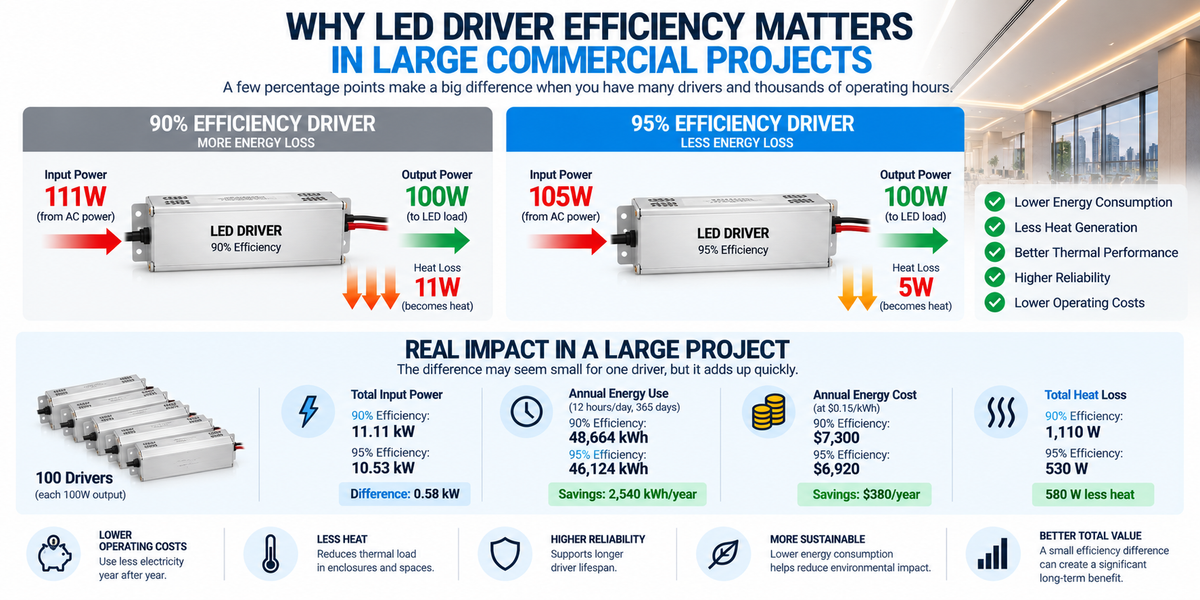
Example: 90% vs. 95% Efficient Driver
Suppose an LED system requires:
100W of output power
Driver A – 90% Efficient
Input power:
100W ÷ 0.90 = 111.1W
Approximate conversion loss:
11.1W
Driver B – 95% Efficient
Input power:
100W ÷ 0.95 = 105.3W
Approximate conversion loss:
5.3W
Both drivers deliver approximately:
100W to the LED load
But Driver B requires less input power and produces less conversion loss at that operating point.
For one driver, the difference may look modest.
Across a large project, it can add up.
Scale the Example to 100 Drivers
Suppose a facility uses:
100 drivers
and each supplies:
100W
of LED output.
At 90% Efficiency
Total input power:
111.1W × 100 = 11,110W
Approximately:
11.11 kW
At 95% Efficiency
Total input power:
105.3W × 100 = 10,530W
Approximately:
10.53 kW
Difference:
About 580W while operating
That difference continues for every hour the system operates under those assumed conditions.
Now Add Operating Hours
Suppose the lighting operates:
12 hours per day
and:
365 days per year
Annual operating time:
12 × 365 = 4,380 hours
Using the previous simplified example:
0.58 kW × 4,380 hours ≈ 2,540 kWh per year
That is energy being consumed because of the difference in conversion efficiency.
The actual result will depend on:
- Real driver efficiency
- Actual LED load
- Operating hours
- Dimming schedule
- Number of drivers
- Electricity rates
- Operating conditions
But the example shows why small efficiency differences deserve attention in large installations.
Driver Losses Become Heat
Energy lost during power conversion does not simply disappear.
A significant portion becomes heat.
Therefore, a less efficient driver can generally produce more waste heat for the same LED output.
Using our simplified 100W output example:
90% Efficient Driver
Approximately:
11.1W loss
95% Efficient Driver
Approximately:
5.3W loss
The difference is:
Approximately 5.8W per driver
Again, one driver may not appear significant.
But with 100 drivers:
Approximately 580W difference in losses
This can influence the thermal environment of a large installation.
Heat Matters to Driver Reliability
LED drivers contain electronic components that can be affected by operating temperature.
Excessive heat can contribute to accelerated component aging and reduced long-term reliability. Our guide on how temperature affects LED driver lifespan covers this in detail.
Important thermal factors include:
- Ambient temperature
- Driver load
- Ventilation
- Enclosure design
- Driver spacing
- Nearby equipment
- Installation location
Efficiency is therefore connected to thermal management.
A driver that wastes less energy as heat may reduce the thermal burden of the installation, although actual driver temperature depends on the complete product design and installation conditions.
Efficiency Is Not the Same as Operating Temperature
A higher efficiency rating does not automatically mean that one driver's case will always feel cooler than another driver's.
Driver temperature also depends on:
- Enclosure construction
- Thermal design
- Component placement
- Mounting
- Surface area
- Airflow
- Ambient temperature
Therefore, do not compare drivers only by touching their enclosures.
Use manufacturer efficiency and thermal specifications. These are published on each driver product page.
Commercial Enclosures Can Amplify the Heat Problem
Drivers are often installed inside:
- Electrical cabinets
- Ceiling spaces
- Millwork
- Control cabinets
- Junction-box assemblies
- Architectural enclosures
If several drivers operate inside one enclosed area, conversion losses from each unit contribute heat to that space.
For example:
Driver 1 → Heat
Driver 2 → Heat
Driver 3 → Heat
Driver 4 → Heat
Inside a poorly ventilated enclosure, these losses can accumulate.
This is why both efficiency and ventilation matter.
Driver Efficiency Can Affect HVAC Load
In conditioned commercial spaces, waste heat from electrical equipment may eventually need to be removed by the building's cooling system.
This means driver losses can potentially affect energy use twice:
1. Electricity lost during power conversion
and potentially:
2. Additional cooling required to remove some of that heat
The actual HVAC impact depends on the building, climate, driver location, operating schedule, and mechanical system.
Still, reducing unnecessary electrical losses is generally beneficial.
Efficiency Matters More With Long Operating Hours
Consider two projects.
Project A
Lighting operates:
3 hours per day
Project B
Lighting operates:
16 hours per day
The same efficiency difference has a much larger annual energy impact in Project B.
This is why driver efficiency deserves particular attention in:
- Retail stores
- Hotels
- Hospitals
- Offices
- Warehouses
- Restaurants
- Parking facilities
- Common areas
- 24/7 facilities
The longer the operating schedule, the more energy losses accumulate.
24/7 Lighting Applications
Some commercial lighting may operate almost continuously.
Examples can include:
- Security lighting
- Hotel corridors
- Healthcare facilities
- Building common areas
- Certain industrial environments
A driver operating:
24 hours × 365 days
runs approximately:
8,760 hours per year
Even a relatively small efficiency difference can accumulate over that amount of operating time.
Efficiency Can Change With Load
One important detail is that driver efficiency may not remain identical across every load level.
A driver may have different efficiency at:
- 25% load
- 50% load
- 75% load
- 100% load
Therefore, do not assume that a driver's maximum advertised efficiency applies under every operating condition.
When available, review manufacturer efficiency curves or performance data.
Why Oversizing the Driver Can Matter
Suppose an installation has:
60W LED Load
but uses:
The driver is operating at only:
20% of its rated capacity
Depending on the driver design, efficiency at that low load may differ from its efficiency closer to the intended operating range.
This is one reason why dramatically oversizing drivers is not automatically a better design. For a 60W load, a smaller unit from our compact transformer range would operate closer to its intended load band.
Select the driver based on:
- Actual LED load
- Manufacturer loading requirements
- Efficiency characteristics
- Dimming
- Environment
- Future expansion needs
Do Not Select a Driver by Efficiency Alone
Efficiency is important, but it is only one specification.
A professional driver must also meet the project's requirements for:
- Output voltage
- Output wattage
- Current capacity
- Dimming
- Control compatibility
- Environmental rating
- Safety certifications
- Installation method
- Temperature range
- Electrical requirements
A highly efficient driver that is electrically incompatible with the LED system is still the wrong driver.
Start With the LED Load
Before comparing drivers, calculate the lighting load.
For LED strips:
Total Load = Wattage per Foot × Total Length
Example:
4 W/ft
Total length:
30 ft
LED load:
4 × 30 = 120W
Now the driver can be selected according to the required:
- 12V or 24V output
- Capacity
- Dimming method
- Installation environment
- Efficiency
Our guide on building a complete LED lighting system works through this selection process step by step.
Driver Efficiency and Large COB LED Strip Projects
Large COB strip projects may contain hundreds or thousands of feet of lighting.
Examples include:
- Retail shelving
- Hotels
- Restaurants
- Commercial coves
- Display systems
- Architectural features
These projects may require many drivers distributed throughout the building.
In these installations, evaluating efficiency at the system level becomes more useful than looking at one driver in isolation.
Example: Large Retail Installation
Imagine a retail project requiring:
50 LED drivers
Each driver supplies approximately:
Total LED output load:
50 × 150W = 7,500W
or:
7.5 kW
Now compare two simplified efficiency scenarios.
At 90% Efficiency
Input power:
7.5 ÷ 0.90 = 8.33 kW
At 95% Efficiency
Input power:
7.5 ÷ 0.95 = 7.89 kW
Difference:
Approximately 0.44 kW
If the lighting operates thousands of hours annually, that difference continues to accumulate.
Example: 12 Hours per Day
Using the previous simplified example:
Difference:
0.44 kW
Operating time:
4,380 hours per year
Annual difference:
0.44 × 4,380 ≈ 1,927 kWh
This demonstrates why project-scale calculations are useful.
Again, actual savings depend on the real products and operating conditions.
Calculate Energy Cost
Once annual energy difference is known, estimating operating-cost impact is straightforward.
Use:
Annual Energy Cost = kWh × Electricity Rate
For example, if an efficiency improvement saves:
2,000 kWh/year
and electricity costs:
$0.15/kWh
then:
2,000 × $0.15 = $300/year
If the system operates for many years, the cumulative difference grows.
For larger installations, the savings can be considerably greater.
Look at Lifetime Cost, Not Only Purchase Price
A lower-cost driver may initially appear attractive.
But commercial project economics should consider:
Purchase Cost + Energy Cost + Maintenance Cost + Replacement Cost
This is sometimes called a lifecycle-cost approach.
A slightly higher initial component cost may be justified if the product provides benefits such as:
- Better efficiency
- Appropriate reliability
- Better thermal performance
- Required certifications
- Suitable warranty
- Better control compatibility
The best choice depends on the specific project.
Maintenance Costs Can Be Larger Than the Driver Cost
In a commercial building, replacing a failed driver may involve more than buying another driver.
Potential costs include:
- Electrician labor
- Lift rental
- Ceiling access
- Store disruption
- Troubleshooting
- Facility downtime
- Repeated service visits
This is why system reliability matters. Drivers with an integrated junction box can make a large installation faster to service.
Driver efficiency alone does not determine lifespan, but thermal losses and operating temperature are part of the reliability picture.
Efficiency and Driver Placement
Even an efficient driver needs appropriate installation conditions.
Avoid treating efficiency as a substitute for proper:
- Ventilation
- Spacing
- Enclosure design
- Environmental protection
- Temperature management
For example, a high-efficiency driver installed inside an extremely hot, sealed enclosure may still experience poor operating conditions.
Efficiency and installation design must work together.
Multiple Drivers in One Location
Large projects may centralize several drivers.
For example:
Driver 1 – Zone A
Driver 2 – Zone B
Driver 3 – Zone C
Driver 4 – Zone D
When multiple drivers share one enclosure or service area, evaluate:
- Combined heat
- Ventilation
- Spacing
- Accessibility
- Electrical capacity
A few watts of loss per driver can become a much larger thermal load when many drivers operate together.
Distributed Drivers
Some projects use smaller drivers distributed closer to the LED loads.
Potential advantages include:
- Shorter low-voltage wire runs
- Easier zoning
- Reduced voltage drop
- Easier troubleshooting
However, distributed drivers create more installation locations.
Each location must still provide appropriate:
- Ventilation
- Access
- Environmental protection
Driver efficiency remains relevant regardless of architecture.
Driver Efficiency vs. LED Efficacy
These two specifications should not be confused.
LED Efficacy
Describes how effectively the LED light source converts electrical power into visible light, often expressed as:
Lumens per Watt
Driver Efficiency
Describes how effectively the driver converts its electrical input into usable electrical output for the LED load.
The complete system depends on both.
A highly efficient LED strip powered by an inefficient driver loses some of its system-level energy advantage.
Think About System Efficiency
Instead of evaluating only one component, consider the complete chain:
AC Power
↓
↓
↓
↓
Light Output
Each stage can introduce losses.
A well-designed commercial LED system should therefore consider the performance of the complete system.
Controllers Also Have Electrical Losses
If the system uses:
Driver → Controller → LED Strip
the controller is another electronic component in the power path.
Controllers can also generate heat and have electrical limits.
For large systems, verify:
- Controller current
- Per-channel current
- Total wattage
- Voltage
- Thermal requirements
A highly efficient driver does not compensate for an incorrectly sized controller.
Dimming Can Change Real Energy Consumption
Commercial lighting does not always operate at full output.
A project may use:
- Occupancy sensors
- Daylight controls
- Scheduled dimming
- Multi-zone controls
- 0–10V dimming
- Other compatible control systems
These strategies can reduce operating energy significantly.
Driver efficiency should therefore be considered alongside the complete control strategy.
Efficiency + Controls
A strong commercial energy strategy may combine:
Efficient LED Light Source
Efficient Driver
Appropriate Dimming
Occupancy / Scheduling Controls
Correct Zoning
This system-level approach can produce greater benefits than focusing on one specification alone.
Example: Retail Store After Closing
Suppose a retail store operates at:
100% lighting during business hours
but after closing:
Display lighting = OFF
General lighting = 20%
Security zones = ON
A properly designed control system can significantly reduce total operating hours at full output. A multi-zone remote makes this kind of nightly scene practical to operate.
This can make both driver performance and control architecture important to lifecycle energy use.
Power Factor Is Not the Same as Efficiency
This is an important distinction.
Efficiency describes how much input power becomes usable output power.
Power Factor describes the relationship between real power and apparent power in an AC electrical system.
A driver can have:
- Good efficiency
- Good power factor
but these are separate characteristics.
Both may be important in commercial electrical design.
Do not use the terms interchangeably.
Why Power Factor Matters in Commercial Projects
In installations containing many drivers, poor power factor can affect the electrical system differently from conversion efficiency.
Depending on the facility and utility structure, electrical designers may consider:
- Current
- Apparent power
- Circuit loading
- Power factor
- Harmonics
These issues become more relevant as the project scale increases.
Always use the manufacturer's electrical specifications.
Total Harmonic Distortion Can Also Matter
Large commercial installations may contain many electronic drivers connected to the same electrical system.
Depending on project requirements, electrical engineers may also evaluate:
THD – Total Harmonic Distortion
This is separate from efficiency and power factor.
For major commercial projects, driver selection may therefore involve several electrical performance specifications, not simply wattage.
Check the Driver Datasheet
Before selecting drivers for a large project, review available manufacturer data.
Important specifications may include:
- Output voltage
- Rated wattage
- Efficiency
- Power factor
- THD
- Dimming method
- Operating temperature
- Case temperature
- Environmental rating
- Certifications
- Protection functions
For high-volume commercial installations, small specification differences can become significant.
Do Not Assume Maximum Efficiency Is Constant
A datasheet may state:
Efficiency: Up to 95%
The phrase:
“Up to”
is important.
Maximum efficiency may occur only under particular:
- Input voltage
- Load
- Temperature
- Operating conditions
For accurate project calculations, use performance data corresponding as closely as possible to the actual installation.
Why Quality Matters
Driver efficiency should be considered together with overall product quality.
A professional commercial driver should provide stable performance under its specified conditions.
Important factors may include:
- Reliable output
- Thermal design
- Protection features
- Dimming performance
- Electrical compatibility
- Certifications
- Environmental suitability
Do not select drivers based only on the highest efficiency number printed on a specification sheet. Every driver in our range lists its certifications, dimming methods, and environmental rating alongside its electrical data.
Commercial Project Example
Imagine a large shopping mall project with:
200 LED drivers
Each driver powers architectural LED strips throughout:
- Corridors
- Storefronts
- Cove lighting
- Display areas
- Common spaces
Suppose each driver wastes only:
5W more
than an alternative design at the actual operating point.
Across 200 drivers:
5W × 200 = 1,000W
That equals:
1 kW
of additional power whenever the complete system operates at that condition.
If the system runs:
12 hours per day
annual energy difference becomes:
1 kW × 4,380 hours = 4,380 kWh
This is why small per-driver differences become important at scale.
Commercial Project Checklist
When selecting LED drivers for a large project, confirm:
Electrical Compatibility
- Correct output voltage
- Correct wattage
- Correct current
- Appropriate driver type
Efficiency
- Efficiency data reviewed
- Actual operating load considered
- Input conditions considered
- Project-scale energy impact evaluated
Controls
- Dimming compatibility
- Controller compatibility
- Zone requirements
- Control strategy
Thermal Design
- Ambient temperature
- Ventilation
- Driver spacing
- Enclosure conditions
- Manufacturer thermal limits
Commercial Electrical Performance
- Power factor
- THD where relevant
- Circuit requirements
- Applicable certifications
Maintenance
- Driver accessibility
- Clear labeling
- Replaceable components
- Service locations documented
Common Driver Efficiency Mistakes
Avoid:
- Comparing drivers only by wattage
- Assuming all drivers have similar efficiency
- Using maximum advertised efficiency for every operating condition
- Ignoring driver load
- Dramatically oversizing drivers without checking performance
- Confusing efficiency with power factor
- Ignoring heat losses
- Ignoring operating hours
- Looking only at purchase price
- Forgetting maintenance costs
- Ignoring controller losses
- Treating one driver independently in a large project
How to Compare Two LED Drivers
When comparing drivers for a commercial project, do not ask only:
Which driver costs less?
Compare:
Driver A vs. Driver B
across:
- Voltage
- Wattage
- Efficiency
- Load range
- Dimming
- Power factor
- THD
- Temperature rating
- Environmental rating
- Certifications
- Warranty
- Project compatibility
Then calculate the potential difference across the total number of drivers and expected operating hours.
This creates a much more meaningful comparison.
A Simple Efficiency Calculation for Project Buyers
Use these four steps.
Step 1 – Calculate LED Output Load
Example:
10,000W
Step 2 – Estimate Driver Input Power
At 90%:
10,000 ÷ 0.90 = 11,111W
At 95%:
10,000 ÷ 0.95 = 10,526W
Step 3 – Find the Difference
11,111 − 10,526 = 585W
Step 4 – Multiply by Annual Operating Hours
At:
4,000 hours/year
Difference:
0.585 kW × 4,000 = 2,340 kWh/year
Then multiply by the local electricity rate to estimate the energy-cost difference.
Efficiency Is a Project-Level Decision
For one small installation, a few watts of driver loss may not be the deciding factor.
For a large commercial project, however, the same loss can be repeated across hundreds of devices and thousands of hours.
That changes the economics.
This is why driver efficiency should be evaluated at:
System Scale
rather than only:
Component Scale
Conclusion
LED driver efficiency matters because every watt lost during power conversion contributes to the total energy consumption of the lighting system.
In a large commercial project, even a small efficiency difference can multiply across:
Many Drivers × High Loads × Long Operating Hours
Higher driver efficiency can contribute to:
- Lower electrical losses
- Lower energy consumption
- Reduced waste heat
- Better system-level energy performance
But efficiency should never be evaluated alone.
The complete driver selection should also consider:
Voltage + Wattage + Load + Dimming + Power Factor + THD + Temperature + Environment + Certifications + Reliability
For contractors, electricians, lighting designers, facility managers, and project buyers, the best approach is to evaluate LED drivers as part of the entire lighting system.
A driver may be a relatively small component in the installation.
But when hundreds of drivers operate for thousands of hours, small efficiency differences can become large project-level differences.
If you are specifying drivers in volume for a commercial project, contact our team for specification data and wholesale pricing.
Frequently Asked Questions
What does LED driver efficiency mean?
Driver efficiency is the percentage of input electrical power that the driver successfully delivers as usable output power to the LED load.
Is a 95% efficient LED driver better than a 90% efficient driver?
In terms of conversion losses, a 95% efficient driver loses less power at the specified operating point. However, overall driver selection must also consider compatibility, load, dimming, thermal performance, quality, and other specifications.
Where does the lost energy from an LED driver go?
Much of the conversion loss ultimately becomes heat.
Does LED driver efficiency affect electricity costs?
Yes. Lower conversion losses can reduce input energy consumption, and the difference becomes more significant across many drivers and long operating hours.
Does a more efficient driver always run cooler?
Not necessarily. Efficiency affects heat generation, but actual case temperature also depends on enclosure design, thermal management, mounting, airflow, load, and ambient temperature — see our guide on temperature and driver lifespan.
Is driver efficiency constant at every load?
Not always. Efficiency can vary with load and operating conditions. Check manufacturer performance data when available.
Is power factor the same as LED driver efficiency?
No. They describe different electrical characteristics and should not be used interchangeably.
Why is driver efficiency especially important in commercial projects?
Because small losses are multiplied across many drivers and thousands of annual operating hours, affecting project-wide energy consumption and heat generation.