
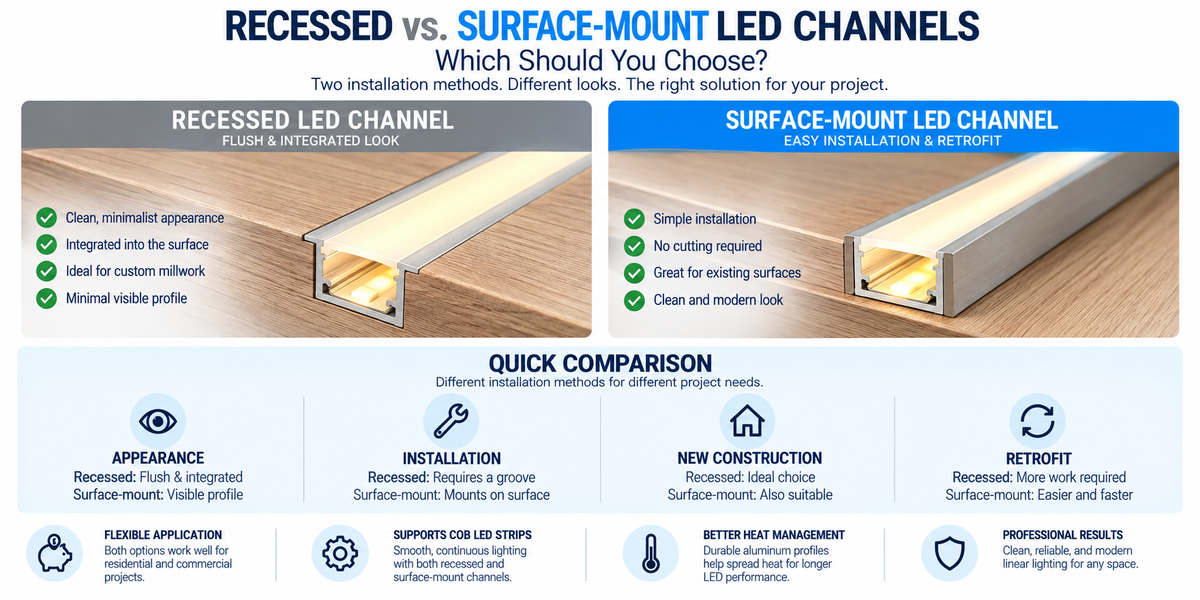
Choosing the right aluminum channel can make a major difference in the appearance and installation of an LED strip lighting system.
Two of the most common options are:
Recessed LED Channels
and
Surface-Mount LED Channels
Both can provide a professional mounting system for COB LED strips, support diffusers, protect the strip, and create clean linear lighting.
However, they are designed for different installation conditions.
A recessed profile can create a more integrated architectural appearance, while a surface-mount profile can often be installed with less modification to the existing surface.
So which one should you choose?
The answer depends on:
- Installation surface
- Available depth
- New construction vs. retrofit
- Desired appearance
- LED strip width
- Channel dimensions
- Accessibility
- Project budget
- Installation time
- Lighting application
For contractors, electricians, designers, millwork installers, and project buyers, understanding these differences before ordering can prevent costly installation problems.
What Is a Recessed LED Channel?
A recessed LED channel is designed to sit partially or fully inside a prepared opening. Examples include the BN257 flush-mount profile and the wider BN262.
Instead of mounting completely on top of the surface, the body of the profile is inserted into:
- Wood
- Millwork
- Cabinets
- Shelving
- Walls
- Ceilings
- Architectural details
Depending on the profile, small flanges may remain visible along the sides.
The result can create a clean, built-in line of light.
What Is a Surface-Mount LED Channel?
A surface-mount LED channel is installed directly on top of a finished surface. Common examples include the BN253 and the shallower BN252 low-profile channel.
It does not normally require a deep groove for the body of the profile.
Common mounting surfaces include:
- Cabinets
- Shelves
- Walls
- Ceilings
- Display cases
- Furniture
- Millwork
The channel remains visible as part of the installation.
This can make installation simpler, particularly when working with an existing finished surface.
The Main Difference
The easiest way to understand the difference is:
Recessed Channel → Installed Into the Surface
Surface-Mount Channel → Installed On the Surface
That single difference affects:
- Appearance
- Installation labor
- Surface preparation
- Required tools
- Retrofit suitability
- Finished dimensions
Neither option is automatically better.
The correct choice depends on the project.
Recessed LED Channels Create an Integrated Look
One of the biggest advantages of recessed profiles is appearance.
Because most of the aluminum body is hidden inside the mounting surface, the final installation can appear more architectural.
Instead of seeing a channel attached to the surface, the viewer primarily sees:
A clean linear diffuser and line of light
This can work particularly well in:
- Custom cabinetry
- High-end millwork
- Retail fixtures
- Shelving
- Architectural ceilings
- Wall details
Surface-Mount Channels Are Easier to Add to Existing Surfaces
Surface-mount profiles can be particularly useful in retrofit projects.
Suppose a cabinet has already been manufactured and installed.
Creating a recessed groove may require:
- Routing
- Cutting
- Removing cabinetry
- Additional finishing
A surface-mounted channel may allow the installer to add linear lighting without making a deep modification to the existing structure.
This can reduce installation complexity.
New Construction vs. Retrofit
This is often one of the easiest ways to narrow the choice.
New Construction or Custom Millwork
A recessed channel can be planned into the project before surfaces are completed. The BN5617 pre-embedded profile is designed to be built in at this stage.
The contractor can prepare the correct opening based on the channel dimensions.
Existing Construction
A surface-mount channel may be easier because it can often be attached to the finished surface with less structural modification.
This is not an absolute rule, but it is a useful starting point.
Installation Comparison
Recessed Channel
Usually requires:
- Measuring the channel
- Preparing a groove or opening
- Confirming installation depth
- Installing the aluminum profile
- Installing the COB strip
- Connecting wiring
- Installing the diffuser
- Completing surrounding finishes where required
Surface-Mount Channel
May require:
- Marking the channel location
- Installing clips or appropriate fasteners
- Mounting the profile
- Installing the COB strip
- Connecting wiring
- Installing the diffuser
The exact procedure depends on the profile and application.
Recessed Channels Require Accurate Dimensions
A recessed profile must physically fit inside the prepared opening.
This means installers need to know more than the overall channel width.
Important dimensions may include:
- Body width
- Overall flange width
- Recessed depth
- Channel height
- Internal strip width
For example, a channel may have a wider visible flange than the body that actually enters the groove.
The cutout should be based on the manufacturer's product dimensions. Every profile in our aluminum channel collection includes a dimensioned drawing showing body, flange, and internal widths.
Measure Before Cutting
A common installation mistake is cutting the recess before physically confirming the profile dimensions.
For custom millwork or expensive finished surfaces, this can be costly.
A better process is:
Channel Selected → Dimensions Confirmed → Sample Checked if Needed → Opening Prepared
Do not rely on an approximate channel category such as “half-inch profile.”
Use the actual dimensions of the specific product.
Surface-Mount Channels Still Require Planning
Surface-mounted profiles may be easier to install, but placement still matters.
Consider:
- Channel width
- Channel height
- Visibility
- Wiring entry
- Mounting clips
- Screw locations
- Diffuser access
- End caps
- Nearby doors or hardware
For example, a channel mounted beneath a cabinet should not interfere with:
- Cabinet doors
- Hinges
- Trim
- Shelving
- Other hardware
Which One Looks Better?
This depends on the desired design.
Recessed
Usually creates a more integrated and minimal appearance.
Surface-Mount
Creates a visible architectural profile but can still look very clean when properly selected and installed.
A visible aluminum channel is not necessarily a disadvantage.
In some modern commercial interiors, the aluminum profile itself can become part of the design. A black finish such as the BN252-Black or BN252-Black-B with black diffuser suits dark millwork and ceilings.
Recessed Channels for Under-Cabinet Lighting
Under-cabinet lighting is a common application for both styles.
A recessed channel such as the BN257 can be routed into the bottom of the cabinet.
This creates a nearly flush lighting detail.
Advantages can include:
- Minimal profile visibility
- Clean finished appearance
- Integrated design
- Reduced protrusion below the cabinet
This approach is especially useful when the cabinetry is being custom manufactured.
Surface-Mount Channels for Under-Cabinet Lighting
A surface profile such as the BN252 can be attached directly underneath an existing cabinet. Where the light should be aimed toward the countertop, a BN254 corner channel mounts at the cabinet edge instead.
This can be a practical solution for:
- Renovations
- Existing kitchens
- Retail displays
- Office cabinetry
- Retrofit lighting
Installation can often be completed without routing a channel into the cabinet.
Recessed Channels for Shelving
Recessed channels can be integrated into shelves to create a very clean display-lighting system.
Applications include:
- Retail shelving
- Closets
- Display cabinets
- Bars
- Showrooms
- Product displays
When installed correctly, the profile can appear to be part of the shelf itself.
Surface-Mount Channels for Shelving
Surface channels can also work well on shelves.
They are particularly useful when:
- The shelf is already finished
- Routing is not practical
- Installation speed is important
- A visible profile is acceptable
The profile dimensions should still be considered carefully so it does not interfere with the usable shelf space. A shallow profile such as the BN252 keeps the projection to a minimum.
Recessed Channels in Ceilings
Recessed aluminum profiles can create architectural lines of light in ceilings.
However, it is important to distinguish between different types of recessed products.
Some profiles are designed for:
- Wood
- Millwork
- Standard recessed mounting
while others are specifically designed as:
The correct product should be selected for the construction method.
Recessed Is Not Always the Same as Plaster-In
This distinction is important.
A standard recessed profile typically fits into a prepared opening and may leave visible flanges.
A plaster-in profile such as the BN5615 is designed so that surrounding drywall compound or finishing material can integrate with the profile.
The finished result may hide the profile edges.
Therefore:
Recessed Channel ≠ Automatically Plaster-In Channel
Always check the intended installation method. Plaster-in variants also exist for inside corners (BN5618), baseboards (BN5619), and curved walls (BN5616).
Surface-Mount Channels on Ceilings
Surface-mounted channels can also be installed on ceilings when appropriate for the project.
This can create visible linear lighting without requiring the profile body to be recessed.
It may be useful in:
- Commercial interiors
- Offices
- Retail
- Utility spaces
- Modern architectural designs
The mounting method must be appropriate for the surface and channel. For suspended linear lighting, the BN258 extra-large profile is designed for that application.
Which Is Better for COB LED Strips?
Both recessed and surface-mount profiles can work very well with COB LED strips.
COB technology can provide a smooth, continuous-looking line of illumination.
The channel decision should therefore be based primarily on:
- Installation method
- Dimensions
- Desired appearance
- Strip width
- Thermal requirements
- Application
rather than assuming COB automatically requires one channel style.
Check the Internal Channel Width
Before selecting either profile, confirm that the COB strip fits inside the channel.
Common strip widths can include:
Do not compare the strip width with the channel's external width.
You need the:
Usable Internal Width
For example:
A channel may appear wide enough externally while having an internal mounting surface that is too narrow for a 12mm strip.
Do Not Forget Connector Clearance
The LED strip may fit perfectly while the connector does not.
This is especially important in narrow or shallow channels.
Check:
- Strip width
- Connector width
- Wire bend radius
- End-cap opening
- Solder-joint clearance
For tight architectural installations, soldered wire connections may sometimes require less space than certain solderless connectors, depending on the product and installation.
Channel Depth Affects the Appearance
The distance between the LED strip and diffuser can affect how the light appears.
A deeper profile provides more distance for the light to mix before reaching the diffuser.
A shallow profile keeps the LEDs closer to the diffuser.
With COB strips, visible LED dots are already greatly reduced compared with many traditional SMD strips.
However, channel geometry and diffuser type still influence the finished appearance. Compare the shallow BN252 with the deeper BN256.
Recessed Channels and Furniture Clearance
Because recessed profiles sit inside the surface, they can be useful where protrusion must be minimized.
For example:
A surface-mounted channel underneath a shelf may extend downward.
A recessed profile can reduce that projection.
This can be useful when:
- Space is limited
- The profile is close to eye level
- A minimal detail is desired
- Furniture clearance matters
Surface-Mount Channels and Accessibility
Surface-mounted profiles may offer easier physical access in some installations.
If a strip needs to be:
- Inspected
- Replaced
- Rewired
the channel may be easier to reach because it is not embedded deeply into the construction.
However, accessibility depends on the complete installation, including the diffuser and surrounding architecture.
Recessed Channels Can Require More Labor
Creating a precise recess adds installation work.
Depending on the surface, installers may need:
- Router
- Saw
- Milling equipment
- Drywall preparation
- Custom fabrication
This can increase labor compared with mounting a channel directly to the surface.
The difference becomes especially important across large commercial projects with many linear feet of lighting.
Surface-Mount Channels Can Reduce Installation Time
When the mounting surface is already finished, surface profiles may reduce preparation work.
This can be useful in:
- Retrofit projects
- Existing retail stores
- Renovations
- Quick commercial upgrades
However, faster installation should not be the only selection criterion.
The final appearance and physical requirements still matter.
Example: New Retail Display
Imagine a new custom retail display being manufactured.
The designer wants the light source to disappear into the shelving.
A recessed profile can be planned into each shelf before fabrication.
The result:
Shelf Surface
↓
Flush Diffuser
↓
COB LED Strip Hidden Inside Channel
This can produce a clean, integrated retail display.
Example: Existing Retail Shelves
Now imagine an existing store where the shelving is already installed.
The owner wants to add COB lighting without rebuilding the display system.
A surface-mount profile may be more practical.
The installer can attach the channel beneath the shelf while preserving most of the existing construction.
This is a classic retrofit application.
Example: Custom Kitchen Cabinets
For new custom cabinetry, a recessed channel can be integrated during manufacturing.
This can create a minimal under-cabinet lighting detail with an 8mm COB strip.
For an existing kitchen, surface mounting may require much less modification.
The correct option therefore depends heavily on when the lighting is being added to the project.
Example: Commercial Office
An office renovation may use surface-mounted linear channels beneath cabinets or shelves because:
- Existing furniture remains in place
- Installation time is limited
- Major routing is undesirable
A new office build-out, however, may incorporate recessed profiles into custom millwork from the beginning.
Same lighting function.
Different construction conditions.
Heat Management
Both recessed and surface-mount aluminum profiles can provide an aluminum mounting surface that helps spread heat from the LED strip. Our guide on how aluminum channels help extend LED strip lifespan covers this in detail.
However, thermal performance depends on more than whether the channel is recessed or surface mounted.
Important factors include:
- Aluminum mass
- Profile geometry
- Strip wattage
- Strip-to-channel contact
- Ambient temperature
- Airflow
- Installation surface
Can Recessed Channels Trap More Heat?
Potentially, depending on the installation.
A recessed profile may have more of its body surrounded by:
- Wood
- Drywall
- Millwork
- Other building materials
This can change how heat is transferred to the surrounding environment.
That does not mean recessed channels are inherently problematic.
It means high-output LED installations should consider the thermal conditions of the complete assembly.
Follow product and LED strip specifications.
Surface-Mount Channels and Air Exposure
A surface-mounted profile may have more of its aluminum body exposed to surrounding air.
Depending on profile geometry and installation conditions, this can influence thermal behavior.
But do not assume every surface profile automatically provides better cooling.
Thermal performance must be evaluated based on the actual product and installation.
Diffuser Options
Both profile types may support diffusers.
Common diffuser styles can include:
The diffuser affects:
- Light appearance
- Glare
- Visibility of the light source
- Light transmission
- Physical protection
For architectural installations, the diffuser should be selected together with the COB strip and channel.
Wiring Should Be Planned Before Installation
Recessed installations can become difficult to modify after the surrounding surface is completed.
Before installation, determine:
- Where power enters
- Driver location
- Controller location
- Wire routing
- Feed points
- Connection method
For long LED strip runs, also consider voltage drop and additional power feeds.
Keep Drivers and Controllers Accessible
The aluminum channel may be built into the architecture, but the driver and controller should remain appropriately accessible for:
- Testing
- Troubleshooting
- Replacement
- Re-pairing
- Maintenance
Do not permanently bury serviceable electrical components simply to hide the lighting system. Drivers with an integrated junction box can simplify an accessible installation.
Which Is Better for Retrofit Projects?
In many retrofit situations:
is the easier option because it requires less modification to existing surfaces.
But recessed installation may still be possible if:
- The material can be routed
- Construction access is available
- The project requires a flush appearance
- Additional labor is acceptable
The decision should be based on both design and construction constraints.
Which Is Better for New Construction?
New construction provides more flexibility.
Because the channel can be planned before surfaces are completed, recessed or plaster-in profiles can be integrated into the architecture more easily.
However, surface profiles may still be intentionally selected for:
- Visible architectural lines
- Easier maintenance
- Specific design aesthetics
- Installation requirements
New construction does not automatically mean recessed is better.
Which Is Better for a Minimal Look?
If the goal is to minimize the visible aluminum profile:
Recessed is usually the stronger choice.
If the goal is an even more integrated drywall appearance, a:
may be appropriate.
For applications where a visible aluminum extrusion is acceptable or desirable:
can still create a modern professional appearance.
Which Is Easier to Replace Later?
This depends on the installation.
The LED strip inside either profile can often be serviced after removing the diffuser.
But a surface-mounted channel may be easier to remove or reposition in some applications.
A recessed profile becomes part of the prepared surface and is generally less convenient to relocate.
This should be considered in temporary or frequently modified commercial displays.
Recessed vs. Surface-Mount Comparison
| Feature | Recessed Channel | Surface-Mount Channel |
|---|---|---|
| Installation | Inside prepared opening | On top of surface |
| Appearance | Integrated / flush | Visible profile |
| Surface Modification | Usually required | Usually less |
| Retrofit Use | More installation work | Often easier |
| New Construction | Excellent option | Also suitable |
| Custom Millwork | Excellent | Good |
| Installation Speed | Usually slower | Often faster |
| Relocation | More difficult | Often easier |
| Strip Protection | Yes | Yes |
| Diffuser Support | Yes | Yes |
| COB Compatibility | Yes, if dimensions match | Yes, if dimensions match |
Cost Comparison
The aluminum profile itself is only part of the cost.
Consider:
Channel Cost + Installation Labor + Surface Preparation + Finishing
A recessed channel may require more labor even if the extrusion itself costs approximately the same as a comparable surface profile.
For large commercial projects, installation labor can become a major part of the total cost.
Do Not Choose Based Only on Channel Price
Suppose:
Channel A = Lower Price
but requires significant custom routing.
Channel B = Slightly Higher Price
but installs directly onto the existing surface.
The total installed cost may favor Channel B.
Always evaluate:
Installed Cost
rather than:
Profile Price Alone
When to Choose a Recessed LED Channel
A recessed profile is often a good choice when:
- A flush appearance is important
- The project is new construction
- Custom millwork is being fabricated
- A groove can be prepared accurately
- Minimal channel visibility is desired
- Protrusion must be reduced
- Architectural integration is a priority
When to Choose a Surface-Mount LED Channel
A surface profile is often a good choice when:
- The surface is already finished
- The project is a retrofit
- Routing is not practical
- Faster installation is important
- A visible profile is acceptable
- Easy mounting is preferred
- Future relocation may be required
For damp or exterior surfaces, the BN265 IP65 surface-mount channel is the appropriate option.
Common Recessed Channel Mistakes
Avoid:
- Cutting before confirming dimensions
- Making the recess too narrow
- Making the recess too shallow
- Confusing recessed and plaster-in profiles
- Forgetting flange dimensions
- Ignoring wire entry
- Choosing a channel too narrow for the strip
- Forgetting connector clearance
- Installing before testing the COB strip
Common Surface-Mount Channel Mistakes
Avoid:
- Ignoring the visible channel height
- Mounting where the profile interferes with doors
- Poorly aligning long channel sections
- Forgetting end-cap clearance
- Using inappropriate mounting hardware
- Ignoring wire routing
- Choosing a profile too narrow for the LED strip
- Failing to plan diffuser removal
Selection Checklist
Before ordering an aluminum channel, confirm:
LED Strip
- Strip type
- Voltage
- Wattage
- Width
- COB dimensions
- Maximum run length
Channel
- Internal width
- External width
- Height
- Recess dimensions if applicable
- Diffuser type
- End caps
- Mounting accessories
Surface
- Wood
- Drywall
- Cabinet
- Shelf
- Ceiling
- Wall
- Other architectural material
Project Type
- New construction
- Retrofit
- Custom millwork
- Commercial renovation
Appearance
- Flush/integrated
- Visible architectural profile
- Minimal
- Decorative
Electrical Planning
- Driver location
- Controller location
- Wiring
- Voltage drop
- Power feeds
- Service access
A Simple Decision Process
Ask these four questions.
1. Can the Surface Be Cut or Routed?
No → Surface-Mount is usually easier
Yes → Continue
2. Is a Flush Appearance Important?
Yes → Consider Recessed
No → Either may work
3. Is This Existing Construction?
Yes → Surface-Mount may reduce installation work
No → Recessed can be planned into construction
4. Does the Strip Fit the Channel?
Regardless of style:
Always verify internal dimensions.
Think Beyond Appearance
The decision between recessed and surface-mounted channels is not purely aesthetic.
It affects:
- Construction
- Labor
- Installation time
- Maintenance
- Thermal conditions
- Wiring
- Cost
- Future modifications
The best channel is the one that fits both the lighting design and the physical realities of the project. Our guide on building a complete LED lighting system covers how the channel fits into the wider design.
Conclusion
Both recessed and surface-mount LED channels can create professional COB LED strip installations.
The primary difference is how they integrate with the mounting surface.
Choose a recessed LED channel when you want:
- A flush, integrated appearance
- Minimal visible profile
- Integration into new construction or custom millwork
Choose a surface-mount LED channel when you want:
- Easier installation on an existing surface
- Less cutting or routing
- A practical retrofit solution
- A visible but clean architectural profile
Neither option is universally better.
The correct decision depends on:
Application + Surface + Construction Stage + Dimensions + Appearance + Labor + Serviceability
Most importantly, choose the channel before preparing the installation surface.
Confirm the actual profile dimensions, COB strip width, wiring requirements, and diffuser system first.
That small amount of planning can prevent expensive modifications later and produce a much cleaner professional installation. If you would like help choosing a profile, contact our team for dimensioned drawings, samples, and wholesale pricing.
Frequently Asked Questions
What is the difference between recessed and surface-mount LED channels?
A recessed channel sits inside a prepared opening, while a surface-mount channel attaches on top of the mounting surface.
Which LED channel is better for COB strips?
Both can work well with COB strips. The channel must have sufficient internal width and appropriate dimensions for the selected strip.
Are recessed LED channels better looking?
They generally create a more integrated or flush appearance, but surface-mounted profiles can also look very professional when properly installed.
Which channel is easier to install?
Surface-mount channels are often easier, especially on existing finished surfaces, because they usually require less cutting or routing.
Which LED channel is better for a retrofit?
Surface-mount profiles such as the BN253 or BN252 are often more practical for retrofit projects, although the best choice depends on the existing construction.
Is a recessed LED channel the same as a plaster-in channel?
No. Some recessed profiles leave visible flanges, while plaster-in profiles are specifically designed to integrate into finished drywall or similar surfaces.
Do recessed channels help cool LED strips?
They provide an aluminum mounting surface that can help spread heat, but actual thermal performance depends on profile design, airflow, surrounding materials, strip wattage, and installation conditions.
Should I buy the LED strip or aluminum channel first?
Ideally, select them as a compatible system. Confirm the LED strip width, wattage, channel internal dimensions, diffuser, connectors, and installation requirements before ordering.