
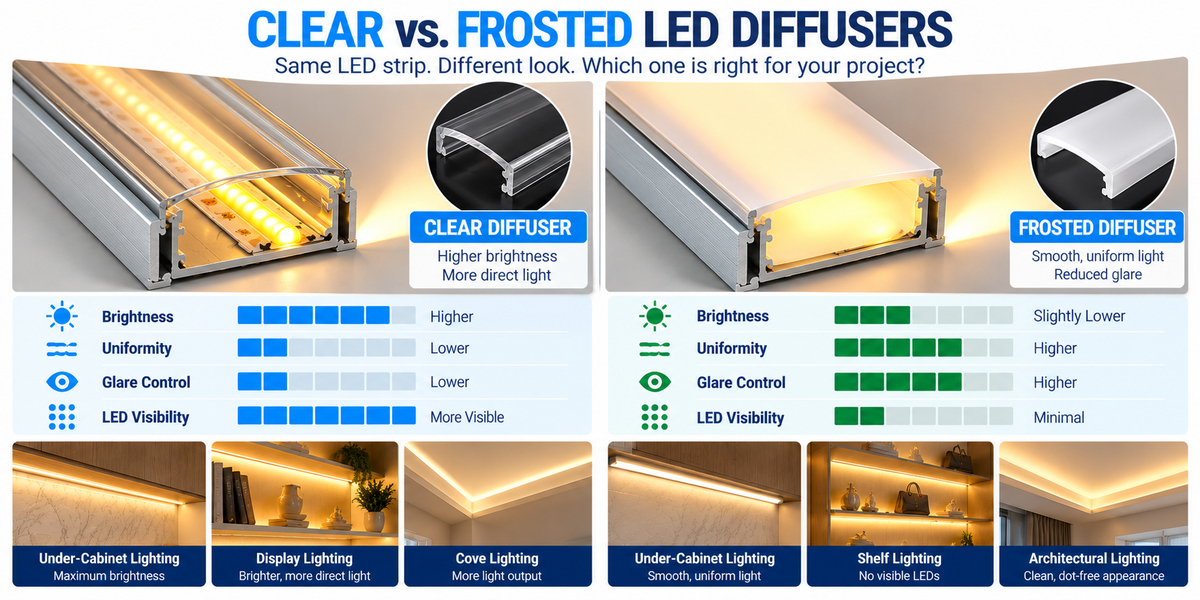
Clear vs. Frosted LED Diffusers: What's the Difference?
When choosing an aluminum channel for LED strip lighting, the diffuser may seem like a small detail.
It isn't.
You can install the same LED strip inside the same aluminum channel and get noticeably different results simply by changing the diffuser.
A clear diffuser generally prioritizes light transmission and brightness.
A frosted diffuser generally prioritizes light blending, reduced glare, and a smoother appearance.
The basic tradeoff is:
Clear Diffuser → More Direct Light
Frosted Diffuser → More Diffused Light
But choosing between them requires more than deciding which one looks better when the lights are off.
The right choice depends on:
- LED strip type
- Channel depth
- Viewing angle
- Required brightness
- Glare
- Application
- Whether the LED source is visible
For contractors, electricians, designers, and project buyers, understanding these differences can significantly improve the finished installation.
What Is an LED Diffuser?
An LED diffuser is the cover installed over an LED strip inside an aluminum channel.
The complete assembly typically looks like:
↓
↓
Diffuser
↓
Finished Line of Light
The diffuser can perform several jobs:
- Protect the LED strip
- Hide internal components
- Reduce direct glare
- Blend light
- Reduce visible LED points
- Create a cleaner finished appearance
But the amount of diffusion depends heavily on the material and opacity of the cover.
What Is a Clear LED Diffuser?
A clear diffuser—or clear LED channel cover—is designed to allow relatively high light transmission.
Because the material scatters less light, more of the original light from the LED strip can pass through directly.
The primary advantage is:
Higher light transmission
The tradeoff is:
Less light blending
That means individual LEDs, bright areas, connections, or imperfections may be easier to see.
What Is a Frosted LED Diffuser?
A frosted diffuser has a translucent surface designed to scatter light as it passes through.
Instead of allowing most of the light to travel directly outward, it spreads light across a broader range of directions.
The result is generally:
Softer + More Uniform + Less Glaring
illumination.
However, some light is reflected or absorbed in the process.
Therefore, a frosted diffuser will generally transmit less light than a comparable clear diffuser.
The exact difference depends on the specific product. Most BrightNex profiles ship with a frosted cover, including the BN252, BN250 and BN259.
Clear vs. Frosted: Quick Comparison
| Feature | Clear Diffuser | Frosted Diffuser |
|---|---|---|
| Light Transmission | Higher | Lower |
| Apparent Brightness | Higher | Slightly lower |
| LED Visibility | Higher | Lower |
| Hotspot Reduction | Limited | Better |
| Light Uniformity | Lower | Better |
| Glare Reduction | Limited | Better |
| Dot-Free Appearance | Harder | Easier |
| Strip Protection | Yes | Yes |
| Best When Source Is Hidden | Excellent | Excellent |
| Best When Channel Is Visible | Depends | Usually better |
These are general tendencies. Actual performance varies with the exact diffuser, LED strip, and channel.
The Biggest Difference: Light Transmission
If maximum brightness is your main priority, a clear diffuser generally has an advantage.
Imagine an LED strip producing a certain amount of light inside a channel.
With a clear cover:
LED → Clear Cover → More Direct Light
With a frosted cover:
LED → Frosted Material → Scattered Light
Some of that light may be:
- Reflected
- Redirected
- Absorbed
So the amount of light leaving the channel can be lower.
However, this does not automatically mean the clear diffuser creates better lighting. Our guide on how diffusers affect brightness and light quality covers the tradeoff in more detail.
More Brightness Does Not Always Mean Better Light
This is one of the most important concepts when choosing a diffuser.
Suppose a clear diffuser produces more measured light.
But when you look at the installation, you see:
● ● ● ● ● ● ● ●
individual bright LED points.
You may also experience stronger glare.
Now replace it with a frosted diffuser.
The measured output may decrease somewhat, but visually you see:
━━━━━━━━━━━━
a smoother continuous line.
Which is better?
That depends on the application.
For decorative or architectural lighting, the second result may be much more desirable.
Why Frosted Diffusers Look Smoother
A frosted diffuser scatters the light before it reaches your eyes.
Instead of seeing each LED source individually, the light from neighboring LEDs overlaps.
Think of it as:
LED 1 + LED 2 + LED 3 + LED 4
becoming:
One blended luminous surface
This is why frosted diffusers are often preferred for visible linear lighting.
What Are LED Hotspots?
Hotspots are visibly brighter areas corresponding to individual LEDs.
With traditional LED strip, you may see:
Bright → Dark → Bright → Dark → Bright
rather than one uniform line.
Hotspots are affected by several factors:
LED Spacing
Channel Depth
Diffuser
Distance Between LEDs and Diffuser
A frosted diffuser can help, but it cannot always completely eliminate hotspots.
COB LED Strip Changes the Comparison
COB LED strips already produce a much more continuous light source than conventional LED tape with widely spaced LED packages.
Instead of obvious points of light, COB creates a nearly continuous luminous line.
That means both clear and frosted diffusers can work well with COB.
But they create different effects.
COB + Clear Diffuser
Provides:
- High transmission
- Strong brightness
- Cleaner appearance than conventional LED strip
- More direct light
COB + Frosted Diffuser
Provides:
- Very smooth appearance
- Reduced glare
- Better visual blending
- More finished architectural look
For many BrightNex architectural installations, COB + frosted diffuser can be an excellent combination when visual quality is the priority.
Does COB Still Need a Frosted Diffuser?
Not necessarily.
One of COB's main advantages is that the light source itself is already much smoother.
So if:
- Maximum brightness is important
- The channel is hidden
- The strip cannot be viewed directly
a clear diffuser may be a good option.
But if:
- The channel is visible
- The viewer can see the light source
- Glare matters
- A perfectly smooth luminous line is desired
a frosted diffuser may produce a better finished appearance.
Channel Depth Is Extremely Important
Diffuser type is only half the story.
The distance between the LED strip and diffuser also affects how well the light blends.
Compare:
Shallow Channel
LED → Diffuser
There is very little distance for the light to spread — for example the BN252 or BN257.
Deep Channel
LED → Mixing Space → Diffuser
There is more distance for neighboring light sources to overlap — for example the BN256 or BN258.
As a result, a deeper channel can often produce better uniformity.
Clear Diffuser in a Shallow Channel
This combination can make LED points especially visible when using conventional SMD strip.
The diffuser sits close to the LEDs and provides relatively little scattering.
You may see:
● ● ● ● ● ●
This may be acceptable if:
- The channel is concealed
- Maximum light transmission is required
- The illuminated surface matters more than the channel itself
But it may not be ideal for visible decorative linear lighting.
Frosted Diffuser in a Shallow Channel
A frosted cover can improve the appearance substantially.
However, it still has limitations.
If the LEDs are:
- Widely spaced
- Extremely close to the diffuser
- Very bright
some hotspots may remain.
This is where COB strip becomes especially useful.
A dense COB source combined with a frosted diffuser can produce a very smooth result even in relatively compact profiles such as the BN252M.
Where Clear Diffusers Work Best
Clear diffusers are useful when the priority is maximizing useful light.
Typical applications can include:
Hidden Cove Lighting
If the channel itself cannot be seen, perfect diffuser uniformity may be unnecessary.
Indirect Lighting
When the light is aimed toward a ceiling or wall, the illuminated surface becomes the primary visual element.
Task Lighting
When higher illumination is required on a work surface.
High-Output Applications
Where minimizing optical losses is important.
Concealed Cabinet Lighting
When the strip is hidden behind a cabinet lip and cannot be viewed directly.
In these applications, the higher transmission of a clear cover can be valuable.
Where Frosted Diffusers Work Best
Frosted diffusers are especially useful when the channel itself is part of the visible design.
Typical applications include:
Visible Recessed Linear Lighting
The goal is often a continuous architectural line.
Under-Cabinet Lighting
Especially where the strip may reflect from polished countertops.
Shelving
Where customers or occupants can see the channel directly.
Retail Displays
Where visual quality is important.
Furniture Lighting
Where the source is close to eye level.
Wall Lighting
Where glare needs to be controlled — for example a baseboard profile at floor level.
Architectural Details
Where the luminous line itself is part of the design.
Under-Cabinet Lighting: Clear or Frosted?
Under-cabinet lighting is a good example because either option can work.
Clear Diffuser
Choose clear when:
- Maximum countertop illumination is the priority
- Channel is well concealed
- COB strip is being used
- Direct glare is not a problem
Frosted Diffuser
Choose frosted when:
- The channel is visible from seated positions
- Countertops are glossy
- Reflections matter
- A smooth finished line is desired
For high-end kitchens, the visual improvement from a frosted diffuser can sometimes be more valuable than preserving every possible lumen. A corner channel can also aim the light forward toward the countertop.
Glossy Countertops Can Reveal the Difference
Even when the LED strip itself is hidden, a polished surface can act like a mirror.
With a less-diffused source, you may see individual bright reflections.
This is particularly noticeable on:
- Polished stone
- Granite
- Quartz
- Glass
- Glossy tile
A frosted diffuser combined with COB strip can help create a smoother reflected line.
This is something worth testing before installing an entire kitchen.
Cove Lighting: Clear or Frosted?
Cove lighting is different because the viewer usually does not see the channel directly.
Instead:
LED Channel → Ceiling → Reflected Light → Room
In this case, a clear diffuser can sometimes be advantageous because more light reaches the ceiling.
The ceiling itself then acts as a large secondary diffuser.
However, a frosted diffuser can still provide:
- Strip protection
- Improved blending
- Reduced localized bright areas
- Cleaner assembly
The best choice depends on cove geometry and whether the source can be seen from any normal viewing angle. Our BN5620 cove profile includes a diffuser over its LED compartment.
Retail Display Lighting
For retail displays, consider both:
Product Illumination
and:
Customer View
A clear diffuser may provide more output onto merchandise.
But if customers can see the LED channel directly, glare may become distracting.
A milky or frosted diffuser can provide a more refined appearance.
For jewelry, cosmetics, clothing, electronics, and premium displays, perceived lighting quality can be just as important as maximum brightness.
Shelf Lighting
Shelves often place the LED channel close to eye level.
This makes glare particularly important.
If customers or occupants can see the channel directly:
Frosted diffuser is usually the stronger starting point.
If the channel is hidden behind a shelf edge and only the illuminated surface is visible:
Clear may work very well.
The viewing angle should influence the decision.
Corner LED Channels
Corner channels commonly direct light at approximately 45 degrees.
Depending on installation position, the diffuser may be visible.
For example:
Under Cabinet Corner → Countertop
A frosted diffuser can help reduce direct glare.
But if the channel is deeply concealed and maximum task illumination is required, a clear diffuser may be appropriate.
Again:
Application > General Rule
Our guide on corner LED channels covers beam direction in more detail.
Recessed Channels
When a recessed channel is installed flush with:
- Ceiling
- Wall
- Cabinet
- Shelf
the diffuser often becomes part of the visible surface.
This makes uniformity important.
A frosted diffuser generally provides a cleaner architectural appearance — the wider BN262 is supplied this way.
With COB strip, the combination can create a nearly continuous luminous line.
Plaster-In Channels
Plaster-in profiles are specifically designed to visually integrate with drywall.
Once finished, the aluminum edges disappear and the light line becomes the main visible element.
In this application, a highly visible row of LEDs can undermine the trimless architectural effect.
Therefore:
COB + Frosted Diffuser
is often a strong choice for visible plaster-in linear lighting — including the BN5618 corner and BN5616 bendable versions.
Does a Frosted Diffuser Change the Beam Angle?
It can change how light is distributed.
A clear cover allows more light to continue in its original direction.
A frosted cover scatters more light.
As a result, the illumination can appear:
- Softer
- Broader
- Less directional
This can improve uniformity across nearby surfaces.
However, exact beam behavior depends on the profile and diffuser geometry — a curved arc cover spreads light differently from a flat one.
Does a Frosted Diffuser Reduce Glare?
Generally, yes.
A small, extremely bright source can produce uncomfortable glare.
Diffusion spreads the apparent light-emitting area.
Instead of your eyes seeing:
Small intense LED sources
they see:
A larger softer luminous surface
This can improve visual comfort.
It is particularly useful where LED channels are:
- At eye level
- Under shelves
- Near seating
- Reflected in glass
- Installed in stairs or handrails
Can a Frosted Diffuser Completely Hide LED Dots?
Not always.
If the LED spacing is large and the channel is extremely shallow, individual bright areas may remain visible.
The complete optical system matters:
LED Density + Channel Depth + Diffuser Opacity
For conventional strips, increasing LED density can improve the result — compare our 384 LEDs/m and 480 LEDs/m COB strips.
For very smooth visible lighting, COB can make the job much easier.
Can a Clear Diffuser Look Dot-Free With COB?
Yes, depending on the strip and channel.
Because COB already creates a continuous-looking source, a clear cover does not automatically mean visible dots.
This is one reason COB gives designers more flexibility.
You may be able to combine:
COB + Clear Diffuser
to achieve:
High Transmission + Smooth Light
when conditions are appropriate.
Does Diffuser Color Affect Color Temperature?
A quality clear or frosted diffuser should be designed to transmit the LED's light without introducing undesirable color changes.
However, optical materials can influence the final appearance slightly.
For projects where color quality is critical, evaluate:
LED Strip + Channel + Diffuser
together — including any CCT-adjustable strip across its full tuning range.
This is particularly important for:
- Retail
- Hospitality
- Galleries
- Premium residential projects
Does a Frosted Diffuser Reduce CRI?
CRI is primarily determined by the LED source.
However, optical materials can affect spectral transmission.
For color-critical installations, rely on data for the complete lighting assembly when available rather than assuming the bare strip specification perfectly represents the finished system.
Diffusers Also Protect the LED Strip
Both clear and frosted covers provide another important benefit:
Physical protection.
They help protect the LED tape from:
- Dust
- Accidental contact
- Small objects
- Cleaning activity
However, installing a diffuser does not automatically change an indoor LED channel into a waterproof fixture.
Environmental protection depends on the complete system and its rating — for wet locations, use a purpose-built IP65 channel.
Clear Diffusers Show More of the Inside
Because a clear cover is transparent, it may reveal:
- LED strip
- Wiring
- Connectors
- Solder joints
- Small alignment errors
This may not matter when the channel is concealed.
But for visible architectural lighting, these details can reduce the clean appearance.
A frosted diffuser can help visually hide the internal components.
Frosted Diffusers Can Hide Minor Imperfections
Because the cover is translucent, small internal details are less visible.
That can help conceal:
- Strip markings
- Minor connection points
- Small alignment variations
But a diffuser should not be used to hide poor workmanship.
Large gaps, badly positioned strips, or oversized connectors may still create visible dark areas.
Connections Matter With Either Diffuser
Imagine:
COB Strip → 1-inch Gap → COB Strip
A frosted diffuser may soften the transition, but it cannot generate light where there is none.
The result may still contain a visible dark spot.
The better solution is to minimize the gap first.
Then let the diffuser perform the final optical blending. Our guide on avoiding dark spots at LED strip connections covers this.
Diffuser Joints Matter Too
Long channel runs may require multiple diffuser sections. Our profiles come in 8ft lengths, so long runs need fewer joints.
Poorly aligned joints can create:
- Visible seams
- Small dark areas
- Uneven light
- Unprofessional appearance
Plan:
- Cut locations
- Channel joints
- Diffuser joints
- LED strip connections
together.
This becomes particularly important in long commercial linear installations.
Don't Choose a Diffuser by Looking at It While the Light Is Off
This is a common mistake.
Two diffusers may look nearly identical sitting on a table.
Turn the LED strip on and the difference can become obvious.
Always evaluate the diffuser:
with the actual LED strip illuminated.
Better still, evaluate it inside the actual aluminum channel.
Test From the Real Viewing Position
Do not judge the system only while standing six inches away from the channel.
Look at it from where people will actually be.
For example:
Kitchen
Stand and sit at the counter.
Retail
View the display from the customer aisle.
Hotel
View the cove from the room entrance and seating area.
Office
View the channel from normal working positions.
The correct diffuser is partly determined by how people experience the space.
Build a Mock-Up for Large Projects
For a project involving hundreds of feet of aluminum channel, test a short section first.
Use the actual:
LED Strip + Channel + Clear Diffuser
and compare it with:
LED Strip + Same Channel + Frosted Diffuser
Then evaluate:
- Brightness
- Uniformity
- Hotspots
- Glare
- Reflections
- Finished appearance
A small mock-up can prevent a costly mistake. Contact our team if you would like samples for comparison.
Clear vs. Frosted: Application Guide
| Application | Recommended Starting Point |
|---|---|
| Hidden Cove Lighting | Clear or Frosted |
| Visible Recessed Lighting | Frosted |
| Plaster-In Linear Lighting | Frosted |
| Under-Cabinet – Hidden Channel | Clear or Frosted |
| Under-Cabinet – Visible Channel | Frosted |
| Retail Display | Frosted |
| Shelf Lighting | Frosted |
| Maximum Task-Light Output | Clear |
| Decorative Linear Lighting | Frosted |
| COB in Concealed Channel | Clear can work very well |
| COB in Visible Channel | Frosted often gives the cleanest finish |
These are starting points rather than universal rules.
When Should You Choose Clear?
Choose a clear diffuser when:
- Maximum light transmission is important
- The LED source is concealed
- Direct glare is minimal
- The channel is not a major visual element
- You are illuminating another surface indirectly
- You are using COB and want to preserve more output
Think:
Performance first, diffusion second.
When Should You Choose Frosted?
Choose a frosted diffuser when:
- The channel is visible
- A smooth line of light is important
- You want to reduce glare
- Hotspots need to be minimized
- The installation is decorative or architectural
- Reflections are visible on glossy surfaces
- The finished appearance matters as much as output
Think:
Visual comfort and uniformity first.
What About Milky or Opal Diffusers?
Some channels are available with even more opaque covers commonly described as:
- Milky
- Opal
- White
These generally provide stronger diffusion than lightly frosted covers. The BN252-Black uses a milky cover, and the BN252-Black-B uses a black diffuser for dark millwork.
The potential benefit is even better LED concealment.
The tradeoff is typically lower light transmission.
A simplified spectrum looks like:
Clear → Frosted → Milky / Opal
with:
Higher Transmission ←————→ Greater Diffusion
Actual performance varies by material.
The Best Diffuser Depends on the Complete System
There is no single diffuser that is best for every LED project.
Instead, evaluate:
1. LED Technology
COB or conventional LED strip?
2. LED Density
How close are the light sources?
3. Channel Depth
How much optical mixing distance is available?
4. Viewing Angle
Can people see the diffuser directly?
5. Required Brightness
Is this decorative or functional lighting?
6. Surface
Will glossy materials reflect the LED source?
7. Glare
How close is the lighting to eye level?
Only after answering these questions should you choose the diffuser.
Common Mistakes When Choosing LED Diffusers
Avoid:
- Assuming clear is automatically better because it is brighter
- Assuming frosted always hides every LED dot
- Ignoring channel depth
- Ignoring LED density
- Using low-density strip in a very shallow visible profile
- Ignoring reflections from countertops or glass
- Choosing before testing the actual COB strip
- Expecting a diffuser to hide large connection gaps
- Forgetting about glare
- Selecting the diffuser independently from the aluminum channel
A Better Way to Specify LED Channels
Instead of specifying:
“We need 100 feet of LED channel.”
specify the complete system:
LED Density / COB
Diffuser Type
Installation Method
This reduces surprises on the job site.
For commercial projects, it also makes it easier to reproduce the same lighting appearance across multiple areas. Our guide on building a complete LED lighting system covers the full specification process.
Final Takeaway
The difference between clear and frosted LED diffusers comes down to a fundamental lighting tradeoff:
Clear Diffuser
More Light Transmission
but potentially:
More Glare + More Visible LED Detail
Frosted Diffuser
Better Light Blending + Lower Glare
but potentially:
Some Reduction in Light Output
Neither is automatically better.
For concealed lighting where maximum output matters, clear can be an excellent choice.
For visible architectural lighting where uniformity and visual comfort matter, frosted is often the better choice.
And when using COB LED strip, both options become more effective because the LED source already produces a much smoother line of light.
The best approach for a professional installation is to test:
The Actual COB Strip + Actual BrightNex Channel + Actual Diffuser
together.
That allows you to choose based on the finished light—not just the appearance of the diffuser itself. If you would like help matching a strip, profile, and cover, contact our team for samples and wholesale pricing.
Frequently Asked Questions
Is a clear LED diffuser brighter than a frosted diffuser?
Generally, a clear diffuser transmits more direct light than a comparable frosted diffuser. Exact transmission depends on the material and product.
Which diffuser hides LED dots better?
A frosted diffuser generally provides better LED blending and hotspot reduction.
Which diffuser is better for COB LED strips?
Both can work well. Clear can preserve more output, while frosted can provide an even softer and more uniform appearance.
Do I need a frosted diffuser with COB strip?
Not necessarily. COB is already highly uniform. The decision depends on glare, visibility, channel depth, and the desired finished appearance.
Which diffuser is better for under-cabinet lighting?
If the channel is visible or reflections are a concern, frosted is often preferable. If the channel is fully concealed and maximum task-light output is important, clear may be appropriate.
Which diffuser is better for cove lighting?
Either may work. Because the LED source is normally hidden, clear can help maximize output onto the reflective surface. Frosted can provide additional blending and protection — see the BN5620 cove profile.
Can a frosted diffuser completely remove hotspots?
Not always. LED density, channel depth, diffuser distance, and strip technology also determine whether hotspots remain visible.
Does a diffuser make an LED channel waterproof?
No. A diffuser alone does not establish the environmental rating of the complete lighting system — use a purpose-built IP65 channel for wet locations.
Should I choose the diffuser before choosing the LED strip?
Ideally, select the strip, channel, and diffuser together because they function as one optical system.