
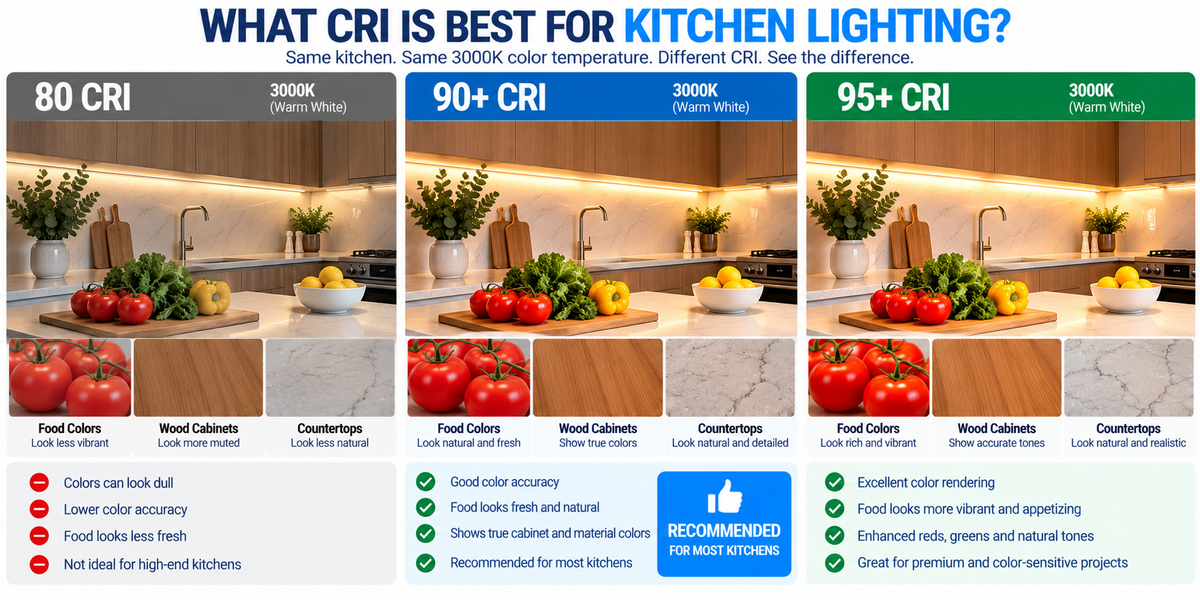
What CRI Is Best for Kitchen Lighting?
When choosing kitchen lighting, people usually compare:
- Color temperature
- Lumens
- Wattage
- Dimming
- Fixture style
But there is another specification that can dramatically affect how a finished kitchen looks:
CRI — Color Rendering Index.
Two LED lights can both be:
3000K
and produce similar brightness, yet make food, wood cabinets, stone countertops, and colorful finishes look noticeably different.
Why?
One reason can be color rendering.
For most kitchen installations, a useful starting recommendation is:
90+ CRI for general kitchen lighting and task lighting.
For premium residential kitchens, hospitality spaces, display kitchens, or projects where material and food color accuracy are especially important, 95+ CRI may be worth considering.
But CRI alone does not determine lighting quality.
A successful kitchen requires the right combination of:
CRI + CCT + Brightness + Placement + Glare Control + Dimming
Let's look at each part.
What Is CRI?
CRI stands for:
Color Rendering Index
It is a metric used to describe how accurately a light source renders certain colors compared with a reference source.
The traditional CRI scale runs up to:
100
In simple terms:
Higher CRI → Generally better color fidelity
But CRI should not be interpreted as a percentage.
For example:
90 CRI does not mean colors are “90% accurate.”
CRI is a calculated lighting metric based on standardized color samples.
Why Does CRI Matter in a Kitchen?
Kitchens contain a surprisingly large variety of colors and materials.
Think about:
- Tomatoes
- Green vegetables
- Fruit
- Meat
- Bread
- Wood cabinets
- Marble
- Granite
- Quartz
- Tile
- Paint
- Metal finishes
Poor color rendering can make some of these surfaces appear:
- Dull
- Flat
- Gray
- Washed out
- Less natural
Good color rendering can help them appear more like they do under a high-quality reference light source.
This makes CRI particularly relevant in kitchens.
80 CRI vs. 90 CRI vs. 95 CRI
A simple practical comparison looks like this:
| CRI | General Color Quality | Kitchen Recommendation |
|---|---|---|
| 80+ | Acceptable for many general applications | Basic |
| 90+ | Very good color rendering | Recommended for most kitchens |
| 95+ | Excellent color rendering | Premium / color-sensitive projects |
This is a practical guideline rather than an absolute rule.
A high-quality 90 CRI product can be an excellent kitchen-lighting solution — our COB LED strips and LED downlights are rated at approximately CRI 90.
You do not automatically need 95+ CRI everywhere.
Is 80 CRI Good Enough for a Kitchen?
It can be functional.
An 80 CRI light may provide perfectly adequate illumination for:
- Walking
- Cleaning
- General visibility
But kitchens are not purely functional spaces.
People also:
- Prepare food
- Eat
- Entertain
- Evaluate food color
- Look at cabinetry and finishes
For those reasons, moving to 90+ CRI can provide a noticeable improvement in visual quality.
This is particularly worthwhile for under-cabinet and countertop lighting.
Why 90+ CRI Is a Strong Kitchen Standard
For most residential and commercial kitchens, 90+ CRI offers an excellent balance.
It can help colors appear more natural without requiring the project to move into specialized color-critical lighting.
This makes 90+ CRI particularly appropriate for:
- Under-cabinet COB strips
- Kitchen downlights
- Island lighting
- Toe-kick lighting where color quality matters
- Shelf lighting
- General architectural lighting
If you're specifying kitchen LEDs professionally, 90+ CRI is a sensible minimum target when good color rendering is a priority.
When Does 95+ CRI Make Sense?
Moving from 90+ to 95+ CRI can make sense when the project places a premium on color quality.
Examples include:
Luxury Residential Kitchens
High-end materials deserve lighting that presents them well.
Showrooms
Kitchen showrooms need cabinetry, stone, hardware, and finishes to appear accurate and attractive.
Restaurants and Hospitality
Food presentation can benefit from high-quality color rendering.
Photography or Video Kitchens
If food or interiors will frequently be photographed, higher-quality spectral performance may be useful.
Premium Retail Displays
If a kitchen-like display environment contains color-sensitive products or materials.
However, do not choose 95+ CRI based only on the number.
The complete spectral quality of the LED matters. Contact our team if a project requires color-critical specifications.
CRI Is Not the Whole Story
This is one of the most important points in this article.
Two products can both say:
CRI 90
and still look different.
Why?
Traditional CRI is based on a limited set of test colors.
It does not describe every aspect of a light source's spectral performance.
For more demanding projects, additional metrics can be useful.
One of the most important is:
R9
What Is R9?
R9 describes how a light source renders a strong red test color.
Red rendering matters in kitchens because many common items contain red or warm tones:
- Tomatoes
- Red peppers
- Meat
- Fruit
- Wood
- Warm stone
- Skin tones
A light source can have a respectable general CRI while performing less impressively with saturated reds.
This is why professional lighting specifications may look beyond the headline CRI number.
Why R9 Matters for Food
Imagine preparing:
- Steak
- Tomatoes
- Strawberries
- Red peppers
under lighting with weak red rendering.
They may appear less vivid or natural.
A light source with better red rendering can make food appear more visually accurate.
This is especially important in:
- Residential kitchens
- Restaurants
- Food preparation areas
- Hospitality
- Food displays
So when detailed photometric data is available, do not look only at Ra/CRI.
Consider R9 too.
CRI and Color Temperature Are Different
CRI and CCT are often confused.
They describe different things.
CCT
Correlated Color Temperature
describes whether white light appears warmer or cooler.
Examples:
2700K → Warm
3000K → Warm-neutral
4000K → Neutral
5000K → Cooler/daylight-like
Our 10mm COB strip is available in all four.
CRI
describes how colors appear under that light.
Therefore, you can have:
3000K / 80 CRI
and:
3000K / 90+ CRI
Both have similar apparent white-light color temperature, but their color rendering may differ.
What Color Temperature Is Best for a Kitchen?
There is no single correct CCT for every kitchen.
However, common choices include:
2700K
Very warm and comfortable.
Often works well in kitchens integrated with warm living spaces.
3000K
One of the most versatile choices for residential kitchens.
Warm enough to feel inviting but clean enough for task lighting.
3500K
A useful middle ground between warm residential and neutral commercial lighting.
4000K
Cleaner and more neutral.
Common in contemporary kitchens and some commercial environments.
The right choice depends on:
- Cabinet color
- Countertop material
- Surrounding rooms
- Interior design
- Personal preference
Where the decision should stay open, a 5CCT selectable downlight lets the installer set 2700K through 5000K on site.
3000K + 90 CRI: A Strong Combination
For many residential kitchens, a very practical specification is:
3000K + 90 CRI or higher
Why?
3000K provides a warm but relatively clean appearance, while 90+ CRI helps food and materials render naturally.
This combination can work especially well with:
- White cabinetry
- Natural wood
- Quartz
- Marble
- Warm metal finishes
But it is not universally correct.
Some modern spaces may look better at 3500K or 4000K.
4000K + 90 CRI
For a cleaner, more contemporary appearance:
4000K + 90 CRI
can be an excellent option.
This is particularly useful for:
- Modern kitchens
- Commercial kitchens
- Retail kitchen displays
- Cooler interior palettes
- Work-oriented spaces
Again, CRI and CCT should be chosen independently.
You can maintain good color quality at either warm or neutral color temperatures.
Under-Cabinet Lighting Is Where CRI Really Shows
Under-cabinet lighting directly illuminates:
Food + Countertop + Backsplash
from a relatively short distance.
This makes color quality particularly noticeable.
For under-cabinet installations, I would generally prioritize:
90+ CRI
along with:
- Appropriate CCT
- Good brightness
- Smooth COB illumination
- Low glare
- Correct placement
This is one of the kitchen applications where spending more attention on light quality can make a real visual difference.
Why COB LED Strip Works Well Under Cabinets
COB LED strip is especially useful in kitchens because it can create a smooth continuous line of light.
Instead of:
● ● ● ● ● ● ●
the visual effect is closer to:
━━━━━━━━━━━━━━
This can reduce visible dotting and produce cleaner reflections on countertops.
Combine:
High-CRI COB Strip
and you can create a professional under-cabinet lighting system. For shorter cabinet sections requiring precise lengths, our 12V COB strip cuts every 25mm.
CRI Does Not Fix Poor LED Placement
You can buy a very high-CRI LED strip and still create poor kitchen lighting if it is installed incorrectly.
For example, an under-cabinet strip installed too close to the back wall may produce:
- Strong backsplash illumination
- Less light near the front working area
- Uneven countertop coverage
In many under-cabinet installations, positioning the strip closer to the front portion of the cabinet can provide better task illumination across the countertop.
The exact position depends on cabinet geometry and channel design — a 45-degree corner channel mounted at the cabinet edge aims the light forward onto the work surface.
High CRI Does Not Mean High Brightness
Another common misunderstanding:
CRI ≠ Lumens
A 95 CRI strip is not automatically brighter than an 80 CRI strip.
CRI describes color rendering.
Lumens describe light output.
When choosing kitchen lighting, evaluate both:
Light Quantity + Light Quality
A beautifully rendered countertop is not useful if there is insufficient illumination for food preparation. Lumens per foot are listed on each strip product page.
High CRI Does Not Mean Better Efficiency
Similarly:
Higher CRI does not automatically mean higher efficacy.
Depending on LED technology and spectral design, there can sometimes be tradeoffs between:
- Color quality
- Luminous efficacy
- Cost
The goal is not necessarily to chase the highest possible number in every category.
The goal is to select the right performance balance for the project.
Kitchen Downlights Need Good CRI Too
Under-cabinet lighting is not the only source affecting kitchen colors.
Downlights illuminate:
- Floors
- Cabinet faces
- Islands
- People
- Walls
- Food
If under-cabinet strips are high CRI but ceiling downlights have noticeably different color quality or CCT, the room can feel inconsistent.
For a cohesive design, coordinate:
Downlights + LED Strips + Pendants + Decorative Fixtures
Our guide on combining downlights and LED strips covers how to balance the layers.
Match Color Temperature Across Lighting Layers
Imagine:
Under-Cabinet COB = 3000K
but:
Downlights = 5000K
The countertop may appear warm from one direction and cool from another.
Unless this contrast is intentional, it can look disconnected.
For most kitchen projects, keeping major lighting layers reasonably consistent in color temperature produces a cleaner result. A 5CCT selectable downlight makes it easier to match whatever CCT the strip uses.
CRI for Kitchen Islands
Kitchen islands often combine:
- Food preparation
- Dining
- Entertaining
- Decorative lighting
For this reason, 90+ CRI is an excellent target.
If decorative pendants are also used, try to coordinate their color quality and CCT with the surrounding lighting. For directional accent light over an island, an adjustable gimbal downlight can be aimed where it is needed.
A premium high-CRI under-counter or architectural LED system cannot fully compensate for poor-quality overhead lighting.
White Kitchens
White kitchens can reveal differences in lighting quality very clearly.
Under poor lighting, whites may appear:
- Dull
- Gray
- Slightly tinted
Good-quality LED lighting can help white cabinetry, marble, and quartz appear cleaner and more natural.
However, CCT also has a strong effect.
A warm 2700K light will naturally make white surfaces appear warmer than 4000K light.
That is normal and should not be confused with poor CRI.
Wood Cabinets
Wood contains complex:
- Red
- Brown
- Orange
- Yellow
tones.
Good color rendering can help preserve the richness of these materials.
This is one reason 90+ CRI can be especially valuable in kitchens with:
- Walnut
- Oak
- Cherry
- Natural wood finishes
Lighting is part of how the material is perceived. A warm 2700K or 3000K COB strip generally suits natural wood cabinetry.
Stone Countertops
Natural and engineered stone can contain subtle:
- Veining
- Warm tones
- Cool tones
- Mineral colors
A high-quality lighting system can reveal those details more naturally.
For expensive countertop materials, choosing low-quality lighting solely to save a small amount on the LED system can undermine the appearance of the finish.
Food Preparation Areas
Food-preparation surfaces need both:
Adequate illumination
and:
Good color rendering
CRI becomes particularly relevant because people visually inspect food while:
- Cutting
- Cooking
- Checking doneness
- Plating
- Cleaning
For these areas, 90+ CRI is a strong recommendation.
What About Commercial Kitchens?
Commercial kitchens have different priorities.
They often require:
- High illumination
- Reliability
- Easy maintenance
- Suitable environmental protection
- Code compliance
Good color rendering can still be valuable for food preparation and inspection.
However, fixture selection must also account for the actual commercial environment, including moisture, grease, temperature, and cleaning requirements — a waterproof IP65 channel and a suitably rated driver may be appropriate.
CRI should never replace environmental and safety considerations.
Restaurants Need to Think Beyond the Kitchen
Restaurants have two different lighting environments:
Back of House
Priorities include:
- Visibility
- Food preparation
- Cleaning
- Reliability
Front of House
Priorities include:
- Food presentation
- Atmosphere
- Interior materials
- Customer comfort
High-quality color rendering can be valuable in both, but the CCT and brightness strategy may differ. Front-of-house architectural details often use cove lighting as a separate layer.
Dimming Makes High-Quality Kitchen Lighting More Flexible
A kitchen does not need the same brightness all day.
During food preparation:
Higher output
During dinner:
Lower output
Late at night:
Lower ambient lighting
A compatible dimming system allows one installation to support multiple uses.
But make sure:
are compatible.
Poor dimming compatibility can cause:
- Flicker
- Buzzing
- Limited dimming range
- Unstable operation
Where the dimming method is not fixed at the design stage, a 5-in-1 dimmable driver covers several protocols in one unit.
Does Dimming Change CRI?
A quality LED system should maintain acceptable color quality across its intended operating range, but LED spectral behavior can vary with product design and dimming method.
For demanding projects, evaluate the product at the actual dimming levels that will be used.
This is especially relevant for hospitality and luxury residential installations where lighting may operate at low levels for long periods.
What About Tunable White CCT?
Tunable-white LED systems allow users to change color temperature.
For example:
Warm White ←→ Neutral White ←→ Cool White
This can be useful in multifunction kitchens.
Morning:
Brighter / Cooler
Evening:
Warmer / Dimmer
Tunable-white strips require a CCT controller or a driver with built-in CCT controls.
But again, check color-rendering performance across the supported CCT range.
Do not assume that a tunable-white strip has identical CRI performance at every setting.
Is 100 CRI Necessary?
No.
A CRI of 100 represents the top of the traditional CRI scale, but most kitchens do not require a theoretical perfect score.
For most projects:
90+ CRI = Excellent practical target
95+ CRI = Premium option where additional color quality matters
Do not reject an otherwise excellent lighting system simply because its specification says 90 rather than 97.
Evaluate the entire product.
What Should Contractors Specify?
For a quality kitchen LED project, a specification might include:
LED Strip
- COB
- 90+ CRI
- Appropriate CCT
- Correct voltage
- Suitable wattage
- Correct PCB width
Aluminum Channel
- Compatible with strip width
- Appropriate profile for installation
- Suitable diffuser
Driver
- Correct voltage
- Adequate wattage
- Compatible dimming method
- Appropriate environmental rating
Downlights
- Similar CCT
- 90+ CRI where good color rendering is required
- Appropriate beam and lumen output
This is much more useful than specifying only:
“Warm white LED.”
Our guide on building a complete LED lighting system covers the full specification process.
A Practical Kitchen Example
Imagine a modern residential kitchen with:
- White upper cabinets
- Walnut lower cabinets
- White quartz countertop
- Warm metal hardware
One possible lighting strategy could be:
Under Cabinets
3000K / 90+ CRI COB LED Strip
Ceiling
3000K / 90+ CRI Downlights
Island
3000K decorative pendants with good color rendering
Controls
Separate dimming zones for:
- Downlights
- Under-cabinet lighting
- Pendants
This creates consistent color while allowing each layer to be adjusted independently.
Should Every Kitchen Light Have the Same CRI?
Not necessarily.
But the primary lighting layers should be reasonably coordinated.
For example, decorative toe-kick lighting may be less color-critical than countertop task lighting.
If budget needs to be prioritized, put the highest emphasis on lighting that illuminates:
- Food
- Countertops
- Cabinetry
- People
- Important finishes
That is where better color rendering provides the greatest visual benefit.
Common CRI Mistakes in Kitchen Lighting
Avoid these common mistakes:
- Choosing LEDs based only on wattage
- Assuming CCT and CRI mean the same thing
- Assuming 90 CRI means “90% color accuracy”
- Using low-quality under-cabinet lighting over expensive countertops
- Ignoring R9 when color quality is important
- Mixing dramatically different CCTs unintentionally
- Assuming higher CRI means higher brightness
- Assuming 95 CRI is automatically better for every project
- Ignoring LED placement
- Ignoring glare
- Forgetting driver and dimming compatibility
Quick CRI Selection Guide
Basic Kitchen
80+ CRI
Functional, but not my first choice when appearance matters.
Good Residential Kitchen
Recommended.
High-End Residential Kitchen
90–95+ CRI
Excellent choice depending on product quality and budget.
Kitchen Showroom
95+ CRI worth considering
Materials need to look their best.
Restaurant / Food Presentation
90+ CRI, with good red rendering especially valuable.
Photography / Content Kitchen
95+ CRI or other color-critical lighting specifications may be appropriate depending on production requirements.
CRI Checklist Before Buying Kitchen LEDs
Before choosing the lighting, check:
Color Quality
- CRI rating
- R9 data if available
- Consistency between products
Color Temperature
- 2700K, 3000K, 3500K, 4000K, etc.
- Coordination with surrounding rooms
- Cabinet and countertop colors
Brightness
- Lumens
- Watts per foot for strip lighting
- Task-light requirements
Installation
- LED placement
- Channel depth
- Diffuser
- Glare
- Reflections
Electrical
- Voltage
- Driver capacity
- Dimming compatibility
- Controls
The best kitchen lighting comes from treating all these specifications as one system.
Final Takeaway
So, what CRI is best for kitchen lighting?
For most kitchens:
Choose 90 CRI or higher.
It provides a strong level of color rendering for:
Food + Countertops + Cabinets + Wood + Stone + People
For premium kitchens, showrooms, hospitality projects, or applications where color appearance is especially important, 95+ CRI can be worth considering.
But do not select lighting based on CRI alone.
A successful kitchen lighting system combines:
90+ CRI
Appropriate Color Temperature
Enough Brightness
Correct Placement
Good Glare Control
Compatible Dimming
For under-cabinet applications, a high-CRI COB LED strip inside a properly selected aluminum channel can provide an especially clean result: smooth linear illumination, good color rendering, and effective task lighting across the countertop.
The goal is not simply to make the kitchen brighter.
It is to make everything in the kitchen look clear, natural, and visually comfortable. If you are specifying a kitchen project, contact our team for samples and wholesale pricing.
Frequently Asked Questions
Is 80 CRI enough for kitchen lighting?
80 CRI can provide functional general illumination, but 90+ CRI is a better target when food, cabinetry, countertops, and finishes should appear more natural.
Is 90 CRI good for a kitchen?
Yes. For most residential and professional kitchen projects, 90+ CRI provides an excellent balance of color quality and practicality — our COB strips and downlights are rated at approximately CRI 90.
Is 95 CRI better than 90 CRI?
It can provide better color rendering depending on the products being compared, but the CRI number alone does not describe every aspect of spectral quality. For most kitchens, a quality 90+ CRI product is already an excellent choice.
What is R9 and why does it matter in kitchens?
R9 measures the rendering of a saturated red test color. It can be useful when evaluating lighting for food, warm materials, wood, and other red-rich colors.
What CRI is best for under-cabinet LED strips?
For kitchen countertops and food-preparation areas, 90+ CRI is a strong recommendation.
What color temperature is best for kitchen lighting?
3000K is a popular residential choice, while 3500K–4000K can provide a cleaner, more neutral appearance. The best CCT depends on the interior materials and desired atmosphere.
Is 3000K the same as 90 CRI?
No. 3000K describes color temperature; 90 CRI describes color rendering. A light can be 3000K at different CRI levels.
Does higher CRI mean brighter light?
No. Brightness and color rendering are different specifications. Compare lumen output separately.
Should kitchen downlights and LED strips have the same CRI?
They do not have to be identical, but coordinating the main lighting layers—especially CCT and good color rendering—usually creates a more consistent result.