
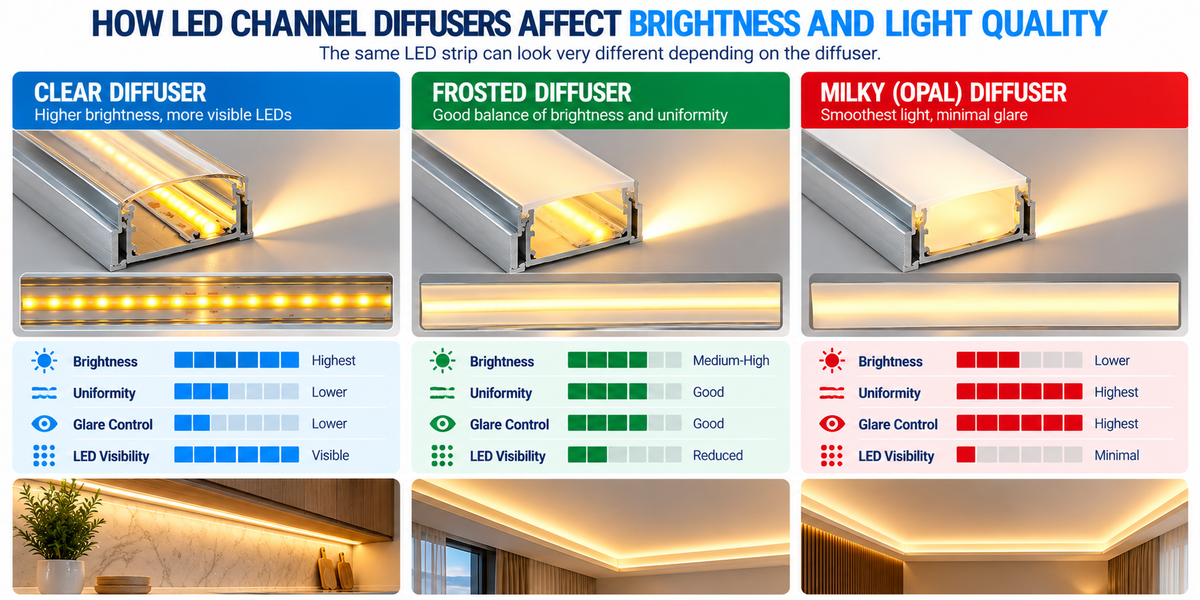
How LED Channel Diffusers Affect Brightness and Light Quality
When selecting an aluminum channel for LED strip lighting, most people focus on the profile itself:
- Width
- Depth
- Installation method
- Strip compatibility
- Surface-mount vs. recessed
- Plaster-in vs. suspended
But another component can significantly change how the finished lighting looks:
The diffuser.
The diffuser is the cover installed over the LED strip inside an aluminum channel. Depending on its material, opacity, shape, and distance from the LEDs, it can change:
Brightness + Uniformity + Glare + Hotspots + Appearance
This creates an important tradeoff:
More diffusion usually improves visual smoothness, but it can also reduce some light output.
For contractors, electricians, designers, and project buyers, understanding this relationship helps prevent a common problem: choosing an LED strip based on its brightness specifications and then being surprised by how different it looks after installation inside a channel with a diffuser.
What Does an LED Channel Diffuser Do?
A diffuser performs several functions at once.
It can:
- Blend light from the LED source
- Reduce visible LED points
- Reduce direct glare
- Protect the LED strip from casual contact and dust
- Create a cleaner finished appearance
- Help produce a more continuous line of light
Without a diffuser, the LED source is much more directly visible.
With a diffuser, some of that light is scattered before leaving the channel.
That scattering changes both the quantity and quality of the visible light.
Brightness and Light Quality Are Not the Same Thing
This distinction is important.
A lighting system can produce a lot of lumens and still look uncomfortable or unfinished.
Likewise, a slightly lower-output system can sometimes look better because the illumination is:
- More uniform
- Less glaring
- Better blended
- More visually comfortable
Think of it this way:
Maximum Brightness ≠ Best Lighting Quality
The right diffuser balances usable light output with the visual effect required by the project.
Why Does a Diffuser Reduce Brightness?
A diffuser is a physical material placed between the LEDs and the room.
When light reaches it, several things can happen:
- Some light passes through
- Some is scattered
- Some is reflected back into the channel
- Some is absorbed by the diffuser material
Therefore, the amount of light leaving the channel can be lower than the raw output of the LED strip alone.
The amount of reduction depends on the specific diffuser.
There is no universal percentage that applies to every clear, frosted, or milky cover.
Always check manufacturer photometric or transmission data when exact output matters. The cover supplied with each profile is listed on its product page.
Clear Diffusers
A clear or highly transparent cover generally allows more direct light through than a heavily diffusing cover.
Potential Advantages
- Higher light transmission
- Greater apparent brightness
- Useful when maximum output is important
Potential Disadvantages
- LEDs may remain visible
- More glare
- More visible hotspots
- Less uniform line of light
A clear diffuser may therefore preserve more brightness but provide less visual blending.
Frosted Diffusers
A frosted diffuser offers a balance between transmission and diffusion.
It scatters the light more than a clear cover while still allowing substantial illumination through.
Potential benefits include:
- Reduced glare
- Better LED blending
- Cleaner appearance
- Improved uniformity
For many architectural LED strip applications, this balance makes frosted diffusers practical. Most of our profiles ship with a frosted cover, including the low-profile BN252 and the wider BN259.
However, actual performance depends on:
Diffuser + LED Strip + Channel Geometry
not the diffuser alone.
Milky or Opal Diffusers
A more opaque milky diffuser typically provides stronger visual blending.
This can be especially useful when the goal is a smooth line of light. The BN253 and BN252-Black are supplied with milky covers.
Potential advantages:
- Better hotspot reduction
- Softer appearance
- Reduced visibility of individual LEDs
- More uniform luminous surface
The tradeoff can be:
Lower light transmission
compared with a clearer cover.
For decorative and architectural installations, that tradeoff may be worthwhile. Where the unlit channel should disappear into dark millwork, the BN252-Black-B uses a black diffuser instead.
The Basic Tradeoff
A simplified way to think about diffuser selection is:
| Diffuser | Light Transmission | LED Visibility | Uniformity | Glare Control |
|---|---|---|---|---|
| Clear | Higher | Higher | Lower | Lower |
| Frosted | Medium–High | Reduced | Good | Good |
| Milky / Opal | Lower | Lowest | Highest | Highest |
This table illustrates the general relationship only. Actual performance varies significantly by product.
Why COB LED Strips Work Well With Diffusers
COB LED strips already produce a much more continuous luminous surface than conventional strips with widely spaced individual LEDs.
That gives COB an important advantage inside aluminum channels.
With a suitable COB strip and diffuser, it is often possible to create a very smooth line of light.
The system becomes:
Dense COB Light Source
↓
Diffuser
↓
Smooth Linear Illumination
This combination is particularly useful for:
- Under-cabinet lighting
- Shelving
- Cove lighting
- Recessed architectural lighting
- Retail displays
- Hospitality projects
- Visible linear lighting
Does COB Mean You No Longer Need a Diffuser?
Not necessarily.
COB reduces visible LED dotting, but a diffuser still provides several benefits.
It can:
- Further soften the light
- Reduce glare
- Protect the strip
- Hide wiring or small imperfections
- Create a finished architectural appearance
In some concealed installations, the diffuser may be less important optically.
But in visible aluminum-channel applications, it can significantly improve the finished appearance.
Channel Depth Can Be Just as Important as Diffuser Type
One of the most overlooked factors is the distance between:
LED Strip → Diffuser
A deeper channel provides more space for the light to spread before reaching the diffuser.
That additional distance can improve blending.
Conceptually:
Shallow Channel
LED → Diffuser
Very little mixing distance — for example the BN257 flush-mount profile.
Deeper Channel
LED → Light Mixing Space → Diffuser
More opportunity for light to spread — for example the BN256 or the extra-large BN258.
This is why the same diffuser can look different on two different aluminum profiles.
Why Shallow Channels Can Show Hotspots
In a shallow profile, the LEDs sit very close to the diffuser.
If the light source has visible spacing, the diffuser may not have enough distance to blend the individual points completely.
The result can look like:
Bright → Dark → Bright → Dark → Bright
instead of:
──────── Smooth Continuous Light ────────
COB strips help significantly because the source itself is already much more continuous.
LED Density Matters
For non-COB strips, LED density can strongly influence diffuser performance.
A strip with widely spaced LEDs requires more optical blending than a high-density strip.
That means a diffuser that looks smooth with one strip may show visible dots with another. Compare our 384 LEDs/m and 480 LEDs/m COB strips.
When evaluating an LED channel system, consider:
LED Density + Channel Depth + Diffuser
as one optical system.
Strip Width Can Affect the Light Pattern
Suppose a channel can accept several strip widths.
A wider luminous source may distribute light differently across the diffuser than a narrow source.
Therefore, two LED strips with similar lumen output may still create different visual results inside the same profile.
This is another reason to test the actual:
combination whenever appearance is critical.
Diffuser Shape Matters Too
Not every diffuser is flat.
Depending on the profile, the cover may be:
- Flat
- Curved
- Domed
- Recessed
- Raised
The geometry changes how light spreads and how the luminous line appears from different viewing angles.
A raised or curved diffuser can sometimes create a broader visible luminous surface — the BN251 arc cover is designed around this.
A recessed cover may produce a more controlled line.
The correct option depends on the desired architectural effect.
Diffusers Can Reduce Glare
Brightness is useful only when it reaches the space comfortably.
A bare high-output LED strip can create uncomfortable glare, especially when:
- Installed at eye level
- Used under shelves
- Installed in handrails
- Used in retail displays
- Reflected by glossy surfaces
A diffuser increases the apparent emitting area and scatters the light.
This can make the source appear softer.
For many applications, reducing glare is more valuable than preserving every possible lumen.
Example: Under-Cabinet Lighting
Under-cabinet lighting illustrates the tradeoff clearly.
Imagine a bright COB strip mounted in an aluminum channel.
Without Effective Diffusion
You may have:
- Maximum direct output
- Strong reflections on polished countertops
- More glare from seated positions
With an Appropriate Diffuser
You may have:
- Slightly lower transmitted output
- Softer reflections
- Better visual comfort
- Cleaner finished appearance
The second installation can look better even if a light meter measures somewhat less output. A low-profile frosted channel is a common choice here.
Example: Retail Display Shelves
Retail shelves often place LED channels close to products and customers.
Visible hotspots can make a display look inexpensive or unfinished.
A suitable diffuser can help create:
One clean luminous line
rather than:
A row of visible LEDs
This can improve the presentation of:
- Jewelry
- Clothing
- Cosmetics
- Electronics
- Decorative products
In retail lighting, perceived quality matters alongside raw brightness.
Example: Cove Lighting
Cove lighting works differently because the LED source is usually hidden.
The viewer primarily sees light reflected from:
- Ceiling
- Wall
- Architectural surface
In this application, the diffuser may be less important for hiding LED dots from direct view.
However, it can still:
- Protect the strip
- Help blend the source
- Reduce localized bright areas
- Provide a cleaner channel assembly
The illuminated surface itself also acts as a large secondary diffuser. Our BN5620 cove profile includes a diffuser over its LED compartment for this reason.
Example: Recessed Linear Lighting
In recessed channels where the diffuser is directly visible, uniformity becomes much more important.
If the finished design is supposed to look like:
One continuous architectural line
visible hotspots can be distracting.
For these applications, consider:
- COB strip
- Suitable channel depth
- Appropriate diffuser opacity
- Proper strip centering
All four affect the result. For trimless drywall lines, see the BN5615 plaster-in profile.
Example: Corner Channels
Corner channels often direct light at approximately 45 degrees toward a work surface, wall, or room.
Because the diffuser may be visible from certain angles, glare control becomes important.
A frosted or milky diffuser may help soften the appearance.
But if maximum task-light output is the priority, excessive diffusion may not be desirable.
Again, application determines the correct balance. Our guide on corner LED channels covers beam direction in more detail.
Diffusers Affect Beam Distribution
A diffuser does not simply make the light dimmer.
It can also change how the light is distributed.
A bare strip may produce more concentrated light in certain directions.
A diffusing cover can scatter some of that light across a wider range of angles.
This means that even if total transmitted lumens decrease, some surfaces may receive more visually uniform illumination.
That is why diffuser performance should not be evaluated using brightness alone.
What Is Light Transmission?
Light transmission describes how much incoming light passes through a material.
For example, if a hypothetical diffuser transmitted 85% of the incoming light, then some portion would be lost through reflection, scattering, or absorption.
But do not assume:
Clear = 95%
Frosted = 85%
Milky = 70%
as universal numbers.
Different materials and manufacturers can have very different transmission values.
Use actual product data whenever precise calculations are required.
Do Diffusers Change Color Temperature?
A quality diffuser is generally designed to transmit the LED light without creating an undesirable color shift.
However, diffuser material can affect the visual appearance of the light slightly.
For color-critical applications, evaluate the complete system — including any CCT-adjustable strip across its full tuning range.
This is particularly important for:
- Retail
- Galleries
- Hospitality
- High-end residential projects
Do not evaluate the LED strip only before installing the diffuser.
Does a Diffuser Affect CRI?
The LED strip itself is the primary source determining color rendering.
However, any optical material placed between the LEDs and the illuminated environment can influence the final spectral transmission to some degree.
For projects with strict color-rendering requirements, rely on tested photometric data for the complete luminaire or assembly when available.
Diffuser Cleanliness Matters
A diffuser can gradually collect:
- Dust
- Grease
- Smoke residue
- Construction debris
This can reduce light output and change appearance.
This is especially relevant in:
- Kitchens
- Restaurants
- Workshops
- Retail environments
One benefit of a removable diffuser is easier access for cleaning and maintenance.
Follow the product's cleaning recommendations to avoid scratching or clouding the material.
Scratched Diffusers Can Look Different When Illuminated
Small scratches may not be obvious while the lights are off.
Once illuminated, however, scratches can scatter light and become more visible.
During installation:
- Protect diffuser surfaces
- Avoid dragging them across rough materials
- Remove protective film at the appropriate stage
- Keep construction compound and paint away from the optical surface
Good installation practices matter to the final lighting quality.
Diffuser Joints Can Become Visible
For long architectural runs, multiple channel and diffuser sections may be required. Our profiles come in 8ft lengths, so long runs need fewer joints.
Where two diffuser sections meet, a visible transition may occur.
For cleaner results:
- Cut accurately
- Keep joints straight
- Align adjacent sections
- Avoid unnecessary gaps
- Plan joint locations
In high-end projects, even small details can affect the perceived quality of the final installation.
Dark Spots at Connections Still Matter
A diffuser can help hide small variations between connected LED strip sections.
But it cannot completely eliminate a large physical gap.
If you have:
COB Strip → Large Connector Gap → COB Strip
the diffuser may still reveal a darker area.
The best strategy is:
Minimize the connection gap first, then use the diffuser for additional blending.
Our guide on avoiding dark spots at LED strip connections covers this in detail.
How Diffuser Distance Affects Dark Spots
A deeper channel can sometimes make small connection gaps less visible because the light has more space to mix before reaching the diffuser.
In a shallow channel, the same connection gap may appear much more obvious.
Therefore:
Connection Quality + Channel Depth + Diffuser
all work together.
Brightness Loss Matters More in Some Projects
A small reduction in transmitted light may not matter much in decorative lighting.
But it can matter significantly when the LED strip is being used for:
- Task lighting
- Work surfaces
- Commercial illumination
- High-output applications
If a specific illuminance level is required, account for the complete optical system rather than relying only on the bare LED strip's lumen rating.
Do Not Compensate Automatically by Using a Much Stronger Strip
If a diffuser reduces output, the immediate reaction may be:
“I'll just use the highest-wattage strip possible.”
That can create new problems:
- More heat
- Larger driver requirement
- Higher energy consumption
- More demanding thermal management
- Greater glare if the optical system is poorly designed
Instead, design the complete system around the required light level. Our guide on building a complete LED lighting system works through the process.
Aluminum Channels Help With Thermal Management
Higher-output LED strips generate more heat.
The aluminum profile provides a surface that can help transfer heat away from the strip.
This is another reason the channel is more than decorative trim.
However, thermal performance depends on:
- Strip wattage
- Profile size
- Installation
- Ambient temperature
- Airflow
The diffuser does not replace the need for proper thermal design. See our guide on how aluminum channels help extend LED strip lifespan.
How to Choose the Right Diffuser
Start with the application.
Choose More Transparency When:
- Maximum transmitted light is important
- LED visibility is acceptable
- The strip is hidden from direct view
Choose Moderate Diffusion When:
- You want a balance of output and uniformity
- The channel is visible
- Glare needs to be reduced
Choose Stronger Diffusion When:
- A seamless line of light is the priority
- Hotspots must be minimized
- The channel is directly visible
- Decorative appearance matters more than maximum output
Then evaluate the channel depth and LED strip type.
The Best Combination for Smooth Linear Light
For many visible architectural installations, a strong combination is:
High-Density COB LED Strip
Properly Sized Aluminum Channel
Adequate Mixing Depth
This combination can create a clean, professional line of light.
But exact performance should always be tested for the specific products being used.
Build a Sample Before a Large Project
For a commercial installation involving hundreds of feet of LED channels, build a short mock-up.
Use the actual:
- LED strip
- Aluminum profile
- Diffuser
- Driver
- Mounting surface
Then evaluate:
With Lights Off
- Appearance
- Fit
- Finish quality
With Lights On
- Brightness
- Hotspots
- Glare
- Uniformity
- Color appearance
This small test can prevent a costly mistake across an entire project.
Compare Diffusers Side by Side
If multiple diffuser options are available, install them over identical sections of the same LED strip.
Compare them from:
- Directly below
- Normal viewing position
- Side angle
- Typical working distance
Also compare:
- Light on the target surface
- Reflections
- Visible hotspots
Do not judge only by looking directly at the diffuser. Contact our team if you would like samples of different covers for comparison.
Measure When Light Levels Matter
For projects requiring specific lighting levels, visual comparison alone is not enough.
Use appropriate photometric information or measurement to verify:
- Lumens
- Illuminance
- Distribution
- Required task-light levels
A diffuser changes the optical system, so the bare-strip specification may not represent the finished installation.
Common Diffuser Selection Mistakes
Avoid these mistakes:
- Choosing solely by appearance when lights are off
- Assuming every white diffuser has the same transmission
- Ignoring channel depth
- Ignoring LED density
- Expecting a diffuser to hide very large LED spacing
- Expecting it to eliminate large connection gaps
- Selecting maximum opacity without considering required brightness
- Using excessive LED wattage simply to compensate
- Ignoring glare
- Forgetting to test the completed system
- Comparing strips without the actual diffuser installed
Quick Selection Guide
Under-Cabinet Lighting
Prioritize:
Good transmission + glare control + smooth appearance
COB with an appropriate frosted diffuser is often a strong combination.
Retail Display
Prioritize:
Uniformity + color quality + low glare
Test reflections on merchandise and glass.
Cove Lighting
Prioritize:
Indirect distribution + strip protection + clean assembly
The illuminated architectural surface provides additional blending — see the BN5620 cove profile.
Visible Recessed Linear Lighting
Prioritize:
Maximum uniformity
COB, sufficient profile depth, and effective diffusion can be especially valuable.
Decorative Lighting
Prioritize:
Visual appearance
A softer luminous line may be more important than maximum lumen output.
Task Lighting
Prioritize:
Useful illumination
Do not sacrifice too much transmission simply to achieve a perfectly opaque line.
A Diffuser Is Part of the Lighting System
Do not think of the diffuser as an accessory added after the important decisions have been made.
The complete system is:
↓
↓
↓
Diffuser
↓
Illuminated Surface
↓
Viewer
Changing any part can change the final result.
A different diffuser can make the same LED strip appear softer, smoother, less glaring, or less bright.
That makes diffuser selection part of lighting design—not simply product finishing.
Final Takeaway
LED channel diffusers create a tradeoff between:
Maximum Light Transmission
and
Maximum Light Uniformity
A clearer diffuser generally preserves more direct light but may reveal LEDs and produce more glare.
A more diffusing frosted or milky cover can create a smoother, more comfortable line of light while reducing some transmitted output.
But diffuser type is only part of the equation.
The final result depends on:
LED Strip Type + LED Density + Channel Depth + Diffuser + Installation Geometry
For smooth architectural lighting, COB LED strips can provide an excellent starting point because the source is already highly uniform.
Combine that with the right aluminum channel and diffuser, and the result can be a clean continuous line rather than a row of visible light points.
For professional projects, the best approach is simple:
Test the actual strip, channel, and diffuser together before committing to the full installation.
That is the most reliable way to balance brightness, uniformity, glare control, and overall light quality. If you would like help matching a strip, profile, and cover, contact our team for samples and wholesale pricing.
Frequently Asked Questions
Do LED channel diffusers reduce brightness?
Yes. A diffuser can reduce some transmitted light because some light is scattered, reflected, or absorbed. The actual reduction depends on the diffuser material and design.
Which LED diffuser is brightest?
A clearer diffuser generally allows more direct light transmission than a heavily frosted or milky diffuser, but actual transmission varies by product.
Which diffuser is best for hiding LED dots?
More strongly diffusing frosted or milky covers generally hide LED points better, especially when combined with sufficient channel depth and a high-density LED source.
Do COB LED strips need a diffuser?
Not always for eliminating dots, because COB already creates a continuous-looking source. However, a diffuser can still reduce glare, protect the strip, improve blending, and provide a cleaner finished appearance.
Does a deeper LED channel improve diffusion?
Often, yes. Greater distance between the LED source and diffuser gives light more space to mix before reaching the cover — compare the shallow BN257 with the deeper BN256.
Can a diffuser completely hide dark spots at LED strip connections?
Not necessarily. It can help blend small variations, but large physical gaps between illuminated sections may remain visible.
Should I choose the diffuser before selecting the LED strip?
The strip, channel, and diffuser should ideally be selected together because they function as one optical system.
Is the brightest diffuser always the best choice?
No. For many architectural installations, reducing glare and improving uniformity can be more important than maximizing raw light transmission.