
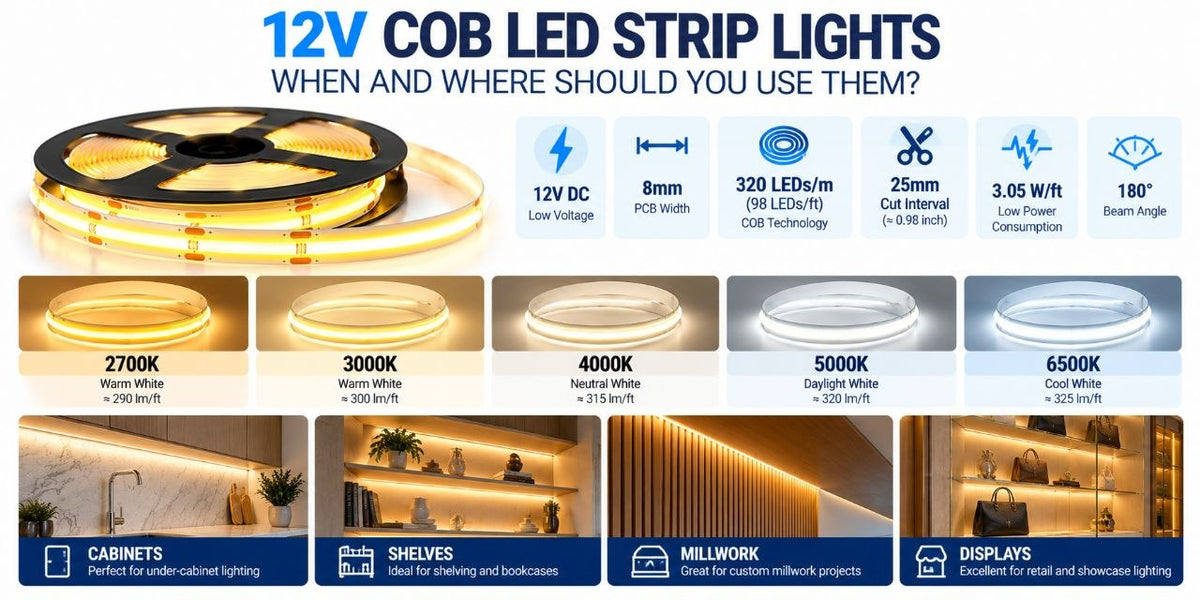
12V COB LED Strip Lights: When and Where Should You Use Them?
Most professional LED strip discussions eventually come down to one question:
Should I use 12V or 24V?
For long architectural runs, 24V often gets most of the attention.
But that does not mean 12V LED strips are outdated or inferior.
In the right application, 12V COB LED strip lighting can actually be the more practical choice, particularly when a project requires:
- Short lighting sections
- Precise cutting
- Compact installations
- Cabinet and millwork lighting
- Display lighting
- Shelving
- Small architectural details
BrightNex's 12V COB LED Strip combines a narrow 8mm PCB, 320 LEDs per meter, a 25mm cutting interval, approximately 3.05W/ft power consumption, and multiple white color temperatures from 2700K through 6500K.
Understanding where those specifications matter can help contractors and installers decide when 12V is the right tool for the project.
What Is a 12V COB LED Strip?
Let's start with the two important parts of the name:
12V describes the operating voltage.
COB describes the LED technology.
COB stands for:
Chip on Board
Instead of using widely spaced individual LED packages, COB technology places a high density of LED chips along the strip to create a much smoother luminous surface.
The result is the familiar:
Continuous, dot-free line of light
that makes COB particularly useful in visible architectural applications.
Meet the BrightNex 12V COB Series
The BrightNex 12V COB strip is designed around a relatively compact format.
Key specifications include:
| Specification | BrightNex 12V COB |
|---|---|
| Input Voltage | 12V DC |
| LED Technology | COB |
| LED Density | 320 LEDs/m |
| Approx. Density | 98 LEDs/ft |
| PCB Width | 8mm |
| Power | 3.05 W/ft |
| Current | 0.25 A/ft |
| Cut Interval | 25mm |
| Beam Angle | 180° |
| Standard Roll | 16.4–16.5 ft / 5m |
| Color Temperatures | 2700K / 3000K / 4000K / 5000K / 6500K |
The product also uses adhesive backing and is offered with multiple protection-level options depending on configuration.
These specifications make it quite different from simply choosing a generic LED tape.
The Biggest Advantage of 12V: Precise Short Sections
One of the most useful characteristics of this strip is its:
25mm cutting interval
That is approximately:
0.98 inch
In other words, installers can adjust the strip length in increments of roughly one inch.
This becomes extremely useful in applications such as:
- Custom cabinets
- Bookshelves
- Display cases
- Closets
- Vanities
- Small niches
- Millwork
- Furniture lighting
Imagine a cabinet opening where the illuminated section needs to finish very close to the cabinet edge.
A strip with long cutting intervals may force you to stop several inches early.
With a short cut interval, the strip can be sized much more precisely.
Why Cutting Interval Matters More Than Many Buyers Realize
Consider a custom shelf that requires approximately:
37 inches of illumination
The installer wants the light to extend nearly from edge to edge.
If the strip has long cut intervals, the nearest permitted cut point might leave a noticeable unlit section.
With approximately 25mm cut increments, the BrightNex 12V COB strip provides much finer adjustment.
For repetitive millwork projects involving dozens of:
- Shelves
- Cabinets
- Display openings
that flexibility can become very valuable.
Where 12V COB Really Makes Sense
Rather than thinking of 12V as a replacement for every 24V installation, think of it as a specialized option.
It is particularly useful when the project consists of:
many short, accurately sized lighting sections.
For example:
Kitchen
Multiple short under-cabinet sections.
Retail
Individual display shelves.
Closet
Separate shelves and hanging sections.
Millwork
Custom recesses with exact dimensions.
Display Case
Small illuminated compartments.
Vanity
Short linear lighting around architectural details.
These are exactly the types of projects where precision can matter more than extremely long run capability.
12V vs. 24V: The Important Difference
Voltage affects current.
Remember:
Power = Voltage × Current
Suppose a lighting load requires:
120W
At 12V:
120 ÷ 12 = 10A
At 24V:
120 ÷ 24 = 5A
For the same power, the 12V system requires approximately twice the current.
That matters because higher current can increase the effects of:
- Voltage drop
- Wire resistance
- Connection resistance
This is why 24V is generally better suited to longer runs, while 12V is more appropriate for shorter runs.
So Why Use 12V at All?
Because longer run capability is not the only design priority.
Suppose you're lighting a 30-inch cabinet.
You do not need a 50-foot continuous run.
Instead, you may care more about:
- Precise cutting
- Compact components
- 8mm strip width
- Smooth COB illumination
- Easy integration into small spaces
That's where 12V becomes particularly useful.
12V Is Excellent for Cabinet Lighting
Consider a kitchen with several separate cabinets.
You might have:
Cabinet A → 28 inches
Cabinet B → 36 inches
Cabinet C → 24 inches
Cabinet D → 42 inches
This is not one long continuous architectural run.
It is a collection of shorter lighting sections.
A 12V COB strip with short cutting intervals is well suited to this type of layout.
The COB construction also helps produce a smooth line rather than visible individual LED points.
Why 8mm Width Matters
The BrightNex 12V COB strip uses an:
8mm PCB
which makes it relatively narrow.
This can be particularly useful for:
- Slim aluminum channels
- Cabinet recesses
- Shelving
- Narrow millwork
- Display fixtures
- Compact architectural details
Strip width should always be checked against the actual internal dimensions of the channel.
Even small differences between 6mm, 8mm, 10mm, and 12mm strips can determine whether a strip fits correctly inside a profile or recess. Each profile page in our aluminum channel collection includes a dimensioned drawing.
8mm Is a Practical Middle Ground
Extremely narrow strips can be useful when installation space is severely restricted.
Wider strips may be needed for specialized or higher-output designs.
But 8mm is a useful size for many everyday architectural applications because it remains compact while fitting many slim profile designs. 8mm COB is also a common starting point for cabinet and shelving installations in 24V as well as 12V.
Why 320 LEDs per Meter Matters
This strip uses:
320 LEDs/m
or approximately:
98 LEDs/ft.
High-density COB construction helps produce the continuous appearance that makes this technology useful for architectural lighting.
Instead of seeing:
• • • • • • • •
the objective is closer to:
━━━━━━━━━━━━━━━━
a smooth line of illumination.
This becomes especially important when the light source is:
- Directly visible
- Reflected by countertops
- Installed inside shallow channels
- Used near glossy materials
COB Is Especially Useful Under Cabinets
Traditional LED strips with visible LED points can sometimes create individual reflections on polished countertops.
Instead of one clean line, you may see:
multiple bright dots reflected in the surface.
COB helps reduce that effect by creating a more continuous luminous source.
Adding an appropriate aluminum channel and diffuser can improve the finished appearance further.
Choosing the Right Color Temperature
One of the strongest features of this BrightNex series is that it is available across a broad white-light range:
2700K
3000K
4000K
5000K
6500K
These are not simply different brightness settings.
They create distinctly different visual environments.
2700K — Warm and Relaxed
2700K produces a warm white appearance.
It is particularly useful for:
- Residential interiors
- Bedrooms
- Living spaces
- Warm wood cabinetry
- Hospitality
- Decorative shelving
If the surrounding lighting is warm and the goal is comfort, 2700K can integrate naturally with the space.
The BrightNex product lists approximately 290 lumens per foot for its 2700K version.
3000K — Warm but More Neutral
3000K is one of the most versatile architectural color temperatures.
It works well in:
- Kitchens
- Residential millwork
- Restaurants
- Hotels
- Vanities
- Shelving
- Warm commercial interiors
It maintains warmth without appearing as yellow as lower color temperatures can in some spaces.
BrightNex lists approximately:
300 lm/ft
for the 3000K version.
4000K — Clean Neutral White
4000K creates a more neutral appearance.
It is useful for:
- Offices
- Retail displays
- Commercial cabinets
- Work areas
- Modern kitchens
- Product displays
BrightNex lists approximately:
315 lm/ft
for this version.
This can be a strong choice when the goal is a clean contemporary appearance without moving fully into cool white.
5000K — Bright Daylight Appearance
5000K creates a cooler, daylight-oriented appearance.
Possible applications include:
- Commercial displays
- Task areas
- Workshops
- Product inspection
- Modern retail environments
The BrightNex product lists approximately:
320 lm/ft.
Always coordinate the strip's color temperature with the surrounding lighting.
6500K — Cool White
At the cool end of the series is:
6500K
This produces a distinctly cool white appearance.
BrightNex lists approximately:
325 lm/ft.
This can be useful where a crisp, cool appearance is specifically desired.
It will look substantially different from 2700K or 3000K, so the choice should be intentional. Where the client wants to change the white balance after installation, a CCT-adjustable strip covers the full range instead.
Quick Color Temperature Guide
| CCT | Approx. Brightness* | Typical Character |
|---|---|---|
| 2700K | 290 lm/ft | Warm, comfortable |
| 3000K | 300 lm/ft | Warm-neutral |
| 4000K | 315 lm/ft | Neutral, clean |
| 5000K | 320 lm/ft | Daylight |
| 6500K | 325 lm/ft | Cool, crisp |
*Values shown are the current outputs published for this BrightNex 12V COB series.
This is important because installers should not assume every CCT version necessarily produces exactly the same lumen output.
How Much Power Does It Use?
The strip is rated at approximately:
3.05 W/ft
or approximately:
10 W/m.
That makes driver calculations straightforward.
For example:
5 Feet
5 × 3.05 = 15.25W
10 Feet
10 × 3.05 = 30.5W
15 Feet
15 × 3.05 = 45.75W
This gives you the connected strip load before applying any project-specific driver-sizing requirements.
Example: 8 Feet of Cabinet Lighting
Suppose your project needs:
8 ft
of BrightNex 12V COB.
Power consumption:
8 × 3.05W = 24.4W
Your 12V driver must therefore have sufficient usable capacity for that connected load while meeting the driver's manufacturer requirements and any design margin used for the project — a 30W driver is tight for this load, so a 12V 60W compact transformer would leave comfortable headroom.
Do not simply choose a driver because it says 12V.
You need both:
Correct Voltage + Sufficient Wattage
Example: 15 Feet
For:
15 ft
the approximate connected load is:
15 × 3.05 = 45.75W
Again, driver selection should account for the actual connected load and the driver's specifications.
BrightNex offers 12V constant-voltage driver options, including the 12V 60W compact transformer, the switchable 100W and 150W models, and a 12V 6A plug-in adapter for smaller cabinet projects.
Driver Voltage Must Match
This is critical.
A:
12V LED Strip
requires an appropriate:
12V constant-voltage power supply/driver.
Do not connect this strip to a 24V constant-voltage output. Several of our dimmable drivers are switchable between 12V and 24V, so confirm the setting before connecting.
Likewise, do not choose the driver based only on wattage.
The correct order is:
1. Match voltage
2. Calculate wattage
3. Verify dimming/control compatibility
4. Check installation environment
What About Dimming?
A 12V COB installation can be dimmable when the system components are designed to work together.
The complete control chain may include:
AC Dimmer → Compatible Dimmable 12V Driver → COB Strip
or another compatible control architecture.
The key is system compatibility.
A premium COB strip paired with an incompatible driver or control system can still produce poor results.
Check the strip, driver, and dimming protocol as a complete system. Where the dimming method is not fixed yet, a 5-in-1 dimmable driver covers several protocols in one unit.
Can You Use It With an Aluminum Channel?
Yes—and for many installations, that is the preferred approach.
The strip's 8mm width makes it compatible with many appropriately sized aluminum profiles, provided the channel's internal dimensions are verified first. The low-profile BN252 and the BN254 corner channel are common choices for cabinet work.
An aluminum channel can provide:
- Cleaner installation
- Better finished appearance
- Physical strip protection
- A mounting surface
- Diffuser support
- Heat spreading
For visible architectural installations, the combination can be:
12V COB Strip + Aluminum Channel + Diffuser
Does COB Still Need a Diffuser?
Not necessarily for eliminating LED dots.
The COB source itself already creates a very smooth line.
But a diffuser can still help:
- Reduce glare
- Protect the strip
- Hide small installation imperfections
- Create a finished architectural appearance
In a very shallow channel, COB is particularly useful because there is less distance available for optical blending. Our guide on how diffusers affect brightness and light quality covers the tradeoff.
Use the Correct 8mm Connector
If solderless connections are required, connector width matters.
An 8mm strip requires a connector designed for the appropriate:
8mm single-color COB strip configuration.
BrightNex carries an 8mm COB single-color strip connector in its wire and connector range.
Do not assume that a 10mm connector will properly fit an 8mm strip.
Plan Connections Carefully
Even though COB creates a smooth line, a large connector can create a physical gap between two illuminated sections.
For highly visible applications:
- Minimize unnecessary connection gaps
- Keep strips aligned
- Check connector dimensions
- Consider the aluminum channel
- Test with the diffuser installed
The quality of the connection can affect the finished line of light.
12V and Voltage Drop
This is where 12V requires more attention.
Because a 12V system carries more current than an equivalent 24V system, voltage drop can become significant sooner.
Possible symptoms include:
- Brightness decreasing toward the end
- Uneven illumination
- Poor performance
- Visible difference between sections
Use shorter runs, parallel wiring, or additional power feeds when voltage drop becomes an issue. Correctly sized wire also matters.
Do Not Confuse Driver Capacity With Maximum Run Length
Suppose your 12V driver has enough wattage for a large amount of strip.
That does not automatically mean you should connect all of that strip as one continuous run.
These are two different limits:
Driver Capacity
How much total wattage can the driver support?
Strip Run Length
How far can the strip run from a feed point while maintaining acceptable performance?
Always evaluate both. Our guide on how many feet one driver can power works through the calculation.
Use Parallel Runs for Multiple Cabinets
This is especially relevant to cabinet projects.
Instead of:
Driver → Cabinet 1 → Cabinet 2 → Cabinet 3 → Cabinet 4
a better architecture may be:
12V Driver
↙ ↓ ↓ ↘
Cabinet 1 | Cabinet 2 | Cabinet 3 | Cabinet 4
with appropriately designed parallel feeds, usually run with jumper wire and connectors.
This can help keep the short-run advantage of 12V while avoiding one unnecessarily long daisy-chained strip run.
The actual wiring arrangement must be designed for the project's current, distance, conductor size, and applicable electrical requirements.
Example: Four Retail Shelves
Imagine four display shelves.
Each requires:
3 ft of COB strip
Each shelf load:
3 × 3.05 = 9.15W
Four shelves:
9.15 × 4 = 36.6W
Rather than creating one 12-foot continuous strip, the project can use separate short sections sized precisely for each shelf. A 12V 60W transformer suits this total load.
This is an excellent example of where 12V COB can make practical sense.
Example: Custom Closet
Suppose a custom closet contains:
- 4 shelves
- 2 hanging sections
- 2 cabinet sections
Each lighting section is relatively short.
The goal is not maximum run distance.
The priorities are:
Precise Length + Narrow Width + Smooth Light + Clean Integration
Again, those priorities align well with this 12V COB format.
Example: Display Case
Display cases can contain very small illuminated sections.
A short cutting interval allows the installer to size each section more precisely.
The 8mm width also helps when working inside narrow profile systems such as the BN252.
And because COB produces a smooth luminous surface, the lighting can look cleaner when reflected by glass or polished materials.
When 24V May Be the Better Choice
A useful product guide should also explain when not to choose 12V.
Consider 24V instead when the project involves:
- Long continuous architectural runs
- Large perimeter coves
- Long corridors
- Extensive linear installations
- Long driver-to-strip wiring distances
- High total power distributed over long distances
24V is generally preferable for longer runs because of voltage-drop considerations.
The point is not:
12V is better than 24V
or:
24V is better than 12V.
The correct statement is:
Each voltage is better suited to different project conditions.
12V vs. 24V Quick Comparison
| Project Requirement | 12V | 24V |
|---|---|---|
| Short sections | Excellent | Excellent |
| Precise custom lengths | Excellent with this 25mm-cut product | Depends on strip |
| Cabinet lighting | Excellent | Excellent |
| Display shelving | Excellent | Excellent |
| Long continuous runs | More limited | Generally better |
| Current for same wattage | Higher | Lower |
| Voltage-drop resistance | More sensitive | Better |
| Large architectural projects | Depends on layout | Often preferred |
The actual decision should always be based on the specifications of the exact strips being compared.
Indoor vs. Protected Applications
The BrightNex 12V COB strip is currently presented as an indoor product, while the product information also references optional protection configurations. Verify the exact version being ordered for the project's environment.
For any project, check whether the installation is:
- Dry
- Damp
- Exposed to water
- Outdoor
Then select the appropriate strip, driver, connectors, and enclosure system.
The environmental rating of one component does not protect the entire installation. Our guide on where to install an outdoor LED driver covers this in more detail.
Why UL Certification Matters
BrightNex lists this 12V COB series as UL Certified.
For professional projects, certification can be especially important for:
- Contractors
- Electricians
- Builders
- Commercial projects
- Project approvals
- Inspection requirements
Treat certification as a core specification alongside voltage, width, dimming compatibility, and driver selection.
How to Choose Between the Five Versions
A simple approach is:
Choose 2700K if:
You want a very warm residential or hospitality atmosphere.
Choose 3000K if:
You want warm architectural light with broad versatility.
Choose 4000K if:
You want clean neutral light for modern residential or commercial spaces.
Choose 5000K if:
You want a cooler daylight appearance for task or commercial applications.
Choose 6500K if:
You specifically want a crisp, cool-white appearance.
Do not choose CCT based solely on which version has the highest lumen figure.
Choose it based on the desired visual environment.
How to Specify the Complete System
Do not order the strip in isolation.
For a professional installation, specify:
LED Strip
12V COB / 8mm / desired CCT
Driver
12V constant voltage / sufficient wattage / correct dimming type
Channel
Internal width compatible with 8mm strip
Diffuser
Selected for desired brightness and uniformity
Wiring
Sized for current and distance
Connections
Compatible with 8mm single-color COB
This approach prevents compatibility problems during installation. Our guide on building a complete LED lighting system covers the full process.
Installation Checklist
Before installing BrightNex 12V COB strip, confirm:
Voltage
- 12V driver selected
- Controller, if used, is 12V compatible
Strip
- Correct CCT
- 8mm installation space available
- Required footage calculated
- Cut locations planned
Driver
- Total wattage calculated
- Appropriate capacity
- Dimming compatibility verified
- Internal dimensions checked
- Diffuser selected
- Connection clearance verified
- Wire gauge appropriate
- Cable distance checked
- Voltage drop considered
- Parallel feeds planned where necessary
Installation
- Surface clean
- Strip properly supported
- Polarity checked
- System tested before final finishing
Common Mistakes With 12V LED Strips
Avoid:
- Connecting the strip to a 24V driver
- Selecting the driver based only on voltage
- Ignoring total wattage
- Creating unnecessarily long 12V runs
- Ignoring voltage drop
- Using the wrong connector width
- Cutting outside approved cut points
- Assuming 8mm means every 8mm channel accessory automatically fits
- Choosing CCT only by brightness
- Forgetting driver/control compatibility
- Installing before testing the complete system
Who Is This 12V COB Strip Best For?
The BrightNex 12V COB series is particularly useful for professionals working on:
Cabinetry
Millwork
Retail displays
Shelving
Closets
Vanities
Furniture lighting
Short architectural details
Custom-sized linear lighting
Its combination of:
12V + 8mm PCB + 320 LEDs/m + 25mm Cut Interval + Five CCT Options
makes it especially useful when the installation requires short, precise, smooth-looking sections rather than extremely long continuous runs.
Final Takeaway
The question should not be:
“Is 12V better than 24V?”
The better question is:
“Which voltage better fits this project?”
For long architectural runs, 24V often has an advantage because it carries less current for the same power and can simplify voltage-drop management.
But for short, highly customized installations, the BrightNex 12V COB LED Strip offers a very useful combination:
320 LEDs/m
8mm width
25mm cutting intervals
3.05 W/ft
180° beam angle
and:
2700K / 3000K / 4000K / 5000K / 6500K options.
That makes it particularly attractive for cabinet makers, millwork contractors, electricians, lighting installers, retail-display builders, and other professionals who need precise lengths and smooth dot-free illumination in compact spaces.
The key is to design it as a complete 12V system:
COB Strip + Correct 12V Driver + Wiring + Connectors + Aluminum Channel + Diffuser
When those components are properly matched, 12V COB can be an excellent solution for short-run professional linear lighting. For project quantities, contact our team for wholesale pricing.
View the BrightNex 12V COB LED Strip – 8mm, 320 LEDs/m
Frequently Asked Questions
What is the main advantage of this BrightNex 12V COB strip?
One of its most useful advantages is the combination of an 8mm width and 25mm cutting interval, making it well suited to short, accurately sized installations such as cabinets, shelves and millwork.
How many LEDs does the strip have?
It uses 320 LEDs per meter, approximately 98 LEDs per foot.
How much power does it use?
BrightNex specifies approximately 3.05 watts per foot, or about 10W/m.
How often can the strip be cut?
The listed cutting interval is 25mm, approximately one inch.
What color temperatures are available?
The series currently includes 2700K, 3000K, 4000K, 5000K and 6500K.
What driver should I use?
Use an appropriately sized 12V constant-voltage driver that meets the total load, dimming, environmental and installation requirements — for example the 12V 60W compact transformer.
Can I use this strip inside an aluminum channel?
Yes. Its 8mm PCB can work with appropriately sized profiles. Verify the channel's actual internal width and connector clearance before installation.
Is 12V or 24V better for long LED strip runs?
24V is generally preferable for longer runs because the same power requires less current, which helps with voltage drop. Use 12V for shorter runs and 24V for longer applications.