
Do LED Lights Really Last Longer Than Regular Bulbs?
One of the biggest claims about LED lighting is simple:
LEDs last longer.
But how much longer?
And if LEDs can operate for tens of thousands of hours, why do some LED lights fail much sooner?
The answer is more interesting than simply comparing numbers on product packaging.
In most applications, quality LED lighting can provide a substantially longer useful operating life than traditional incandescent and halogen lamps. It can also outperform many fluorescent lighting systems.
But an LED system's lifespan depends on much more than the LED chips themselves.
It depends on the complete system:
LEDs + Driver + Heat Management + Installation + Operating Conditions
Understanding these factors is particularly important for commercial projects, where replacing lighting across hundreds of fixtures can become a significant maintenance expense.
How Long Do Different Types of Lights Typically Last?
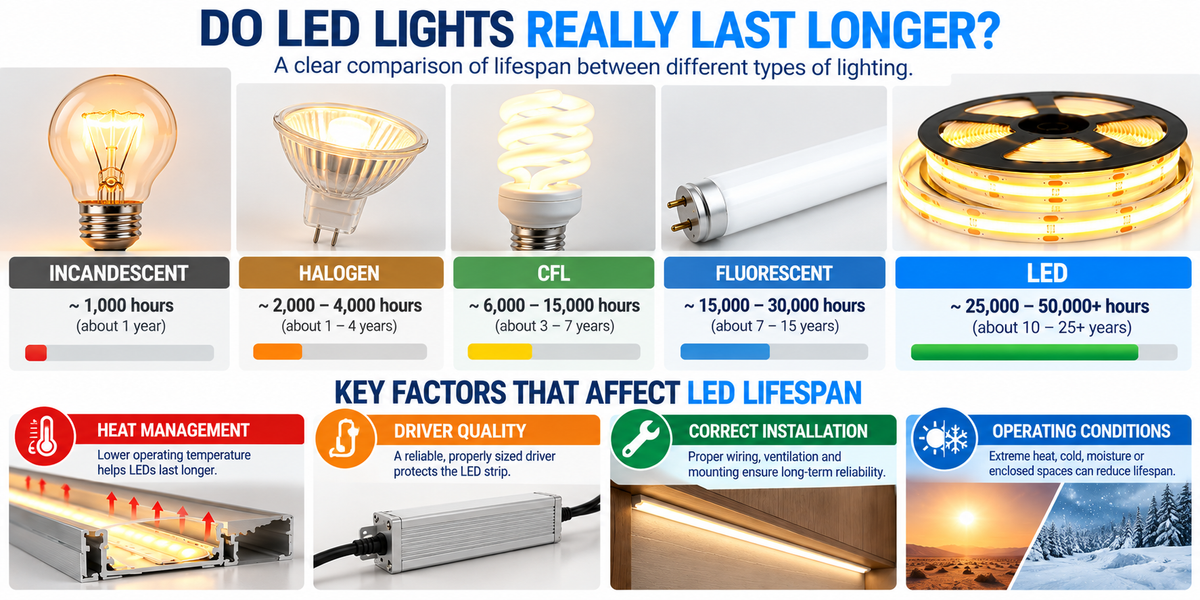
Typical rated-life ranges vary considerably by product quality and application, but the general comparison looks something like this:
| Lighting Technology | Typical Rated Life |
|---|---|
| Incandescent | ~1,000 hours |
| Halogen | ~2,000–4,000 hours |
| CFL | ~6,000–15,000 hours |
| Linear Fluorescent | ~15,000–30,000+ hours |
| Quality LED | ~25,000–50,000+ hours |
These are general ranges, not guarantees.
A specific lamp or LED product should always be evaluated using its manufacturer's rated-life specifications.
Still, the difference explains why LEDs have become so important in residential, commercial, retail, hospitality, and architectural lighting.
Why Can LEDs Last So Much Longer?
Traditional incandescent lamps create light by heating a thin filament until it glows.
That filament operates at extremely high temperature.
Eventually, it weakens and breaks.
The result is familiar:
Bulb working → Filament fails → Bulb immediately goes dark
LEDs operate differently.
An LED is a semiconductor light source and does not rely on a fragile glowing filament.
That eliminates one of the fundamental failure mechanisms found in incandescent lighting.
But this does not mean LEDs are immune to heat.
In fact, heat management is one of the most important factors determining LED longevity.
LEDs Usually Don't "Burn Out" the Same Way
This is one of the most important differences between LEDs and traditional bulbs.
An incandescent bulb often works normally until its filament fails.
LEDs can behave differently.
Over time, their light output may gradually decline.
So instead of:
100% → 100% → 100% → OFF
an LED may behave more like:
100% → 95% → 90% → 85% → ...
This is why LED lifespan is often discussed in terms of lumen maintenance, not simply the moment when the LEDs stop producing light.
What Does L70 Mean?
You may see a specification such as:
L70
in professional LED lighting documentation.
L70 refers to the point at which the LED system is expected to produce approximately:
70% of its initial light output
under the applicable test or projection conditions.
For example, if an LED product has an appropriate L70 projection of 50,000 hours, that does not necessarily mean:
The LED suddenly dies at hour 50,001.
Instead, it relates to the expected depreciation of light output over time.
This distinction is important when comparing LED life with traditional lamp life.
What Does 50,000 Hours Mean in Real Life?
Let's put operating hours into perspective.
If a light operates:
4 Hours per Day
50,000 ÷ 4 = 12,500 days
Approximately:
34 years
8 Hours per Day
50,000 ÷ 8 = 6,250 days
Approximately:
17 years
12 Hours per Day
50,000 ÷ 12 = 4,167 days
Approximately:
11.4 years
24 Hours per Day
50,000 ÷ 24 = 2,083 days
Approximately:
5.7 years
These calculations illustrate operating hours only.
They do not mean every LED product rated at 50,000 hours will necessarily remain in service for exactly those calendar periods.
Actual system life depends on operating conditions and component quality.
LED vs. Incandescent
This is the easiest comparison.
Suppose:
Incandescent bulb = 1,000 hours
and:
LED product = 25,000 hours
On rated operating hours alone, the LED could represent roughly:
25× the rated life
of that incandescent lamp.
If comparing against a 50,000-hour LED product:
50×
would be the theoretical rated-hour difference.
Again, actual product ratings vary, but the scale of the difference is significant.
LED vs. Halogen
Halogen lamps generally last longer than conventional incandescent lamps, but they still rely on a filament.
Typical life may be in the range of several thousand hours.
A quality LED product rated for tens of thousands of hours can therefore provide a substantial longevity advantage.
This is particularly useful in places where changing lamps is difficult, such as:
- High ceilings
- Commercial spaces
- Retail stores
- Hotels
- Architectural details
For existing recessed cans, a 5CCT LED retrofit module replaces the lamp and trim in one piece.
LED vs. CFL
Compact fluorescent lamps improved energy efficiency and lifespan compared with incandescent lighting.
However, LEDs generally offer several practical advantages, including:
- Longer potential life
- Instant full output
- Better compatibility with frequent switching in many applications
- Compact form factors
- Greater design flexibility
The exact comparison depends on the specific products.
LED vs. Fluorescent Tubes
The comparison becomes more nuanced with quality linear fluorescent systems.
Some fluorescent lamps can achieve substantial rated lifetimes.
However, commercial LED systems can still offer advantages in:
- Energy efficiency
- Control
- Dimming
- Maintenance
- Directionality
- Architectural integration
The best choice should be evaluated as a complete system rather than by lifespan alone. Linear fluorescent is most often replaced by COB LED strip in an aluminum profile or by LED downlights.
Why Do Some LED Lights Fail Early?
If LEDs can last so long, why do people sometimes see LED products fail after only a few years—or even sooner?
Because:
The LED chip is only one part of the lighting system.
A complete LED system may include:
- LED chips
- PCB
- Driver
- Capacitors
- Connectors
- Wiring
- Thermal management
- Controls
- Enclosure
A weakness in any of these components can affect the entire system.
The Driver May Fail Before the LEDs
This is particularly important with LED strip lighting.
A typical constant-voltage system looks like:
AC Power → LED Driver → LED Strip
The driver converts incoming AC power to the DC voltage required by the LED strip.
For example:
120V AC → Driver → 24V DC → COB LED Strip
Even if the LED strip itself is capable of long operating life, a poor-quality or improperly installed driver can become the weak point.
Driver quality therefore matters to the longevity of the complete lighting system. Our guide on how temperature affects LED driver lifespan covers the conditions that shorten it.
Heat Is One of the Biggest Enemies of LED Life
LEDs are efficient, but they still produce heat.
The important question is:
Where does that heat go?
If heat cannot dissipate effectively, operating temperature increases.
Higher temperatures can accelerate degradation of:
- LED components
- Phosphor materials
- PCB
- Adhesives
- Drivers
- Electronic components
In general:
Better Thermal Management → Better Conditions for Long-Term Reliability
Why Aluminum Channels Can Help LED Strips
For LED strip installations, an aluminum channel is not only decorative.
It can also provide a larger surface for spreading heat away from the LED strip.
The basic idea is:
LED Strip → Aluminum Profile → Larger Heat-Spreading Surface
This is particularly useful with:
- Higher-output strips
- Long operating hours
- Commercial installations
- Enclosed architectural applications
The exact thermal benefit depends on the strip, channel, mounting conditions, and ambient temperature — a larger profile such as the BN256 offers more aluminum mass than a shallow extrusion. Our guide on how aluminum channels help extend LED strip lifespan explains the mechanism.
Do All LED Strips Need Aluminum Channels?
Not every installation has exactly the same thermal requirements.
A low-power strip operating for short periods may have very different requirements from a high-output strip operating 16 hours per day.
However, aluminum profiles can offer additional benefits beyond thermal management:
- Physical protection
- Cleaner installation
- Diffuser support
- Better finished appearance
- Straight mounting surface
For professional installations, the strip and channel should be selected as a system.
Ambient Temperature Matters
Consider two identical LED systems.
Installation A
Air-conditioned interior:
72°F / 22°C
Installation B
Hot enclosed architectural space:
110°F / 43°C
Even with identical LEDs and drivers, the operating environment is very different.
Heat generated by the lighting system is added to the surrounding ambient temperature.
This can create much higher component temperatures in Installation B.
Enclosed Spaces Can Trap Heat
LED strips and drivers are sometimes installed in:
- Small cabinets
- Ceiling cavities
- Display cases
- Signs
- Architectural recesses
If the enclosure has poor thermal conditions, heat can accumulate.
This is particularly important for the driver.
A driver should not simply be hidden wherever it fits.
Consider:
- Ambient temperature
- Air movement
- Manufacturer requirements
- Driver load
- Service accessibility
Where millwork space is tight, compact transformers distributed near each run are easier to ventilate than one large unit.
Overloading the Driver Can Reduce Reliability
Suppose a driver is selected very close to its maximum capacity.
For example:
with:
99W LED Load
Even if the numbers appear technically close, this may not be an ideal design depending on the driver's specifications and operating conditions — a 150W driver would carry the same load at 66% of rating.
Good system design should account for:
- Driver manufacturer recommendations
- Load
- Ambient temperature
- Dimming
- Installation environment
Running electrical components under inappropriate conditions can increase heat and reduce reliability. Our guide on what happens when an LED driver is overloaded covers the symptoms.
Correct Voltage Is Critical
A constant-voltage LED strip must be paired with the correct voltage.
For example:
Connecting a 12V strip to a 24V constant-voltage source can severely damage the strip.
Correct voltage matching is one of the most basic—but most important—requirements for LED system longevity.
Poor Connections Can Create Problems
Loose or poor electrical connections can cause:
- Intermittent operation
- Local heating
- Flickering
- Voltage problems
- Reliability issues
For professional installations:
- Use appropriate connectors
- Make reliable terminations
- Protect connections from mechanical stress
- Use components rated for the application
The lifespan of the system depends on more than the LED strip itself.
Voltage Drop Can Affect System Performance
Long low-voltage LED strip runs can experience voltage drop.
This may cause:
- Lower brightness at the far end
- Uneven illumination
- Color inconsistency in some systems
Trying to solve these problems incorrectly can create additional stress on the installation.
For larger projects, plan:
- Wire gauge
- Feed locations
- Driver placement
- Parallel wiring
- Strip run lengths
before installation.
Dimming Compatibility Matters
A dimmable LED system contains several components that must work together.
For example:
Wall Dimmer → Dimmable Driver → LED Strip
or:
Driver → Low-Voltage Controller → LED Strip
Using incompatible components can cause:
- Flickering
- Buzzing
- Unstable operation
- Poor dimming range
- Unwanted electrical stress
A professional LED installation should be designed as a complete control system. Where the dimming protocol is not fixed at the design stage, a 5-in-1 dimmable driver covers several methods in one unit.
Does Dimming Make LEDs Last Longer?
Potentially, but it depends on the system.
When properly implemented, operating LEDs below maximum output can reduce electrical and thermal stress.
But that does not mean every dimmed system automatically lasts longer.
Poor dimmer-driver compatibility can create its own problems.
So the more accurate principle is:
Properly designed lower-stress operation can support longevity.
Frequent Switching: LED vs. Traditional Lighting
LEDs generally handle frequent switching well when the system is properly designed.
This is useful for:
- Occupancy sensors
- Motion sensors
- Closets
- Bathrooms
- Commercial control systems
- Smart-home applications
Traditional fluorescent systems can be more sensitive to switching patterns depending on the lamp and ballast technology.
This makes LED particularly useful for spaces where lighting turns on and off frequently.
Outdoor Conditions Affect Lifespan Too
Outdoor LEDs face additional environmental stress:
- Heat
- Cold
- Rain
- Humidity
- UV exposure
- Snow
- Irrigation
An outdoor LED system must use components suitable for the environment.
That includes:
LED Strip + Driver + Controller + Connections + Enclosures
An IP-rated LED strip does not automatically make the entire system weather-resistant. Our guide on where to install an outdoor LED driver covers placement in detail.
Moisture Can Shorten System Life
Water intrusion can damage:
- PCB traces
- Connections
- Drivers
- Controllers
For damp or outdoor projects, environmental ratings must match the actual installation.
For example, an IP65 component is not automatically suitable for underwater installation.
Always follow the manufacturer's environmental specifications.
Product Quality Matters
Two products can both be called:
LED Strip
while having very different:
- LED quality
- PCB quality
- Copper thickness
- Thermal performance
- Driver quality
- Manufacturing consistency
- Certification
- Quality control
Therefore, comparing products based only on:
Watts + Lumens + Price
can miss important long-term differences.
For commercial projects, reliability can have significant financial value. Full specifications for each of our COB strips are listed on the product page.
Why Certification Matters
For professional installations, third-party certification and appropriate product listings can be important.
They help provide documented product information relevant to:
- Electrical safety
- Project specifications
- Contractors
- Inspectors
- Commercial installations
Certification does not mean a product will last forever, but it should be part of professional product selection rather than relying solely on marketing claims. Our strips and drivers are UL certified.
Maintenance Cost Is Where LED Lifespan Really Matters
Imagine a commercial facility with:
500 lights
Replacing one inexpensive bulb may not seem important.
Replacing hundreds of lights repeatedly is different.
Maintenance can involve:
- Replacement lamps
- Technician labor
- Ladders or lifts
- Access equipment
- Store disruption
- Hotel-room downtime
- Warehouse interruption
This is why LED lifespan has value beyond the cost of the light itself. The same logic applies to driver efficiency across many fixtures.
Example: High Ceiling
Imagine a light installed 25 feet above the floor.
The replacement lamp may cost relatively little.
But changing it could require:
- Maintenance staff
- Lift rental
- Safety procedures
- Area shutdown
In this situation, longer service life can be extremely valuable.
The real cost is:
Product Cost + Replacement Labor + Access Cost + Downtime
Example: Retail Store
A retail store may operate its lights:
12 hours per day
every day.
A 1,000-hour incandescent lamp would theoretically accumulate that operating time in only:
83 days
A 25,000-hour LED rating represents approximately:
5.7 years
at the same 12-hour daily schedule, based purely on rated operating hours.
A 50,000-hour rating corresponds to approximately:
11.4 years
of accumulated operating time.
Actual field life will depend on the product and conditions, but the maintenance implications are clear.
Example: Hotel
Hotels contain lighting in:
- Guest rooms
- Corridors
- Lobbies
- Restaurants
- Elevators
- Cove details
- Exterior areas
Frequent lamp replacement creates ongoing maintenance work.
A well-designed LED system can reduce the frequency of those interventions.
That becomes especially valuable when lighting is integrated into architectural details rather than installed as easily replaceable bulbs.
LED Strip Life Depends on the Whole Installation
For a professional strip-lighting project, think of lifespan as:
Correct Electrical Design
Environmental Protection
Installation Quality
=
System Reliability
Buying a high-quality strip but pairing it with a poor driver does not create a high-quality system.
Neither does using a premium driver with an overheated or poorly installed LED strip.
How to Help LED Strip Lighting Last Longer
For a professional installation:
1. Use the Correct Voltage
2. Size the Driver Correctly
Follow driver specifications and appropriate design practices — our guide on how many feet one driver can power works through the calculation.
3. Manage Heat
Use suitable mounting methods and aluminum channels where appropriate.
4. Avoid Excessive Ambient Temperature
Do not place components in unnecessarily hot locations.
5. Use Quality Connections
Avoid loose or unreliable wiring.
6. Control Voltage Drop
Plan long runs correctly.
7. Use Compatible Dimming Components
Treat dimming as a system.
8. Protect Outdoor Components
Match environmental ratings to the installation.
9. Keep Drivers Accessible
Drivers may eventually require inspection or replacement — models with an integrated junction box can simplify this.
10. Follow Manufacturer Specifications
Do not assume all LED products have identical installation requirements.
What About COB LED Strip Lifespan?
COB LED strips offer excellent optical uniformity because of their dense light-emitting structure.
But COB does not eliminate the normal principles of LED longevity.
A COB strip still benefits from:
- Correct voltage
- Appropriate driver
- Thermal management
- Proper installation
- Suitable environment
The fact that COB creates a smooth, dot-free line is an optical advantage—not permission to ignore system design.
When Should LEDs Be Replaced?
LEDs do not always need replacement simply because they have accumulated a certain number of operating hours.
Replacement may be appropriate when:
- Light output has depreciated too much
- Color has shifted noticeably
- Flickering develops
- Driver problems occur
- The system becomes unreliable
- The space requires higher performance
- Maintenance costs justify an upgrade
For commercial facilities, lighting replacement can be managed based on performance rather than waiting for every light to fail individually.
LED Lifespan vs. LED System Lifespan
This distinction is worth remembering:
LED Lifespan
How the LED light source performs over time.
System Lifespan
How long the entire installed system continues to provide acceptable operation.
A system includes much more than the LED chips.
For professional projects, system lifespan is usually the more useful concept. Our guide on building a complete LED lighting system covers how the parts fit together.
Are LEDs Worth It Just Because They Last Longer?
Long life is only one advantage.
A properly designed LED system can also offer:
- Lower energy consumption
- Dimming
- Control flexibility
- Compact dimensions
- Multiple color temperatures
- Architectural integration
- Reduced maintenance
For commercial projects, the combination of:
Energy Savings + Maintenance Savings + Design Flexibility
can be more important than any single specification.
Final Takeaway
So, do LED lights really last longer than regular bulbs?
Yes—quality LED lighting can generally provide substantially longer useful life than traditional incandescent and halogen lighting, and often longer life than fluorescent alternatives.
But the number printed on the product specification is only part of the story.
The real lifespan of an LED installation depends on:
LED Quality + Driver Quality + Temperature + Thermal Management + Electrical Design + Installation + Environment
For LED strip projects in particular, choosing the right driver, controlling heat, using appropriate aluminum channels, designing wiring correctly, and protecting components from environmental stress can make a major difference.
The goal should not simply be to buy an LED strip with the largest lifespan number.
The goal is to build a complete LED system designed for long-term reliability.
That is especially important in commercial installations, where every avoided replacement can reduce labor, downtime, and maintenance costs. If you are specifying lighting for a commercial project, contact our team for product selection support and wholesale pricing.
Frequently Asked Questions
How long do LED lights usually last?
Many quality LED products are rated in the tens of thousands of operating hours, commonly around 25,000–50,000 hours or more depending on the product and test method.
Do LEDs really last 50,000 hours?
Some LED products carry 50,000-hour ratings or lumen-maintenance projections, but this should not be interpreted as a guarantee that every installed system will operate exactly 50,000 hours. Temperature, driver quality, installation, and operating conditions matter.
Do LEDs suddenly burn out?
Not necessarily. LED light output can gradually depreciate over time, although electronic components such as drivers can also fail and cause a more sudden loss of light.
What does L70 mean for LED lighting?
L70 generally refers to the point at which light output has declined to approximately 70% of its initial level under the relevant rating or projection methodology.
What shortens LED lifespan?
Excessive heat, poor-quality drivers, incorrect voltage, unsuitable operating conditions, bad connections, and environmental exposure can all reduce system reliability.
Can an LED driver fail before the LED strip?
Yes. The driver is an electronic component and can become the limiting component in an LED system.
Do aluminum channels help LED strips last longer?
They can help spread heat away from the strip and also provide physical protection and a stable mounting surface. The actual thermal benefit depends on the channel, strip, and installation.
Is COB LED longer-lasting than regular LED strip?
COB primarily describes the construction of the light source and its smooth optical appearance. Lifespan still depends heavily on product quality, temperature, driver selection, and installation.
Are LEDs better for commercial projects?
They can be especially valuable in commercial applications because longer service intervals can reduce replacement labor, access costs, and downtime in addition to lowering energy consumption.