
Can I Use a Bigger Power Supply for My LED Strip Lights?
When installing LED strip lights, one of the most common questions is:
“Can I use a bigger power supply than my LED strip actually needs?”
For example, imagine your LED strip consumes 100 watts.
You already have a 150W or 200W LED power supply.
Can you use it safely, or will the extra wattage damage the strip?
The short answer is:
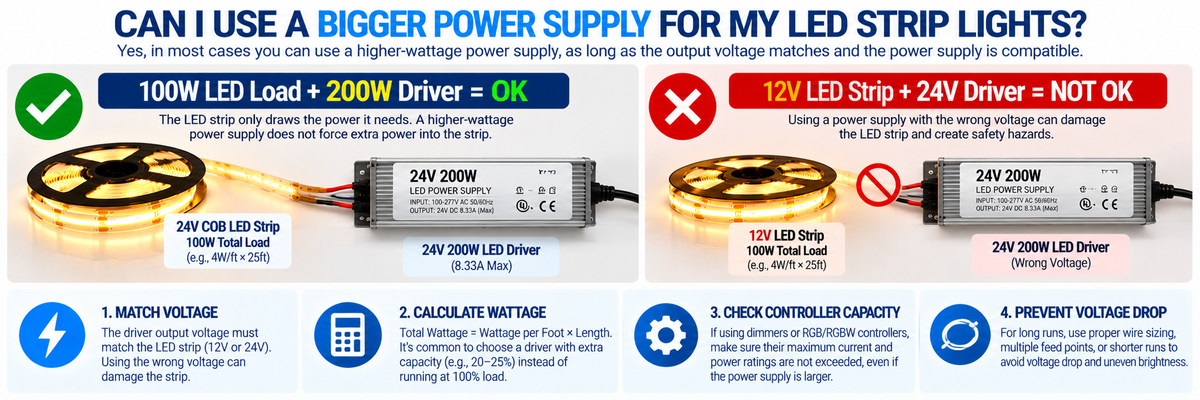
Yes. In most cases, you can use a higher-wattage constant-voltage LED power supply, provided the output voltage matches the LED strip and the supply is compatible with the installation.
A 200W power supply does not automatically push 200W into a 100W LED strip.
Instead, a properly functioning constant-voltage LED strip draws the current it requires at its rated voltage.
However, there are important conditions.
Choosing a bigger power supply does not solve incorrect voltage, excessive voltage drop, incompatible dimming, or unsafe wiring.
In this guide, we explain how LED power supply sizing works, when extra capacity is beneficial, and how to avoid common installation mistakes.
1. What Does LED Power Supply Wattage Mean?
An LED power supply converts electrical power into the output required by a compatible LED lighting system.
For example:
120V AC Input → 24V DC Power Supply → 24V COB LED Strip
A constant-voltage LED power supply is designed to maintain a specified output voltage while supplying current up to its rated capacity.
Common power supply capacities include:
The wattage rating indicates the maximum output power the supply is designed to deliver under its specified operating conditions.
It does not mean the supply always consumes or delivers that amount.
Example
A 24V, 200W constant-voltage power supply can provide up to approximately:
200W ÷ 24V = 8.33A
If a compatible LED strip requires only 100W:
100W ÷ 24V = 4.17A
The strip normally draws approximately 4.17A, not the full 8.33A available.
This is the key difference between power supply capacity and actual LED load.
2. Can a 200W Power Supply Run a 100W LED Strip?
Yes, generally.
If both products are compatible and operate at the same rated voltage, a 200W constant-voltage power supply can usually operate a 100W LED strip safely.
For example:
| Component | Specification |
|---|---|
| LED Strip | 24V DC |
| LED Strip Load | 100W |
| Power Supply | 24V DC |
| Power Supply Capacity | 200W |
| Actual LED Load | Approximately 100W |
| Available Unused Capacity | 100W |
The power supply has additional capacity available, but the LED strip does not automatically consume it.
Important Conditions
The installation must still satisfy:
- Correct output voltage
- Constant-voltage compatibility
- Appropriate output regulation
- Suitable wiring and connections
- Proper electrical protection
- Manufacturer loading requirements
- Suitable operating environment
A higher-wattage rating alone does not guarantee compatibility.
3. Why Voltage Matters More Than Extra Wattage
One of the most dangerous mistakes is confusing voltage with wattage.
A higher-wattage power supply can be acceptable.
A higher-voltage power supply may damage the LED strip.
Correct Example
24V LED Strip + 24V 200W Power Supply
This can be compatible even if the strip only requires 100W.
Incorrect Example
12V LED Strip + 24V 200W Power Supply
This is not an acceptable combination for a standard 12V constant-voltage strip. Use a matching 12V transformer instead, or a switchable 12V/24V driver set to 12V.
Applying excessive voltage may cause:
- Excessive current
- Overheating
- LED damage
- Component failure
- Potential electrical hazards
Professional Rule: Match the voltage exactly. Choose wattage capacity based on the load.
4. Does a Bigger Power Supply Force More Current Into the LED Strip?
Not when using a properly regulated constant-voltage supply with a compatible LED strip.
The strip's electrical characteristics determine its current draw at the rated voltage.
Consider two supplies:
Power Supply A: 24V, 100W
Power Supply B: 24V, 200W
If the same 24V LED strip requires 80W, its nominal current is:
80W ÷ 24V = 3.33A
Either compatible supply can deliver that current.
The larger supply simply has more available capacity.
Important Exception: Constant-Current Drivers
This explanation applies to constant-voltage LED strip systems.
Constant-current LED drivers operate differently and are designed to regulate current.
They must be selected according to the LED load's required current and voltage range.
Do not substitute a constant-current driver for a constant-voltage strip power supply unless the lighting product specifically requires it.
5. How to Calculate the Power Supply Size for LED Strips
Before selecting a driver, calculate the total LED load.
The basic formula is:
Total LED Wattage = Wattage per Foot × Total Strip Length
Example: 24V COB LED Strip
Suppose your LED strip consumes:
4 watts per foot
and your installation requires:
30 feet
The total load is:
4W × 30 ft = 120W
The power supply must support at least 120W of output under the applicable operating conditions.
A suitable higher-capacity supply may be selected to provide additional headroom. Wattage per foot is listed on every COB strip product page, and our guide on how many feet one driver can power works through the calculation.
6. Should You Add 20% Extra Power Supply Capacity?
A common design practice is to provide additional capacity rather than operating a power supply continuously at its maximum rating.
One frequently used approach is to target approximately 80% loading.
However, an 80% loading target is a design guideline, not a universal requirement for every LED driver.
Some drivers are designed and rated for continuous operation at full output under specified conditions.
Always follow the manufacturer's instructions and account for ambient temperature and any derating requirements.
Formula Using an 80% Loading Target
Required Power Supply Capacity = Total LED Load ÷ 0.80
Example
LED load:
120W
Calculation:
120W ÷ 0.80 = 150W
A 150W supply would meet this example's 80% loading target.
A compatible 192W or 200W supply could also be used, provided its operating specifications are suitable.
Important Calculation Detail
Dividing by 0.80 is not the same as adding 20%.
For example:
120W × 1.20 = 144W
120W ÷ 0.80 = 150W
If the design goal is to keep the load at or below 80% of the supply rating, use the division formula.
7. LED Power Supply Sizing Examples
The following table illustrates a commonly used 80% design target.
| LED Strip Load | Calculated Minimum at 80% Loading | Example Supply Capacity |
|---|---|---|
| 40W | 50W | 60W |
| 75W | 93.75W | 96W or 100W |
| 100W | 125W | 150W |
| 120W | 150W | 150W |
| 150W | 187.5W | 192W or 200W |
| 200W | 250W | 300W |
| 240W | 300W | 300W |
These are illustrative capacities, not recommendations for specific products. Actual selection must consider the manufacturer's ratings and the complete electrical design. Every capacity shown is available in our LED driver range.
8. Is a Power Supply That Is Too Big Bad for LED Strips?
Not necessarily.
For a properly matched constant-voltage system, extra wattage capacity is generally not harmful by itself.
However, an excessively oversized power supply can have disadvantages.
Higher Initial Cost
Larger supplies may cost more than smaller models.
Larger Physical Size
A high-wattage supply may require more mounting space. For cabinets and millwork, compact transformers are easier to fit and ventilate.
Different Efficiency at Light Loads
Some supplies operate less efficiently when their load is very small relative to rated capacity. Our guide on why driver efficiency matters covers this.
Minimum Load Requirements
Certain dimmable or specialized power supplies require a minimum connected load for stable operation.
Electrical Protection
A larger supply may be capable of delivering substantially more fault current.
This makes appropriate wiring, circuit protection, and manufacturer-approved installation methods especially important.
Conclusion
Extra capacity can be useful, but the largest available power supply is not automatically the best choice.
9. Can I Use a 300W Power Supply for a 50W LED Strip?
Potentially, yes.
If the supply is the correct voltage, properly regulated, and approved for the application, a 300W constant-voltage supply may operate a 50W strip.
However, the LED load would represent only:
50W ÷ 300W × 100 = 16.7%
of the supply's rated capacity.
At this relatively light load, consider:
- Efficiency
- Minimum loading requirements
- Dimming performance
- Physical size
- Cost
- Electrical protection
A smaller compatible supply may be a more practical choice — at an 80% planning load, a 60W or 80W driver suits a 50W load far better.
10. Does a Bigger LED Power Supply Use More Electricity?
Not automatically.
The electrical consumption of the complete system depends primarily on the LED load and the power supply's efficiency.
Example
A 100W LED load is connected to two different compatible power supplies.
Supply A: 150W Rated Capacity
Supply B: 300W Rated Capacity
If both operate at 90% efficiency at that load:
AC Input Power = 100W ÷ 0.90 = 111.1W
Both would draw approximately 111.1W from the AC supply.
In practice, their efficiencies may differ at the actual operating load.
Therefore, a larger supply does not automatically double electricity consumption, but it may operate at a different efficiency.
11. Can a Bigger Power Supply Make LED Strips Brighter?
Usually not.
If the existing supply already delivers the correct voltage and sufficient current, replacing it with a higher-wattage supply should not significantly increase brightness.
For example:
24V LED Strip + Properly Operating 24V 150W Supply
Replacing it with:
24V LED Strip + Properly Operating 24V 300W Supply
should not make the strip brighter simply because the new supply has a higher wattage rating.
When Brightness Might Improve
If the original supply was overloaded, entering current limiting, or failing to maintain its rated output, replacing it with a correctly sized supply may restore normal brightness.
That is a correction of an inadequate power system—not an increase beyond the strip's intended output.
12. Does a Bigger Power Supply Prevent Voltage Drop?
Not necessarily.
This is one of the most important distinctions in long LED strip installations.
A larger power supply provides more available power.
However, voltage drop occurs because electrical resistance in conductors causes voltage loss as current flows.
Example
A long 24V COB strip is powered from one end.
The power supply is rated for 300W, while the strip consumes only 150W.
Even though the supply has sufficient capacity, the far end of the strip may appear dimmer if the run exceeds the manufacturer's recommended length.
Better Solutions
- Shorter LED strip runs
- Appropriate wire sizing
- Additional power feeds where permitted
- Better feed-point placement
- Multiple lighting zones — a 288W transformer with three output channels provides a separate feed for each
- Manufacturer-approved wiring arrangements
More driver wattage does not automatically solve voltage drop.
13. What About 12V vs. 24V LED Strip Power Supplies?
The same power supply sizing principles apply to both 12V and 24V constant-voltage systems.
However, the current requirements differ.
Example: 120W LED Load
120W ÷ 12V = 10A
120W ÷ 24V = 5A
For the same power, a 24V system draws half the current.
This can help reduce voltage drop for a given conductor size and wiring distance.
However, the LED strip and power supply must be designed for the same voltage.
Never connect a 12V strip directly to a 24V supply. Our guide on when to use 12V COB strip compares the two systems.
14. Can One Bigger Power Supply Run Multiple LED Strips?
Yes, provided the power supply is compatible and the complete system is designed correctly.
For example, a 24V power supply may support multiple separate 24V LED strip runs.
Example
A commercial installation includes:
Zone 1: 60W
Zone 2: 80W
Zone 3: 40W
Total:
60W + 80W + 40W = 180W
Using an 80% loading target:
180W ÷ 0.80 = 225W
A suitable 24V supply rated at 240W or more could meet this illustrative capacity target — our 288W 3-channel transformer also provides a separate output terminal for each of the three zones.
However, the design must also consider:
- Branch-circuit wiring
- Output current limits
- Overcurrent protection
- Voltage drop
- Controller ratings
- Driver instructions
Multiple strips should not simply be connected without checking these requirements.
15. One Large Power Supply vs. Multiple Smaller Supplies
For commercial projects, there are two common approaches.
Option A: One Large Power Supply
A larger supply serves multiple compatible LED runs.
Potential Advantages
- Fewer power supplies
- Centralized maintenance
- Simplified equipment inventory
- Potentially lower installation complexity
Potential Disadvantages
- Larger failure impact
- Longer wiring distances
- More complex load distribution
- Greater importance of branch protection
Option B: Multiple Smaller Power Supplies
Each lighting zone has its own appropriately sized supply.
Potential Advantages
- Independent zones
- Shorter low-voltage wiring
- Easier fault isolation
- Reduced impact of one supply failure
Potential Disadvantages
- More equipment
- More installation locations
- Additional wiring and documentation
- Potentially higher equipment costs
Neither option is always better.
The choice depends on the project layout, maintenance requirements, and control strategy. Our guide on where LED drivers should be installed covers the placement side of this decision.
16. Can I Use a Bigger Power Supply With a Dimmer?
Sometimes, but dimming compatibility must be verified.
LED power supplies may support different dimming methods, including:
A higher-wattage dimmable supply is not automatically compatible with every dimmer.
Potential Problems
- Flickering
- Buzzing
- Incomplete dimming
- Lights remaining on at low settings
- Unstable operation
What to Check
Verify:
- Supply output voltage.
- Supported dimming method.
- Dimmer compatibility.
- Minimum load requirements.
- Maximum load requirements.
- Manufacturer-approved wiring configuration.
A properly sized dimmable power supply is preferable to a larger but incompatible model. Where the dimming method is not fixed at the design stage, a 5-in-1 dimmable driver covers several protocols in one unit.
17. Can I Use a Bigger Power Supply With an LED Controller?
Yes, if the power supply and controller are compatible.
However, the controller's electrical capacity must also be considered.
Example
You have:
and a controller rated for:
24V, 8A Maximum Total Output
The controller's nominal maximum output power is:
24V × 8A = 192W
Even though the supply can deliver 300W, the controller cannot safely be loaded beyond its specified 8A limit.
Important Rule
The lowest applicable electrical rating in the system can become the limiting factor.
This is particularly important for RGB, RGBW, and CCT installations.
18. RGB and RGBW LED Strip Power Supply Sizing
Multi-color LED strips require careful load calculations.
The maximum power consumption may occur when several channels operate simultaneously.
For example, an RGBW strip may draw more power when all permitted channels operate at high output than when displaying a single color.
Always use the manufacturer's maximum specified power consumption for sizing.
Also check:
- Total controller current
- Per-channel current
- Wiring configuration
- Maximum strip run length
- Power injection requirements
A larger supply does not increase the current capacity of the controller.
19. Can an Oversized Power Supply Damage LED Strips?
An oversized constant-voltage supply does not inherently damage a compatible LED strip merely because it has extra wattage capacity.
However, damage may occur when the system has other problems.
Examples include:
Incorrect Voltage
Using 24V on a standard 12V strip can cause serious damage.
Incorrect Driver Type
Using a constant-current driver where a constant-voltage supply is required can be unsafe or incompatible.
Faulty Regulation
A defective or unsuitable supply may deliver improper output.
Wiring Faults
Short circuits or undersized wiring can create overheating and electrical hazards.
Insufficient Protection
A high-capacity supply may be capable of delivering substantial current into a fault.
Proper system protection is essential.
The correct goal is not simply a bigger supply.
It is a properly engineered LED power system.
20. Should Contractors Always Choose Extra Capacity?
Additional capacity is often useful, but it should be selected intentionally.
For example, extra capacity may be beneficial when:
- A driver will operate for long periods.
- The installation has high ambient temperatures.
- The manufacturer requires derating.
- Future expansion is planned.
- Multiple lighting runs share a supply.
However, future expansion should not be assumed without checking wiring and protection requirements.
Professional Recommendation
Choose the power supply based on:
Actual Load + Manufacturer Requirements + Operating Conditions + Appropriate Design Margin
Avoid selecting wattage based only on the largest model available.
21. Power Supply Sizing for Commercial LED Projects
Large projects require more detailed planning.
Consider a retail installation with:
200 feet of COB LED strip
Power consumption:
4W per foot
Total load:
200 × 4W = 800W
Using an 80% loading target:
800W ÷ 0.80 = 1,000W
The project would require at least 1,000W of combined supply capacity to meet that illustrative target.
However, that does not mean one 1,000W power supply is necessarily the best solution.
A professional design should consider:
- Multiple lighting zones
- Maximum run lengths
- Voltage drop
- Power injection
- Driver locations
- Controller capacity
- Maintenance access
- Fault isolation
Several appropriately sized supplies may provide better installation flexibility — for example, four 300W drivers or three 384W quad-channel drivers distributed across the store. Contact our team for project quantities and wholesale pricing.
22. Does a Bigger Power Supply Last Longer?
Not automatically.
A supply operating well within its rated limits may experience lower thermal stress than one operating near its limits, depending on its design.
However, lifespan depends on:
- Component quality
- Efficiency
- Operating temperature
- Ventilation
- Electrical conditions
- Load profile
- Manufacturer design
A high-quality 150W driver operating at an appropriate load may be more reliable than a poorly designed 300W driver.
Quality and operating conditions matter more than wattage alone.
23. Common Mistakes When Choosing a Bigger LED Power Supply
Avoid these errors:
- Using a 24V supply for a 12V strip.
- Confusing constant-voltage and constant-current drivers.
- Assuming higher wattage means higher brightness.
- Assuming a bigger supply eliminates voltage drop.
- Ignoring minimum-load requirements.
- Using an incompatible dimmable supply.
- Exceeding controller current limits.
- Connecting multiple strips without suitable wiring and protection.
- Ignoring environmental ratings.
- Installing supplies in poorly ventilated locations.
- Selecting a supply without checking the actual LED load.
- Assuming every supply must follow the same 80% loading rule.
24. How to Choose the Correct LED Power Supply: Step-by-Step
Step 1: Confirm LED Strip Voltage
Identify whether the strip requires 12V, 24V, or another specified voltage.
Step 2: Identify the Driver Type
Most common low-voltage LED strips require constant-voltage power.
Verify the actual product requirements.
Step 3: Calculate Total Wattage
Multiply the rated wattage per foot by the total installed length.
Step 4: Account for Design Margin
Follow manufacturer loading limits and any relevant thermal derating.
Use an additional margin where appropriate.
Step 5: Select the Power Supply
Choose a suitable capacity at the correct voltage.
Step 6: Check Controller Compatibility
Confirm total and per-channel current ratings.
Step 7: Review Wiring and Voltage Drop
Check conductor sizing, run length, and feed arrangements.
Step 8: Confirm Environmental Requirements
Select the appropriate equipment for indoor, damp, or outdoor applications.
Step 9: Verify Dimming Compatibility
Match the supply to the intended dimming and control system.
Step 10: Plan Maintenance Access
Install the supply where it can be serviced according to the applicable requirements — drivers with an integrated junction box can simplify this.
25. BrightNex LED Power Supply Solutions
At BrightNex LED, contractors and project buyers can find lighting components for residential and commercial applications, including:
- 12V and 24V LED drivers
- Dimmable LED transformers
- TRIAC, ELV, and MLV dimming solutions
- 0–10V compatible driver options
- Compact drivers with junction boxes
- Higher-wattage LED power supplies
- Outdoor-rated driver options
- COB LED strip lights
- LED controllers
- Aluminum LED channels
The correct driver should be selected according to the LED strip's electrical requirements and the complete lighting system.
Explore professional LED lighting solutions in our LED driver and transformer range, or contact our team for project support and wholesale pricing. Our guide on building a complete LED lighting system covers the full specification process.
Final Takeaway
So, can you use a bigger power supply for LED strip lights?
Yes. A higher-wattage constant-voltage power supply is generally acceptable when its output voltage matches the LED strip and the complete system is properly designed.
For example:
100W LED Strip + Compatible 24V 200W Power Supply = Generally Acceptable
But:
12V LED Strip + 24V Power Supply = Incorrect and Potentially Damaging
Remember these essential rules:
- Match the voltage.
- Use the correct power supply type.
- Calculate actual wattage.
- Follow manufacturer loading requirements.
- Check dimmer and controller compatibility.
- Plan wiring and voltage drop.
- Provide appropriate electrical protection.
The most important principle is:
A bigger power supply provides more available capacity—not automatically more power delivered to the LED strip.
Choose the right power supply for the application, not simply the highest wattage.
Frequently Asked Questions
Can I use a 200W LED power supply for a 100W LED strip?
Yes, generally, if the output voltage and driver type are correct and the supply is compatible with the installation.
Can I use a 300W power supply for a 150W LED strip?
Usually yes, with a properly matched constant-voltage supply. Check minimum load, efficiency, dimming compatibility, and protection requirements.
Will a bigger power supply burn out my LED strip?
Extra wattage capacity alone does not normally damage a compatible constant-voltage LED strip. Incorrect voltage or faulty electrical design can cause damage.
Does a bigger power supply make LED strips brighter?
Not if the original supply already provides the correct voltage and sufficient power.
Can I use a 24V power supply for a 12V LED strip?
No. A standard 12V strip must not be connected directly to a 24V constant-voltage supply. Use a 12V transformer instead.
Do LED strips draw only the power they need?
A properly designed constant-voltage LED strip normally draws current according to its electrical characteristics at the rated voltage, within the supply's operating limits.
Should an LED power supply be 20% bigger than the load?
Additional capacity is often useful. An 80% loading target is one common design guideline, but it is not mandatory for every driver.
Does a larger LED power supply waste electricity?
Not automatically. Actual input power depends on the LED load and supply efficiency at that operating point.
Can one large power supply run several LED strips?
Yes, when the total load, wiring, electrical protection, and controller ratings are suitable. Multi-output transformers provide a separate terminal for each run.
Will a larger power supply fix voltage drop?
Not necessarily. Voltage drop depends on current, conductor resistance, wiring distance, and the strip's design.
Can I use a bigger dimmable LED driver?
Potentially, but the dimming method, minimum load, and dimmer compatibility must be verified.
Is one large power supply better than multiple smaller supplies?
It depends on the project. Multiple smaller supplies can improve zone separation and reduce wiring distances, while one larger supply may simplify centralized equipment management.