
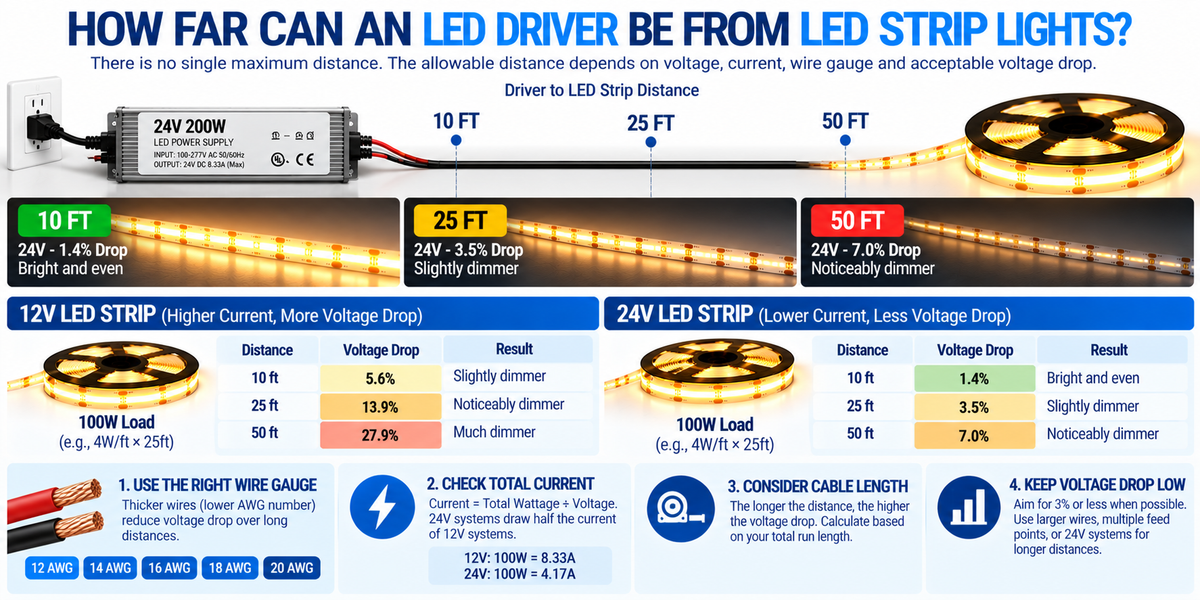
How Far Can an LED Driver Be from LED Strip Lights? Distance & Voltage Drop Guide
When installing LED strip lights, one important question often comes up:
How far can the LED driver be from the LED strip without losing brightness or causing electrical problems?
For example, you may want to install a COB LED strip under kitchen cabinets while keeping the driver inside an accessible utility cabinet.
Or you may be designing a commercial lighting system where drivers are installed in an equipment room, several feet away from the actual lighting.
Is 10 feet acceptable? What about 25 feet or 50 feet?
The answer depends on several factors.
There is no universal maximum distance between an LED driver and an LED strip.
The allowable distance depends on:
- LED strip voltage (12V or 24V)
- Total wattage and current
- Wire gauge and conductor material
- Distance between driver and strip
- Acceptable voltage drop
- Driver and controller specifications
- Electrical installation requirements
In this guide, we explain how to calculate voltage drop, estimate practical driver distances, and design reliable LED lighting systems for residential and commercial applications.
1. Why LED Driver Distance Matters
Most low-voltage LED strips require a compatible constant-voltage power supply.
A typical system looks like this:
AC Power → LED Driver → Low-Voltage Wiring → COB LED Strip
The LED driver converts incoming power into the required DC voltage.
For example:
120V AC → 24V DC Driver → 24V COB LED Strip
As the distance between the driver and LED strip increases, the connecting wires become longer.
Every wire has electrical resistance.
When current flows through that resistance, some voltage is lost.
This is called voltage drop.
Excessive voltage drop can reduce LED performance, especially in long lighting installations.
2. What Is Voltage Drop?
Voltage drop is the reduction in voltage that occurs as electrical current travels through a conductor.
The basic formula is:
Voltage Drop (V) = Current (A) × Circuit Resistance (Ω)
For a two-wire DC LED system, current travels from the driver to the strip and returns through the other conductor.
Therefore, both conductors must be included in the calculation.
For equal-size copper conductors:
Voltage Drop ≈ Current × 2 × One-Way Length × Wire Resistance per Foot
This formula provides an estimate for a simple two-wire constant-voltage installation.
Actual performance depends on conductor temperature, connections, load distribution, and system configuration.
3. What Happens When the LED Driver Is Too Far Away?
If the wiring distance is excessive for the conductor size and current, the LED strip may receive less than its intended voltage.
Possible symptoms include:
- Reduced brightness
- Uneven illumination
- Color inconsistency in RGB or RGBW systems
- Poor performance at high brightness
- Unstable operation in some installations
For example, a 24V LED strip may receive only 22.8V after losses in a long cable.
Whether that reduction is acceptable depends on the LED strip's design and manufacturer specifications.
Excessive voltage drop should be addressed during the design stage rather than after installation.
4. Is 24V Better Than 12V for Longer Driver Distances?
For the same power load and wire resistance, a 24V system generally experiences a smaller percentage voltage drop than a 12V system.
Consider a 120W LED load.
12V System
Current = Power ÷ Voltage
120W ÷ 12V = 10A
24V System
120W ÷ 24V = 5A
The 24V system draws half the current.
With the same wire length and gauge, its absolute voltage drop is approximately half as large.
Because its operating voltage is also twice as high, the percentage voltage drop is approximately one-quarter of the 12V system's percentage drop.
This is one reason 24V LED strips are commonly useful in larger architectural lighting installations, and why every strip in our COB range is 24V apart from the dedicated 12V short-run series.
However, the strip and driver must be designed for the same voltage.
5. How Far Can a 24V LED Driver Be from the Strip?
There is no fixed distance that applies to every 24V installation.
A driver may be located 10, 25, or even 50 feet away in some systems, provided the wire size, current, voltage drop, and equipment specifications support that distance.
The key is to calculate the electrical loss.
For example, a low-power 24V strip may tolerate a longer cable than a high-power strip using the same wire.
The following example illustrates why.
6. Practical Example: 24V LED Strip, 100W Load
Suppose a lighting installation uses:
- 24V COB LED strip
- 100W total load
- 25-foot one-way driver distance
- 16 AWG copper wire
First calculate the nominal current:
100W ÷ 24V = 4.17A
The approximate resistance of 16 AWG copper wire at 20°C is:
0.004016 Ω per foot
Because current travels through both conductors:
Total Wire Length = 25 × 2 = 50 feet
Total resistance:
50 × 0.004016 = 0.2008 Ω
Voltage drop:
4.17 × 0.2008 ≈ 0.84V
Percentage voltage drop:
0.84 ÷ 24 × 100 ≈ 3.5%
The estimated voltage reaching the strip is:
24 − 0.84 = 23.16V
This example shows that a 25-foot cable run can produce a measurable voltage drop even when the driver has enough wattage capacity. At an 80% planning load, a 150W driver would suit this 100W example.
The calculation assumes nominal load current and conductor resistance at 20°C; actual current and losses can vary.
7. LED Driver Distance Comparison: 12V vs. 24V
Consider the same 100W load, using 16 AWG copper conductors at 20°C.
| One-Way Distance | 12V System | 24V System |
|---|---|---|
| 10 ft | 5.6% drop | 1.4% drop |
| 15 ft | 8.4% drop | 2.1% drop |
| 25 ft | 13.9% drop | 3.5% drop |
| 50 ft | 27.9% drop | 7.0% drop |
These values are approximate, based on nominal current and the resistance of a two-conductor circuit.
They are not universal approved installation distances.
Actual conductor temperature, terminal resistance, driver behavior, and LED strip characteristics can change the results.
For professional projects, the acceptable voltage drop should be determined from the product specifications and electrical design requirements.
8. How Wire Gauge Affects LED Driver Distance
Wire gauge has a major influence on voltage drop.
In the American Wire Gauge (AWG) system, a smaller gauge number generally indicates a larger conductor.
For example:
12 AWG is thicker than 16 AWG.
A larger conductor has lower electrical resistance.
This can help reduce voltage drop over long distances.
Approximate Copper Wire Resistance
| Wire Gauge | Resistance per 1,000 ft at 20°C |
|---|---|
| 12 AWG | 1.588 Ω |
| 14 AWG | 2.525 Ω |
| 16 AWG | 4.016 Ω |
| 18 AWG | 6.385 Ω |
| 20 AWG | 10.15 Ω |
These are approximate standard copper-conductor values. Available gauges are listed in our wire and connectors collection.
Conductor selection must also account for ampacity, insulation rating, installation conditions, terminal compatibility, and applicable electrical codes.
9. How Much Difference Does Wire Size Make?
Consider a 24V LED installation with:
100W Load
25-Foot One-Way Distance
Nominal current:
4.17A
Approximate results:
| Wire Gauge | Voltage Drop | Percentage Drop |
|---|---|---|
| 18 AWG | 1.33V | 5.5% |
| 16 AWG | 0.84V | 3.5% |
| 14 AWG | 0.53V | 2.2% |
| 12 AWG | 0.33V | 1.4% |
The comparison demonstrates how a larger conductor can reduce voltage loss.
However, using a larger wire does not automatically make every installation acceptable.
The wire and terminals must be compatible, and all applicable electrical requirements must be met.
10. What Is an Acceptable Voltage Drop for LED Strips?
There is no single voltage-drop limit that applies to all LED strips.
For many constant-voltage lighting designs, engineers use a relatively small percentage drop as a design target.
A commonly used planning target is approximately 3% or less, but this is not a universal manufacturer requirement or code limit for every LED installation.
Some products may tolerate more.
Others may require tighter control to maintain uniform brightness and color.
For critical architectural installations, review the manufacturer's specifications and test the system under full load.
11. How to Calculate Maximum Driver Distance
For a simple two-wire DC circuit, the approximate maximum one-way distance can be calculated as:
Maximum Distance = Allowable Voltage Drop ÷ (2 × Current × Wire Resistance per Foot)
Example
Suppose:
- 24V LED strip
- 100W load
- 16 AWG copper wire
- 3% voltage-drop target
First calculate the allowable voltage drop:
24V × 0.03 = 0.72V
Nominal current:
100W ÷ 24V = 4.17A
Wire resistance:
0.004016 Ω/ft
Maximum distance:
0.72 ÷ (2 × 4.17 × 0.004016)
Result:
Approximately 21.5 feet one-way
This is an illustrative calculation, not a guaranteed maximum distance.
Actual design must account for temperature, connection losses, and product requirements.
12. Does a Bigger LED Driver Allow a Longer Distance?
Not automatically.
A 300W driver does not inherently allow a longer cable run than a 150W driver if both deliver the same voltage to the same load.
The voltage drop depends primarily on:
Current + Wire Resistance + Distance
A higher-wattage driver provides additional output capacity.
It does not eliminate resistance in the wiring. Our guide on whether you can use a bigger power supply covers this distinction in detail.
Example
A 24V LED strip consumes 100W.
Whether the driver is rated for 150W or 300W, the nominal load current remains approximately:
100W ÷ 24V = 4.17A
The voltage drop in the same connecting wires will therefore be approximately the same.
13. Driver-to-Strip Distance vs. Maximum LED Strip Run Length
These are two different limitations.
Driver-to-Strip Distance
This refers to the wiring distance between the driver and the beginning of the LED strip.
Maximum LED Strip Run Length
This refers to how far the LED strip itself can operate from a feed point while maintaining acceptable performance.
A driver can be located close to the strip, yet the far end may still be dim because the strip run is too long.
Likewise, a short LED strip can perform poorly if its driver is connected through an excessively long or undersized cable.
Both distances must be evaluated separately.
14. Can I Install the LED Driver 50 Feet Away?
Potentially, yes.
However, 50 feet may require larger conductors, a lower-current load, or a different system arrangement.
For example, a 24V installation carrying only 1A may experience much less voltage drop than a 24V installation carrying 8A over the same distance.
The correct answer depends on the calculation.
Do not assume that 50 feet is safe or unsuitable without evaluating the complete installation.
15. Can I Install the Driver 100 Feet Away?
Some specialized installations can use long low-voltage cable runs, but 100 feet requires careful electrical design.
At that distance, conductor resistance can become a significant factor.
Possible solutions include:
- Using appropriately sized conductors
- Reducing the current in each cable
- Splitting loads into separate circuits
- Locating drivers closer to the strips
- Using distributed power supplies
For larger commercial projects, distributed drivers may be more practical than long, high-current low-voltage runs. Where a long run is unavoidable, a 110V COB strip avoids the low-voltage distance problem entirely by running line voltage to the strip.
16. Why Multiple LED Strip Zones Can Be Better
Imagine a retail store requiring:
200 feet of 24V COB LED strip
Instead of powering everything through one long low-voltage cable, the project may be divided into separate zones.
For example:
Zone A → Driver A → COB Strip
Zone B → Driver B → COB Strip
Zone C → Driver C → COB Strip
Zone D → Driver D → COB Strip
This approach can help:
- Reduce wiring distances
- Improve fault isolation
- Simplify maintenance
- Support independent controls
- Reduce voltage-drop problems
The exact number of zones depends on the strip's wattage, maximum run length, and project layout. A multi-output model such as the 288W 3-channel transformer can feed three nearby zones from one accessible location.
17. Centralized vs. Distributed LED Drivers
For large installations, driver location affects both electrical performance and maintenance.
Centralized Drivers
Several drivers are installed in one accessible equipment area.
Advantages
- Centralized maintenance
- Organized equipment
- Easier labeling
- Convenient troubleshooting
Challenges
- Longer low-voltage wiring
- Potentially larger conductors
- More voltage-drop calculations
- Equipment-room thermal management
Distributed Drivers
Drivers are installed closer to the lighting zones.
Advantages
- Shorter low-voltage cables
- Potentially less voltage drop
- Flexible zone layouts
- Reduced dependence on long feeder runs
Challenges
- More equipment locations
- More distributed maintenance points
- Greater need for documentation
The best solution balances electrical performance, accessibility, cost, and installation requirements.
18. Where Should LED Drivers Be Installed?
Driver placement should consider more than distance.
The location should also provide:
- Appropriate service accessibility
- Suitable environmental protection
- Compliance with manufacturer instructions
- Adequate thermal conditions
- Safe wiring arrangements
- Protection from physical damage
Common possibilities include accessible cabinet compartments, approved equipment enclosures, and suitable ceiling service areas. Drivers with an integrated junction box provide a defined, serviceable mounting point.
Do not permanently conceal serviceable drivers in inaccessible spaces.
For commercial projects, driver locations should be documented. Our guide on where LED drivers should be installed for easy maintenance covers this in detail.
19. LED Driver Distance for Under-Cabinet Lighting
Under-cabinet lighting often uses relatively short COB LED strips.
The driver may be installed in an accessible cabinet compartment or another suitable nearby location.
Example
A kitchen installation includes:
15 feet of 24V COB strip
Power consumption:
4W per foot
Total load:
15 × 4W = 60W
Nominal current:
60W ÷ 24V = 2.5A
At this load, a moderate driver-to-strip distance may be practical with appropriately selected wiring — an 80W compact driver fits this load at an 80% planning target and mounts easily inside a cabinet.
However, the actual allowable distance still requires evaluation.
20. LED Driver Distance for Cove Lighting
Cove lighting often involves long runs and concealed architectural details.
Typical applications include:
- Living rooms
- Hotels
- Restaurants
- Offices
- Retail stores
- Commercial lobbies
In these installations, the driver may need to be located away from the visible lighting.
For example, a driver could be placed in an accessible equipment location rather than inside an inaccessible plaster cove.
The wiring distance must be calculated before finalizing the design.
21. LED Driver Distance for Retail Display Lighting
Retail displays may contain multiple illuminated shelves or showcases.
A centralized driver can sometimes serve several compatible strips.
However, each branch should be evaluated for:
- Current
- Wire length
- Voltage drop
- Connection quality
- Controller requirements
If one branch is much longer than another, the strips may receive different voltages and appear to have different brightness.
Proper branch design helps maintain uniform lighting. A dual-output transformer lets two branches be fed separately from the same accessible location.
22. LED Driver Distance for RGB and RGBW Strips
RGB and RGBW LED strips require additional attention because they use multiple color channels.
Excessive voltage drop can affect channel performance and color consistency.
For example, a long RGB strip may display a slightly different color near the far end.
When designing these systems, check:
- Total power consumption
- Per-channel current
- Controller output ratings
- Wiring configuration
- Cable distance
- Maximum run length
For multi-channel systems, conductor and common-return currents must be evaluated according to the actual wiring arrangement.
23. Should the Controller Be Near the Driver or LED Strip?
The correct location depends on the controller design.
Some systems use:
Driver → Controller → LED Strip
Others have different configurations.
For a typical low-voltage controller, the wiring between the controller and LED strip can also experience voltage drop.
Therefore, placing the driver near the controller does not automatically eliminate voltage drop if the controller-to-strip cable is long.
Evaluate the complete current path.
For RGB and RGBW installations, controller placement can be particularly important. Our guide on what causes LED controllers to lose connection covers related issues.
24. Can Power Injection Help?
Power injection means providing electrical power at additional points along a compatible LED strip installation, usually run with jumper wire and connectors.
It can help reduce brightness loss along long strips.
However, power injection does not automatically solve voltage drop in the cable between the driver and the injection point.
That cable must also be properly sized.
Important Safety Note
Additional feeds must follow the manufacturer's wiring instructions.
Do not connect outputs from separate power supplies together unless the system is specifically designed and approved for that arrangement.
25. Does Wire Temperature Affect Voltage Drop?
Yes.
Copper resistance increases as temperature rises.
The wire resistance values used in many basic calculations are based on a reference temperature, commonly 20°C.
In warmer environments, conductor resistance is higher.
This can increase voltage drop.
For commercial projects with high ambient temperatures, conductor temperature should be considered in the electrical design.
26. Do Connectors Affect Voltage Drop?
Yes.
Connectors and terminals introduce additional resistance.
Poor-quality or loose connections can increase voltage loss and create localized heating.
For reliable installations:
- Use compatible connectors.
- Follow specified termination methods.
- Avoid damaged conductors.
- Ensure secure electrical connections.
- Follow manufacturer instructions.
Electrical connections should be inspected and tested by qualified personnel where required.
27. What Happens If the Driver Is Too Far Away?
Possible symptoms include:
| Symptom | Possible Cause |
|---|---|
| LED strip is dimmer than expected | Excessive voltage drop |
| Far end of strip is noticeably dim | Voltage drop along strip |
| RGB colors look inconsistent | Uneven channel performance |
| Lighting changes with load | Voltage regulation or wiring issues |
| Connectors become hot | Excessive resistance or poor termination |
| Lighting flickers | Driver, controller, or connection problems |
Not every symptom is caused by distance.
A systematic inspection is needed to identify the actual cause.
28. How to Reduce Voltage Drop in LED Installations
Several strategies can help.
Use the Correct Wire Gauge
Larger conductors can reduce resistance.
Reduce Cable Length
Place drivers closer to lighting zones where practical.
Use 24V Systems When Appropriate
Higher voltage can reduce current for the same power.
Divide Large Loads
Use separate drivers or branches where suitable.
Plan Additional Feed Points
Follow the LED strip manufacturer's recommendations.
Check Connections
Avoid unnecessary resistance at terminals and connectors.
Verify Full-Load Performance
Test the installation at maximum intended brightness.
For RGBW systems, test the highest permitted combined load.
29. Common Mistakes When Planning LED Driver Distance
Avoid these errors:
- Assuming every 24V strip supports the same distance.
- Ignoring the return conductor in voltage-drop calculations.
- Using wire that is too small for the load.
- Assuming a larger driver eliminates voltage drop.
- Confusing driver distance with maximum strip run length.
- Ignoring controller-to-strip wiring.
- Connecting multiple strips without evaluating branch currents.
- Forgetting connector resistance.
- Ignoring conductor temperature.
- Installing drivers in inaccessible locations.
- Exceeding controller ratings.
- Failing to test the system under full load.
30. Professional Installation Checklist
Before installing the driver, confirm:
- Rated voltage
- Wattage per foot
- Total length
- Maximum run length
- Correct output voltage
- Sufficient rated capacity
- Compatible output type
- Appropriate environmental rating
- One-way distance
- Total circuit length
- Conductor size
- Nominal current
- Calculated voltage drop
- Proper electrical protection
- Voltage compatibility
- Total current rating
- Per-channel limits
- Controller-to-strip distance
Installation
- Driver accessibility
- Thermal management
- Secure connections
- Suitable mounting
- Full-load testing
31. BrightNex LED Solutions for Professional Projects
BrightNex LED offers components for residential, architectural, and commercial lighting projects, including:
- 12V COB LED strip lights
- 24V COB LED strip lights
- Constant-voltage LED drivers
- Dimmable LED transformers
- Compact drivers with junction boxes
- Higher-wattage power supplies
- Aluminum LED channels
- RGB and RGBW controllers
- Tunable-white lighting solutions
For contractors and commercial buyers, driver placement and cable sizing should be considered together.
Explore professional LED lighting solutions in our LED driver and wire and connector collections, or contact our team for project support and wholesale pricing. Our guide on building a complete LED lighting system covers the full specification process.
Final Takeaway
So, how far can an LED driver be from LED strip lights?
There is no universal maximum distance.
A driver may be installed several feet or considerably farther from the strip, depending on the electrical design.
The key factors are:
Voltage + Current + Wire Gauge + Distance + Acceptable Voltage Drop
For example, a 24V, 100W LED load connected with 16 AWG copper wire over a 25-foot one-way distance has an estimated voltage drop of approximately 3.5% at nominal current and 20°C.
A larger conductor or shorter distance can reduce that loss.
For professional installations, always calculate voltage drop, verify product specifications, and test the complete system.
The objective is to keep the driver accessible while ensuring that the LED strip receives suitable electrical power.
Frequently Asked Questions
How far can a 24V LED driver be from an LED strip?
It depends on current, conductor size, allowable voltage drop, and product specifications. There is no fixed distance suitable for every installation.
Can an LED driver be 25 feet away?
Yes, in some systems. The allowable distance depends on the load, wire gauge, and voltage-drop requirements.
Can I install an LED driver 50 feet away?
Potentially, but longer distances may require larger conductors, lower current, or a different wiring arrangement.
Is 24V better than 12V for long cable runs?
Generally, yes. For the same power, 24V systems draw less current and typically experience a smaller percentage voltage drop.
Will a bigger LED driver reduce voltage drop?
Not automatically. Voltage drop primarily depends on current, resistance, and distance.
What wire gauge should I use for a 24V LED strip?
The correct gauge depends on current, distance, installation conditions, and acceptable voltage drop. There is no universal wire size.
Can voltage drop damage LED strips?
Voltage drop commonly causes reduced brightness or performance issues. Other electrical faults, poor connections, or improper wiring may create additional risks.
Does driver distance affect RGB LED color?
Yes. Excessive voltage drop can affect RGB and RGBW channel performance, potentially causing visible color differences.
Can I install the driver in another room?
Potentially, provided the cable distance, conductor sizing, environmental conditions, accessibility, and electrical requirements are satisfied.
Does power injection solve driver-distance problems?
Power injection can reduce voltage drop along an LED strip, but the wiring to each feed point must still be properly designed.
Should I use one central driver or several smaller drivers?
The best approach depends on project size, wiring distance, maintenance access, controls, and load distribution.
What is the difference between driver distance and LED strip maximum run length?
Driver distance refers to the connecting cable between the driver and strip. Maximum run length refers to how far the strip itself can extend from a power feed while maintaining acceptable performance.