
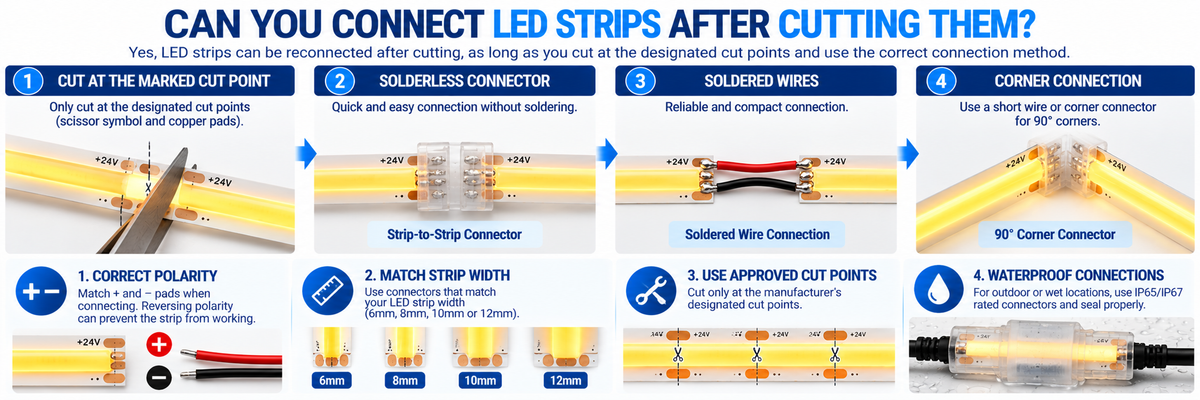
Can You Connect LED Strips After Cutting Them? A Complete Installation Guide
One of the biggest advantages of LED strip lighting is its flexibility.
Whether you're installing lighting under kitchen cabinets, inside aluminum channels, around corners, or across commercial shelving, LED strips can often be cut to fit the required dimensions.
But an important question comes up during installation:
Can you connect LED strips again after cutting them?
The short answer is yes.
Most cuttable LED strips can be reconnected using compatible connectors, soldered wires, or manufacturer-approved connection accessories.
However, there are important rules.
Not every LED strip can be cut anywhere, and not every connector works with every strip.
The correct method depends on:
- LED strip voltage
- Strip width
- Number of electrical channels
- Copper pad layout
- Waterproof coating
- COB or SMD construction
- Installation environment
- Electrical load
This guide explains how to reconnect LED strips safely, choose the correct accessories, and avoid common installation mistakes.
1. Can LED Strips Be Cut and Reconnected?
Yes. Many low-voltage LED strips are specifically designed to be cut at designated locations.
These locations are usually marked by:
- Scissor symbols
- Printed cutting lines
- Copper connection pads
- Manufacturer markings
After cutting, the remaining sections can often be connected using appropriate accessories.
For example:
24V COB LED Strip → Cut Point → Connector → Extension Wire → COB LED Strip
The electrical connection must preserve the correct polarity and channel arrangement.
Important Rule
Always cut LED strips only at the manufacturer's designated cut points.
Cutting between approved locations can damage the electrical circuit and prevent part of the strip from operating.
Some specialized strips have different cutting and connection requirements. Always check the product instructions.
2. How Do LED Strip Cut Points Work?
LED strips contain repeating electrical circuit sections.
Each section typically includes LED components and associated circuitry.
Cut points are positioned where the manufacturer has designed the strip to be separated without damaging the intended circuit.
For example, a particular strip might allow cutting every:
- 25mm
- 50mm
- 100mm
The actual interval varies by product and voltage. It is listed on each COB strip product page, and our free-cut 8mm COB strip can be cut at any point.
Never assume that two LED strips have the same cutting interval.
Example
Suppose a strip can be cut every 50mm.
You need a section measuring 720mm.
You cannot necessarily cut at exactly 720mm.
Instead, you must select an approved cut point, such as 700mm or 750mm, depending on the installation and available cutting locations.
This is why cut intervals should be checked before designing precise cabinet or channel layouts.
3. Can You Reconnect COB LED Strips After Cutting?
Yes. Many COB LED strips can be reconnected after cutting at their approved locations.
COB stands for Chip on Board.
Unlike traditional LED strips with individually visible LED packages, COB strips use densely packed LED chips to produce a smooth, continuous-looking line of illumination.
COB strips are commonly used for:
- Under-cabinet lighting
- Cove lighting
- Retail displays
- Shelving
- Furniture
- Architectural aluminum channels
Why COB Connections Need Special Attention
COB strips may have a continuous phosphor or encapsulation layer that makes their contact pads less accessible than those of some traditional strips.
For reliable connections, use connectors specifically designed for the strip's:
- Width
- Pad layout
- Number of contacts
- PCB thickness
- Coating type
Do not assume that a connector designed for a conventional SMD strip will automatically work with a COB strip — our 8mm, 10mm, RGB, CCT and RGBW connectors are made specifically for COB construction.
4. Three Common Ways to Reconnect Cut LED Strips
There are three main approaches.
Method 1: Solderless LED Strip Connectors
Solderless connectors mechanically contact the copper pads on the LED strip.
They are popular because they do not require soldering equipment.
Method 2: Soldering Wires to the Strip
Wires are soldered directly to the approved connection pads.
This can provide a compact electrical connection when performed correctly.
Method 3: Manufacturer-Approved Connection Accessories
Some LED strip systems use dedicated connection kits or accessories.
These may include:
- Strip-to-strip connectors
- Strip-to-wire connectors
- Corner connectors
- Extension cables
- Waterproof connection kits
The correct option depends on the specific LED product.
5. Solderless Connectors: How Do They Work?
Solderless LED strip connectors are designed to make electrical contact without solder.
A typical connector includes a housing with metal contacts that press against the strip's copper pads.
Advantages
- Quick installation
- No soldering equipment required
- Convenient for accessible locations
- Useful for some cabinet and shelving projects
Limitations
- Not compatible with every LED strip
- Can be bulky inside narrow channels
- Contact quality depends on proper installation
- Some connectors are unsuitable for high-current applications
- Waterproofing may require additional accessories
For commercial installations, connector reliability and current ratings should be evaluated carefully.
6. How to Connect LED Strips Without Soldering
For a compatible low-voltage strip and solderless connector, the general process is:
Step 1: Disconnect Power
Turn off and isolate the electrical supply before working on the strip.
Never cut or reconnect an energized LED strip.
Step 2: Identify the Cut Point
Locate the manufacturer's approved cutting line.
Step 3: Cut the Strip
Use suitable cutting tools to make a clean cut at the designated location.
Step 4: Inspect the Copper Pads
Verify that the connection pads are intact.
Some coated strips require manufacturer-approved preparation before connecting.
Step 5: Open the Connector
Follow the connector manufacturer's instructions.
Step 6: Insert the LED Strip
Align the strip pads with the connector contacts.
Step 7: Match Polarity
For single-color strips, align positive and negative contacts correctly.
Step 8: Secure the Connector
Close or lock the connector according to its design.
Step 9: Test the Connection
Restore power only after confirming that the installation is properly assembled.
Check for stable illumination and correct operation.
Step 10: Complete the Installation
Mount and protect the connection according to the intended environment.
7. How to Reconnect LED Strips by Soldering
Soldering is another common connection method for compatible low-voltage LED strips.
It can be useful when:
- The installation space is limited
- A connector will not fit inside the channel
- A custom wire length is required
- A compact corner connection is needed
General Process
- Disconnect and isolate power.
- Cut the strip at an approved point.
- Prepare the manufacturer's designated solder pads.
- Use appropriately sized wire and suitable soldering equipment.
- Make the connections according to the strip's polarity and channel markings.
- Inspect the joints for shorts or damage.
- Provide appropriate insulation and strain relief.
- Test the connection before final mounting.
Important
Excessive soldering heat can damage the flexible PCB, pads, or LED components.
Soldering should be performed by someone with the appropriate skills and equipment.
Follow the strip manufacturer's instructions, especially for coated COB products.
8. Soldering vs. Solderless Connectors
| Feature | Solderless Connectors | Soldered Connections |
|---|---|---|
| Installation speed | Often faster | Usually requires more preparation |
| Tools | Minimal | Soldering equipment |
| Skill level | Lower for compatible products | Higher |
| Connection size | Often bulkier | Can be compact |
| Compatibility | Connector-specific | Pad and product-specific |
| Reliability | Depends on contact quality | Depends on workmanship |
| Waterproofing | May need rated accessories | Requires suitable sealing |
| Maintenance | Often easier to disconnect | Usually requires rework |
Neither method is universally better.
For professional installations, select the method approved for the strip and suitable for the electrical load and environment.
9. Can You Connect Two LED Strips Together?
Yes, many compatible LED strips can be joined.
However, connecting two strips physically does not mean they can always be powered as one continuous run.
For example:
5m LED Strip + Connector + 5m LED Strip
creates a 10m physical length.
But the manufacturer may not permit a 10m single-ended electrical run.
The complete installation must consider:
- Maximum run length
- Total wattage
- Voltage drop
- Connector current rating
- Wiring configuration
- Driver capacity
A connector does not eliminate the electrical limitations of the strip.
10. Can You Connect LED Strips After Cutting Them Around Corners?
Yes.
This is one of the most common reasons installers cut LED strips.
For example, a kitchen installation may require the strip to turn around a 90-degree cabinet corner.
Instead of sharply folding the PCB, the installer may use:
LED Strip → Short Wire Jumper → LED Strip
or a compatible corner connector.
Why This Is Useful
It can help prevent:
- PCB damage
- Broken copper traces
- Stress on solder joints
- Poor mounting
- Premature connection failure
Contractor Tip
Do not force LED strips into sharp bends that exceed their permitted bend radius. For curved runs, a bendable profile is a better solution.
For architectural projects, plan corner connections before installing aluminum channels. Our guide on corner LED channels covers the options.
11. Can You Reconnect 12V and 24V LED Strips?
Yes, both 12V and 24V cuttable strips may be reconnected using compatible methods.
However, 12V and 24V strips must not be treated as interchangeable.
For example:
12V LED Strip + 12V Driver = Correct Voltage Match
24V LED Strip + 24V Driver = Correct Voltage Match
A standard 12V constant-voltage strip must not be connected directly to a 24V supply.
Likewise, joining 12V and 24V strips on the same unregulated output is not an acceptable way to create a mixed-voltage installation. Our guide on when to use 12V COB strip compares the two systems.
12. Can You Connect LED Strips of Different Widths?
Sometimes, but not with every connector.
LED strips may be available in widths such as:
Connector dimensions must match the strip.
For example, an 8mm connector may not properly fit a 10mm strip.
Even when two strips have the same width, their pad layouts may differ.
Before Selecting a Connector
Verify:
Strip Width + Pad Layout + Channel Count + Voltage + Current Rating
For COB strips, confirm that the connector is specifically compatible with the strip's construction.
13. Single-Color LED Strip Connections
Single-color strips commonly use two electrical contacts.
These are typically marked:
Positive (+)
and
Negative (−)
The connection must preserve polarity.
Reversing polarity may prevent the strip from lighting and can cause problems in some products.
Always follow the strip's printed markings and manufacturer instructions. Matching connectors are available for 8mm and 10mm COB strips, plus a 2-pin double-end connector for 12V/24V single-color runs.
14. CCT LED Strip Connections
Tunable-white CCT strips use separate control channels for warm-white and cool-white LEDs.
A common arrangement uses three contacts:
- Common positive
- Warm-white channel
- Cool-white channel
However, not all CCT strips use the same wiring configuration.
Common Mistake
Connecting the warm-white and cool-white channels incorrectly can cause unexpected color-temperature behavior.
Use connectors and controllers compatible with the actual product.
15. RGB LED Strip Connections
RGB strips typically use separate red, green, and blue control channels.
Many analog RGB strips have four electrical contacts.
However, other architectures exist.
When reconnecting RGB strips, the channel mapping must remain correct.
For example:
R → R
G → G
B → B
and the appropriate common connection.
Incorrect wiring may cause the strip to display the wrong colors or fail to operate properly. Use an RGB COB connector matched to the strip width, and a compatible RGB controller.
16. RGBW LED Strip Connections
RGBW strips add a dedicated white-light channel.
Many analog RGBW systems use five contacts.
However, the actual connection layout depends on the product.
Before reconnecting, confirm:
- Common conductor arrangement
- Red channel
- Green channel
- Blue channel
- White channel
- Controller compatibility
A connector designed for a four-contact RGB strip is not automatically suitable for a five-contact RGBW strip — use the 12mm RGBW COB connector or the RGBW strip connector as appropriate.
17. What About Addressable LED Strips?
Addressable LED strips require additional attention.
Unlike conventional analog RGB strips, addressable systems may use data signals to control individual pixels or groups.
Connections may include:
- Power
- Ground
- Data
- Additional signal connections, depending on the product
Some addressable strips also have a required data direction.
If the strip is connected backward, the data signal may not pass correctly.
Always follow the manufacturer's wiring diagram and directional markings, and use a compatible SPI controller.
18. Can Waterproof LED Strips Be Cut and Reconnected?
Some waterproof or water-resistant LED strips can be cut and reconnected.
However, cutting a protected strip can compromise its environmental sealing.
For example, an IP65-rated strip may have a protective coating.
Cutting or exposing the contacts can create a potential moisture-entry point.
Important Rule
The original IP rating should not be assumed to remain valid after cutting and reconnecting.
The cut ends and connections must be resealed using the manufacturer's approved method.
For outdoor or damp installations, use appropriately rated connectors, sealing materials, and enclosures. Our guide on whether waterproof LED strips can be used in the rain covers the complete system.
19. How to Protect LED Strip Connections From Moisture
Moisture protection is particularly important for:
- Outdoor architectural lighting
- Bathrooms
- Kitchens
- Pergolas
- Landscape lighting
- Commercial exterior installations
Depending on the product, suitable protection may involve:
- Manufacturer-approved waterproof connectors
- Compatible end caps
- Approved sealants
- Suitable junction enclosures
- Proper cable entries
Do not assume that ordinary electrical tape restores an IP65 or IP67 rating.
The complete connection assembly must be suitable for the environment — a waterproof IP65 channel adds protection for the finished run.
20. Do Connectors Cause Dark Spots in LED Strips?
Sometimes.
A connector may create a small unlit gap between two illuminated strip sections.
This can be noticeable in:
- Shallow aluminum channels
- Exposed linear lighting
- Display cases
- Short decorative runs
COB strips create smooth-looking illumination, so interruptions may stand out.
How to Reduce Visible Gaps
- Use compact compatible connectors.
- Plan connection locations.
- Position joints where they are less visible.
- Use approved soldered connections when suitable.
- Test the completed assembly inside the channel.
For highly visible architectural installations, mock up the connection before final installation. Our guide on avoiding dark spots at LED strip connections covers this in detail.
21. Can LED Strips Be Reconnected Inside Aluminum Channels?
Yes, but the connection must fit the channel.
Some solderless connectors are wider or taller than the strip itself.
This may create problems inside narrow profiles.
Example
An 8mm COB LED strip fits inside a compact aluminum channel.
However, the selected connector may be wider than 8mm.
The strip fits, but the connector does not.
Professional Recommendation
Check the dimensions of:
- LED strip
- Connector
- Aluminum channel
- Diffuser
- End cap
before installation.
For tight profiles, a suitable low-profile connection method may be preferable. A deeper channel such as the BN256 provides more room for the connector body.
22. Does Cutting and Reconnecting LED Strips Reduce Brightness?
Not necessarily.
A properly made connection should allow the strip to operate as intended.
However, poor connections can introduce electrical resistance.
This may cause:
- Voltage drop
- Reduced brightness
- Intermittent operation
- Localized heating
Long extension wires can also contribute to voltage loss.
Therefore, connection quality and wire sizing matter.
23. Can You Connect LED Strips Using Extension Wires?
Yes, compatible LED strip sections can often be connected using extension wires.
For example:
COB Strip → 3 ft Extension Wire → COB Strip
This can be useful for:
- Cabinet gaps
- Corners
- Separate shelves
- Architectural transitions
- Display cases
However, the extension wire must be sized for the current and distance.
Long or undersized wires may cause excessive voltage drop.
For multi-channel systems, all required conductors must be connected correctly.
24. How to Calculate the Total Load After Reconnecting Strips
When multiple strips are connected to one driver, calculate the total load.
The formula is:
Total Wattage = Wattage per Foot × Total Strip Length
Example
A 24V COB LED strip consumes:
4W per foot
You reconnect three sections:
- Section A: 8 feet
- Section B: 6 feet
- Section C: 10 feet
Total length:
8 + 6 + 10 = 24 feet
Total load:
24 × 4W = 96W
The driver must provide sufficient capacity for the complete load.
If an 80% loading target is appropriate for the selected driver:
96W ÷ 0.80 = 120W
A compatible 120W or 150W driver could meet that illustrative capacity target.
However, the manufacturer's actual loading requirements must take priority. Our guide on how many feet one driver can power works through the calculation.
25. Does a Bigger Driver Allow More LED Strips to Be Connected?
A larger driver may support a higher total load.
However, it does not automatically permit longer continuous strip runs.
For example, a 300W driver may have enough capacity for multiple strips.
But each strip run must still comply with:
- Maximum run length
- Voltage-drop limits
- Connector ratings
- Controller limits
- Wiring requirements
Driver capacity and maximum strip run length are separate design considerations.
Our guide on whether you can use a bigger power supply explains this distinction.
26. Series vs. Parallel Connections
This distinction is important.
Most standard 12V and 24V constant-voltage LED strip systems are designed to receive their rated voltage across each compatible strip run.
Multiple runs are commonly supplied using a parallel arrangement.
Parallel Connection
Each compatible strip run receives the specified supply voltage. A multi-output transformer provides a separate terminal for each run.
Series Connection
The supply voltage is divided across loads according to their electrical characteristics.
Connecting standard constant-voltage strips in series is generally not an appropriate substitute for the manufacturer's intended wiring arrangement.
Always follow the actual strip wiring diagram.
27. Can You Reconnect LED Strips After Cutting Them Incorrectly?
It depends on where the strip was cut and whether the circuit was damaged.
If the strip was cut between designated cut points, part of a circuit section may no longer function.
Possible remedies may include trimming back to an approved cut point or replacing the damaged section.
However, this depends on the strip design and available contact pads.
Do not assume that every incorrectly cut strip can be repaired. Keeping spare material from the same batch makes replacement easier — and helps avoid color differences between sections.
28. Why Reconnected LED Strips Sometimes Do Not Work
Common causes include:
- Incorrect polarity
- Wrong connector width
- Incompatible pad layout
- Poor contact with copper pads
- Damaged PCB traces
- Incorrect RGB or CCT channel wiring
- Unsupported addressable data direction
- Incorrect voltage
- Overloaded driver
- Loose or damaged connections
Troubleshooting Tip
If a newly connected section does not light, disconnect power and inspect the connection method and compatibility before replacing the strip.
29. Why LED Strip Connectors Become Hot
Excessive connector temperature can indicate a problem.
Possible causes include:
- High contact resistance
- Loose connections
- Current above connector rating
- Damaged contacts
- Incorrect installation
- Poor termination
A connection that becomes unusually hot should not be ignored.
Disconnect power and have the installation evaluated before continued operation.
For commercial projects, connection reliability is an important maintenance consideration.
30. Best Practices for Commercial LED Strip Connections
Large installations may involve dozens of LED strip sections.
Examples include:
- Retail stores
- Shopping malls
- Hotels
- Offices
- Restaurants
- Architectural coves
- Display systems
For these projects, connection planning should be part of the initial design.
Recommended Practices
Standardize Products
Use consistent strip types, widths, voltages, and connectors.
Plan Cut Points
Check the manufacturer's cut interval before finalizing dimensions.
Minimize Unnecessary Joints
Every connection introduces another potential maintenance point.
Check Current Ratings
Ensure connectors and wiring are suitable for the load.
Plan Voltage Drop
Avoid excessive run lengths.
Protect Connections
Use appropriate environmental protection.
Maintain Access
Where practical, avoid placing serviceable connections in inaccessible finished spaces.
Test Before Closing
Verify operation before installing final diffusers or completing architectural finishes.
31. LED Strip Connection Checklist
Before reconnecting cut LED strips, verify:
Strip Compatibility
- Correct voltage
- Correct width
- Correct number of channels
- Approved cut point
- Compatible pad layout
Connection Method
- Suitable solderless connector or soldering method
- Correct polarity
- Proper channel mapping
- Adequate current rating
- Appropriate strain relief
Electrical Design
- Total wattage
- Driver capacity
- Maximum run length
- Voltage drop
- Controller limits
Installation Environment
- Indoor or outdoor suitability
- Moisture protection
- Mechanical protection
- Suitable mounting method
Final Testing
- Correct illumination
- No flickering
- Correct colors
- No visible connection defects
- No abnormal heating
32. BrightNex LED Solutions for Professional Strip Installations
At BrightNex LED, contractors and project buyers can build professional LED lighting systems using:
- 12V COB LED strip lights
- 24V COB LED strip lights
- Single-color LED strips
- CCT LED strips
- RGB and RGBW LED strips
- LED drivers and transformers
- Aluminum LED channels
- Corner LED channels
- Recessed and surface-mount profiles
- LED controllers and remotes
For projects involving cut and reconnected strips, selecting compatible products and connection methods is essential.
Explore available professional lighting solutions in our wire and connector and COB strip collections, or contact our team for project support and wholesale pricing.
Final Takeaway
So, can you connect LED strips after cutting them?
Yes. Many LED strips can be cut and reconnected successfully when the manufacturer provides approved cut points and compatible connection methods.
The most common options are:
- Solderless connectors
- Soldered wire connections
- Manufacturer-approved connection accessories
However, reliable results require more than simply joining two strip ends.
You must consider:
Voltage + Strip Width + Pad Layout + Polarity + Current + Waterproofing + Maximum Run Length
For professional installations, the best approach is to plan cutting and connections before mounting the LED strips.
A properly designed connection can help deliver smooth illumination, reliable electrical performance, and easier long-term maintenance. Our guide on building a complete LED lighting system covers the full specification process.
Frequently Asked Questions
Can you reconnect LED strips after cutting them?
Yes. Many cuttable LED strips can be reconnected at approved cut points using compatible connectors, soldering, or manufacturer-approved accessories.
Can COB LED strips be cut and reconnected?
Yes, many COB LED strips support cutting and reconnection. Use connection methods compatible with their PCB width, pad layout, and coating.
Can you reconnect LED strips without soldering?
Yes. Suitable solderless connectors can be used with compatible strips — we stock versions for 8mm, 10mm and 12mm COB strips.
Can you connect two LED strips together?
Yes, provided they are electrically compatible and the complete installation stays within the manufacturer's limits.
Can you cut LED strips anywhere?
No. Most cuttable LED strips must be cut only at designated locations, although our free-cut COB strip can be cut at any point.
Can you reconnect waterproof LED strips?
Some can be reconnected, but the cut ends and connections must be sealed using an approved method appropriate to the environment.
Can you connect LED strips around a 90-degree corner?
Yes. Compatible corner connectors or short jumper wires can allow sections to turn a corner without sharply bending the PCB. A corner channel provides the mounting.
Why won't my LED strip work after cutting it?
Possible causes include cutting outside approved locations, incorrect polarity, damaged pads, or incompatible connectors.
Do LED strip connectors reduce brightness?
A properly installed connector should not cause significant brightness loss, but poor contacts or long wires can introduce voltage drop.
Can you connect 12V and 24V LED strips together?
Not directly as if they were the same-voltage load. Each strip must receive its specified voltage through a compatible system.
Can you reconnect RGB or RGBW LED strips?
Yes, using compatible connectors — an RGB COB connector or RGBW COB connector — and correct channel wiring.
Is soldering better than solderless connectors?
Both methods can work. The best choice depends on product compatibility, installation space, electrical load, environment, and workmanship.