
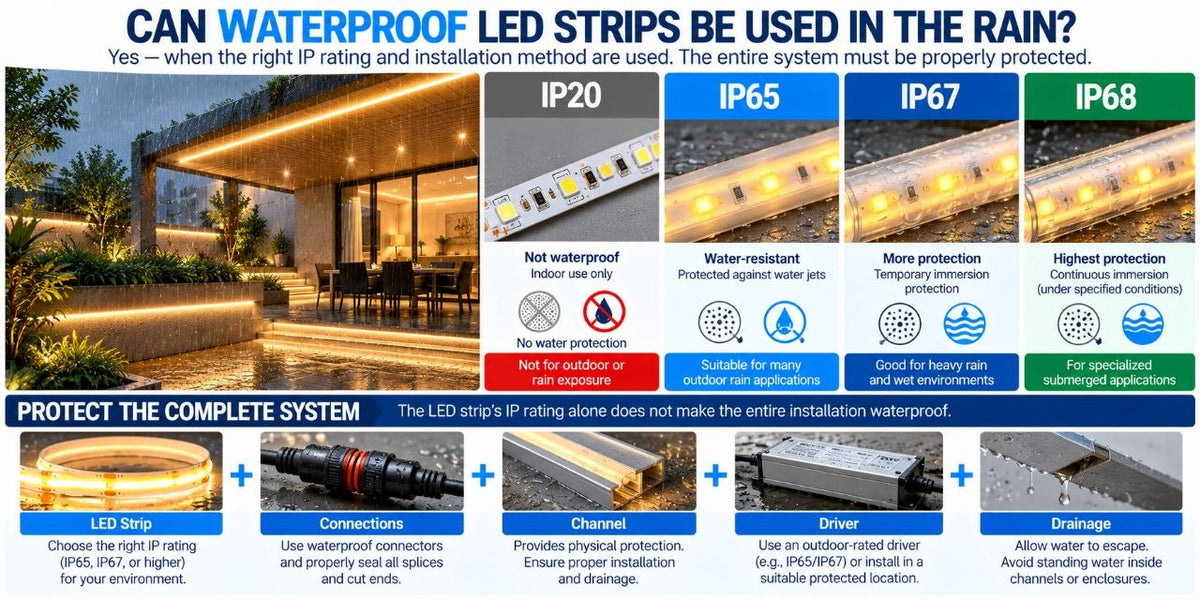
Can Waterproof LED Strips Be Used in the Rain?
Yes—but there is an important condition.
A properly rated LED strip can be used in locations exposed to rain when its environmental rating and installation method are appropriate for that exposure.
However, one of the most common outdoor LED mistakes is assuming:
“The strip is waterproof, so the entire installation is waterproof.”
That is not necessarily true.
An outdoor LED strip system may include:
LED Strip + Wires + Connectors + Controller + Driver + Splices + Aluminum Channel
Every vulnerable part of that system must be considered.
One unprotected connection can compromise an otherwise weather-resistant installation.
So before installing LED strips outdoors, contractors and installers need to understand IP ratings, water exposure, drainage, connections, driver placement, and physical protection.
What Does “Waterproof LED Strip” Actually Mean?
The term waterproof is often used loosely in product descriptions.
For professional installations, the more useful specification is the product's:
IP Rating
IP stands for:
Ingress Protection
An IP rating describes the level of protection an enclosure provides against solids and water under defined test conditions.
You may commonly encounter LED products labeled:
- IP20
- IP44
- IP65
- IP67
- IP68
These ratings are not interchangeable.
A strip suitable for an indoor cabinet is very different from one designed for outdoor exposure. Every strip in our strip-light range states its IP rating on the product page.
Understanding the Two IP Numbers
An IP rating normally contains two digits.
For example:
IP65
The first digit relates to protection against solid objects and dust.
The second digit relates to protection against water.
For outdoor LED lighting, the second number is particularly important.
But remember:
The rating applies to the specific product as tested—not automatically to every connection and accessory attached to it.
Quick IP Rating Guide
| IP Rating | General Protection | Typical LED Application |
|---|---|---|
| IP20 | No meaningful water protection | Dry indoor areas |
| IP44 | Protection against splashing water | Certain protected damp locations |
| IP65 | Protected against water jets | Many outdoor/protected applications |
| IP67 | Temporary immersion protection under defined conditions | Higher-exposure installations |
| IP68 | Continuous immersion protection under manufacturer-defined conditions | Specialized applications |
This is only a simplified guide.
Always verify the exact manufacturer's rating and installation requirements before specifying a product.
Can IP65 LED Strip Be Used in the Rain?
An IP65-rated product provides protection against water jets under its applicable test conditions, so it can be appropriate for many outdoor installations involving rain exposure.
But that does not mean you should install it anywhere outdoors without further planning.
Consider:
- How much rain reaches the strip
- Whether water can collect around it
- Whether connections are protected
- Whether the driver is protected
- Whether the strip can dry
- Whether water can enter from cut ends
For example:
Under a Covered Patio
An appropriately rated strip may experience occasional wind-driven rain.
This can be a reasonable application when the complete system is properly designed — our outdoor IP65 COB strip is intended for this kind of location.
Horizontal Open Surface
A strip may sit where water collects around it for extended periods.
That creates a very different exposure.
The word outdoor does not describe one single environment.
Rain Exposure and Water Immersion Are Different
This distinction is extremely important.
A product designed to withstand rain or water jets is not automatically designed to remain underwater.
Think of:
Rain ≠ Standing Water ≠ Submersion
If water pools inside a channel or around a connection, the installation may experience conditions beyond what was intended.
This is why drainage and mounting orientation matter.
What About IP67 LED Strips?
IP67 generally provides a higher level of water protection than IP65, including temporary immersion under specified test conditions.
That can make IP67 useful for installations with greater water exposure.
But IP67 still should not automatically be interpreted as:
“Install anywhere underwater permanently.”
Temporary immersion and continuous immersion are different conditions.
Always follow the manufacturer's actual product specifications. Contact our team if a project calls for a rating beyond IP65.
What About IP68?
IP68 products are designed for immersion beyond the IP67 test level, with exact conditions specified by the manufacturer.
However, even an IP68 strip does not automatically mean:
- The driver is IP68
- The controller is IP68
- Every splice is IP68
- Every connector is IP68
- The complete installation is suitable for pools
For specialized submerged installations, use products specifically designed and approved for that environment and follow applicable electrical requirements.
The Most Important Outdoor Rule
For rain-exposed LED installations, remember this:
The system is only as weather-resistant as its weakest component.
Imagine:
IP65 Strip
Indoor Connector
Unsealed Wire Splice
Indoor Driver
The result is not an IP65 lighting system.
Each component needs to be evaluated individually.
Connections Are Often the Weakest Point
The strip itself may be well protected while its electrical connections remain exposed.
Common vulnerable areas include:
- Cut ends
- Solder joints
- Strip-to-wire connectors
- Extension-wire connections
- Controller terminals
- Driver connections
Water can enter at these points and cause:
- Corrosion
- Intermittent operation
- Short circuits
- Premature failure
For outdoor installations, connections require deliberate weather protection. Connection quality also affects the appearance of the finished line of light.
Cutting a Waterproof Strip Changes the Situation
This is a common installation mistake.
Suppose you purchase a protected LED strip and cut it to length.
The newly exposed cut end may no longer have the same protection as the factory-sealed strip.
The end may need to be resealed using the manufacturer's recommended method.
That may involve appropriate:
- End caps
- Sealant
- Heat-shrink systems
- Waterproof connectors
depending on the product.
Do not assume a freshly cut strip remains protected automatically.
Waterproof Connectors Matter
Standard indoor solderless connectors should not automatically be used in exposed outdoor installations.
For outdoor projects, the connection method should be appropriate for:
- Moisture
- Temperature
- UV exposure
- Mechanical movement
- Electrical current
If a connector is hidden inside an enclosure, that enclosure must also provide suitable protection.
The LED Driver Needs Protection Too
The driver is one of the most important parts of an outdoor LED system.
Consider a typical installation:
120V AC → LED Driver → 24V LED Strip
Even if the strip is weather-resistant, the driver may not be.
An indoor-rated driver should not simply be installed outdoors because the LED strip itself is waterproof.
Check the driver's:
IP Rating + Location Rating + Temperature Rating + Installation Requirements
Our 96W, 100W, 150W, 200W and 300W dimmable drivers are UL wet-location rated.
Where Should an Outdoor LED Driver Be Installed?
When possible, place the driver in a:
- Dry
- Protected
- Ventilated
- Accessible
location that complies with the driver's requirements.
For example, a driver might be installed inside a suitable protected enclosure or another approved location away from direct rain. Drivers with an integrated junction box can simplify this.
However, do not sacrifice ventilation simply to hide the driver.
Drivers produce heat and need to operate within their specified temperature limits. Our guide on where to install an outdoor LED driver covers placement in detail.
What If the Driver Is IP65?
An appropriately rated driver can provide greater environmental protection.
But IP65 still does not mean:
“Mount it anywhere without planning.”
You still need to consider:
- Cable entry points
- Connections
- Drainage
- Orientation
- Direct sun
- Ambient temperature
- Accessibility
- Applicable electrical requirements
A high IP rating is part of good outdoor design—not a substitute for it.
Outdoor Controllers Need Protection Too
If your LED system includes:
- RGB controller
- RGBW controller
- CCT controller
- Dimmer
- RF receiver
- Amplifier
that component also needs suitable environmental protection.
A common mistake is:
Outdoor Strip → Indoor Controller → Outdoor Driver
The indoor controller becomes the vulnerable part of the system.
Either select a controller suitable for the environment or install it inside an appropriate enclosure/location — most low-voltage RF controllers are rated for dry indoor locations only.
Why Aluminum Channels Are Useful Outdoors
An aluminum channel can provide valuable physical protection for LED strips.
It can help:
- Keep the strip straight
- Protect it from accidental contact
- Support a diffuser
- Improve appearance
- Spread heat
- Shield the strip from some mechanical damage
But an aluminum channel does not automatically waterproof the strip.
Unless the complete channel system is specifically rated for the application, treat it primarily as:
Mechanical + Optical + Thermal Protection
rather than as the waterproof barrier. Where a sealed profile is required, use a purpose-built IP65 surface-mount channel.
Water Can Become Trapped Inside a Channel
This is an important outdoor design issue.
Imagine a channel installed horizontally.
Rain enters through:
- A joint
- End cap
- Screw opening
- Diffuser edge
but cannot escape.
Now the channel behaves like a small trough.
The LED strip may remain surrounded by moisture far longer than it would have been if installed openly.
Therefore, outdoor channel installations need to consider:
Water Entry + Water Exit
not simply water entry.
Drainage Matters
Good outdoor lighting design should prevent unnecessary standing water.
Depending on the approved installation method, consider:
- Channel orientation
- Drainage
- End treatment
- Mounting angle
- Water paths
- Cable-entry direction
The goal is to prevent water from collecting around electrical components.
Never drill drainage holes or modify a rated enclosure unless permitted by its manufacturer, because modification may invalidate its protection rating.
Installations Under Roof Overhangs
A covered outdoor area can provide a much less demanding environment than a fully exposed location.
Examples include:
- Covered patios
- Pergolas with suitable overhead protection
- Porch ceilings
- Building overhangs
- Covered entrances
These locations can reduce direct rain exposure.
But wind-driven rain can still reach the lighting.
Therefore, outdoor-rated products may still be necessary.
Outdoor Cove Lighting
Outdoor architectural coves can look excellent with COB LED strips.
A typical design might use:
Weather-Appropriate COB Strip
Diffuser
The cove itself can provide additional physical protection.
But you still need to plan:
- Water drainage
- Strip rating
- Connections
- Driver location
- Access for maintenance
Do not rely on the cove alone to protect indoor-rated components. Our guide on creating cove lighting covers the geometry.
Deck and Railing Lighting
LED strips can be used to create attractive lighting along:
- Deck edges
- Railings
- Steps
- Handrails
But these installations can receive:
- Rain
- Snow
- Ice
- Cleaning water
- Foot traffic
- Mechanical impact
This makes both environmental and physical protection important.
A protected LED channel can be particularly useful where the strip could otherwise be touched or damaged.
Outdoor Stair Lighting
Outdoor stairs require additional attention because lighting contributes to visibility and safety.
The installation may be exposed to:
- Rain
- Snow
- Dirt
- Salt
- Cleaning
- Foot traffic
Do not choose the strip based only on appearance.
Consider:
- IP rating
- Slip hazards
- Glare
- Physical protection
- Electrical safety
- Code requirements
The LED strip should not become a point of water collection or physical damage. For step nosings and walkways, a recessed floor profile is designed to take foot traffic.
Landscape Lighting
LED strip can sometimes be integrated into landscape features such as:
- Retaining walls
- Outdoor seating
- Pergolas
- Architectural edges
- Planters
But landscape environments can be particularly harsh.
They may involve:
Water + Soil + Irrigation + UV + Temperature Changes
A product suitable for occasional rain may not necessarily be suitable for direct contact with soil or constant irrigation.
Match the product to the actual environment.
Irrigation Can Be More Demanding Than Rain
This is often overlooked.
A strip installed outdoors may receive little natural rain because it sits under an overhang.
But a nearby sprinkler may spray it directly every morning.
That means the real exposure is not:
Occasional Rain
but:
Repeated Pressurized Water Exposure
Always inspect the actual site before selecting the IP rating.
Snow and Ice Matter Too
Outdoor LED installations in colder climates must account for:
- Snow accumulation
- Ice
- Freeze/thaw cycles
- Road salt
- De-icing chemicals
- Low temperatures
Water may enter a small gap, freeze, expand, and place stress on materials or seals.
Check the manufacturer's operating-temperature specifications as well as the IP rating.
Temperature Changes Can Affect Seals
Outdoor systems experience much larger temperature swings than typical indoor lighting.
Materials expand and contract.
Over time, this can affect:
- Sealants
- End caps
- Adhesives
- Cable glands
- Connections
This is another reason outdoor installation quality matters so much.
Adhesive Alone May Not Be Enough Outdoors
Many LED strips include adhesive backing.
Indoors, that can work well when applied to a properly prepared surface.
Outdoors, conditions can be more demanding:
- Heat
- Cold
- Humidity
- Surface contamination
- Expansion and contraction
For long-term installations, an aluminum channel or another manufacturer-approved mechanical mounting system can provide more reliable support.
UV Exposure Matters
Direct sunlight can affect some:
- Plastics
- Diffusers
- Adhesives
- Coatings
over time.
For fully exposed outdoor installations, verify that components are appropriate for UV exposure where relevant.
A product being water-resistant does not automatically make every material UV-resistant.
Waterproofing and Heat Management Must Work Together
There is an interesting challenge with waterproof LED strips.
Additional protective coatings can help resist moisture.
But LED systems still produce heat.
Therefore, you need both:
Water Protection
and:
Thermal Management
Installing a high-output waterproof strip inside a completely sealed, poorly ventilated space can create thermal problems.
This is another reason aluminum profiles can be useful.
12V vs. 24V Outdoors
Both 12V and 24V LED strips can be used outdoors when appropriately rated.
However, 24V often offers an advantage for longer runs because it requires less current for the same power.
For example:
120W Load at 12V
120 ÷ 12 = 10A
120W Load at 24V
120 ÷ 24 = 5A
Lower current can help with voltage-drop management.
For long architectural outdoor runs, 24V is often the more practical choice. Our guide on when to use 12V COB strip compares the two.
Voltage Drop Still Matters Outdoors
Suppose the driver is installed safely inside the building while the LED strip is outside.
That may require a longer low-voltage cable run.
Longer wire creates additional voltage drop.
Therefore, calculate:
- Cable length
- Wire gauge
- Current
- Strip length
- Feed locations
before installation.
A protected driver location is useful, but the wiring still needs to be engineered correctly.
Long Outdoor Runs May Need Multiple Feeds
Instead of:
Driver → One Very Long Strip
a large project may work better with:
Driver → Multiple Shorter Feeds
This can help maintain more consistent voltage and brightness.
Depending on the project, multiple drivers or power-injection points may also be appropriate — a 384W quad-channel IP65 driver provides four separate outputs from one weather-rated unit.
The correct design depends on the strip specifications and wiring distances. Our guide on how many feet one driver can power works through the calculation.
Example: Covered Patio
Imagine a 24V COB strip installed around a covered patio.
The strip is protected from most direct rainfall but may experience wind-driven moisture.
A good system design might include:
Weather-Appropriate Driver or Protected Driver Location
Correct Wiring
Drainage Planning
This treats the lighting as a complete system.
Example: Outdoor Restaurant
An outdoor restaurant may use LED strips under:
- Bar counters
- Railings
- Seating
- Architectural features
The lights may operate:
8–12 hours every day
and experience:
- Rain
- Cleaning
- Heat
- Cold
- Customer contact
For this type of commercial installation, durability and maintenance access are especially important. For color-changing bar and feature lighting, an outdoor RGBW COB strip is the weather-rated option.
Do not permanently bury drivers and controllers where they cannot be serviced.
Example: Building Facade
Architectural facade lighting can involve long runs.
The design needs to consider:
- Water exposure
- UV
- Long wire distances
- Voltage drop
- Driver placement
- Access
- Expansion/contraction
- Channel mounting
- Control zones
This is not simply an indoor LED strip moved outside.
Outdoor architectural lighting requires its own system design. For very long facade runs, our 110V outdoor COB strip runs up to 100ft from a single feed.
Common Outdoor LED Strip Mistakes
Avoid these common errors:
1. Using IP20 Strip Outdoors
Indoor strips are not designed for direct rain exposure — use the IP65 version instead.
2. Protecting the Strip but Not the Connections
One exposed splice can become the weak point.
3. Cutting a Protected Strip and Leaving the End Open
The cut end may require resealing.
4. Using an Indoor Driver Outdoors
The strip's rating does not protect the driver.
5. Ignoring the Controller
Controllers also need environmental protection.
6. Allowing Water to Collect in Channels
Drainage matters.
7. Assuming IP65 Means Submersible
It does not.
8. Ignoring UV Exposure
Outdoor components face more than water.
9. Relying Only on Adhesive
Mechanical support may be appropriate.
10. Forgetting Voltage Drop
Long outdoor cable and strip runs still need electrical planning.
Outdoor LED System Checklist
Before installation, verify:
LED Strip
- Correct IP rating
- Correct voltage
- Suitable operating temperature
- Appropriate UV resistance if required
Connections
- Cut ends sealed correctly
- Outdoor-suitable connection method
- Protected splices
- Proper cable entry
Driver
- Correct voltage
- Sufficient wattage
- Appropriate environmental rating/location
- Accessible for maintenance
Controller
- Correct voltage/current capacity
- Protected from moisture
- Accessible
Channel
- Suitable for installation
- Correct strip width
- Appropriate diffuser
- Water drainage considered
Wiring
- Correct conductor size
- Voltage drop calculated
- Connections protected
Location
- Rain exposure evaluated
- Sprinklers considered
- Standing water avoided
- Snow/ice considered
- Direct sunlight considered
IP65 vs. IP67: Which Should You Choose?
The correct answer depends on the environment.
IP65
May be appropriate where the product is exposed to rain or water jets but is not intended for immersion — this is the rating used across our outdoor strip range.
IP67
Provides a higher level of water protection and temporary immersion protection under specified conditions.
Do not automatically choose the highest number without considering the entire installation.
The strip, driver, connections, and controls all need compatible protection strategies.
Should You Use IP67 Everywhere Outdoors?
Not necessarily.
Higher environmental protection can add:
- Cost
- Bulk
- Installation complexity
For a protected under-cabinet outdoor application, a properly specified system may have different requirements from lighting installed close to the ground beside irrigation.
The best specification is:
The appropriate protection level for the actual exposure.
Not simply the highest available IP number.
Can Waterproof LED Strips Be Left Outside All Year?
Potentially, if the specific product and complete system are designed for the year-round conditions at that location.
But consider more than rain:
Summer Heat
Winter Cold
Snow
Ice
UV
Humidity
Freeze/Thaw
Irrigation
The environmental rating and temperature specifications need to cover those conditions.
Can You Put Waterproof LED Strips Under a Pergola?
Yes, an appropriately rated LED strip system can be suitable for pergola lighting.
A pergola can be a good application for:
- COB strip
- Aluminum channels
- Warm-white lighting
- Dimming
- Zoned controls
But an open pergola does not necessarily protect the lighting from rain.
Choose components according to the actual exposure.
Can You Put LED Strips Under Outdoor Cabinets?
Yes, when appropriately rated and installed.
Outdoor kitchens are a particularly good application for linear LED lighting.
Potential locations include:
- Under cabinets
- Under counters
- Shelves
- Bar areas
Because these areas can also experience cleaning water and food preparation, make sure the installation is suitable for more than occasional rain — the 8mm outdoor COB strip suits narrow cabinet profiles.
Can LED Strips Be Installed Near a Pool?
This requires much more caution.
Pool and spa environments have specialized electrical safety requirements.
Do not assume that a strip's IP rating alone makes it suitable for installation in or near a pool.
Products, power supplies, installation distances, wiring methods, and approvals must comply with applicable pool/spa electrical requirements.
Use equipment specifically intended for that environment.
Can LED Strips Be Installed Underwater?
Only products specifically designed and approved for the intended submerged application should be considered.
Do not use:
IP65
or assume any generic “waterproof” strip is suitable for underwater installation.
Even when the strip itself is designed for immersion, the complete electrical system requires appropriate engineering.
Why Professional Outdoor Installation Matters
Indoor LED mistakes can cause inconvenient failures.
Outdoor mistakes can involve:
Water + Electricity
which raises the stakes.
Commercial outdoor installations should be planned with:
- Correct product ratings
- Appropriate electrical enclosures
- Proper wiring methods
- Applicable electrical codes
- Manufacturer instructions
When required, installation should be performed by a qualified electrical professional.
Final Takeaway
So, can waterproof LED strips be used in the rain?
Yes—when the LED strip is appropriately rated for the exposure and the entire lighting system is designed for outdoor conditions.
But do not focus only on the strip.
Think about:
↓
Cut Ends
↓
↓
Wiring
↓
↓
↓
Enclosures
↓
Drainage
Every part matters.
For many rain-exposed installations, appropriately rated LED strips can provide excellent outdoor lighting.
But:
An IP-rated strip does not automatically create an IP-rated system.
For professional outdoor projects, choose the correct environmental protection, manage water and drainage, protect every electrical connection, place the driver appropriately, and design the wiring for the required distance.
That is how you build an outdoor LED system that is not only attractive on installation day—but designed for reliable operation through changing weather conditions. If you are specifying an outdoor project, contact our team for IP-rated product selection and wholesale pricing.
Frequently Asked Questions
Can IP65 LED strips be exposed to rain?
IP65-rated products are protected against water jets under specified test conditions and can be appropriate for many rain-exposed applications. The complete installation still needs suitable protection.
Is IP65 waterproof enough for outdoors?
It can be suitable for many outdoor installations, but the required rating depends on actual exposure to rain, standing water, irrigation, snow, and other conditions. Our outdoor COB strips are IP65 rated and UL certified.
Can IP65 LED strips be submerged?
No. IP65 should not be treated as an immersion rating.
What is the difference between IP65 and IP67 LED strips?
IP67 provides a higher degree of water protection, including temporary immersion under specified conditions, while IP65 is designed around protection from water jets rather than immersion.
Does cutting a waterproof LED strip affect its protection?
It can. A newly cut end may need to be properly resealed using the manufacturer's recommended method.
Does an aluminum channel make an LED strip waterproof?
Not automatically. Unless the complete channel system is specifically rated for the application, it should not be assumed to provide waterproofing — the BN265 is our purpose-built IP65 profile.
Does the LED driver also need to be waterproof?
If the driver is installed where it can be exposed to moisture, it needs an appropriate environmental rating or suitable protected enclosure/location. Our dimmable drivers are available in UL wet-location rated versions from 96W to 300W.
Can waterproof LED strips stay outside during winter?
Potentially, but verify both the environmental protection and operating-temperature specifications for the actual product.
Can outdoor LED strips be installed near a swimming pool?
Pool and spa installations have specialized electrical safety requirements. Use products specifically approved for the environment and follow applicable codes.
Is 12V or 24V better for outdoor LED strips?
Both can work, but 24V is often preferable for longer runs because the same wattage requires less current, which can help reduce voltage-drop problems.