
When Should You Replace an Aging LED Driver? Warning Signs, Lifespan & Maintenance Guide
LED lighting systems are known for their long operating life, energy efficiency, and relatively low maintenance requirements.
However, one important component is often overlooked:
The LED driver.
While LED strips and fixtures may continue operating for many years, their drivers contain electronic components that can deteriorate over time.
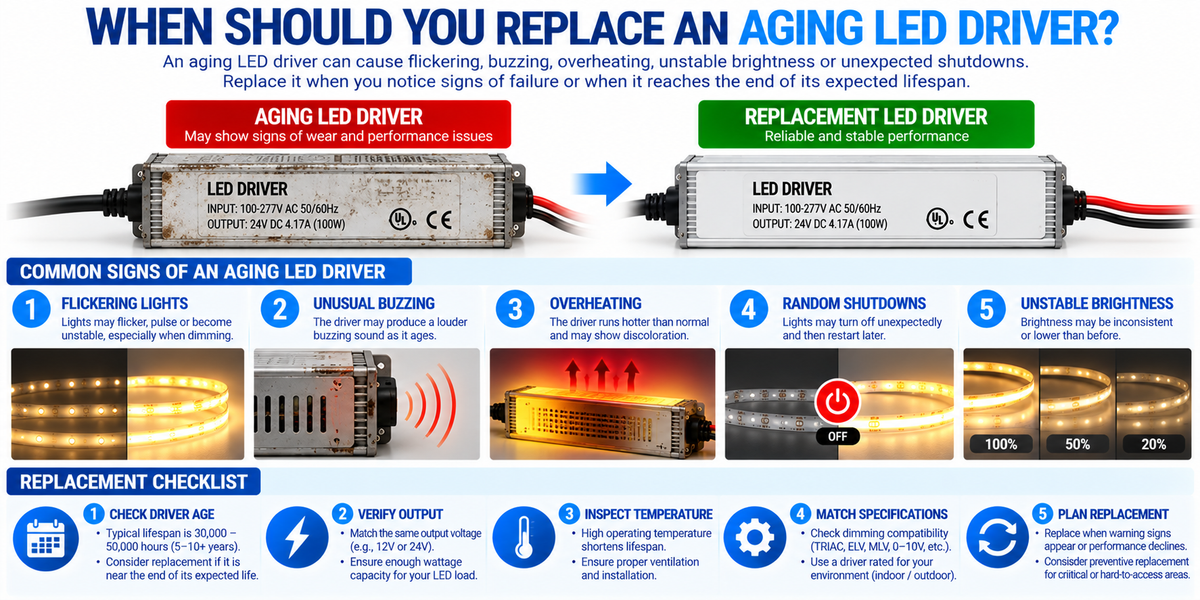
An aging LED driver may cause flickering, buzzing, unstable brightness, intermittent shutdowns, or complete lighting failure.
For electricians, contractors, facility managers, and commercial property owners, knowing when to replace an LED driver can help prevent unexpected outages and expensive maintenance calls.
But how can you tell whether a driver is approaching the end of its useful life?
And should you replace it before it completely fails?
In this guide, we explain the typical lifespan of LED drivers, the most important warning signs, how to distinguish driver problems from other electrical issues, and when preventive replacement makes financial sense.
1. What Does an LED Driver Do?
An LED driver provides the electrical output required by a compatible LED lighting system.
For many low-voltage LED strip installations, a constant-voltage driver converts incoming AC power into regulated DC power.
For example:
120V AC → 24V DC LED Driver → 24V COB LED Strip
Other LED fixtures may require constant-current drivers.
The driver helps maintain suitable electrical conditions for the connected lighting load.
Depending on the product, it may also provide:
- Dimming functionality
- Overcurrent protection
- Short-circuit protection
- Thermal protection
- Output regulation
- Additional control features
Because the driver is an essential part of the lighting system, its condition directly affects lighting reliability.
2. How Long Do LED Drivers Typically Last?
There is no universal lifespan for every LED driver.
Some manufacturers specify an expected operating life of approximately 30,000 to 50,000 hours, while certain higher-quality products are designed for 70,000 hours or more under specified conditions.
These figures are examples of possible product ratings, not guarantees for every driver.
Actual service life depends on:
- Product design
- Component quality
- Operating temperature
- Electrical loading
- Ventilation
- Input power conditions
- Environmental exposure
- Daily operating hours
What Do Operating Hours Mean in Years?
| Rated Operating Hours | 8 Hours/Day | 12 Hours/Day | 24 Hours/Day |
|---|---|---|---|
| 30,000 hours | 10.3 years | 6.8 years | 3.4 years |
| 50,000 hours | 17.1 years | 11.4 years | 5.7 years |
| 70,000 hours | 24.0 years | 16.0 years | 8.0 years |
These are mathematical conversions based on operating hours.
They do not account for calendar aging, environmental conditions, switching cycles, or unexpected component failures.
A driver rated for 50,000 hours does not necessarily fail at exactly 50,000 hours.
Likewise, it is not guaranteed to operate without problems until that point. Our guide on LED lifespan explains how rated hours relate to real service life.
3. The 8 Most Important Warning Signs of an Aging LED Driver
An aging driver may produce several symptoms before complete failure.
However, these symptoms can also result from wiring, dimmers, controllers, or LED strip problems.
They should be treated as warning signs that require investigation.
1. LED Lights Begin Flickering
Flickering is one of the most noticeable symptoms.
The lights may:
- Flicker intermittently
- Pulse at certain brightness levels
- Flash during startup
- Become unstable after warming up
Possible causes include deteriorating driver components, unstable output regulation, incompatible dimming equipment, or poor connections.
When to consider replacement: If testing identifies the driver as the source of unstable output, replacement may be appropriate.
2. The LED Driver Starts Buzzing
Some LED drivers produce a small amount of audible noise during normal operation.
However, a new or increasingly loud buzzing sound may indicate a problem.
Possible causes include:
- Magnetic component vibration
- Dimming incompatibility
- Loose mounting
- Component aging
- Abnormal electrical operating conditions
Buzzing alone does not prove that the driver is failing.
But a significant change in sound deserves attention.
3. The Driver Runs Unusually Hot
LED drivers generate heat during normal operation.
However, excessive temperature can accelerate electronic component deterioration.
Warning signs may include:
- Discoloration
- A burning smell
- Heat-related shutdowns
- Visible enclosure damage
- Abnormally high temperature compared with similar installations
Important: A driver that smells burned, smokes, shows physical damage, or repeatedly trips protection should be disconnected and inspected by qualified personnel.
Do not continue operating equipment with signs of an electrical hazard. Our guide on how temperature affects LED driver lifespan covers the underlying mechanism.
4. LED Lights Randomly Turn Off
Intermittent shutdowns can be frustrating, particularly in commercial environments.
Possible causes include:
- Driver thermal protection
- Overload protection
- Internal component failure
- Poor wiring connections
- Unstable input power
If the driver repeatedly shuts down and restarts, investigate the cause before returning it to service.
5. Brightness Becomes Unstable
A properly functioning constant-voltage LED driver should maintain output within its specified operating range.
An aging or defective driver may fail to regulate its output correctly.
Symptoms may include:
- Brightness fluctuations
- Unexpected dimming
- Changes during warm-up
- Reduced light output under load
However, voltage drop along long LED strip runs can produce similar symptoms.
The driver should not be replaced without checking the complete system.
6. Dimming Performance Gets Worse
A driver that previously dimmed smoothly may begin behaving differently.
For example:
- Lights flicker at low brightness.
- The minimum brightness changes.
- The lights turn off unexpectedly while dimming.
- The dimming range becomes unstable.
These problems may be associated with the driver, but the dimmer and controller should also be checked.
7. The Driver Requires Repeated Resets
A driver that repeatedly requires power cycling to resume normal operation may have an underlying fault.
Possible causes include:
- Overload
- Thermal protection
- Short circuits
- Internal electronics problems
Repeated resetting is not a permanent solution.
The underlying cause must be identified.
8. Visible Physical Deterioration
Physical damage is a serious warning sign.
Look for:
- Corrosion
- Cracked housing
- Burn marks
- Discoloration
- Damaged terminals
- Water intrusion
- Swollen or leaking components, where visible without opening the enclosure
A driver showing significant physical deterioration may require immediate removal from service.
Do not open a sealed driver or touch internal components. Dangerous voltages can remain present even after power is disconnected.
4. Why LED Drivers Age Over Time
LED drivers contain electronic components that experience electrical and thermal stress.
One important component category is electrolytic capacitors, which are used in many power supply designs.
These components may gradually deteriorate with time and temperature.
Other components, including semiconductors, magnetic components, solder joints, and insulation materials, may also be affected by operating conditions.
Common Aging Factors
Heat: High temperature accelerates deterioration in many electronic components.
Electrical Stress: Voltage surges and operation outside rated conditions can damage components.
Moisture: Water intrusion can cause corrosion and electrical faults.
Mechanical Stress: Vibration and poor mounting may affect connections.
Continuous Operation: Long daily operating hours increase accumulated operating time.
A driver designed for demanding environments may incorporate features intended to improve reliability, but actual performance still depends on the installation.
5. How Temperature Affects LED Driver Lifespan
Temperature is one of the most important factors affecting driver reliability.
Higher operating temperatures can accelerate aging in temperature-sensitive electronic components.
For example, some electrolytic capacitor manufacturers use temperature-based lifetime models in which a reduction of approximately 10°C can substantially extend predicted component life.
However, this is not a universal rule for the lifespan of a complete LED driver.
Different components have different failure mechanisms.
Common Installation Problems
- Drivers installed in tightly enclosed spaces
- Poor ventilation
- Excessive ambient temperature
- Installation near heat-producing equipment
- Operation beyond manufacturer temperature limits
Professional Recommendation
Follow the driver's specified ambient-temperature and case-temperature requirements.
If the product provides a designated case-temperature measurement point, use the manufacturer's instructions when evaluating operating temperature. Where millwork space is tight, compact transformers distributed near each run are easier to ventilate than one large unit. Our guide on where LED drivers should be installed covers placement.
6. Does Running a Driver at Full Load Shorten Its Life?
Operating load can influence temperature and reliability.
For example, a 150W driver continuously supplying 150W may experience different thermal conditions than the same driver supplying 100W.
However, this does not mean every driver must operate below 80% capacity.
Some products are specifically rated for continuous operation at their full specified load.
Example
A 24V COB LED installation requires 120W.
A compatible 150W driver would operate at:
120W ÷ 150W × 100 = 80% load
A compatible 200W driver would operate at:
120W ÷ 200W × 100 = 60% load
The larger driver has more unused capacity.
However, its actual temperature and lifespan depend on its efficiency, design, and operating conditions.
Choose driver capacity according to manufacturer ratings, required derating, and the complete system design—not an assumed universal loading rule.
Our guide on whether you can use a bigger power supply covers this in more detail.
7. How to Tell Whether the Driver or LED Strip Is Failing
Before replacing an aging driver, identify which component is responsible.
| Symptom | Driver-Related Possibility | Other Possible Cause |
|---|---|---|
| Entire LED strip flickers | Unstable output | Dimmer or wiring issue |
| All lights shut off together | Driver protection or failure | Input power interruption |
| Only one section is dark | Less likely to be driver-wide failure | Damaged strip or connector |
| Far end becomes dim | Possible low output | Voltage drop along strip |
| Buzzing during dimming | Driver or dimmer interaction | Mounting vibration |
| One RGB color fails | Possible controller-related issue | Damaged color channel |
| Lights fail after warming up | Thermal or internal fault | Poor connection or excessive load |
A systematic diagnosis can prevent unnecessary replacement costs.
8. How to Test an Aging LED Driver
Electrical testing should be performed by qualified personnel using appropriate instruments and safe procedures.
Step 1: Check the Driver Label
Identify:
- Input voltage
- Output voltage
- Rated current
- Maximum power
- Driver type
- Dimming method
- Temperature limits
Step 2: Inspect the Installation
With power safely isolated, check for visible damage, corrosion, and loose connections.
Step 3: Verify the Connected Load
Calculate the total LED wattage and compare it with the driver's rated capacity. Our guide on how many feet one driver can power works through the calculation.
Step 4: Check Input Conditions
Confirm that the supply conditions are within the manufacturer's specified operating range.
Step 5: Evaluate Output Performance
For a constant-voltage driver, qualified personnel may measure the output voltage under appropriate operating conditions.
For constant-current drivers, different measurements and precautions apply.
Step 6: Check Dimming Compatibility
Verify the driver, dimmer, and controller are compatible.
Step 7: Evaluate Temperature
Check operating conditions against the manufacturer's specifications.
Step 8: Determine Whether Replacement Is Necessary
If testing confirms unstable output, internal failure, or unsafe operation, replace the driver with a suitable unit.
9. Should You Replace an LED Driver Before It Fails?
Sometimes.
Preventive replacement may make sense when unexpected failure would create significant operational costs.
For example, replacing an aging driver in an easily accessible residential cabinet may be less urgent than replacing one serving critical commercial lighting.
Situations Where Preventive Replacement May Be Appropriate
- High daily operating hours
- Drivers approaching a documented service-life target
- Repeated performance problems
- Elevated operating temperatures
- Difficult future access
- High labor or equipment costs for emergency replacement
- Large groups of drivers installed at the same time
When Immediate Replacement May Not Be Necessary
A driver that is operating normally, within its rated conditions, and showing no signs of deterioration does not automatically need replacement because it has reached a particular age.
The decision should consider condition, manufacturer information, maintenance history, and failure consequences.
10. Preventive Replacement vs. Reactive Replacement
| Factor | Preventive Replacement | Reactive Replacement |
|---|---|---|
| Timing | Planned before failure | After failure occurs |
| Downtime | Can be scheduled | May be unexpected |
| Labor | Can be coordinated | May require urgent service |
| Equipment access | Planned in advance | Potentially inconvenient |
| Replacement cost | Earlier expenditure | Deferred until necessary |
| Risk of outage | Can be reduced | Failure occurs before repair |
Neither approach is universally best.
For large commercial projects, a risk-based maintenance strategy often provides the most practical balance.
11. When Should Commercial Buildings Replace LED Drivers?
Commercial buildings often have different maintenance priorities from residential installations.
A driver failure may affect:
- Retail displays
- Office work areas
- Hotel corridors
- Restaurant lighting
- Architectural coves
- Shopping mall installations
- Commercial signage
Some areas can tolerate a short lighting outage.
Others require faster restoration.
Recommended Approach
Classify lighting zones according to their operational importance.
For example:
Low-Criticality Zones: Replace after confirmed failure or during scheduled maintenance.
Moderate-Criticality Zones: Monitor condition and maintain replacement inventory.
High-Criticality Zones: Consider planned replacement, redundancy where appropriate, and faster maintenance response.
Emergency and life-safety lighting must follow applicable codes and specialized equipment requirements.
12. Why Replacing Multiple Drivers at Once Can Save Money
Large commercial installations may contain dozens or hundreds of LED drivers.
If many were installed at the same time, they may have similar operating histories.
Replacing them individually can require repeated:
- Technician visits
- Equipment access
- Work-area preparation
- Shutdown coordination
- Troubleshooting
In some cases, grouping replacements during scheduled maintenance can reduce labor costs.
However, replacing every driver solely because it is the same age may waste equipment with substantial remaining service life.
Use failure history and operating conditions to determine whether group replacement is justified. Contact our team for wholesale pricing on bulk replacement quantities.
13. How to Estimate the Age of an LED Driver
A driver's age can sometimes be estimated using:
- Installation records
- Purchase invoices
- Maintenance logs
- Manufacturer date codes
- Equipment labels
- Building renovation records
For commercial facilities, keeping a driver inventory is particularly useful.
Example Maintenance Record
| Driver ID | Location | Installation Year | Operating Hours/Day | Condition |
|---|---|---|---|---|
| DR-101 | Retail Display A | 2019 | 12 | Normal |
| DR-102 | Lobby Cove | 2019 | 16 | Intermittent flicker |
| DR-103 | Office Zone B | 2022 | 10 | Normal |
| DR-104 | Exterior Sign | 2020 | 12 | Corrosion observed |
These are illustrative records.
They show how a maintenance team can prioritize inspections and replacements based on condition rather than age alone. In this example, the exterior sign driver showing corrosion would be replaced with a wet-location rated unit.
14. Can an Aging Driver Damage LED Strip Lights?
Potentially.
A defective driver may deliver output outside its specified limits or operate unstably.
Depending on the failure mode, this could affect connected LED strips.
However, many drivers include protective features intended to limit certain faults.
The presence and effectiveness of those protections vary by product.
Important Warning
If a driver produces abnormal output, overheating, smoke, or visible electrical damage, disconnect it from service.
Do not repeatedly reconnect a suspected defective driver to valuable LED lighting equipment.
15. Can an Aging LED Driver Cause Flickering?
Yes.
Internal component deterioration may contribute to unstable output and visible flickering.
However, flickering can also be caused by:
- Incompatible dimmers
- Poor electrical connections
- Controller faults
- Input voltage disturbances
- Excessive load
- Defective LED strips
The correct solution depends on identifying the actual cause.
16. Can an Aging Driver Cause LED Lights to Become Dimmer?
Yes, under certain failure conditions.
A defective constant-voltage driver may fail to maintain its intended output.
However, reduced brightness can also result from LED aging, voltage drop, or environmental conditions.
For example, a COB strip may become dimmer over time because of LED lumen depreciation even while its driver continues operating correctly.
Do not assume every reduction in brightness means the driver needs replacement.
17. Is a Buzzing LED Driver Dangerous?
Not every buzzing driver is unsafe.
Some audible noise may occur under certain operating conditions, particularly with specific dimming combinations.
However, a new, unusually loud, or rapidly worsening sound should be investigated.
If buzzing occurs together with overheating, burning odor, visible damage, or unstable operation, disconnect the equipment and have it evaluated.
18. Should You Repair or Replace an LED Driver?
For many sealed commercial LED drivers, replacement is more practical than component-level repair.
Reasons include:
- Electrical safety
- Limited serviceability
- Labor cost
- Warranty conditions
- Reliability requirements
- Product certification considerations
Opening or modifying a driver can expose hazardous voltages and may invalidate its safety certification or warranty.
For most field installations, use manufacturer-authorized service procedures or replace the unit.
19. How to Choose a Replacement LED Driver
Selecting a replacement requires more than matching wattage.
Match the Driver Type
Determine whether the system requires constant-voltage or constant-current operation.
Match Output Voltage or Current
For constant-voltage strips, match the specified voltage — 12V or 24V as applicable.
For constant-current fixtures, match the required current and verify the permitted output-voltage range.
Verify Power Capacity
Calculate the connected load and select an appropriate rating.
Check Dimming Compatibility
Verify TRIAC, ELV, MLV, 0–10V, or other supported control methods as applicable. Where the existing dimming method is uncertain, a 5-in-1 dimmable driver supports several protocols in one unit.
Review Environmental Requirements
Choose equipment suitable for the installation location — our 96W through 300W drivers are UL wet-location rated.
Check Physical Dimensions
Confirm the replacement fits the approved mounting arrangement. Drivers with an integrated junction box provide a defined wiring compartment.
Verify Safety and Compliance Requirements
Review the applicable listing, certification, and manufacturer documentation.
Consider Long-Term Availability
For commercial projects, standardizing replacement models can simplify future maintenance.
20. Can You Replace a 100W Driver with a 150W Driver?
Often, yes, for a compatible constant-voltage system.
For example:
Original Driver: 24V DC, 100W
Replacement Driver: 24V DC, 150W
The larger driver provides additional available capacity.
However, the replacement must also match the required driver type, output regulation, dimming compatibility, and installation requirements.
A larger power rating does not automatically make every replacement suitable. Our guide on using a bigger power supply covers the conditions.
21. Can You Replace a 12V Driver with a 24V Driver?
Not for a standard 12V constant-voltage LED strip.
For example:
12V LED Strip + 24V Driver = Incorrect Voltage Match
Applying excessive voltage can damage the strip and create electrical hazards.
Always verify the output specifications before replacement. Use a matching 12V transformer, or a switchable 12V/24V driver set to the correct output.
22. Should You Upgrade to a More Efficient Driver?
A replacement project can provide an opportunity to evaluate driver efficiency.
A more efficient driver may:
- Reduce input energy consumption
- Generate less waste heat for the same output load
- Reduce operating costs
- Improve thermal conditions
However, the actual benefits depend on the driver's efficiency at the intended load.
Example
Suppose a lighting load requires 100W of DC output.
Driver A: 85% Efficiency
Input power:
100W ÷ 0.85 = 117.65W
Driver B: 92% Efficiency
Input power:
100W ÷ 0.92 = 108.70W
Difference:
8.95W
For one driver, the savings may be modest.
For a large commercial installation with many drivers operating for long hours, the cumulative difference can become meaningful.
23. How to Calculate the Cost of Driver Replacement
Consider the total cost rather than the price of the driver alone.
Replacement Cost Components
- New LED driver
- Installation labor
- Access equipment
- Wiring modifications
- Downtime
- Testing
- Disposal of the old unit
Example
A commercial facility has 50 aging LED drivers.
If replacement labor costs $75 per driver during a coordinated maintenance project:
50 × $75 = $3,750 in labor
If emergency replacement requires multiple separate service visits, the total labor and access costs may be higher.
This is an illustrative calculation, not a market-price estimate.
The actual economics depend on the site and service provider.
24. How to Extend LED Driver Lifespan
Good installation and maintenance practices can help reduce avoidable stress.
Follow Temperature Limits
Keep the driver within its specified operating conditions.
Avoid Overloading
Respect rated capacity and manufacturer derating requirements.
Provide Suitable Ventilation
Follow installation instructions for spacing and enclosure conditions.
Protect Against Moisture
Use equipment suitable for the environment.
Maintain Secure Connections
Loose or damaged connections should be corrected by qualified personnel.
Use Compatible Dimming Equipment
Avoid unsupported driver-dimmer combinations.
Review Electrical Conditions
Investigate recurring surges, abnormal voltage, or other power-quality issues.
Keep Maintenance Records
Track failures and replacement history.
25. Common Mistakes When Replacing LED Drivers
Avoid these errors:
- Replacing a driver without confirming the cause of failure.
- Using the wrong output voltage.
- Confusing constant-voltage and constant-current drivers.
- Ignoring dimming compatibility.
- Choosing insufficient wattage capacity.
- Assuming a higher-wattage driver is always better.
- Installing a replacement in an unsuitable enclosure.
- Ignoring temperature and ventilation requirements.
- Using an indoor-rated driver in an unsuitable outdoor environment.
- Overlooking controller current limits.
- Failing to inspect damaged wiring.
- Discarding maintenance records.
- Reusing a driver that shows serious physical damage.
- Assuming all drivers have the same expected lifespan.
26. LED Driver Replacement Checklist for Contractors
Before replacing an aging LED driver, confirm:
Existing Driver
- Manufacturer and model
- Driver type
- Input voltage
- Output voltage or current
- Rated wattage
- Dimming method
- Environmental rating
- Physical dimensions
- LED strip or fixture voltage
- Total power consumption
- Controller requirements
- Maximum run length
- Wiring condition
- Correct electrical specifications
- Suitable power capacity
- Compatible dimming
- Appropriate operating-temperature rating
- Suitable environmental protection
- Required certifications and listings
Installation
- Safe isolation of electrical power
- Proper mounting
- Correct wiring
- Suitable access
- Final testing
- Maintenance documentation
27. BrightNex LED Driver Solutions
BrightNex LED offers power supply and lighting components for residential and commercial projects, including:
- 12V LED drivers
- 24V LED drivers
- Dimmable LED transformers
- TRIAC-compatible driver options
- ELV and MLV dimming solutions
- 0–10V dimming solutions
- Compact LED drivers with junction boxes
- Higher-wattage power supplies
- Outdoor-rated driver options
- COB LED strip lights
- LED controllers and remotes
For contractors replacing aging equipment, choosing compatible drivers is essential for reliable long-term performance.
Explore LED drivers and professional lighting solutions in our driver and transformer range, or contact our team for replacement support and wholesale pricing. Our guide on building a complete LED lighting system covers the full specification process.
Final Takeaway: When Should You Replace an Aging LED Driver?
An LED driver does not need to be replaced automatically after a fixed number of years.
Instead, replacement decisions should be based on:
Driver Condition + Operating Hours + Temperature + Performance + Maintenance Risk
Consider replacement when:
- Testing confirms unstable electrical output.
- The driver repeatedly shuts down.
- Physical deterioration is present.
- Overheating or other safety concerns are identified.
- Dimming performance becomes unreliable because of a confirmed driver fault.
- Preventive replacement is justified by the cost of unexpected failure.
For commercial facilities, planned maintenance can reduce unexpected outages and improve long-term reliability.
The goal is not to replace every aging driver unnecessarily.
It is to identify drivers that are no longer safe, reliable, or economical to keep in service.
Frequently Asked Questions
How many years does an LED driver last?
Lifespan varies by product and operating conditions. Some drivers have expected operating-life ratings of 30,000–50,000 hours, while others may be designed for longer service.
How do I know if my LED driver is going bad?
Warning signs may include flickering, repeated shutdowns, unstable brightness, unusual buzzing, overheating, or physical deterioration.
Should I replace an LED driver after five years?
Not automatically. Replacement should depend on condition, operating hours, manufacturer information, and maintenance requirements.
Can an aging LED driver cause flickering?
Yes, but flickering can also result from dimmer incompatibility, wiring faults, controllers, or LED strip problems.
Can an LED driver fail without warning?
Yes. Some electronic failures occur suddenly without noticeable earlier symptoms.
Does an LED driver get weaker with age?
Some aging or defective drivers may develop unstable regulation or other performance problems, but not every driver gradually loses output.
Can an old LED driver damage LED strips?
A defective driver may cause problems if its output falls outside specified limits. The actual risk depends on the failure mode and protection features.
Should I replace all LED drivers in a commercial building at once?
Not necessarily. Group replacement may be economical when equipment has similar operating histories and high failure risk, but condition-based decisions can avoid unnecessary replacement.
Can I replace a 100W LED driver with a 150W driver?
Often yes for a compatible constant-voltage system, provided voltage, driver type, dimming, and other requirements match — see our 150W dimmable driver.
Can I replace a 12V LED driver with a 24V driver?
No, not for a standard 12V constant-voltage strip. The replacement output voltage must match the lighting requirements.
Can overheating shorten LED driver lifespan?
Yes. Excessive operating temperature can accelerate aging of electronic components.
Is it better to repair or replace a failing LED driver?
For many sealed drivers, replacement or manufacturer-authorized service is more practical and safer than field-level component repair.
Does a more efficient LED driver last longer?
Higher efficiency can reduce waste heat, but lifespan also depends on component quality, design, and operating conditions.
What is the best way to prevent unexpected LED driver failures?
Use compatible equipment, follow loading and temperature specifications, inspect installations, maintain records, and investigate early warning signs.