
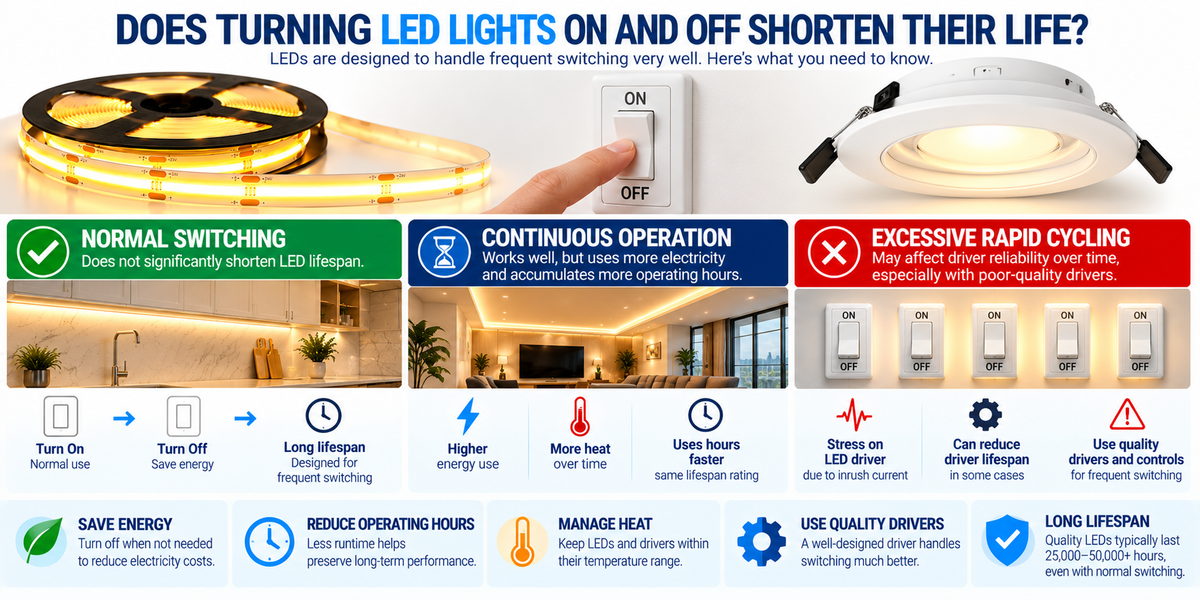
Does Turning LED Lights On and Off Shorten Their Life?
One of the most common questions about LED lighting is whether switching the lights on and off repeatedly can shorten their lifespan.
Many people have heard that turning lights on and off frequently causes them to burn out faster.
That concern comes partly from experience with older lighting technologies, especially incandescent and fluorescent lamps.
But LED lighting works differently.
For most properly designed LED lighting systems, normal switching on and off does not significantly shorten their lifespan.
In fact, switching LEDs off when they are not needed can reduce electricity consumption and operating hours.
However, there are exceptions.
Frequent switching, poor-quality drivers, electrical surges, overheating, and incompatible controls can all affect the reliability of an LED lighting system.
To understand the difference, it is important to look at how LED technology works and which components are most affected by switching.
How Do LED Lights Work?
LED stands for Light-Emitting Diode.
Unlike incandescent bulbs, which produce light by heating a filament, LEDs generate light through semiconductor technology.
A typical LED lighting system includes:
Electrical Power → LED Driver → LED Light Source
For low-voltage LED strips, the system may look like:
120V AC → 24V DC LED Driver → COB LED Strip
The LED driver converts and regulates electrical power so that the LED source operates within its designed electrical limits.
Because LEDs do not rely on a fragile heated filament, they generally tolerate normal switching much better than incandescent bulbs.
Why Turning Incandescent Lights On and Off Can Affect Their Life
Traditional incandescent bulbs use a thin filament that becomes extremely hot when electricity passes through it.
Every time the bulb turns on, the filament heats rapidly.
When the bulb turns off, it cools.
Repeated heating and cooling can contribute to filament fatigue.
Eventually, the filament may fail.
LEDs do not have this type of filament.
That is one reason frequent switching is generally less problematic for LED lighting. Our guide on whether LED lights really last longer than regular bulbs covers the comparison in detail.
What About Fluorescent Lights?
Some fluorescent lighting systems are more sensitive to switching frequency.
Starting a fluorescent lamp can contribute to wear on its electrodes.
Depending on the lamp and ballast design, frequent starts can reduce lamp life.
This is why older advice sometimes recommended leaving fluorescent lights on for short periods rather than repeatedly switching them.
However, that advice should not automatically be applied to LEDs.
Modern LED lighting behaves differently. Our guide on LED vs. fluorescent lighting explains why this matters for retrofits.
LED vs. Incandescent vs. Fluorescent: Switching Comparison
| Lighting Technology | Effect of Frequent Switching |
|---|---|
| Incandescent | Repeated thermal cycling can contribute to filament failure |
| Fluorescent | Frequent starting can reduce lamp life, depending on ballast and lamp design |
| LED | Generally handles normal switching well |
| COB LED Strip | Generally handles normal switching well with a suitable driver |
| LED Downlight | Generally handles normal switching well with compatible electronics |
The actual switching endurance depends on the complete product design.
Do LEDs Have a Maximum Number of Switching Cycles?
Some LED products are tested or specified for a certain number of switching cycles.
A switching cycle typically means:
ON → OFF → ON
or another defined switching sequence.
Manufacturers may provide switching-cycle endurance information as part of product testing.
However, not every LED product lists a switching-cycle rating.
For most quality residential and commercial LED systems, normal daily switching is not a major concern.
Extremely frequent cycling or specialized control applications should be evaluated against the manufacturer's specifications.
Does Turning LED Lights Off Help Them Last Longer?
In many cases, yes.
LED lifespan is influenced by operating conditions, including:
- Operating hours
- Temperature
- Driver quality
- Electrical conditions
- Installation environment
When an LED is switched off, it is no longer generating light or the associated operating heat.
Reducing unnecessary operating hours can therefore help reduce accumulated aging.
However, this does not mean switching an LED on and off continuously is beneficial.
The goal is simply to avoid operating the lighting when it is not needed.
LED Lifespan Is More Than Just Hours
LED lifespan is often discussed in terms of operating hours.
For example, some LED products may have rated lives of:
25,000 hours
50,000 hours
or more, depending on their design and testing.
But rated life does not necessarily mean the product will suddenly stop working after that number of hours.
Many LED lifetime ratings describe lumen maintenance.
This refers to how well the LED maintains its original light output over time.
What Does L70 Mean?
L70 is a commonly used LED lumen-maintenance metric.
It refers to the point at which the light output is projected or measured to decline to 70% of its initial value under defined conditions.
For example, an LED product with an L70 projection of 50,000 hours is expected to maintain at least 70% of its initial light output up to that point under the applicable assumptions.
It does not mean that every complete fixture or driver is guaranteed to operate without failure for 50,000 hours.
LED source lifespan and complete-system reliability are not exactly the same thing.
The LED Driver Is Often More Sensitive Than the LED Chips
This is one of the most important points for professional installations.
The LED chips themselves can tolerate frequent switching well.
However, the electronic driver contains components that may be affected by:
- Inrush current
- Electrical surges
- Temperature
- Component quality
- Repeated power cycling
Therefore, even when the LED strip or downlight is highly durable, the driver may become the limiting component.
This is why selecting a quality LED driver matters. Our dimmable drivers are UL certified and available from 30W to 384W.
What Happens Inside an LED Driver When It Turns On?
When power is applied to an LED driver, its internal electronic components begin operating.
Depending on the design, the driver may experience a brief inrush current as internal capacitors charge.
This is normal.
However, repeated high inrush currents can place additional stress on certain components, particularly in systems not designed for rapid or repeated cycling.
A properly designed driver should be suitable for its intended operating conditions.
For commercial applications with frequent switching, driver specifications should be reviewed carefully.
Can Frequent Switching Damage an LED Driver?
Normal switching generally should not damage a properly specified LED driver.
However, unusually frequent cycling may contribute to stress in some driver designs.
Potential concerns include:
- Repeated inrush current
- Capacitor stress
- Thermal cycling
- Relay contact wear
- Electrical transients
The actual impact depends on driver construction and operating conditions.
For lighting systems controlled by motion sensors or automated equipment, selecting drivers suitable for frequent switching is especially important. Spreading the load across several compact transformers also limits how much of a system is affected if one unit fails.
What About COB LED Strips?
COB LED strips are generally well suited to normal on/off operation.
COB stands for Chip on Board.
This technology uses densely packed LED chips to create a smooth, continuous-looking line of illumination.
Common applications include:
- Under-cabinet lighting
- Cove lighting
- Shelving
- Retail displays
- Architectural channels
- Commercial interiors
Switching a properly designed COB LED system on and off during normal daily use should not significantly reduce its expected lifespan.
However, the complete system must be properly designed.
That includes:
COB Strip + Driver + Controller + Wiring + Thermal Management
Is It Better to Leave COB LED Strips On All Day?
Not necessarily.
If the lighting is not needed, switching it off generally saves energy and reduces operating hours.
For example, imagine a COB LED installation consuming:
100W
If it runs unnecessarily for an additional eight hours per day:
100W × 8 hours = 800Wh
or:
0.8 kWh per day
Over one year:
0.8 × 365 = 292 kWh
At an electricity rate of $0.15 per kWh:
292 × $0.15 = $43.80 per year
That is the approximate cost of just one 100W system operating eight unnecessary hours daily.
For commercial projects with many lighting zones, unnecessary operating hours can create substantial additional costs. Our guide on why driver efficiency matters in commercial projects covers the related savings.
Does Turning LED Downlights On and Off Shorten Their Life?
For most quality LED downlights, normal switching is not a significant problem.
Downlights are frequently installed in:
- Kitchens
- Bathrooms
- Hallways
- Bedrooms
- Offices
- Retail spaces
- Commercial buildings
These areas naturally involve regular switching.
A properly designed LED downlight should be suitable for normal residential and commercial use.
However, unusual cycling patterns, poor electrical connections, overheating, or incompatible dimmers can affect reliability.
Motion Sensors and LED Lifespan
Motion sensors are commonly used to reduce energy consumption.
Examples include:
- Restrooms
- Storage rooms
- Corridors
- Warehouses
- Parking structures
- Utility rooms
A motion sensor turns the lighting on when movement is detected and off after a programmed delay.
LED technology is generally well suited to this type of control.
Why LEDs Work Well With Motion Sensors
LEDs typically provide:
- Instant illumination
- Good switching tolerance
- High energy efficiency
- Long service life
However, the sensor and LED driver must be compatible.
Can a Motion Sensor Turn LEDs On and Off Too Often?
Yes, poorly configured controls can cause unnecessary cycling.
For example, if a motion sensor has an extremely short timeout, the lighting may repeatedly switch off and back on while people remain nearby.
This can cause:
- User discomfort
- Unnecessary control operation
- Additional electrical cycling
- Reduced usability
A better solution is to configure the sensor's timeout appropriately.
For commercial installations, consider occupancy patterns and control requirements before selecting the delay.
Is Dimming Better Than Switching Off?
Dimming can reduce power consumption while keeping some light available.
However, dimming is not automatically better than switching the lights completely off.
If no lighting is required, switching off generally provides the greatest energy savings.
If a space requires low-level illumination for safety, security, or navigation, dimming may be more appropriate.
For example:
Warehouse Aisle Occupied → 100% Output
Warehouse Aisle Unoccupied → 10% Output
This can provide useful illumination while reducing energy use.
The correct approach depends on the application and applicable safety requirements. For low-level night illumination in corridors and bathrooms, a downlight with an integrated nightlight provides this without a separate dimming system.
Does Dimming Extend LED Lifespan?
Dimming can reduce LED operating current and heat in many systems.
Lower operating temperatures may benefit LED longevity.
However, the actual effect depends on:
- Driver design
- Dimming method
- LED operating conditions
- Thermal management
A compatible dimming system may reduce energy consumption and thermal stress.
But it should not be assumed that dimming automatically extends the rated lifespan by a specific percentage.
TRIAC, ELV, and 0–10V Dimming
Different LED systems support different dimming methods.
Common options include:
Using an incompatible dimmer can cause:
- Flickering
- Buzzing
- Unstable operation
- Incomplete dimming
- Unexpected switching behavior
These problems are often caused by electrical incompatibility rather than the normal act of turning LEDs on and off.
For professional projects, always verify driver and dimmer compatibility. Where the dimming method is not fixed at the design stage, a 5-in-1 dimmable driver covers several protocols in one unit.
What Causes LED Lights to Fail Prematurely?
Frequent switching is not usually the primary cause of premature LED failure.
More important factors often include:
1. Excessive Heat
High operating temperatures can accelerate aging of LED components and drivers — see our guide on how temperature affects LED driver lifespan.
2. Poor-Quality Drivers
Low-quality power supplies may provide unstable output or have less durable internal components.
3. Incorrect Voltage
A 12V LED strip should not be connected directly to a 24V constant-voltage supply — use a matching 12V transformer.
4. Overloaded Drivers
Exceeding the driver's rated capacity can cause overheating, shutdown, or premature failure. Our guide on what happens when an LED driver is overloaded covers the symptoms.
5. Poor Electrical Connections
Loose or damaged connections can create intermittent operation and electrical hazards.
6. Moisture Exposure
Indoor-rated components exposed to moisture may experience corrosion or failure — damp locations need IP65 rated strip and a wet-location driver.
7. Incompatible Controls
Incorrect dimmers or controllers can cause unstable operation.
These issues often have a greater effect on system reliability than normal switching.
Heat Is One of the Biggest Factors in LED Lifespan
LEDs generate heat during operation.
Although they are generally more efficient than older lighting technologies, thermal management remains important.
For LED strips, aluminum channels can help spread heat away from the PCB.
For downlights, heat sinks and fixture construction help manage operating temperatures.
A well-designed installation should consider:
LED Power + Mounting Surface + Airflow + Ambient Temperature
This is especially important for high-output strips and commercial installations operating for long hours.
Why Aluminum Channels Can Help COB LED Lifespan
Aluminum LED channels can provide:
- Heat spreading
- Mechanical protection
- Straight mounting
- Diffuser compatibility
- A cleaner architectural appearance
For many high-output or long-operating-hour COB installations, using a suitable aluminum channel can improve thermal conditions — a larger profile such as the BN256 offers more aluminum mass than a shallow extrusion.
However, not every LED strip requires a channel.
The need depends on the strip's wattage, manufacturer instructions, mounting surface, and operating environment. Our guide on how aluminum channels help extend LED strip lifespan explains the mechanism.
Should You Leave LED Lights On Overnight?
If lighting is not required, there is generally no reason to leave LEDs operating solely to avoid switching them on again.
Turning them off saves electricity.
However, some spaces require overnight illumination for:
- Security
- Emergency egress
- Safety
- Navigation
- Operational requirements
In those cases, the lighting should be designed for the intended operating schedule.
The correct decision depends on how the space is used.
What About Commercial LED Lighting That Runs 24/7?
Some commercial facilities operate continuously.
Examples include:
- Hospitals
- Warehouses
- Data centers
- Security areas
- Industrial facilities
For these applications, lighting reliability depends heavily on:
- Product quality
- Driver quality
- Thermal management
- Electrical design
- Maintenance planning
Continuous operation can accumulate LED aging faster in calendar time because more operating hours are being used.
However, continuously operating a properly rated LED system is not inherently harmful when it remains within its specifications. For continuous-duty installations, drivers with an integrated junction box can simplify future servicing.
Switching vs. Continuous Operation: Practical Comparison
| Operating Pattern | Main Consideration |
|---|---|
| Normal daily switching | Generally suitable for LEDs |
| Frequent occupancy-sensor switching | Use compatible controls and drivers |
| Continuous operation | More accumulated operating hours and heat exposure |
| Rapid repeated cycling | May stress some drivers or switching devices |
| Dimming during low occupancy | Can save energy and may reduce thermal load |
| Turning off unused lighting | Saves energy and operating hours |
How Switching Affects Large Commercial Projects
In large commercial installations, the switching strategy can affect both energy consumption and maintenance.
Imagine a facility with:
200 LED fixtures
Each consuming:
30W
Total connected load:
200 × 30W = 6,000W
or:
6 kW
If occupancy controls reduce average operation by four hours per day:
6 kW × 4 hours = 24 kWh/day
Annual energy savings:
24 × 365 = 8,760 kWh
At $0.15/kWh:
8,760 × $0.15 = $1,314/year
This simplified example assumes all 200 fixtures experience the same four-hour reduction.
Actual savings depend on occupancy patterns and control configuration.
The important point is that switching LEDs off when unnecessary can provide meaningful savings.
Should Contractors Recommend Occupancy Sensors?
For many commercial applications, yes.
Occupancy sensors can be useful in:
- Storage rooms
- Restrooms
- Warehouses
- Utility spaces
- Meeting rooms
- Corridors where permitted
However, the system should be designed to avoid unnecessary cycling and comply with applicable lighting and safety requirements.
In some spaces, dimming to a lower level may be preferable to switching completely off.
Can Smart Lighting Shorten LED Lifespan?
Smart lighting systems often use electronic controllers to adjust brightness, color, and operating schedules.
Normal operation through compatible controls should not inherently shorten LED lifespan.
However, poor system design can cause problems.
Examples include:
- Incorrect controller voltage
- Controller overload
- Poor driver compatibility
- Excessive heat
- Unstable electrical connections
A properly designed smart lighting system should consider the complete electrical load and control method. Our guide on what causes LED controllers to lose connection covers common control problems.
Does Changing LED Colors Affect Lifespan?
RGB and RGBW LED systems use multiple LED channels to produce different colors.
Changing colors through a compatible controller is a normal intended function.
However, operating conditions such as current, temperature, and duty cycle can influence component aging.
Color-changing operation should remain within the manufacturer's electrical and thermal specifications.
Is Rapid Flashing Harmful to LEDs?
LED semiconductor devices can switch very quickly.
This is one reason LEDs are used in applications involving PWM dimming and dynamic lighting effects.
However, rapid switching of the LED output is different from repeatedly disconnecting and reconnecting AC power to the driver.
PWM Dimming
A compatible controller rapidly modulates LED output while the power supply remains energized.
Repeated AC Power Cycling
The driver repeatedly starts and stops, potentially experiencing startup transients each time.
These two operating methods should not be treated as identical.
Can Power Surges Shorten LED Lifespan?
Yes.
Electrical surges and unstable supply conditions can damage LED drivers and other electronic components.
Potential causes include:
- Switching transients
- Electrical disturbances
- Lightning-related surges
- Faulty wiring
- Inappropriate power supplies
For commercial installations, suitable surge protection may be worth considering based on the electrical environment and applicable requirements.
Why Driver Quality Matters More Than Switching Frequency
A well-designed driver helps provide stable electrical power to the LED source.
For professional lighting projects, evaluate:
- Correct output voltage
- Rated power capacity
- Efficiency
- Thermal performance
- Dimming compatibility
- Environmental rating
- Safety certifications
- Manufacturer instructions
A properly selected driver can contribute significantly to the reliability of the entire system.
How to Extend LED Lighting Lifespan
For residential and commercial installations, the following practices are more useful than simply avoiding the light switch.
Choose Quality LED Products
Use lighting components appropriate for the intended application.
Match the Driver Correctly
Verify voltage, current, wattage, and dimming requirements.
Avoid Overloading
Keep electrical loads within the manufacturer's specified limits.
Manage Heat
Use suitable mounting methods, channels, and ventilation.
Protect Outdoor Systems
Use appropriately rated strips, drivers, connectors, and enclosures.
Use Compatible Controls
Match sensors, dimmers, and controllers to the lighting system.
Avoid Unnecessary Operating Hours
Switch off or dim lighting when appropriate.
Plan Maintenance Access
Install drivers and controllers where they can be inspected and serviced.
Common Myths About Switching LED Lights
Myth 1: LEDs Should Always Be Left On
False. Turning off unused LEDs generally saves energy and reduces operating hours.
Myth 2: Every Time You Switch an LED On, It Loses Hours of Life
Misleading. Normal switching does not consume a fixed amount of rated LED life.
Myth 3: LEDs Never Experience Switching-Related Problems
False. Drivers, relays, and other electronic components may be affected by extreme cycling or poor electrical conditions.
Myth 4: Motion Sensors Are Bad for LEDs
Generally false. LEDs are usually well suited to compatible occupancy controls.
Myth 5: Dimming and Switching Are the Same Thing
False. Dimming adjusts output, while switching may remove electrical power from the system.
Myth 6: LEDs Produce No Heat
False. LEDs and their drivers generate heat that must be managed.
BrightNex LED Solutions for Reliable Lighting Systems
At BrightNex LED, professional LED installations can be designed using:
- COB LED strip lights
- 12V and 24V LED lighting solutions
- Constant-voltage LED drivers
- Dimmable LED transformers
- Aluminum LED channels
- Recessed LED downlights
- LED controllers and remotes
For contractors and commercial project buyers, the goal is to select compatible components that support the intended operating schedule and control strategy.
Whether the lighting operates continuously or uses occupancy sensors and dimming controls, proper system design is essential for long-term reliability. Our guide on building a complete LED lighting system covers the full specification process.
Explore professional LED lighting solutions in our COB strip, driver and aluminum channel collections, or contact our team for project support and wholesale pricing.
Final Takeaway
So, does turning LED lights on and off shorten their life?
Under normal operating conditions, frequent switching generally does not significantly shorten LED lifespan.
Unlike incandescent filaments and some fluorescent systems, LEDs are well suited to regular switching.
In many cases, turning off unused lighting is beneficial because it:
- Saves electricity
- Reduces operating hours
- Reduces operating heat
- Supports efficient building operation
However, the complete system matters.
Drivers, controllers, switching devices, electrical conditions, and thermal management can influence reliability.
For the best results, focus on:
Quality LEDs + Compatible Drivers + Proper Installation + Effective Controls + Good Thermal Management
The goal is not to avoid turning LED lights off.
It is to operate them efficiently and within their intended specifications.
Frequently Asked Questions
Does switching LED lights on and off damage them?
Normal switching generally does not damage properly designed LED lighting systems. Extreme power cycling or poor-quality electronics may create reliability issues.
Is it better to leave LED lights on all day?
Usually not. If the lighting is unnecessary, switching it off saves electricity and reduces operating hours.
Do LED lights use more electricity when turning on?
Some drivers experience a brief startup inrush current, but this does not mean leaving the lights on is more energy-efficient than switching them off during periods of nonuse.
Can motion sensors shorten LED lifespan?
Properly matched motion sensors are generally suitable for LEDs. Very short timeouts may cause unnecessary cycling, so sensor settings should reflect actual occupancy.
Does turning COB LED strips on and off shorten their lifespan?
Normal switching should not significantly shorten the lifespan of a properly designed COB LED strip system.
Can frequent switching damage an LED driver?
Unusually frequent power cycling may stress some driver components, depending on the design. Normal switching is generally acceptable.
Does dimming help LED lights last longer?
Dimming can reduce electrical load and heat in some systems, which may benefit longevity. Actual results depend on the LED and driver design.
Do LED downlights last longer if they stay on continuously?
Not necessarily. Continuous operation accumulates operating hours and heat exposure. Normal switching is generally preferable when the lighting is not needed.
What causes LED lights to fail early?
Common causes include overheating, incorrect voltage, overloaded drivers, poor connections, moisture exposure, electrical surges, and incompatible controls.
Is rapid flashing the same as switching LED power on and off?
No. PWM control modulates LED output electronically, while repeatedly switching AC input power cycles the driver itself.
Should commercial buildings use automatic LED lighting controls?
Occupancy sensors, scheduling, and dimming can reduce energy consumption when properly designed and compatible with applicable lighting requirements.