
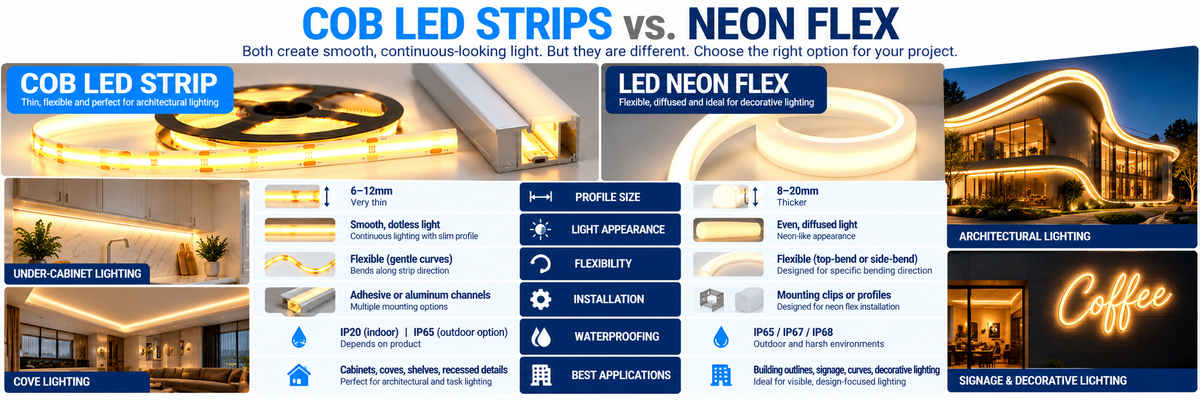
COB LED Strips vs. Neon Flex: What's the Difference?
When planning modern LED lighting, two popular options frequently appear in architectural and commercial projects:
COB LED Strip Lights and LED Neon Flex.
Both can create smooth, continuous-looking lines of illumination, making them attractive alternatives to traditional LED strips with visible individual light points.
However, they are not the same product.
COB LED strips are generally thin, flexible LED circuit boards that can be installed directly or inside aluminum channels.
LED Neon Flex typically incorporates an LED light source inside a flexible diffusing enclosure designed to produce a neon-like appearance.
Although both technologies can achieve beautiful linear lighting, they differ in:
- Construction
- Light distribution
- Flexibility and bending direction
- Installation methods
- Environmental protection
- Heat management
- Cost
- Maintenance
- Architectural applications
Understanding these differences can help contractors, electricians, and lighting designers select the right system for each project.
What Is a COB LED Strip?
COB stands for Chip on Board.
In COB LED strip lighting, multiple LED chips are mounted closely together on a flexible circuit board and covered with a continuous phosphor or encapsulation layer.
This construction produces a smooth-looking line of light with reduced visibility of individual LED points.
Traditional LED strips may show separate bright spots.
COB strips are designed to produce a more continuous appearance.
Main Characteristics of COB LED Strips
- Thin, flexible PCB construction
- Continuous-looking illumination
- Available in different widths
- Suitable for aluminum LED channels
- Available in multiple color temperatures
- Options for single-color, CCT, RGB, and RGBW applications
- Indoor and environmentally protected versions
- Low-voltage operation, commonly 12V or 24V
COB LED strips are particularly useful when the installation requires a compact lighting source.
Common Applications
- Under-cabinet lighting
- Cove lighting
- Shelving
- Display cabinets
- Recessed aluminum channels
- Plaster-in channels
- Furniture lighting
- Architectural accent lighting
For many indoor architectural projects, COB LED strips provide excellent flexibility in both lighting design and installation.
What Is LED Neon Flex?
LED Neon Flex is a flexible linear lighting product designed to imitate the smooth illuminated appearance of traditional neon tubing.
Instead of using gas-filled glass tubes, modern LED Neon Flex typically uses LED technology inside a flexible silicone or other polymer enclosure.
The outer enclosure diffuses the light and creates a continuous illuminated surface.
Main Characteristics of Neon Flex
- Flexible diffusing body
- Neon-like illuminated appearance
- Multiple cross-sectional shapes
- Different bending directions depending on design
- Some models suitable for outdoor use
- Available in different colors and color temperatures
- Suitable for architectural outlines and decorative lighting
Neon Flex is particularly useful when the light itself is intended to be a visible design element.
Common Applications
- Building outlines
- Signage
- Decorative wall lighting
- Outdoor architectural accents
- Curved lighting features
- Hospitality spaces
- Commercial displays
- Landscape features
Unlike a conventional COB strip, Neon Flex is generally designed to be seen as a complete illuminated linear product.
COB LED Strips vs. Neon Flex: Quick Comparison
| Feature | COB LED Strip | LED Neon Flex |
|---|---|---|
| Construction | Flexible PCB with densely packed LEDs | LED source inside diffusing enclosure |
| Light Appearance | Smooth, continuous-looking light | Diffused neon-like light |
| Profile | Very thin | Generally thicker |
| Installation | Adhesive, channels, clips | Mounting clips or compatible profiles |
| Bending | Depends on strip construction | Defined bending direction and radius |
| Waterproofing | Depends on IP-rated version | Depends on IP-rated version |
| Heat Management | Often benefits from aluminum channel | Depends on enclosure and manufacturer design |
| Light Direction | Depends on mounting and optics | Depends on top-view or side-view design |
| Customization | Broad choice of strip and channel combinations | Product-specific profiles and shapes |
| Maintenance | Strip and channel may be serviceable separately | May require replacing a longer assembled section |
| Typical Cost | Often lower for basic systems | Often higher due to integrated enclosure |
| Best Use | Cabinets, coves, recessed details | Visible outlines, curves, signage |
The exact performance depends on the specific products being compared.
1. Light Appearance: Which Looks Better?
Both technologies can create visually smooth illumination.
However, the final appearance is different.
COB LED Strip Appearance
COB LED strips create a continuous-looking line of light along a narrow flexible board.
When installed inside an aluminum channel with a diffuser, the result can be especially clean.
For example:
COB Strip + Aluminum Channel + Diffuser
can create a professional linear lighting effect suitable for modern interiors.
Neon Flex Appearance
Neon Flex uses a larger diffusing enclosure to create an illuminated surface that resembles traditional neon.
The light is often visible directly from the front or side of the enclosure.
This makes it particularly useful for decorative outlines and exposed linear lighting.
Which Is Better?
Choose COB when you want a compact light source that integrates into architecture.
Choose Neon Flex when you want the illuminated line itself to be a prominent visual feature.
2. COB LED Strips Are Usually Thinner
One of the biggest advantages of COB LED strips is their compact size.
COB strips may be available in widths such as:
depending on the product.
This makes them suitable for narrow installations.
For example:
- Slim cabinets
- Furniture details
- Shallow aluminum channels
- Recessed architectural profiles
- Display shelving
Neon Flex generally requires more space because its enclosure surrounds the internal light source.
Practical Example
Imagine a narrow shelf with limited mounting space.
A slim COB LED strip may fit inside a compact aluminum channel.
A larger Neon Flex product might be too bulky for the same location.
For this reason, COB is often preferable for concealed or space-limited installations.
3. Flexibility: Which One Bends Better?
Both COB strips and Neon Flex are flexible, but they bend differently.
This is an important distinction for contractors.
COB LED Strip Flexibility
Most standard COB LED strips are designed to bend along their intended flexible axis.
They should not be sharply folded, twisted, or bent beyond the manufacturer's specifications.
For tight corners, installers may need to use:
- Cut-and-reconnect methods
- Short jumper wires
- Suitable connectors
- Corner-specific mounting solutions
Neon Flex Flexibility
Neon Flex products often have a defined bending direction.
Common categories include:
Top-Bend Neon Flex
and
Side-Bend Neon Flex.
These terms describe how the product is intended to curve relative to its illuminated surface.
A product designed for one bending direction should not be forced to bend in another direction.
Important Installation Rule
Always verify:
Minimum Bend Radius + Bending Direction
before selecting either product.
Neither COB nor Neon Flex should be assumed to bend freely in every direction.
4. Which Is Better for Curved Lighting?
Neon Flex can be especially useful for decorative curves and illuminated outlines.
For example:
- Curved wall patterns
- Building contours
- Decorative arches
- Custom signage
- Hospitality lighting
However, the product must be designed for the required curve.
COB strips can also follow gentle curves, particularly when used with compatible flexible channels such as the BN263 bendable profile or the BN5616 bendable plaster-in channel.
When to Choose COB
When the light needs to be integrated into a shallow or concealed architectural detail.
When to Choose Neon Flex
When the illuminated line needs to follow a visible decorative curve.
5. Brightness: Is COB Brighter Than Neon Flex?
Not automatically.
Brightness depends on:
- LED technology
- Power consumption
- Luminous efficacy
- Optical design
- Diffuser transmission
- Product construction
A high-output COB strip can produce substantial light from a compact profile.
Neon Flex may use a thicker diffuser that changes the light distribution and can reduce transmitted light compared with the internal source.
However, some Neon Flex products are designed for high output.
What Should You Compare?
Instead of relying on the product category, compare:
Lumens per Foot
or
Lumens per Meter
Also consider:
- Beam angle
- Installation height
- Target surface
- Required illuminance
For task lighting, delivered illumination is more important than appearance alone. Lumens per foot are listed on every COB strip product page.
6. Which Is Better for Task Lighting?
For many task-lighting applications, COB LED strips are the more practical choice.
Examples include:
- Kitchen countertops
- Workbenches
- Office shelving
- Retail display shelves
- Cabinets
COB strips can be installed inside appropriately positioned aluminum channels to direct light toward the working surface — a 45-degree corner profile aims the light forward rather than straight down.
Neon Flex is often selected for decorative lighting rather than compact task illumination.
However, actual performance should be evaluated using the product's photometric specifications.
7. Which Is Better for Decorative Lighting?
Neon Flex is particularly effective when the light source itself is intended to be visible.
For example:
Building Outline → Neon Flex
Decorative Wall Curve → Neon Flex
Illuminated Sign → Neon Flex
COB strips are also excellent for decorative lighting, especially when concealed inside:
The difference is often whether the lighting should be integrated into the surface or visibly outlined on it.
8. Waterproofing: COB vs. Neon Flex
A common assumption is that Neon Flex is always waterproof while COB strips are not.
That is incorrect.
Both technologies can be available with different environmental protection ratings.
COB LED Strips
May be available in:
depending on the product.
LED Neon Flex
May be available in:
- IP65
- IP67
- IP68
- Other configurations
depending on the manufacturer and product design.
The exact rating must be verified.
Important
A protected LED product does not automatically make the entire installation waterproof.
Connections, end caps, drivers, controllers, and cable entries also need suitable protection. Our guide on whether waterproof LED strips can be used in the rain covers this in detail.
9. Which Is Better for Outdoor Lighting?
Neon Flex is often an attractive choice for exposed outdoor architectural outlines.
Its integrated enclosure can provide a convenient, finished appearance.
Examples include:
- Building facades
- Outdoor signs
- Pergola outlines
- Decorative exterior features
Protected COB strips can also be used outdoors when appropriately rated and installed.
For example:
IP-Rated COB Strip + Suitable Channel + Protected Connections
can be useful for exterior architectural details. For long facade runs, a 110V outdoor COB strip can run up to 100ft from a single feed.
The Best Choice Depends on Exposure
Consider:
- Rain
- Standing water
- UV
- Temperature
- Snow
- Irrigation
- Mechanical contact
Never select outdoor lighting based only on appearance.
10. Heat Management
Both COB strips and Neon Flex produce heat.
Heat management is important because excessive operating temperature can affect LED performance and lifespan.
COB LED Strips
An aluminum channel can help spread heat away from the strip.
This is especially useful for higher-output products and long operating hours. Our guide on how aluminum channels help extend LED strip lifespan explains the mechanism.
Neon Flex
The LED source is typically enclosed inside a flexible diffusing body.
Its thermal performance depends on the product's construction and installation requirements.
Some Neon Flex systems require specific mounting methods or profiles.
Professional Recommendation
Always follow the manufacturer's thermal and mounting specifications.
A product's environmental enclosure does not eliminate the need for heat management.
11. Installation Differences
COB and Neon Flex typically require different installation methods.
COB LED Strip Installation
A common system includes:
LED Strip → Aluminum Channel → Diffuser → Driver → Controller (if needed)
Installation may involve:
- Measuring the required length.
- Cutting at approved cut points.
- Preparing the mounting surface.
- Installing the channel.
- Mounting the strip.
- Connecting the driver.
- Testing the system.
Neon Flex Installation
A typical installation may involve:
- Selecting the correct bend direction.
- Measuring the required length.
- Cutting only where permitted.
- Installing compatible mounting clips or profiles.
- Securing the Neon Flex.
- Sealing ends and connections as specified.
- Connecting the appropriate driver.
- Testing the installation.
The installation method depends on the actual product.
12. Can COB LED Strips Be Installed Without Aluminum Channels?
Yes, depending on the product and application.
However, aluminum channels can offer several advantages:
- Heat spreading
- Physical protection
- Straight mounting
- Improved appearance
- Diffuser compatibility
- Easier integration into architectural details
For commercial installations, channels are often worth considering.
Neon Flex already includes an integrated diffusing enclosure, so a separate optical diffuser is usually unnecessary.
It may still require a compatible mounting channel or clips.
13. Cutting and Custom Lengths
COB LED strips often provide frequent cut intervals, depending on voltage and design.
This can make them useful for custom-length installations — our 12V COB strip cuts every 25mm, and the free-cut 8mm COB strip can be cut at any point.
Neon Flex products may have longer or more restrictive cut intervals.
Example
A custom cabinet requires a precise length.
A COB strip with suitable cut intervals may allow a closer fit.
A Neon Flex product may require more planning around its permitted cut points.
Never cut either product outside the manufacturer's designated cutting locations.
14. Maintenance and Replacement
Maintenance is especially important in commercial projects.
COB LED Strip Systems
In some installations, the LED strip can be replaced while retaining the aluminum channel.
This can reduce the need to replace the complete architectural profile.
Neon Flex Systems
Depending on the design, maintenance may involve replacing a longer integrated section.
This can be more complicated in installations with sealed ends or custom curves.
Contractor Tip
Before installation, consider:
How will this lighting be serviced five years from now?
Maintenance access should be planned before walls, ceilings, or millwork are completed. Drivers with an integrated junction box can help keep the electrical side accessible.
15. Cost Comparison
COB LED strips are often more economical for basic indoor linear lighting.
However, a complete COB system may require:
- Aluminum channel
- Diffuser
- End caps
- Mounting accessories
- Driver
- Controller
Neon Flex may cost more per foot because of its integrated enclosure and specialized construction.
But the overall project cost depends on the installation.
Compare Total Installed Cost
Do not compare only the strip price.
Calculate:
Lighting Product + Mounting + Driver + Wiring + Labor + Maintenance
A Neon Flex solution may simplify some decorative installations, while COB may be more economical for concealed linear lighting. Contact our team for wholesale pricing on project quantities.
16. COB vs. Neon Flex for Cove Lighting
Cove lighting is one of the most common architectural LED applications.
In many cases, COB LED strips are an excellent choice.
Why?
The light source is usually concealed inside the cove.
The goal is to illuminate the ceiling or wall indirectly.
COB strips provide:
- Compact installation
- Smooth-looking light
- Flexible channel options
- Different brightness levels
- Multiple color temperatures
Neon Flex can also be used in some cove applications, but its larger profile may not provide an advantage when the source is hidden.
For many concealed coves, COB is the more practical choice — our BN5620 plaster-in cove channel is designed around this.
17. COB vs. Neon Flex for Under-Cabinet Lighting
For most kitchen and cabinet projects, COB LED strips are preferable.
They fit inside narrow aluminum channels and can provide smooth task lighting.
A typical under-cabinet system includes:
24V COB LED Strip + Aluminum Channel + Diffuser + Compatible Driver
Neon Flex may be unnecessarily bulky for standard under-cabinet installations.
However, decorative cabinet edges or exposed outlines may benefit from specialized Neon Flex products.
18. COB vs. Neon Flex for Retail Displays
Retail displays require careful lighting selection.
COB strips are excellent for:
- Shelves
- Display cabinets
- Product lighting
- Recessed linear details
- Under-counter illumination
Neon Flex is excellent for:
- Decorative store outlines
- Brand displays
- Curved illuminated features
- Window decorations
- Architectural accents
A professional retail project may use both technologies.
19. COB vs. Neon Flex for Signage
Neon Flex is often the more suitable option for creating neon-style signage.
Its diffusing body allows the illuminated line to remain visible.
COB strips can also be used in signs, especially inside letters, channels, or light boxes.
However, for exposed neon-like outlines, Neon Flex usually provides a more direct solution.
20. COB vs. Neon Flex for Building Facades
Both technologies can be used in architectural facade lighting when appropriately rated.
COB LED Strips
Useful for:
- Concealed facade lighting
- Recessed architectural details
- Exterior coves
- Indirect lighting
Neon Flex
Useful for:
- Visible building outlines
- Curved facade accents
- Decorative exterior lines
- Architectural contours
The selection depends on whether the light source should be visible or concealed. For concealed exterior work, pair an IP65 COB strip with a wet-location rated driver.
21. COB vs. Neon Flex for Hotels and Restaurants
Hospitality projects often combine multiple lighting layers.
For example:
- Under bar counters
- Cove lighting
- Shelves
- Recessed details
Neon Flex
- Decorative wall patterns
- Feature outlines
- Accent signage
- Curved architectural details
Using both products strategically can produce a more complete lighting design. For color-changing feature lighting, an RGBW COB strip with an RGBW controller covers both white and color scenes.
22. Power Supply Requirements
Both COB strips and Neon Flex require compatible electrical power.
Many low-voltage systems use:
12V DC or 24V DC
However, other voltages and system types exist.
Always verify the actual product.
Example
Suppose a 24V COB strip consumes:
4W per foot
and the installation requires:
30 feet
Total load:
30 × 4W = 120W
The driver must provide the correct output voltage and sufficient capacity — at an 80% planning load, a 150W driver suits this example.
The same calculation principle applies to Neon Flex. Our guide on how many feet one driver can power works through the calculation.
23. Voltage Drop
Voltage drop affects both technologies.
Long low-voltage runs can experience reduced voltage toward the far end.
Possible symptoms include:
- Reduced brightness
- Uneven illumination
- Color inconsistency
- Unstable operation
The maximum recommended run length depends on:
- Product voltage
- Wattage
- Internal conductors
- Feed arrangement
- Manufacturer specifications
For larger projects, multiple feed points or shorter runs may be necessary.
24. Which Is Better for Long Commercial Runs?
There is no universal answer.
A long COB installation may require:
- Multiple feed points
- Multiple drivers
- Aluminum channels
- Accessible connections
A long Neon Flex installation may require:
- Multiple approved sections
- Suitable mounting profiles
- Proper sealing
- Multiple power feeds
For either system, follow the manufacturer's maximum-run specifications.
Do not assume that one continuous 100-foot run is electrically suitable simply because the product is flexible.
25. Dimming and Color Control
Both technologies may support:
depending on the product.
A typical low-voltage system may include:
Driver → Controller → LED Lighting
For RGB or RGBW systems, the controller must support the correct number of channels and electrical load.
Control compatibility matters more than whether the product is COB or Neon Flex. Our guide on synchronizing multiple LED strip zones covers multi-zone control.
26. Can COB and Neon Flex Be Used Together?
Yes.
In fact, combining them can be a strong architectural design strategy.
Example: Modern Restaurant
Used for:
- Under-bar lighting
- Shelf illumination
- Cove lighting
Neon Flex
Used for:
- Decorative wall outlines
- Signage
- Curved feature lighting
The two technologies can complement each other rather than compete.
27. Common Mistakes When Choosing Between COB and Neon Flex
Avoid these mistakes:
- Assuming both products bend in the same direction.
- Comparing brightness without checking lumens.
- Assuming Neon Flex is always waterproof.
- Assuming COB strips always need aluminum channels.
- Ignoring minimum bend radius.
- Cutting outside approved cut points.
- Using an undersized LED driver.
- Ignoring voltage drop.
- Choosing a product that is too large for the mounting space.
- Forgetting maintenance access.
- Ignoring thermal requirements.
- Comparing product price instead of total installation cost.
28. How to Choose the Right Product
Use this practical decision process.
Step 1: Determine Whether the Light Source Will Be Visible
If the lighting is concealed inside architecture, COB may be preferable.
If the illuminated line itself is a decorative feature, Neon Flex may be better.
Step 2: Check Available Space
Measure the mounting area.
COB is often more suitable for narrow spaces.
Step 3: Evaluate Curves and Corners
Check the required bending direction and radius — for curved COB installations, see the BN263 bendable profile.
Step 4: Determine Environmental Exposure
For outdoor projects, verify the required IP rating and connection protection.
Step 5: Compare Brightness
Review lumens per foot or meter.
Step 6: Plan the Electrical System
Calculate total wattage, voltage drop, driver capacity, and controller requirements.
Step 7: Consider Maintenance
Choose a system that can be accessed and serviced appropriately.
29. Which Should Contractors Recommend?
For most concealed architectural linear lighting applications, COB LED strips are often the more practical recommendation.
They offer:
- Compact dimensions
- Flexible channel options
- Smooth-looking illumination
- Broad application compatibility
- Potentially easier servicing
For visible decorative outlines, curves, and neon-style effects, Neon Flex is often the better fit.
The best choice depends on the design intent.
BrightNex LED Solutions for Professional Projects
At BrightNex LED, contractors and project buyers can build professional linear lighting systems using:
- COB LED strip lights
- 12V and 24V lighting solutions
- Aluminum LED channels
- Recessed and surface-mount profiles
- Corner LED channels
- Plaster-in and cove lighting channels
- Compatible LED drivers
- Controllers and dimming components
For projects requiring concealed linear lighting, BrightNex COB strips and aluminum channels provide flexible solutions for residential and commercial applications.
Explore the available products in our COB strip and aluminum channel collections, or contact our team for project support and wholesale pricing.
Final Takeaway
So, COB LED strips vs. Neon Flex: what's the difference?
Both technologies can create smooth, continuous-looking lines of light, but they serve different design purposes.
Choose COB LED Strips When You Need:
- Compact linear lighting
- Under-cabinet illumination
- Cove lighting
- Shelving and display lighting
- Recessed aluminum channels
- Flexible architectural integration
Choose Neon Flex When You Need:
- Visible illuminated outlines
- Decorative curves
- Neon-style signage
- Building contours
- Exposed architectural accents
The most important distinction is:
COB LED strips are often best when the light source becomes part of the architecture.
Neon Flex is often best when the illuminated line itself becomes the design feature.
For professional lighting projects, select the system based on appearance, mounting requirements, brightness, environmental protection, electrical design, and long-term maintenance—not simply the product name. Our guide on building a complete LED lighting system covers the full specification process.
Frequently Asked Questions
Is COB LED strip the same as Neon Flex?
No. COB LED strips use densely packed LED chips on a flexible circuit board, while Neon Flex generally uses an LED source inside a flexible diffusing enclosure.
Which is brighter, COB or Neon Flex?
Neither is automatically brighter. Compare the actual lumen output, wattage, optics, and installation conditions of the products.
Which is better for under-cabinet lighting?
COB LED strips are generally more suitable because of their compact size and compatibility with slim aluminum channels.
Which is better for outdoor lighting?
Both can be used outdoors when appropriately rated. Neon Flex is popular for visible exterior outlines, while protected COB strips are useful for concealed architectural lighting.
Can Neon Flex be cut to length?
Many products can be cut, but only at manufacturer-approved cutting points.
Can COB LED strips bend around corners?
COB strips can follow gentle bends within their specifications. Sharp corners may require cutting and reconnecting the strip, or a corner channel.
Does Neon Flex need an aluminum channel?
It generally does not need a separate diffuser, but it may require mounting clips or compatible profiles.
Are COB LED strips waterproof?
Some COB strips are available with IP-rated protection, but not all COB products are waterproof.
Which is more expensive?
Neon Flex often costs more per foot than a basic COB strip, but the total installed cost depends on mounting accessories, wiring, labor, and maintenance.
Can COB LED strips and Neon Flex use the same driver?
Potentially, if their voltage, power requirements, and control methods are compatible. Always verify the complete electrical specifications.
Which is better for signage?
Neon Flex is often preferable for exposed neon-style signs and decorative outlines.
Which is better for commercial cove lighting?
COB LED strips are often the more practical choice because of their compact profile and compatibility with architectural aluminum channels.