
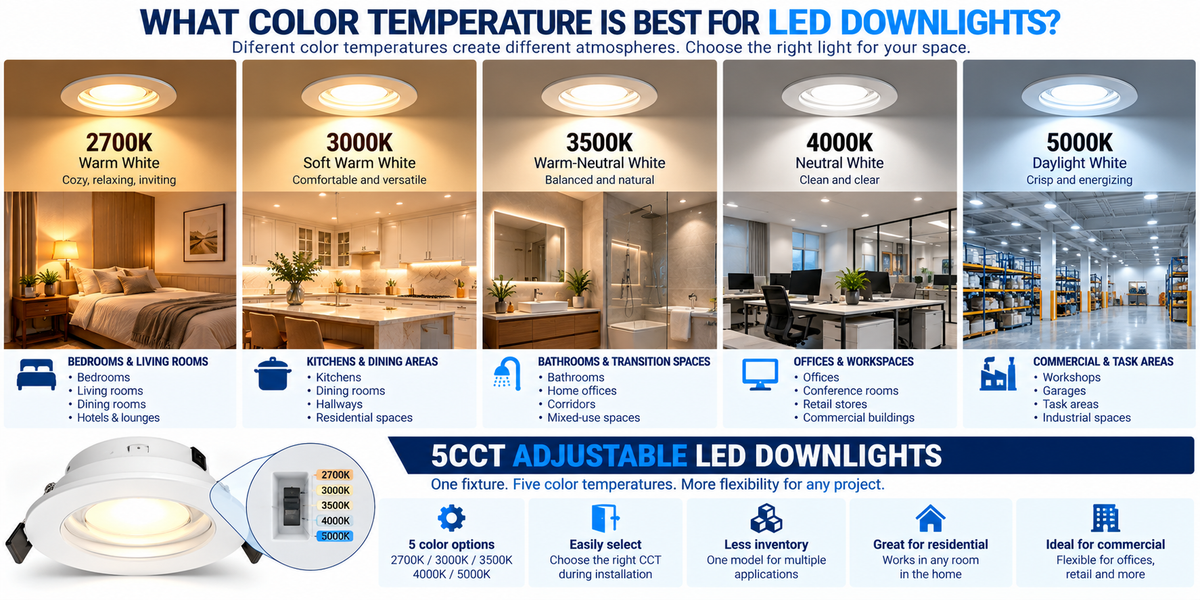
What Color Temperature Is Best for LED Downlights?
Choosing the right LED downlights involves more than selecting wattage, brightness, or fixture size.
One of the most important decisions is color temperature.
The color temperature of an LED downlight influences how a room looks, how materials appear, and how comfortable the lighting feels.
For example, a warm 2700K downlight can make a living room feel relaxing and inviting, while a 4000K downlight can create a cleaner, more neutral appearance in a kitchen or office.
But which color temperature is best?
The answer depends on the application.
For many residential spaces, 2700K–3000K is an excellent starting point. Kitchens, bathrooms, and work-oriented spaces often benefit from 3000K–4000K, while some commercial and task-focused environments may use 4000K–5000K.
Understanding these differences helps homeowners, contractors, and lighting designers make better decisions.
What Is LED Color Temperature?
Color temperature describes the appearance of white light.
It is measured in Kelvin (K).
Lower Kelvin values produce warmer-looking light with more yellow or amber tones.
Higher Kelvin values produce cooler-looking white light.
Unlike the physical operating temperature of the LED, color temperature describes the visual appearance of the light.
Common LED Downlight Color Temperatures
| Color Temperature | Appearance | Common Applications |
|---|---|---|
| 2700K | Warm white | Bedrooms, living rooms, hospitality |
| 3000K | Soft warm white | Homes, kitchens, dining rooms |
| 3500K | Warm-neutral white | Kitchens, bathrooms, offices |
| 4000K | Neutral white | Offices, workspaces, retail |
| 5000K | Daylight-like white | Workshops, task areas, commercial spaces |
| 6500K | Cool daylight-like white | Specialized work environments |
These are general recommendations rather than strict rules.
The best choice depends on the desired atmosphere, surface colors, and lighting requirements. Our 5CCT selectable downlights cover 2700K through 5000K in a single fixture.
2700K LED Downlights: Warm and Relaxing
2700K downlights produce a warm white appearance similar to traditional incandescent lighting.
This makes them particularly popular in residential and hospitality environments.
Best Applications
- Bedrooms
- Living rooms
- Dining rooms
- Hotel rooms
- Lounges
- Relaxation areas
Advantages
2700K creates a comfortable, welcoming atmosphere and complements warm interior finishes such as wood, beige walls, and traditional furniture.
When to Avoid It
In spaces where a crisp, neutral appearance is preferred, 2700K may feel too warm.
For example, some modern offices or commercial workspaces may benefit from a higher color temperature.
Best for: Comfortable, relaxing residential and hospitality lighting.
3000K LED Downlights: The Most Versatile Residential Choice
3000K is one of the most practical color temperatures for modern residential lighting.
It provides a balance between warmth and visual clarity.
Compared with 2700K, it looks slightly less yellow while maintaining a welcoming atmosphere.
Best Applications
- Living rooms
- Kitchens
- Dining rooms
- Hallways
- Bedrooms
- Residential bathrooms
- Hotel interiors
Why 3000K Is So Popular
3000K works with many interior design styles, including contemporary, transitional, and traditional spaces.
It can complement white cabinetry, natural wood, stone countertops, and neutral paint colors.
For contractors working on residential projects, 3000K is often a strong starting recommendation when the customer is unsure which color temperature to choose. A 4-inch selectable downlight lets that decision be made on site.
3500K LED Downlights: The Middle Ground
3500K sits between warm residential lighting and neutral commercial lighting.
It provides a balanced appearance that is less warm than 3000K but softer than 4000K.
Best Applications
- Modern kitchens
- Bathrooms
- Home offices
- Commercial corridors
- Reception areas
- Mixed-use spaces
3500K can be particularly useful when a project needs comfortable illumination without the warmer appearance of 2700K or 3000K.
It is also a good option for transitional spaces between residential and work-oriented environments.
4000K LED Downlights: Clean and Neutral
4000K provides a neutral white appearance.
It is commonly used in spaces where clarity, visibility, and a clean visual environment are priorities.
Best Applications
- Offices
- Modern kitchens
- Bathrooms
- Retail stores
- Commercial buildings
- Conference rooms
- Work areas
Advantages
4000K can create a fresh, neutral appearance that complements modern materials, white surfaces, and cooler interior color palettes.
However, it may feel less relaxing than warmer lighting in bedrooms or living rooms.
Best for: Work-oriented residential spaces and many commercial applications.
5000K LED Downlights: Daylight-Like Appearance
5000K produces a cooler, daylight-like white appearance.
It is often selected for applications where a crisp visual environment is preferred.
Best Applications
- Workshops
- Garages
- Utility rooms
- Certain commercial workspaces
- Technical areas
- Task-focused environments
5000K may be appropriate where visual tasks benefit from a cooler appearance.
However, higher color temperature does not automatically mean higher brightness or better visibility.
Actual illumination, glare, contrast, and color rendering remain important.
Which LED Downlight Color Temperature Is Best for Each Room?
Selecting the right color temperature becomes easier when you consider how each room is used.
| Room or Application | Recommended Starting Range |
|---|---|
| Living Room | 2700K–3000K |
| Bedroom | 2700K–3000K |
| Kitchen | 3000K–4000K |
| Bathroom | 3000K–4000K |
| Dining Room | 2700K–3000K |
| Hallway | 2700K–3500K |
| Home Office | 3000K–4000K |
| Retail Store | 3000K–4000K |
| Commercial Office | 3500K–4000K |
| Workshop | 4000K–5000K |
| Hotel Lobby | 2700K–3500K |
| Restaurant | 2700K–3000K |
These ranges provide useful starting points, but the final choice should reflect the project design. Because every range in this table falls within 2700K–5000K, a selectable-CCT downlight can cover all of them.
What Color Temperature Is Best for Kitchen Downlights?
For most residential kitchens, 3000K–3500K is an excellent starting range.
3000K works well when the kitchen is connected to a warm living or dining space.
3500K can provide a more neutral appearance while retaining some warmth.
4000K may be preferable for contemporary kitchens where a cleaner white appearance is desired. Our 6-inch slim flat panel covers all three settings.
Coordinate Downlights With Under-Cabinet LED Strips
A kitchen often uses multiple lighting layers:
- Recessed LED downlights
- Under-cabinet COB LED strips
- Pendant lights
- Cove lighting
- Decorative fixtures
For a cohesive appearance, the color temperatures should be coordinated.
For example:
3000K Downlights + 3000K COB Under-Cabinet Lighting
can create a consistent warm-white appearance.
Mixing 2700K downlights with 5000K cabinet lighting without a deliberate design reason may create an inconsistent result. Our guide on combining downlights and LED strips covers the layering in detail.
What Color Temperature Is Best for Living Room Downlights?
For most living rooms, 2700K or 3000K works particularly well.
These temperatures create a comfortable environment for:
- Watching television
- Relaxing
- Entertaining
- Reading
- Spending time with family
A 2700K option provides a more traditional warm appearance.
3000K can create a slightly cleaner, more contemporary look.
For rooms that serve multiple purposes, dimmable downlights can provide additional flexibility.
What Color Temperature Is Best for Bathroom Downlights?
Bathrooms commonly benefit from 3000K–4000K.
The best choice depends on the room's design and use.
3000K
Creates a warmer, spa-like atmosphere.
3500K
Balances comfort with a neutral appearance.
4000K
Provides a cleaner, more neutral visual environment.
For mirrors and grooming areas, color rendering and fixture placement are just as important as color temperature.
Avoid placing downlights where they create strong facial shadows. For bathrooms and hallways used at night, a downlight with an integrated nightlight provides low-level illumination without switching on the main fixture.
What Color Temperature Is Best for Office Downlights?
For many office environments, 3500K–4000K is a practical choice.
These color temperatures create a relatively neutral working environment.
However, office lighting should not be designed using CCT alone.
Professional lighting plans should also consider:
- Required illuminance
- Glare control
- Uniformity
- Flicker
- Color rendering
- Daylight availability
- Dimming and controls
A 5000K light is not automatically better for productivity than a 3500K or 4000K light.
Good lighting design depends on the complete system. Our guide on LED vs. fluorescent lighting covers office retrofits in more detail.
What Color Temperature Is Best for Retail Stores?
Retail lighting requires a balance between product visibility and atmosphere.
For many retail environments, 3000K–4000K provides useful flexibility.
Warm Retail Environments
3000K can work well for:
- Fashion boutiques
- Furniture stores
- Hospitality-inspired retail
- Warm interior designs
Neutral Retail Environments
3500K–4000K can work well for:
- Electronics
- Home improvement
- General merchandise
- Contemporary showrooms
Color rendering is especially important because lighting affects how customers perceive merchandise. For aiming light at displays and merchandise rather than straight down, a 90° tilt gimbal downlight provides directional control.
What Color Temperature Is Best for Restaurants?
Restaurants typically benefit from warmer lighting.
2700K–3000K can help create a comfortable dining atmosphere.
Different areas may require different lighting strategies.
For example:
Dining Area: 2700K–3000K
Reception: 3000K
Kitchen Work Area: 3500K–4000K, depending on requirements
The goal is to match lighting to the function of each space. For dark ceilings where the trim should recede, a 3-inch black trim downlight is a discreet option.
What Are 5CCT Adjustable LED Downlights?
One of the most practical developments in recessed lighting is the 5CCT adjustable LED downlight.
Instead of purchasing a fixture with one fixed color temperature, the installer can select from several available settings.
A common configuration includes:
2700K / 3000K / 3500K / 4000K / 5000K
The actual available settings depend on the product.
This makes 5CCT downlights particularly useful for contractors and project buyers. Most of our downlights use this configuration, including the 6-inch BN311-CCT and the Energy Star rated 4-inch BN310-CCT.
Why 5CCT Downlights Are Useful
1. Greater Installation Flexibility
The installer can select the desired color temperature for the room.
2. Easier Product Selection
One fixture model may accommodate several project preferences.
3. Reduced Inventory Complexity
Contractors and distributors may need fewer separate fixed-CCT SKUs.
4. Better Customer Satisfaction
The final setting can be selected after evaluating the interior finishes.
5. Useful for Renovations
Adjustable-CCT products can help match the desired appearance of existing lighting. For existing recessed cans, a 5CCT retrofit module replaces the lamp and trim in one piece.
Important: 5CCT Is Not Always Tunable White
This distinction matters.
A typical selectable 5CCT downlight uses a switch to choose a color temperature during installation.
For example:
2700K → 3000K → 3500K → 4000K → 5000K
The selected setting generally remains fixed until it is manually changed.
A tunable-white lighting system, by comparison, is designed to adjust color temperature electronically through compatible controls — for strip lighting, that means a CCT-adjustable COB strip with a CCT controller or a driver with built-in controls.
Therefore:
Selectable 5CCT ≠ Automatically Remote-Controlled Tunable White
Always verify the fixture's actual features.
Should All Downlights in a Room Have the Same Color Temperature?
In most residential and commercial installations, keeping the primary downlights at the same CCT provides a consistent appearance.
For example, a living room with ten downlights will generally look more cohesive when all ten use 3000K.
Mixing different CCT settings unintentionally can make parts of the ceiling or room appear mismatched.
However, different zones may intentionally use different temperatures.
For example, a large commercial space may have:
- Warm reception lighting
- Neutral office lighting
- Cooler task lighting
The important factor is intentional design. When using selectable-CCT fixtures, confirm that every fixture in a zone is set to the same position before closing the ceiling.
Does Higher Kelvin Mean Brighter LED Lighting?
No.
This is one of the most common misconceptions.
A 5000K downlight is not automatically brighter than a 3000K downlight.
Brightness is generally measured in lumens.
Color temperature describes the appearance of white light.
For example:
3000K Downlight — 900 Lumens
5000K Downlight — 900 Lumens
Both may have similar measured luminous output, although they look different.
Actual output may vary between CCT settings depending on the product. Lumen output at each setting is listed on our downlight product pages.
Color Temperature vs. CRI: What's the Difference?
Color temperature and CRI describe different lighting characteristics.
Color Temperature
Describes the warm or cool appearance of white light.
CRI
Describes how accurately certain colors appear under the light compared with a reference source.
A 3000K downlight can have either 80 CRI or 90+ CRI.
For spaces where color quality matters, such as kitchens, retail stores, and hospitality environments, 90+ CRI is a strong target — our downlights are rated at approximately CRI 90. Our guide on what CRI is best for kitchen lighting explains why this matters.
Does Color Temperature Affect Energy Consumption?
Not directly in the way many people assume.
Choosing 5000K instead of 3000K does not automatically reduce electricity use.
Energy consumption depends on the fixture's actual input wattage and operating conditions.
For example, two downlights rated at 10W may consume similar power even if one is 3000K and the other is 4000K.
Some adjustable-CCT products have slightly different lumen outputs or electrical characteristics at different settings.
Always review the product specifications.
How Does Ceiling Height Affect Color Temperature Selection?
Ceiling height influences lighting design, but it does not determine color temperature by itself.
A 12-foot ceiling does not automatically require 5000K lighting.
Instead, consider:
- Downlight lumen output
- Beam angle
- Fixture spacing
- Target illumination
- Surface reflectance
- Glare
- Room function
Color temperature should be selected according to the desired visual appearance and application. For higher ceilings where light needs aiming, an adjustable gimbal fixture can be more effective than a fixed downlight.
How to Match LED Downlights With COB LED Strip Lighting
Many modern lighting projects combine recessed downlights with COB LED strips.
For example:
Downlights: General illumination
COB Strips: Under-cabinet or cove lighting
Aluminum Channels: Finished linear lighting details
To achieve a coordinated design, consider matching CCT across the primary lighting layers.
Example: Residential Kitchen
- Downlights: 3000K
- Under-cabinet COB strip: 3000K
- Cove lighting: 3000K
Example: Modern Commercial Office
- Downlights: 4000K
- Linear LED lighting: 4000K
- Accent lighting: Selected according to the design
Matching CCT helps create a more cohesive visual result. Our COB strips are available in 2700K, 3000K, 4000K and 5000K to match the downlight settings.
However, LED products from different manufacturers can still have slight color differences even when labeled with the same Kelvin value. Color consistency and binning also matter.
How Dimming Affects the Appearance of Downlights
Dimming reduces light output, but ordinary LED dimming does not necessarily change color temperature.
For example, a standard 3000K downlight may remain approximately 3000K as it dims.
Some specialized warm-dim products are designed to become warmer as brightness decreases.
Therefore:
Dimmable ≠ Warm-Dim
Check the specific product capabilities.
Also verify compatibility between the downlight and its dimmer to avoid flicker, buzzing, or unstable operation. For LED strip layers in the same room, the driver's dimming method must also match the dimmer.
Why Contractors Benefit From Adjustable-CCT Downlights
For contractors managing multiple projects, 5CCT downlights can simplify product selection.
Imagine working on:
- A residential renovation
- A kitchen remodel
- A retail store
- A commercial office
Each project may require a different CCT.
With an appropriate 5CCT downlight, the installer can select the desired setting without necessarily ordering a separate fixed-CCT fixture for every application.
This can improve purchasing flexibility and simplify inventory management. Contact our team for wholesale pricing on project quantities.
However, installers should confirm the CCT setting before final installation and ensure consistency across each lighting zone.
Common Mistakes When Choosing LED Downlight Color Temperature
Avoid these common errors:
- Choosing 5000K simply because it seems brighter.
- Mixing 2700K and 4000K downlights unintentionally in one room.
- Ignoring the color temperature of COB strips and decorative fixtures.
- Selecting CCT without considering interior materials.
- Assuming higher Kelvin means better productivity.
- Confusing CRI with color temperature.
- Assuming every 5CCT downlight can change color temperature by remote control.
- Forgetting to test the lighting against actual wall and cabinet finishes.
- Choosing downlights based only on CCT instead of brightness and beam angle.
- Ignoring dimming compatibility.
A Practical Guide for Choosing the Right CCT
For professional projects, use this simple process.
Step 1: Identify the Space
Is the room intended for relaxation, general use, or detailed work?
Step 2: Determine the Desired Atmosphere
Warm and inviting, balanced, or clean and neutral?
Step 3: Evaluate Interior Materials
Wood, stone, paint, cabinetry, and flooring can all look different under various CCTs.
Step 4: Coordinate Other Light Sources
Check the CCT of LED strips, pendants, and decorative lighting.
Step 5: Select the Appropriate Downlight
Consider fixed-CCT or adjustable 5CCT products.
Step 6: Test Before Final Installation
When possible, compare the available color temperatures in the actual room.
Step 7: Confirm Brightness and Layout
Make sure the downlights provide the required illumination and coverage.
BrightNex LED Downlighting Solutions
At BrightNex LED, LED downlights can be incorporated into residential and commercial lighting systems alongside:
- COB LED strip lights
- Aluminum LED channels
- LED drivers and transformers
- Controllers and dimming components
For projects requiring flexibility, 5CCT adjustable LED downlights can simplify color temperature selection. Available sizes include 3-inch, 4-inch and 6-inch fixtures, plus gimbal, nightlight and retrofit versions.
Contractors can coordinate downlights with LED strip systems to create consistent lighting throughout kitchens, offices, retail spaces, and architectural environments. Our guide on building a complete LED lighting system covers the full specification process.
Final Takeaway
So, what color temperature is best for LED downlights?
The answer depends on the room and the desired atmosphere.
For most residential applications:
2700K–3000K is an excellent starting point.
For kitchens, bathrooms, and mixed-use spaces:
3000K–4000K provides useful flexibility.
For many commercial offices and workspaces:
3500K–4000K is a practical choice.
For some workshops and specialized task environments:
4000K–5000K may be appropriate.
And when project requirements are uncertain, 5CCT adjustable LED downlights provide a convenient way to select the desired color temperature during installation.
The best results come from considering:
Color Temperature + Lumens + CRI + Beam Angle + Placement + Dimming
rather than choosing Kelvin alone.
Frequently Asked Questions
Is 3000K or 4000K better for LED downlights?
3000K provides a warmer appearance and is popular in residential spaces. 4000K creates a more neutral appearance and is common in offices, kitchens, and commercial environments. A 5CCT selectable fixture offers both.
What color temperature is best for living room downlights?
2700K–3000K is generally a good starting range for comfortable living room lighting.
Is 4000K too bright for a living room?
4000K is not inherently brighter, but it looks cooler and more neutral than 2700K or 3000K. Many homeowners prefer warmer lighting for relaxation.
What color temperature is best for kitchen recessed lights?
3000K–3500K is a versatile choice for many residential kitchens. Some modern kitchens use 4000K.
What does 5CCT mean on an LED downlight?
It means the fixture offers five selectable color temperature settings. A common combination is 2700K, 3000K, 3500K, 4000K, and 5000K — the configuration used across our downlight range.
Can you change the color temperature after installing a 5CCT downlight?
Often yes, but it may require accessing the fixture's selector switch. The exact method depends on the product.
Does 5000K use more electricity than 3000K?
Not necessarily. Energy consumption depends on the actual fixture design and input power, not simply the Kelvin rating.
What CRI is best for LED downlights?
80+ CRI may be suitable for general applications, while 90+ CRI is a strong choice when color quality matters.
Should downlights and LED strips have the same color temperature?
For a consistent design, matching or carefully coordinating their CCTs is usually recommended. See our guide on combining downlights and LED strips.
Are adjustable-CCT downlights good for contractors?
Yes. They can provide flexibility across different projects and may reduce the need to stock multiple fixed-CCT versions.