
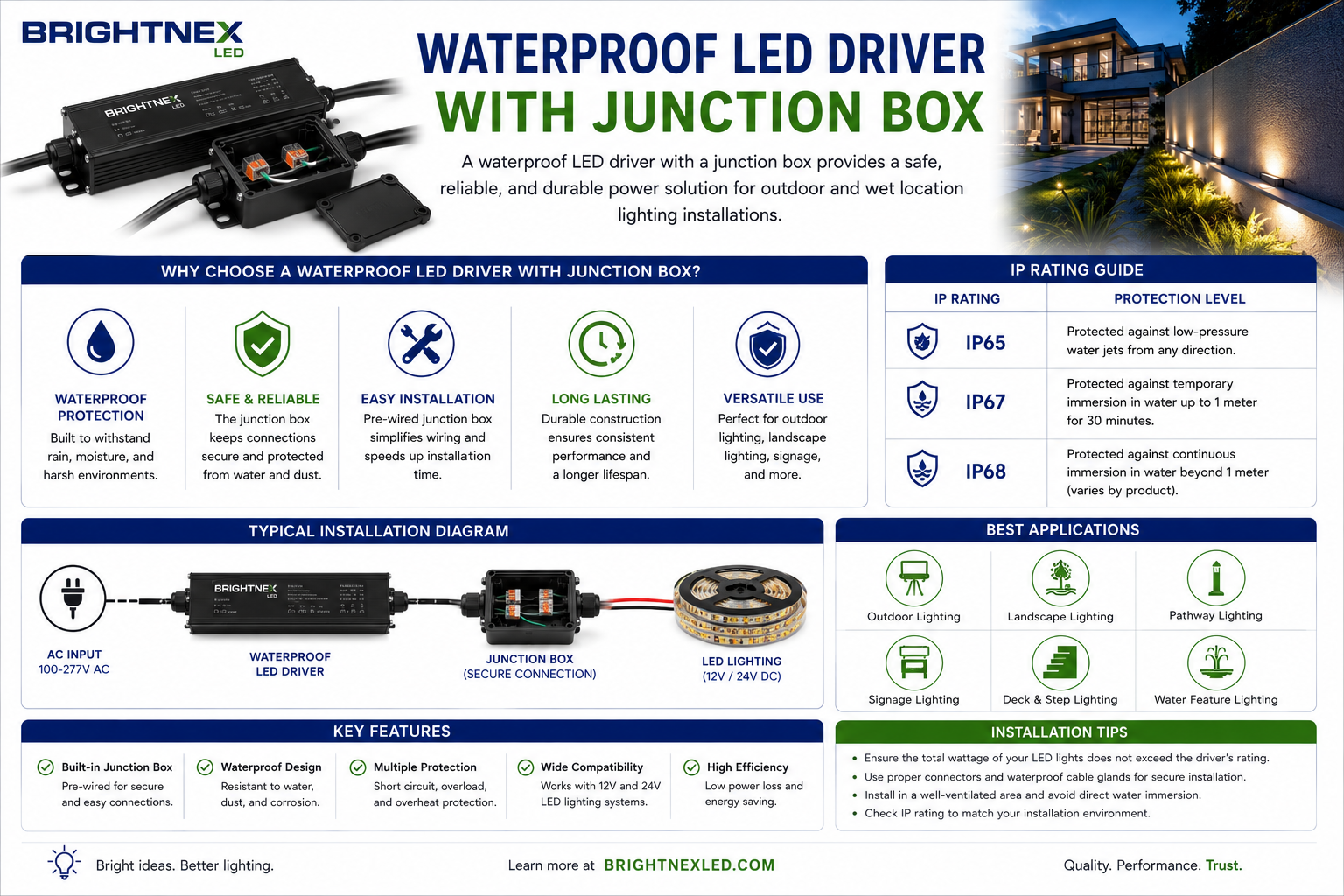
Outdoor strip lighting failures usually do not start with the LED tape. They start at the power point. A waterproof LED driver with junction box solves a problem trade buyers see all the time - exposed splices, poor enclosure choices, failed inspections, and call-backs in wet or damp locations. If the project includes exterior coves, landscape features, bathrooms, garages, or premium residential applications, the driver and its wiring compartment deserve the same attention as the fixture itself.
For electricians, lighting retailers, and project buyers, this is less about a feature list and more about installation risk. The right driver package helps protect line-voltage connections, keeps low-voltage output organized, and supports a cleaner, code-conscious layout. It also saves time on site, especially when crews are working on repeat specifications across multiple jobs.
Why a waterproof LED driver with junction box matters
A standard driver may be electrically suitable for an LED load, but that does not automatically make it suitable for the environment or the install method. When moisture, washdown exposure, or outdoor placement enters the picture, the connection point becomes critical. A waterproof LED driver with junction box gives installers a more controlled way to handle input wiring and output leads in one coordinated assembly.
That matters in luxury residential work and commercial-facing projects where exposed improvised connections are not acceptable. In high-end homes, clients care about clean results. Inspectors care about proper enclosure and rating. Contractors care about avoiding service issues six months later when water intrusion or loose connections start causing flicker or failure.
The junction box also helps from a labor standpoint. Instead of piecing together separate components in the field, installers can work with a purpose-built driver setup designed for wet, damp, or dry locations, depending on the model. That reduces guesswork and makes procurement simpler for buyers who need consistent inventory across jobs.
What trade buyers should check first
The first question is not wattage. It is location rating. A driver may be marketed as waterproof, but the full assembly still needs to match the actual environment. Wet location, damp location, and dry location are not interchangeable terms. Exterior soffits, hardscape lighting, pool-adjacent features, and exposed architectural details may require a higher level of protection than an indoor utility space.
Next comes certification. For professional US installations, UL-listed or UL-recognized components are not just a sales advantage - they are often the baseline expectation. Trade buyers supplying contractors or lighting stores should pay close attention to whether the driver, the junction box configuration, and the intended use align with project requirements.
Then check voltage and load compatibility. Most LED strip systems in residential and light commercial applications run on 12VDC or 24VDC. The driver needs to match the strip voltage exactly. After that, size the wattage with headroom. Running a driver at its absolute maximum can work on paper, but in the field it usually shortens comfort margins. Many pros prefer room above the connected load, especially in enclosed or warmer environments.
Dimming compatibility is where mistakes happen
A driver can be waterproof and still be the wrong choice if the dimming protocol does not match the control system. This is one of the most common issues in specification and purchasing. Contractors may have a TRIAC or ELV wall control already planned. A commercial job may require 0-10V. In some projects, non-dimming is the right answer because consistency matters more than control.
The junction box does not solve dimming mismatch. It simply makes the physical installation more organized. Buyers still need to verify whether the driver is TRIAC dimmable, ELV compatible, MLV compatible, or 0-10V ready. This becomes even more important on high-end residential projects where dimming performance is visible and client expectations are high. Smooth fade, low-end stability, and quiet operation all matter.
There is also a trade-off here. The more specific the dimming requirement, the narrower the driver options may become. Some buyers prioritize broad compatibility. Others choose a driver family around one known control platform to keep troubleshooting to a minimum.
Waterproof does not mean one-size-fits-all
Not every project needs the same driver body style or enclosure approach. Some jobs need compact drivers that can fit within tighter architectural spaces. Others need higher-output units to support long strip runs or multiple zones from a central location. The junction box can be a major advantage, but only if the physical dimensions fit the install.
That is especially relevant in millwork, outdoor niches, recessed cavities, and retrofit situations. A contractor may love the protection and convenience of an integrated junction box, but if the assembly is too large for the planned space, the install becomes harder, not easier. Good purchasing decisions balance environmental protection, power capacity, and real-world mounting conditions.
For large projects, consistency across the line matters too. If one driver family covers multiple wattages with similar form factors and connection logic, stocking and installation become more efficient. That is valuable for electrical distributors, lighting stores, and contractors managing repeat builds.
How this affects LED strip lighting performance
A quality driver does more than power the strip. It supports stable light output, predictable dimming, and long-term reliability. When a driver is undersized, incorrectly rated, or installed with weak connection protection, the first complaints often show up as flicker, intermittent sections, or premature failure.
In premium strip lighting applications, those issues are expensive. Under-cabinet lighting in a luxury kitchen, toe-kick lighting in a custom bath, or outdoor accent lighting in a Los Angeles hillside home all need consistent performance. If the power supply side is weak, the visual result suffers no matter how good the strip itself is.
This is why many professional buyers prefer drivers that pair safety certification with application-specific enclosure support. It reduces the chance that a high-quality strip system gets undermined by an afterthought power solution.
Buying for wholesale means buying for fewer call-backs
Wholesale purchasing is not just about unit cost. It is about field performance, compatibility confidence, and how easily crews can deploy the product at scale. A waterproof LED driver with junction box appeals to professional buyers because it addresses several jobsite variables at once: connection protection, cleaner installation, and easier specification for wet, damp, and dry locations when properly rated.
There is a margin benefit as well. Products that arrive with the right certifications and installation logic can reduce labor waste and return issues. That matters for contractors bidding competitively and for resellers who need dependable inventory that does not create support headaches later.
BrightNex LED focuses on this part of the market for a reason. Trade buyers do not need generic commodity power supplies that create questions in the field. They need professional-grade driver solutions built around real installation conditions, dimming needs, and US project standards.
What to ask before placing a bulk order
Before committing to a driver package for inventory or a large project, buyers should verify five things: exact input voltage range, output voltage, total wattage, dimming type, and location rating. That sounds basic, but most ordering mistakes trace back to one of those points.
It also helps to confirm how the driver will be used in relation to the strip layout. Long runs, multiple home runs, or grouped lighting zones can change the sizing approach. If the project is in a luxury residential setting, buyers should also think beyond electrical compatibility and consider serviceability. A driver that is easier to access and wire correctly is usually the smarter long-term choice.
Another practical question is whether the same driver family can support multiple strip options. For distributors and contractors working with COB, RGB, RGBW, CCT, or single-color strip lighting, product standardization can make purchasing cleaner and project execution faster.
The right driver protects the whole lighting package
A waterproof LED driver with junction box is not the glamorous part of an LED lighting system, but it is often the part that determines whether the install stays reliable. For trade buyers, that makes it a specification item, not an accessory. The best choice depends on the environment, the control method, the load, and the mounting conditions.
When those pieces line up, the result is straightforward: safer installs, cleaner wiring, stronger dimming performance, and fewer surprises after turnover. That is the kind of product decision professionals appreciate because clients rarely notice it when it is done right - and that is exactly the point.