
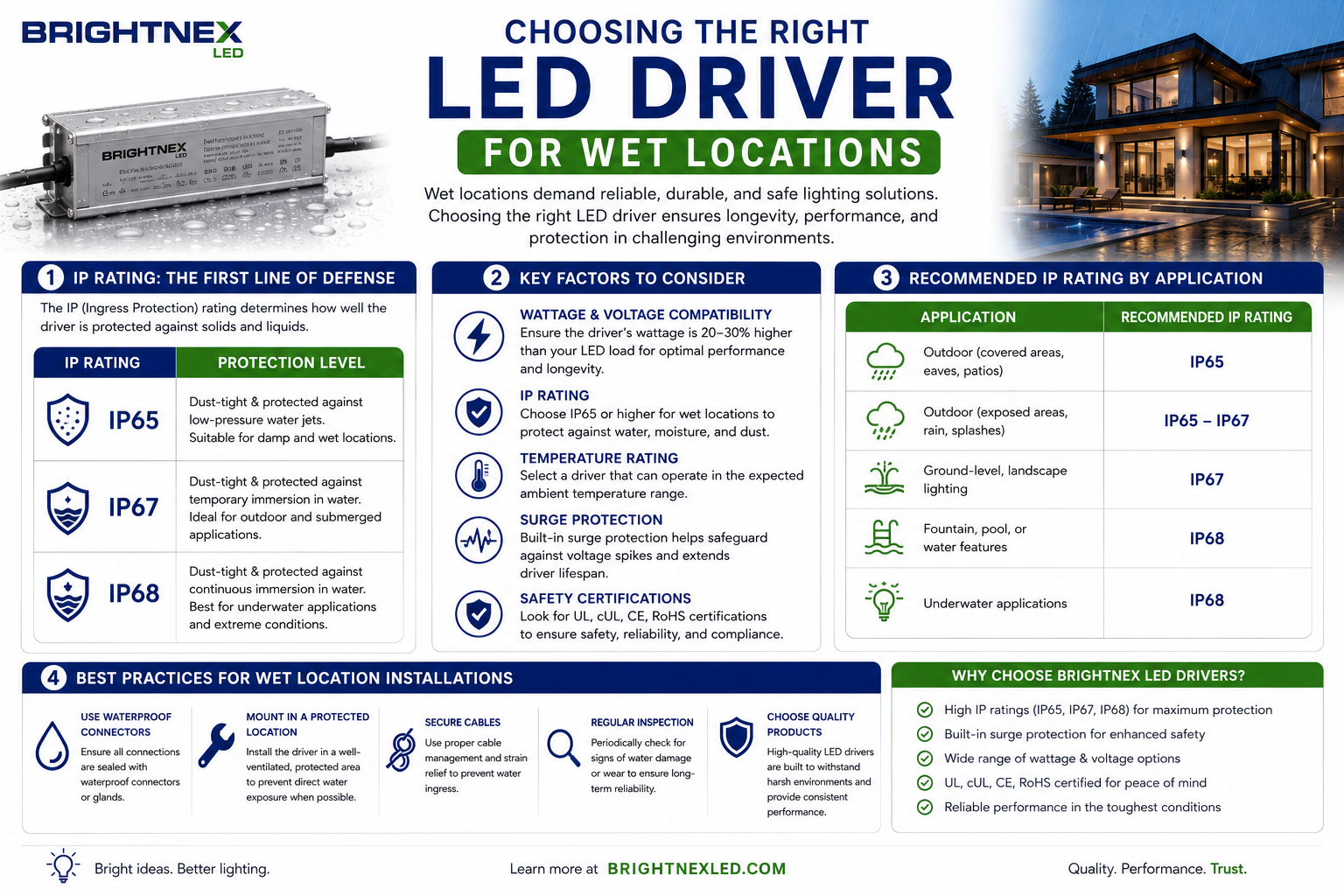
A callback for flicker near a pool deck or a dead strip run in an outdoor bar area usually traces back to one weak point - the power supply. Selecting the right led driver for wet locations is less about chasing wattage alone and more about matching rating, enclosure, dimming method, and installation method to the real jobsite conditions.
For trade buyers, that distinction matters. A premium strip light can still fail early if the driver is exposed to spray, trapped in a hot enclosure, or paired with the wrong dimmer protocol. On luxury residential and commercial projects, especially where lighting is integrated into millwork, hardscape, soffits, and exterior architectural details, the driver choice is part of the finish quality as much as the light output.
What a wet location actually means
In the field, "wet" gets used loosely, but code and product ratings are less forgiving. A wet location is an area subject to direct water exposure, weather, saturation, or routine washdown. That includes exterior walls, pool-adjacent features, landscape structures, outdoor kitchens, and certain commercial environments where moisture is constant.
That does not mean every driver used near the outdoors must sit fully exposed in the rain. Sometimes the LED load is in a wet location while the driver is mounted remotely in a protected section of the structure. Other times, the driver itself must carry the burden of environmental protection because there is no practical dry mounting point. That is where buyers need to separate wet, damp, and dry ratings instead of treating them as interchangeable.
A dry-rated driver belongs indoors in protected spaces. A damp-rated driver can tolerate humidity and indirect moisture but not direct water. A wet-location solution needs an enclosure and certification strategy suitable for direct environmental exposure. If the specification is vague, the safest move is to verify both the driver rating and the complete installation method, including junction box and conduit entry.
How to evaluate an LED driver for wet locations
The first checkpoint is certification. For professional installations in the US, UL listing carries real weight because inspectors, contractors, and project managers expect it. On wet-location jobs, certification is not just a sales feature. It supports code confidence and reduces risk when the driver is part of a hardwired system in a demanding environment.
The second checkpoint is enclosure design. A driver may advertise outdoor use, but the details matter. Is the housing sealed? Are wire entries protected? Does the unit include a junction box suitable for wet, damp, or dry locations as required by the project? Those questions affect longevity and installation speed. A driver with a properly matched junction box often saves labor and avoids improvised field protection that can compromise both safety and appearance.
The third checkpoint is thermal performance. Water resistance does not cancel heat. Drivers still need to dissipate heat effectively, and exterior installations can create difficult combinations of ambient heat, enclosed mounting cavities, and long operating hours. Overspecifying slightly on wattage headroom is often the smarter move, especially on premium residential installations where dimming smoothness and long-term reliability matter more than shaving a few dollars off initial material cost.
Dimming compatibility matters more outdoors than many buyers expect
An led driver for wet locations still has to perform like a good driver. That means stable output and predictable dimming, not just environmental protection. Exterior and semi-exterior applications often include dimmed accent lighting in patios, facades, landscape walls, and high-end outdoor living zones. If the dimming protocol is wrong, clients notice immediately.
TRIAC, ELV, MLV, and 0-10V each have their place, but they are not interchangeable. The right match depends on the control system, the fixture or strip load, and the project scope. On a luxury home, smooth low-end dimming can be just as important outdoors as it is in a kitchen or media room. On a commercial project, consistent behavior across multiple zones may matter more than ultra-low dimming range.
This is where trade buyers gain an advantage by sourcing from a supplier that understands driver compatibility rather than just moving boxes. If the strip type, load calculation, and dimmer family are all aligned upfront, the job runs cleaner and fewer field adjustments are needed.
Why junction boxes are part of the decision
A driver does not operate in isolation. Especially in hardwired strip lighting systems, the junction box is part of the protection strategy. On wet-location work, this can be the difference between a clean pass and a service issue six months later.
A proper junction box helps protect splices, supports compliant installation, and reduces the temptation for crews to create makeshift transitions in the field. For contractors managing multiple crews or repeat installations, driver packages that already account for wet, damp, and dry location needs streamline procurement and standardize results.
BrightNex LED focuses heavily on this practical side of the product. For professional buyers, drivers that come with junction box options for wet, damp, and dry locations solve a real problem - they reduce guesswork while protecting the finished installation.
Common mistakes when specifying drivers for wet environments
One of the most common mistakes is sizing too close to the calculated load. On paper, a 96W load on a 100W driver may appear acceptable. In a wet or outdoor environment with heat buildup, voltage drop concerns, and longer runtime, that little margin disappears quickly. A more conservative load percentage usually pays off in reliability.
Another mistake is assuming the LED strip's location rating covers the full system. It does not. A UL-marked strip can still be compromised by an unsuitable driver, poor connection protection, or an enclosure not intended for direct water exposure. The system has to be evaluated as a whole.
The third mistake is overlooking serviceability. Some concealed outdoor installations look excellent on day one but become expensive when a driver replacement requires opening finished surfaces. When possible, remote mounting the driver in a more accessible protected location is often the better engineering choice. It depends on run length, voltage drop, and project layout, but accessibility should be discussed before walls and ceilings are closed.
Where wet-location LED drivers are commonly used
For trade buyers, the strongest demand usually comes from outdoor strip lighting in soffits, eaves, patios, landscape features, exterior stair lighting, retaining walls, and pool-area accents. In these applications, visual quality matters, but so does resistance to weather and maintenance issues.
There is also steady need in hospitality and retail environments where exterior lighting supports branding and customer experience. Restaurants with illuminated bar fronts, hotels with facade accents, and storefronts with architectural grazing all depend on power components that can handle exposure without creating callbacks.
High-end residential work deserves special attention because expectations are higher. In many Los Angeles projects, LED strip systems are integrated into outdoor living spaces that blur the line between interior and exterior design. Those jobs need premium light quality, clean dimming, and drivers that belong in a professional-grade specification, not a bargain-bin substitute.
Buying considerations for wholesale customers
If you are purchasing in volume, consistency matters as much as unit price. The same driver family should be available across multiple wattages and dimming formats so your team can standardize stocking and simplify replacement. That lowers training time for installers and reduces compatibility mistakes in the field.
Lead time also matters. Drivers are rarely the glamorous line item, but they can hold up an entire installation if supply is unreliable. Wholesale buyers need predictable inventory, clear certification documentation, and product support that respects technical questions. A supplier serving electricians, lighting stores, and project buyers should be able to answer more than basic sales questions. They should understand dimming type, rating requirements, and system matching.
Price still counts, of course. But on wet-location projects, the cheapest driver often becomes the most expensive option once labor, troubleshooting, and replacement are factored in. Trade buyers protect margin by reducing failure risk, not by buying the lowest-cost box.
The right specification starts with the environment
Choosing an led driver for wet locations is really about reading the environment correctly. Will the driver face direct rain, washdown, or splash? Can it be mounted remotely in a protected area? Does the project require smooth dimming, Class 2 compliance, or a junction box that fits the installation method? Those answers shape the right product faster than wattage alone ever will.
On a professional job, the driver should disappear into the system by doing its job quietly for years. When the rating is right, the dimming is matched, and the installation method is built for moisture, the result is what every contractor wants - fewer callbacks, cleaner inspections, and lighting that still looks premium long after the project is complete.
The smartest buy is usually not the driver with the most claims on the label. It is the one that fits the real conditions of the site and supports the standard of work your customers expect.