
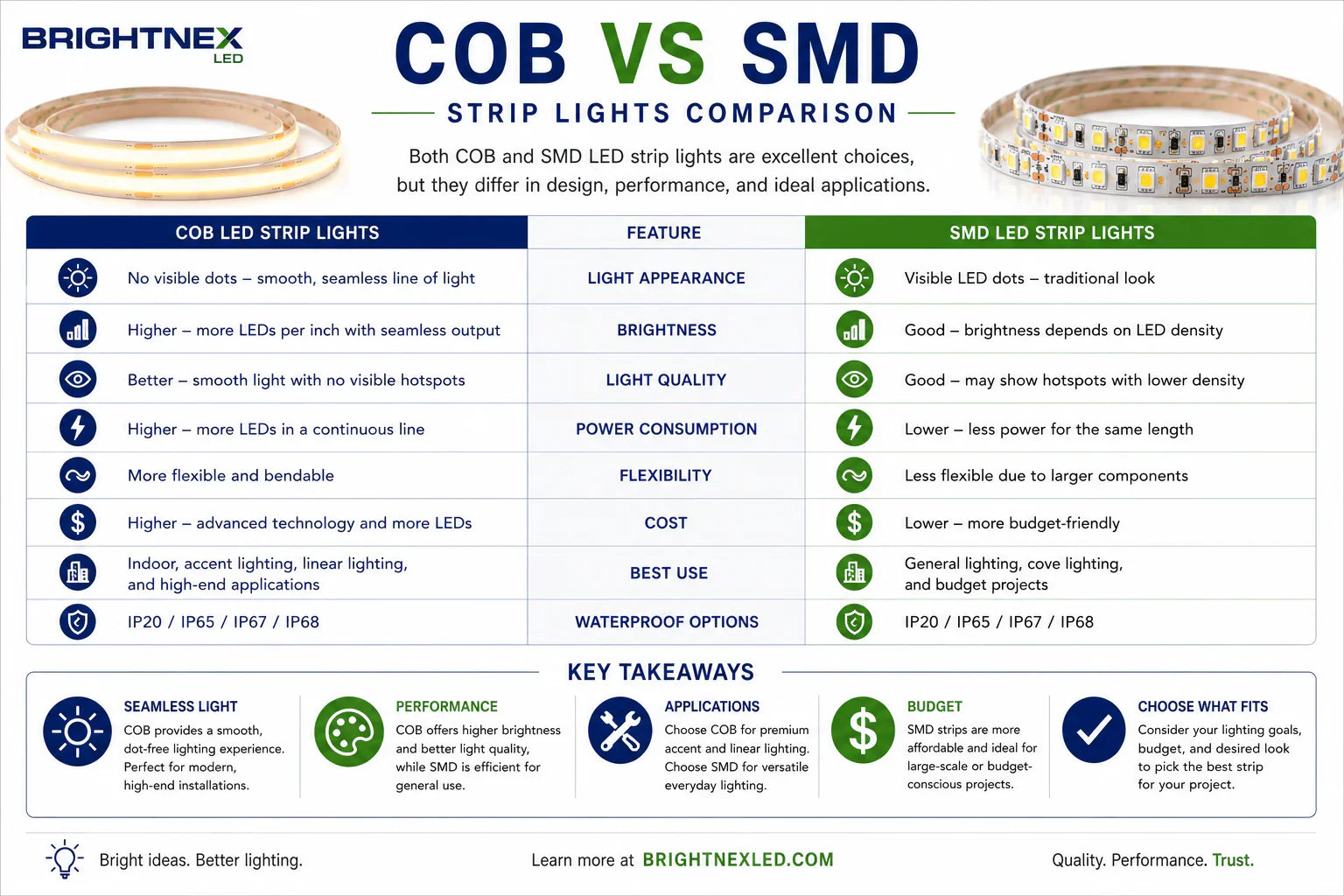
Why the COB vs SMD Decision Matters
A strip light can look excellent on a specification sheet and still fall short once installed in cabinetry, millwork, shelving, or architectural coves. That is why the COB vs SMD strip lights comparison remains one of the most important decisions for contractors, lighting dealers, and project buyers.
The choice affects visual appearance, installation requirements, profile depth, dimming performance, and overall project cost. In luxury residential and high-end commercial applications, the difference is often visible immediately.
For trade buyers, the goal is not choosing the newest technology. The goal is choosing the strip that delivers the right result for the application.
COB vs SMD Strip Lights: Understanding the Difference
The fundamental difference comes down to how the LEDs are built and arranged on the strip.
What Is COB LED Strip Lighting?
COB stands for Chip On Board.
Instead of mounting individual LED packages along the strip, COB technology places a large number of LED chips directly onto the circuit board and covers them with a phosphor layer.
This creates:
• Continuous light output
• Minimal visible spotting
• Smooth illumination
• Better appearance in shallow profiles
The result is a clean line of light that often appears almost seamless.
What Is SMD LED Strip Lighting?
SMD stands for Surface Mounted Device.
Each LED package is mounted individually along the strip at set intervals.
This design creates:
• Visible LED points
• Higher flexibility across product types
• Broad output options
• Wide availability
Depending on diode density and installation method, individual LED points may remain visible unless a diffuser or deeper profile is used.
Visual Appearance: Where COB Usually Wins
For many professional buyers, appearance is the biggest reason to select COB.
When installed under cabinets, inside shelving, or along decorative millwork details, the strip itself often becomes visible through reflections or direct sightlines.
In these situations, COB offers several advantages:
• Cleaner visual presentation
• Reduced hotspot visibility
• Better performance in shallow channels
• Premium architectural appearance
Luxury residential projects frequently favor COB for this reason.
A polished stone countertop or glossy cabinet finish can reflect every LED point from an SMD strip. COB minimizes this effect and creates a more refined result.
Where SMD Still Performs Well
SMD remains highly effective in many applications.
When the strip is:
• Hidden inside deep coves
• Installed behind quality diffusers
• Positioned away from direct sightlines
• Used in indirect lighting applications
The visible difference may become negligible.
In those cases, SMD can deliver excellent performance at a lower cost.
Many contractors continue using SMD successfully in:
• Cove lighting
• Signage
• Back bars
• Utility lighting
• General accent lighting
• Commercial installations
When diode visibility is not a concern, SMD often provides strong value.
Brightness and Light Output
One common misconception is that COB is automatically brighter.
That is not necessarily true.
Brightness depends on factors such as:
• Wattage
• LED density
• Driver quality
• PCB construction
• Thermal management
• Optical design
A high-performance SMD strip can easily outperform a lower-output COB strip.
Rather than comparing technologies alone, buyers should compare:
• Lumens per foot
• Watts per foot
• Efficacy
• Color consistency
• CRI
The application should determine which specification matters most.
Efficiency and Thermal Performance
Efficiency varies by product design rather than technology category.
Both COB and SMD products can deliver excellent efficacy when properly engineered.
However, thermal management remains critical for both.
Professional installations should always consider:
• Aluminum profiles
• Heat dissipation
• Ambient temperature
• Mounting surface material
A premium strip installed in poor thermal conditions may underperform regardless of technology.
COB vs SMD Strip Lights for Dimming
Dimming performance is often more important than the strip itself.
Both COB and SMD strips can dim exceptionally well when paired with compatible drivers and controls.
Problems usually come from system mismatches rather than strip design.
Common dimming methods include:
• TRIAC
• ELV
• MLV
• 0-10V
Regardless of strip type, professional buyers should verify:
• Driver compatibility
• Load sizing
• Voltage matching
• Dimming protocol support
Many flicker issues blamed on LED strips are actually caused by driver or dimmer incompatibility.
Color Options and Control Flexibility
Historically, SMD strips offered broader color-changing options.
Today, that gap has narrowed significantly.
Both COB and SMD technologies are available in:
• Single-color white
• Tunable white (CCT)
• RGB
• RGBW
• IC RGB
This means the selection process should focus more on appearance, installation requirements, and performance rather than assuming one technology supports more control options than the other.
COB for Tunable and Color-Changing Applications
Modern COB technology now supports:
• Tunable white systems
• RGB applications
• RGBW installations
• Architectural color-changing projects
The advantage remains the same:
A smoother visual line with fewer visible hotspots.
For visible installations, this can be a significant benefit.
Installation Considerations
Installation requirements often determine the best choice.
When COB Is the Better Installation Solution
COB is often preferred when:
• Profile depth is limited
• Direct visibility is unavoidable
• Architectural finish quality is critical
• Spot-free appearance is required
It performs particularly well in:
• Under-cabinet lighting
• Floating shelves
• Vanity lighting
• Luxury millwork
• Stair lighting
• Display shelving
When SMD Is the Better Installation Solution
SMD often makes more sense when:
• The strip is concealed
• Deep channels are available
• Cost efficiency matters
• High output is prioritized
Typical applications include:
• Cove lighting
• Indirect lighting
• Signage
• Utility lighting
• Commercial projects
PCB Width and Profile Compatibility
Regardless of technology, strip width matters.
Common widths include:
• 6.5mm
• 8mm
• 10mm
• 12mm
Professional buyers should always verify:
• Profile dimensions
• Channel compatibility
• Cabinet tolerances
• Mounting requirements
The best-performing strip still becomes a problem if it does not fit the intended profile.
Cost Comparison
Cost is often where the decision becomes practical.
Generally:
• COB carries a premium price
• SMD offers lower entry cost
However, cost should be evaluated against project expectations.
In luxury residential work, a slightly higher material cost may be justified if it improves:
• Visual quality
• Client satisfaction
• Installation appearance
• Long-term value
In concealed applications, that premium may not provide a meaningful benefit.
Certification and Compliance
For professional projects, certification remains critical.
Trade buyers should verify:
• UL certification
• Environmental ratings
• Driver compatibility
• Application suitability
Certification helps support:
• Inspection readiness
• Jobsite confidence
• Code compliance
• Long-term reliability
This is especially important when supplying products for residential and commercial projects throughout the United States.
How Trade Buyers Should Choose
The easiest way to decide is to start with visibility.
Choose COB when:
• The strip may be seen directly
• Reflections are likely
• The project is appearance-sensitive
• Profile depth is limited
• Premium finish quality is required
Choose SMD when:
• The strip is hidden
• Deep diffusion is available
• Cost efficiency is important
• Visibility is minimal
Neither technology is universally superior.
The best choice depends entirely on the application.
Conclusion
The COB vs SMD strip lights debate is not really about which technology is better. It is about which technology better fits the installation.
COB excels when visual refinement matters most. It creates smoother light lines, minimizes spotting, and helps deliver the premium appearance expected in luxury residential and architectural projects.
SMD remains a dependable and cost-effective solution for countless commercial and residential applications where visibility is limited and performance requirements are different.
For professional buyers, the smartest specification balances appearance, performance, compatibility, installation conditions, and budget. When those factors align, both COB and SMD can deliver outstanding results.
FAQ
Which is better, COB or SMD LED strip lights?
Neither is universally better. COB is usually preferred for visible architectural lighting, while SMD is often more cost-effective for concealed applications.
Are COB strip lights brighter than SMD strips?
Not necessarily. Brightness depends on wattage, LED density, efficiency, and overall product design.
Do COB strips eliminate LED hotspots?
COB strips significantly reduce visible hotspots and create a much smoother light line than traditional SMD strips.
Can COB strip lights be dimmed?
Yes. COB strips can dim very effectively when paired with compatible drivers and dimming controls.
Are SMD strips still used in professional projects?
Absolutely. SMD strips remain widely used in commercial, residential, signage, and indirect lighting applications due to their flexibility and value.