
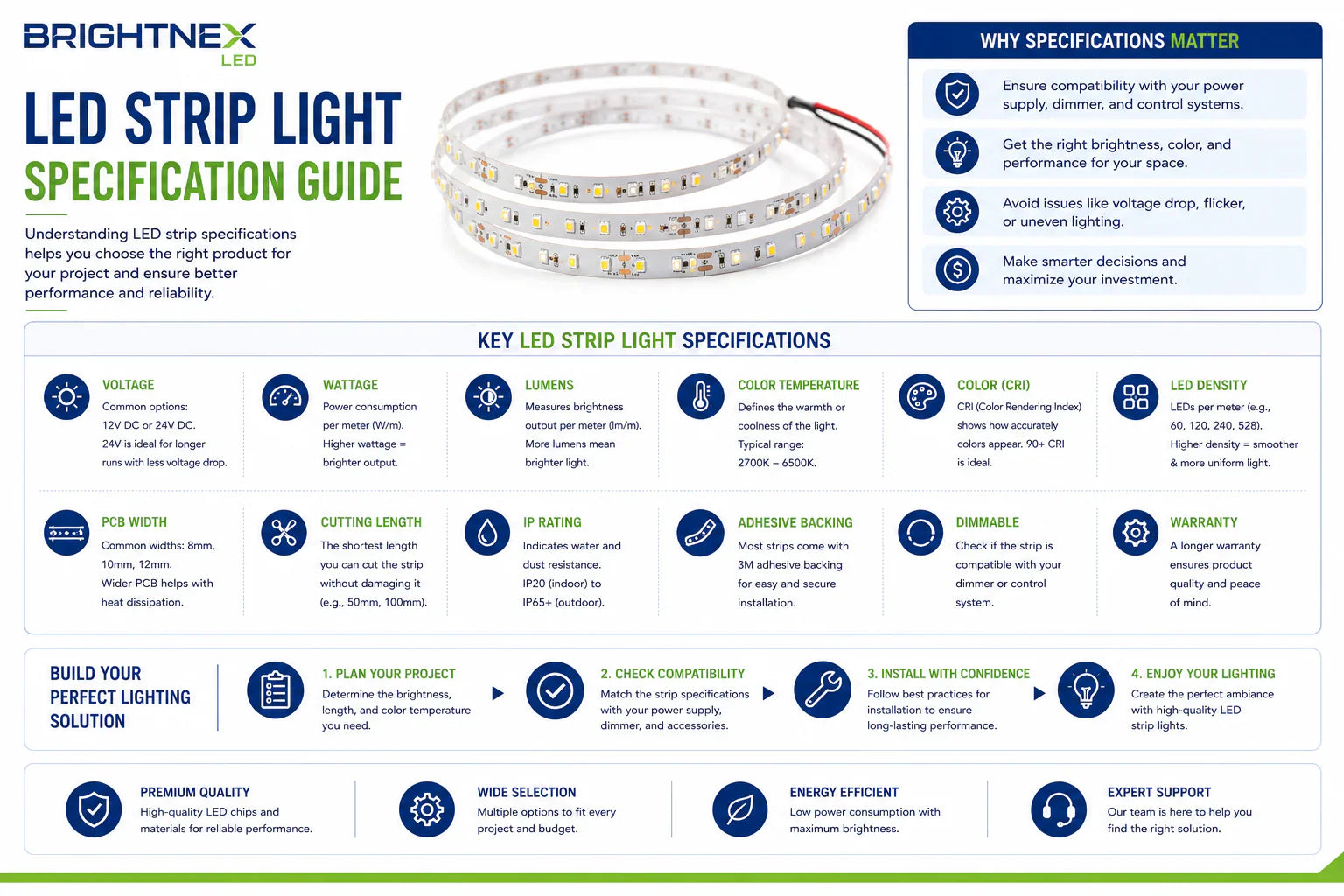
Why Specifications Matter More Than Product Photos
A strip light can look impressive online and still perform poorly in the field if the specifications do not match the application. For electricians, contractors, lighting dealers, and project buyers, specifications determine how the product installs, performs, dims, and holds up over time.
Whether the project involves luxury residential millwork, under-cabinet lighting, retail displays, hospitality spaces, or architectural coves, selecting the right strip starts with understanding the technical details. This LED strip light specification guide explains the most important factors professionals should evaluate before purchasing.
Start with Voltage
Voltage is one of the first specifications that affects installation planning.
Most professional LED strip systems use either:
• 12V DC
• 24V DC
Both options have advantages.
12V LED Strips
12V strips are often selected when:
• Shorter runs are required
• Tight cut intervals are important
• Small custom sections need flexibility
24V LED Strips
24V strips are often preferred when:
• Longer runs are needed
• Voltage drop must be minimized
• Large architectural applications are involved
• Fewer power injection points are desired
For many premium residential and commercial projects, 24V systems provide better overall performance across longer distances.
Understanding Voltage Drop
Voltage drop is one of the most common causes of uneven strip performance.
As current travels through the strip and supply wiring, voltage gradually decreases. This can cause:
• Reduced brightness
• Color shifting
• Uneven output
• Dimming instability
Long runs, higher wattage strips, and undersized wiring increase the risk.
Professional installations often use:
• Center feeding
• Dual-end feeding
• Power injection
• Larger wire gauges
These techniques help maintain consistent output across the full run.
Wattage and Power Consumption
Wattage tells you how much power the strip consumes.
Higher wattage typically means:
• Higher brightness
• Increased heat generation
• Larger driver requirements
However, higher wattage is not always better.
A kitchen under-cabinet application may need significantly different output than a decorative cove or shelving detail.
The goal is to match output to the application rather than simply choosing the highest-powered strip available.
Lumen Output and Efficacy
Lumens measure light output.
Higher lumens generally create brighter installations.
Common applications include:
• Accent lighting
• Task lighting
• Display lighting
• Architectural lighting
Efficacy measures how efficiently the strip converts power into usable light.
While efficacy matters, professional buyers often balance efficiency against:
• Color quality
• CRI
• Diffusion performance
• Visual appearance
In luxury projects, visual quality often takes priority over maximum efficiency.
Color Temperature Selection
Color temperature dramatically affects how a space feels.
Common options include:
2700K – Warm White
Ideal for:
• Luxury homes
• Hospitality environments
• Living spaces
• Bedrooms
3000K – Warm White
Popular for:
• Kitchens
• Residential interiors
• Retail applications
4000K – Neutral White
Common in:
• Offices
• Workspaces
• Commercial environments
5000K+ – Cool White
Used where:
• Maximum visibility is required
• Industrial environments are involved
• Task-oriented lighting dominates
Selecting the correct color temperature should align with the design intent of the project.
Color Consistency Matters
The specified Kelvin temperature is only part of the story.
Professional buyers should also consider:
• LED binning consistency
• Batch-to-batch stability
• Color uniformity
Large residential and commercial projects depend on consistent color across multiple reels and future reorder cycles.
Single Color, CCT, RGB, RGBW, and IC RGB
Different strip types serve different purposes.
Single Color
Best for:
• Standard architectural lighting
• Consistent white illumination
CCT Tunable White
Allows adjustment between warm and cool white tones.
Ideal for:
• Luxury homes
• Hospitality spaces
• Adaptive environments
RGB
Provides decorative color-changing effects.
Best suited for:
• Accent lighting
• Entertainment spaces
RGBW
Adds a dedicated white channel for better everyday lighting.
Often preferred for:
• Architectural applications
• High-end residential installations
IC RGB
Provides individual pixel control.
Used for:
• Dynamic lighting effects
• Entertainment environments
• Specialty installations
CRI and Light Quality
Color Rendering Index (CRI) measures how accurately colors appear under the light source.
Higher CRI is especially important for:
• Kitchens
• Retail displays
• Bathrooms
• Luxury residential spaces
• Wood finishes
• Stone surfaces
• Artwork
Premium installations typically prioritize higher CRI because it helps materials appear more natural and visually appealing.
PCB Width and Profile Compatibility
PCB width determines whether the strip will fit inside the intended aluminum profile.
Common widths include:
• 6.5mm
• 8mm
• 10mm
• 12mm
This specification becomes critical when:
• Profiles are already selected
• Millwork dimensions are fixed
• Recessed channels are tight
Always verify profile compatibility before ordering large quantities.
COB vs SCOB Technology
COB strips use densely packed LED chips to create a smooth, dot-free light line.
Benefits include:
• Reduced spotting
• Better visual continuity
• Excellent performance in shallow channels
SCOB strips add an additional silicone diffusion layer that may provide:
• Enhanced surface protection
• Improved visual smoothness
• Additional environmental resistance
Both technologies are popular in premium residential and architectural lighting projects.
IP Rating and Environmental Protection
Environmental rating should match the installation conditions.
Common categories include:
Dry Location
Suitable for:
• Interior millwork
• Closets
• Living spaces
Damp Location
Suitable for:
• Bathrooms
• Covered outdoor areas
• Utility spaces
Wet Location
Suitable for:
• Exterior applications
• Areas exposed to direct moisture
Remember that drivers, connectors, and accessories must also be rated appropriately.
The strip alone does not determine system suitability.
Dimming Compatibility
Dimming performance is one of the most important specifications in professional installations.
Common dimming methods include:
• TRIAC
• ELV
• MLV
• 0-10V
These methods are not interchangeable.
The strip, driver, and control system must be selected together.
Common dimming problems caused by mismatched components include:
• Flicker
• Buzzing
• Dead travel
• Poor low-end performance
• Inconsistent startup
Premium residential projects place especially high demands on dimming quality.
Driver Compatibility and Sizing
The driver should be treated as part of the lighting system.
Verify:
• Output voltage
• Total wattage
• Dimming method
• Environmental rating
• Installation location
Most professionals size drivers with approximately 20% capacity headroom to improve reliability and thermal performance.
Certification and Compliance
Certification is a critical specification for professional buyers.
UL-certified products support:
• Inspection readiness
• Code compliance
• Jobsite confidence
• Reduced liability
Trade buyers should verify certification not only for the strip itself but also for:
• Drivers
• Transformers
• Controllers
• Related components
A certified system is generally easier to specify and support over the long term.
How to Read an LED Strip Specification Sheet
A practical review process typically follows this order:
- Voltage
- Wattage
- Maximum run length
- Color temperature or color type
- CRI
- PCB width
- IP rating
- Dimming compatibility
- Driver requirements
- Certification status
Reviewing specifications in this order helps identify compatibility issues before materials are purchased.
Common Specification Mistakes
The most common mistakes include:
• Ignoring voltage drop
• Choosing wattage without considering heat
• Forgetting profile compatibility
• Overlooking dimming requirements
• Mixing incompatible system components
• Selecting products based only on price
Most field problems can be traced back to one of these issues.
Conclusion
The best LED strip lighting installations start with proper specification review long before the product arrives on site.
Voltage, wattage, color quality, CRI, profile fit, dimming compatibility, environmental rating, and certification all influence the final result.
For contractors, lighting dealers, and project buyers, the goal is not simply purchasing a strip light. The goal is selecting a complete system that installs cleanly, performs consistently, and delivers the finish quality the project demands.
When specifications are reviewed carefully and matched to the application, the installation becomes easier, the lighting performs better, and callbacks become far less likely.
FAQ
What voltage is best for LED strip lights?
24V is generally preferred for longer runs because it reduces voltage drop, while 12V works well for shorter runs and tighter cut intervals.
Why is CRI important for LED strip lighting?
Higher CRI improves color accuracy and helps materials such as wood, stone, paint, and fabrics appear more natural.
What is the difference between COB and SCOB strips?
COB uses densely packed LED chips for a smooth light line. SCOB adds a silicone diffusion layer for additional protection and visual refinement.
Why does PCB width matter?
PCB width determines compatibility with aluminum channels, profiles, cabinetry details, and recessed installations.
What is the most common cause of LED strip dimming problems?
Driver and dimmer incompatibility is one of the most common causes of flicker, buzzing, and poor dimming performance.