
Why Dimming Selection Matters
Many LED lighting problems are not caused by the fixture or strip light itself. They start with the dimming system. Flicker, buzzing, poor low-end performance, and inconsistent dimming behavior are often the result of choosing the wrong control method for the application.
For electricians, contractors, lighting dealers, and project buyers, understanding the differences between TRIAC and 0-10V dimming helps reduce callbacks, improve installation quality, and support better long-term performance.
The best dimming solution depends on the project type, wiring conditions, control requirements, and customer expectations.
TRIAC vs 0-10V Dimming: The Basic Difference
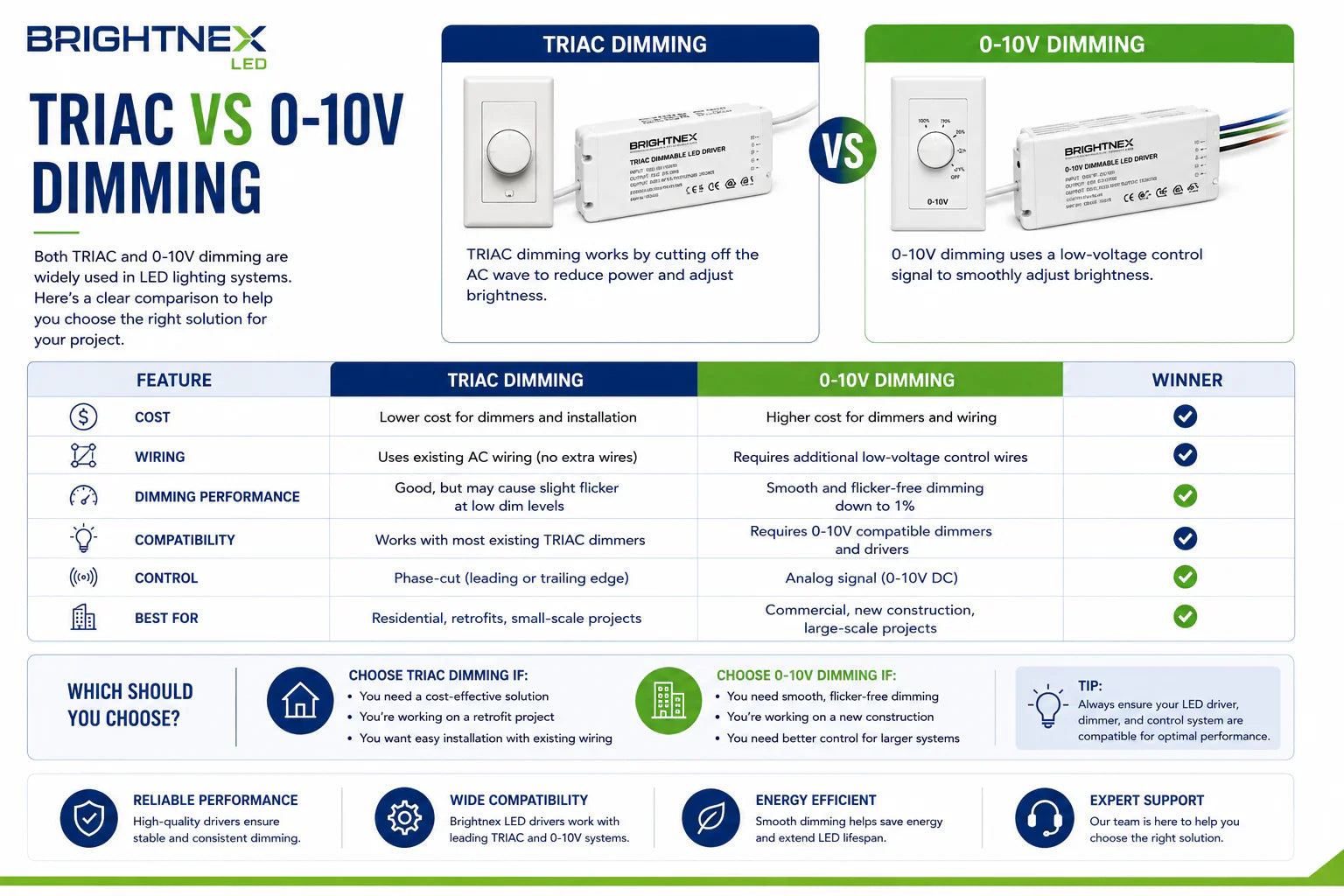
TRIAC dimming uses phase-cut technology to reduce light output. A wall dimmer modifies the incoming AC power signal, and the LED driver interprets that signal to adjust brightness.
0-10V dimming uses a separate low-voltage control signal. Instead of modifying the AC waveform, the controller sends a signal between 0 and 10 volts directly to the driver, which then adjusts light output.
In simple terms:
• TRIAC controls brightness through line-voltage dimmers
• 0-10V controls brightness through dedicated low-voltage control wiring
Both methods can work extremely well when properly designed and installed.
How TRIAC Dimming Works
TRIAC dimming is one of the most common residential dimming methods in North America.
It is widely used because:
• Existing wall dimmers can often remain in place
• Retrofit projects are easier
• Installation is familiar to most electricians
• Products are widely available
TRIAC dimmers operate by cutting part of the AC waveform before it reaches the driver.
The driver then converts that modified signal into the appropriate LED output level.
This approach works particularly well for many residential applications.
Where TRIAC Dimming Works Best
TRIAC dimming is often the preferred choice for:
• Residential remodels
• Existing homes
• Single-room upgrades
• Under-cabinet lighting
• Recessed downlights
• Accent lighting
• Small strip-light installations
If the project already has wall dimmer wiring installed, TRIAC is frequently the simplest solution.
Advantages of TRIAC Dimming
Some of the biggest benefits include:
• Easy retrofit installation
• Familiar controls
• Lower installation complexity
• Broad product availability
• Reduced wiring requirements
For many residential jobs, these advantages make TRIAC the most practical option.
Limitations of TRIAC Dimming
TRIAC systems can be more sensitive to compatibility issues.
Common challenges include:
• Flicker
• Buzzing
• Dead travel
• Limited dimming range
• Driver-to-dimmer mismatch
Performance often depends heavily on the specific driver and dimmer combination.
Not all TRIAC-compatible products perform equally.
How 0-10V Dimming Works
0-10V dimming uses a dedicated control signal separate from line-voltage power.
The driver receives:
• Constant AC power
• Separate 0-10V control input
The control signal tells the driver exactly how much light output to produce.
Because the dimming signal is independent of the incoming power waveform, control tends to be smoother and more predictable.
Where 0-10V Dimming Works Best
0-10V is commonly used in:
• Commercial buildings
• Hospitality projects
• Large residences
• Multi-zone lighting systems
• Architectural lighting
• Cove lighting
• Premium LED strip installations
Projects with centralized control systems often benefit from 0-10V dimming.
Advantages of 0-10V Dimming
Key benefits include:
• Smooth dimming performance
• Stable low-end operation
• Better multi-zone control
• Easier system scalability
• Reduced compatibility issues
For projects where lighting quality is a major priority, these advantages can be significant.
Limitations of 0-10V Dimming
The primary drawback is installation complexity.
0-10V systems require:
• Additional control wiring
• More planning during construction
• Compatible control devices
• Proper polarity management
For simple retrofit projects, these requirements may not be justified.
Installation Considerations
The choice between TRIAC and 0-10V often depends on what is already inside the walls.
Residential Retrofits
If standard wall dimmers already exist, TRIAC typically offers the fastest and most economical solution.
Benefits include:
• Minimal rewiring
• Lower labor costs
• Faster installation
This is why TRIAC remains extremely popular for residential renovations.
New Construction Projects
When walls are open and wiring is being planned from the beginning, 0-10V becomes much more attractive.
Additional control wiring can be installed during rough-in without major cost impact.
This provides greater flexibility later.
Commercial Projects
Commercial buildings frequently favor 0-10V because:
• Multiple zones are common
• Centralized controls are common
• Larger loads require coordination
• Long-term flexibility is important
In these environments, the benefits often outweigh the added wiring requirements.
TRIAC vs 0-10V for LED Strip Lighting
LED strip lighting places greater emphasis on dimming quality because imperfections are highly visible.
Applications include:
• Cove lighting
• Cabinet lighting
• Toe-kick lighting
• Floating shelves
• Architectural reveals
In these settings:
TRIAC performs very well when the driver and dimmer are properly matched.
0-10V often provides smoother and more predictable performance across larger or more complex installations.
For luxury residential applications, both can work successfully when specified correctly.
Which Option Is Better for Luxury Homes?
Luxury residential projects often prioritize:
• Smooth dimming
• Quiet operation
• Consistent low-end performance
• Multiple lighting scenes
For smaller systems, TRIAC frequently remains the practical solution.
For larger homes with multiple lighting zones and sophisticated controls, 0-10V often provides more flexibility and refinement.
The answer depends on the lighting design and control strategy.
Cost Considerations
TRIAC generally has lower upfront costs because:
• Existing wiring can often be reused
• Installation is simpler
• Controls are widely available
0-10V may require:
• Additional wiring
• More planning
• Dedicated control hardware
However, lower initial cost does not always mean lower total cost.
A poorly matched TRIAC system can generate callbacks that quickly erase any upfront savings.
Professional buyers should evaluate installation cost, performance expectations, and long-term reliability together.
How to Choose Between TRIAC and 0-10V
TRIAC is often the better choice when:
• The project is a retrofit
• Existing dimmer wiring is being reused
• The lighting system is relatively simple
• Installation speed matters
0-10V is often the better choice when:
• The project is new construction
• Multiple lighting zones are planned
• Architectural lighting quality is critical
• Centralized control is desired
• Scalability is important
The correct choice depends on the project rather than a universal ranking.
Professional Buying Considerations
Before selecting a dimming method, verify:
• Driver compatibility
• Control requirements
• Installation environment
• Load size
• Wiring conditions
• Future expansion needs
Dimming should be treated as a system specification rather than an individual product feature.
The best results come from matching the driver, controls, and lighting products from the beginning of the project.
Conclusion
The TRIAC vs 0-10V dimming decision is not about which technology is universally better. It is about selecting the right control method for the application.
TRIAC remains an excellent solution for many residential retrofit projects where simplicity and existing wiring are important.
0-10V offers greater control flexibility, smoother performance, and better scalability for larger residential and commercial lighting systems.
When the dimming method, driver, and lighting products are selected as one coordinated system, both technologies can deliver reliable, professional results with minimal callbacks.
FAQ
Is TRIAC dimming better than 0-10V?
Not necessarily. TRIAC is often better for retrofits, while 0-10V is often better for larger or more advanced lighting systems.
Does 0-10V require extra wiring?
Yes. A separate low-voltage control pair is typically required.
Which dimming method is best for residential projects?
TRIAC is common for residential retrofits, while 0-10V is often used in larger custom homes and new construction.
Can LED strip lights use both TRIAC and 0-10V dimming?
Yes, provided the driver is designed for the selected dimming method.
Which dimming method provides smoother low-end dimming?
In many applications, 0-10V offers more predictable low-end dimming performance, although high-quality TRIAC systems can also perform very well.