
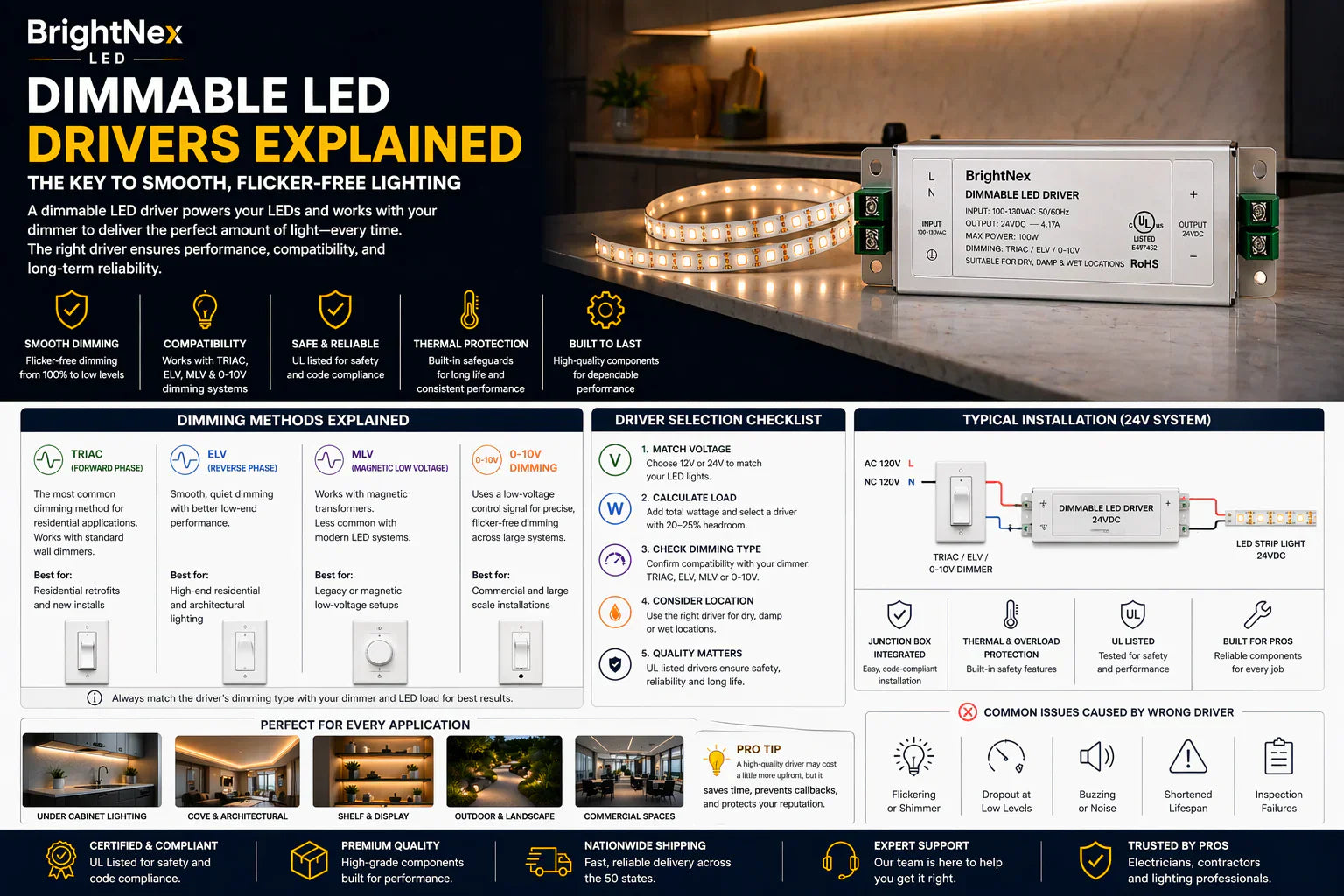
Why Dimmable LED Drivers Matter
Most people see the dimmer switch on the wall, but the component that actually determines dimming performance is the LED driver hidden behind the scenes. Whether installed above a ceiling, inside a junction box, or concealed within cabinetry, the driver controls how smoothly the lighting system operates.
For contractors, electricians, lighting stores, and project buyers, the driver is far more than a power supply. It directly affects dimming quality, installation efficiency, inspection readiness, and long-term reliability. When lighting is a key design element—as it often is in luxury homes, hospitality spaces, and architectural projects—the wrong driver can create flicker, instability, and expensive callbacks.
Understanding how dimmable LED drivers work helps professionals make better purchasing decisions and avoid performance issues long before they appear on the jobsite.
What Does a Dimmable LED Driver Do?
An LED driver converts incoming electrical power into the voltage or current required by LED products while regulating output to ensure safe and stable operation.
A dimmable LED driver adds another layer of functionality by allowing the light output to respond to a compatible dimming signal. As the dimmer adjusts the control signal, the driver changes the amount of power delivered to the LEDs, creating smooth brightness control.
Before selecting a dimmable driver, it is important to determine whether the lighting application requires a constant voltage or constant current solution.
Most LED strip lights operate with constant voltage drivers, while many fixtures and LED modules use constant current drivers. Matching the correct driver type to the LED load is always the first step. Dimming compatibility comes second.
Understanding Different Dimming Technologies
Not all dimmable drivers communicate with dimmers in the same way. The dimming method must be selected based on the project requirements, lighting controls, and installation environment.
TRIAC Dimming
TRIAC dimming remains one of the most common choices for residential projects because it works with many existing wall-box dimmers already installed in homes.
This makes TRIAC drivers particularly useful for remodeling projects and lighting upgrades where replacing control wiring is not practical. Contractors often choose TRIAC solutions because they provide a familiar installation process while maintaining good dimming performance when properly matched.
However, not every TRIAC dimmer and driver combination performs equally. Poor compatibility can lead to flicker, sudden light drop-off, or limited dimming range.
ELV Dimming
Electronic Low Voltage (ELV) dimming is frequently specified in higher-end residential applications where smooth dimming and superior low-end performance are priorities.
ELV systems are often selected for luxury kitchens, custom millwork lighting, premium strip lighting installations, and architectural applications where clients expect flawless lighting behavior.
Compared to standard forward-phase dimming, ELV often delivers cleaner and more refined performance, especially at lower brightness levels.
MLV Dimming
Magnetic Low Voltage (MLV) dimming is designed for systems that use magnetic transformers.
Although less common in many modern LED strip lighting projects, MLV still appears in certain specialty applications. The key consideration is ensuring that the dimmer, driver, and transformer type are all compatible.
Using ELV and MLV components interchangeably can create dimming problems, audible noise, and reduced system performance.
0-10V Dimming
0-10V dimming is widely used in commercial, hospitality, and larger architectural lighting systems.
Unlike phase-cut dimming methods, 0-10V uses a dedicated low-voltage control signal to adjust brightness. This often results in highly predictable dimming behavior across a broad operating range.
For projects that include multiple zones, advanced lighting controls, or larger installations, 0-10V is often one of the most reliable solutions available.
Why Compatibility Matters More Than the Word "Dimmable"
One of the most common mistakes in lighting is assuming that any dimmable driver will work with any dimmer.
The word "dimmable" only tells part of the story. The real question is whether the driver is compatible with the specific dimming protocol, LED load, control system, and installation environment being used.
Professional buyers should verify:
• Input voltage requirements
• Output voltage or current requirements
• Total connected wattage
• Dimming protocol compatibility
• Environmental ratings
• Compatibility with the LED product itself
A premium COB LED strip can still perform poorly if paired with an incompatible driver or dimmer. Successful dimming depends on the entire system working together.
The Importance of Proper Driver Sizing
Selecting the correct wattage is just as important as selecting the correct dimming method.
An undersized driver may overheat, reduce system lifespan, or fail prematurely. An oversized driver can also create unexpected dimming issues if the connected load falls well below the driver's intended operating range.
Experienced lighting professionals typically include reasonable wattage headroom while ensuring the load remains within optimal operating conditions.
For larger strip lighting projects, driver sizing should also account for voltage drop, wire length, and future expansion requirements.
What to Check Before Specifying a Dimmable Driver
Before finalizing a driver selection, professionals should confirm several key specifications.
The first is the LED load itself, including voltage, current, and total wattage requirements.
Next comes dimming compatibility. The driver must support the control method being used, whether TRIAC, ELV, MLV, or 0-10V.
Environmental conditions also matter. Drivers installed in dry, damp, or wet locations require appropriate ratings and protection.
Certification should never be overlooked. UL-certified drivers help simplify inspections and provide additional confidence in safety and reliability.
Finally, installation details such as junction box integration, enclosure style, and available mounting space should be considered before purchasing.
Common Dimming Problems and Their Causes
Flickering lights are among the most common complaints in LED lighting installations.
In many cases, flicker is caused by incompatibility between the dimmer and driver rather than a defect in the LED product itself.
Lights that refuse to dim low enough often indicate a mismatch between the dimming system and the driver. Sudden shutoff at low brightness levels may simply be a limitation of the selected driver-dimmer combination.
Buzzing noises can also occur when components are not properly matched or when equipment is operating outside its intended range.
These issues become especially noticeable in luxury residential projects where lighting quality is closely scrutinized by homeowners, designers, and builders.
Why Driver Selection Is Critical for LED Strip Lighting
LED strip lighting applications place additional demands on dimmable drivers because the lighting is often visible and integrated into architectural details.
Applications such as under-cabinet lighting, floating vanities, display shelving, stair lighting, toe-kick lighting, and ceiling coves rely heavily on smooth dimming performance.
A premium LED strip alone cannot guarantee a premium result. The driver, controls, and installation environment must all work together to achieve the desired appearance.
For projects where aesthetics matter, driver selection is every bit as important as choosing the right strip light.
How Professionals Choose the Right Driver Faster
Experienced buyers simplify driver selection by following a consistent process.
They start by identifying the LED load requirements and determining the preferred dimming method. From there, they calculate wattage requirements, include appropriate headroom, verify location ratings, and confirm certification requirements.
Finally, they select compatible controls, accessories, and installation hardware.
This approach minimizes troubleshooting, reduces installation risks, and helps ensure predictable performance throughout the life of the project.
Why BrightNex LED Is a Trusted Source for Dimmable Driver Solutions
Professional lighting projects require complete systems, not just individual components.
BrightNex LED supplies UL-certified dimmable LED drivers, COB and SMD strip lights, RGBW and tunable white solutions, aluminum channels, controllers, and accessories designed for contractors, electricians, lighting stores, and project buyers.
By sourcing compatible products from a supplier focused on professional lighting systems, buyers can reduce compatibility concerns, improve installation efficiency, and simplify future maintenance.
Conclusion
Dimmable LED drivers play a critical role in the performance of modern lighting systems. They influence dimming quality, energy efficiency, reliability, installation success, and customer satisfaction.
Whether the project involves LED strip lighting, downlights, architectural features, or commercial lighting controls, the best results come from matching the driver to the load, selecting the correct dimming technology, and using products designed for the environment where they will operate.
For professional buyers, choosing the right driver is not simply an electrical decision. It is an investment in performance, reliability, and long-term project success.