
Why Voltage Drop Matters in LED Strip Lighting
Many LED strip installations look perfect during initial testing but develop visible performance issues once installed. Uneven brightness, color shifts, flickering, and dimmer output at the far end of a run are often signs of voltage drop.
For contractors, electricians, lighting dealers, and project buyers, understanding voltage drop is essential for delivering professional lighting results. Proper planning helps prevent callbacks, protects installation quality, and ensures consistent performance across the entire lighting system.
In architectural and luxury residential projects, even minor variations can become highly noticeable.
What Is Voltage Drop?
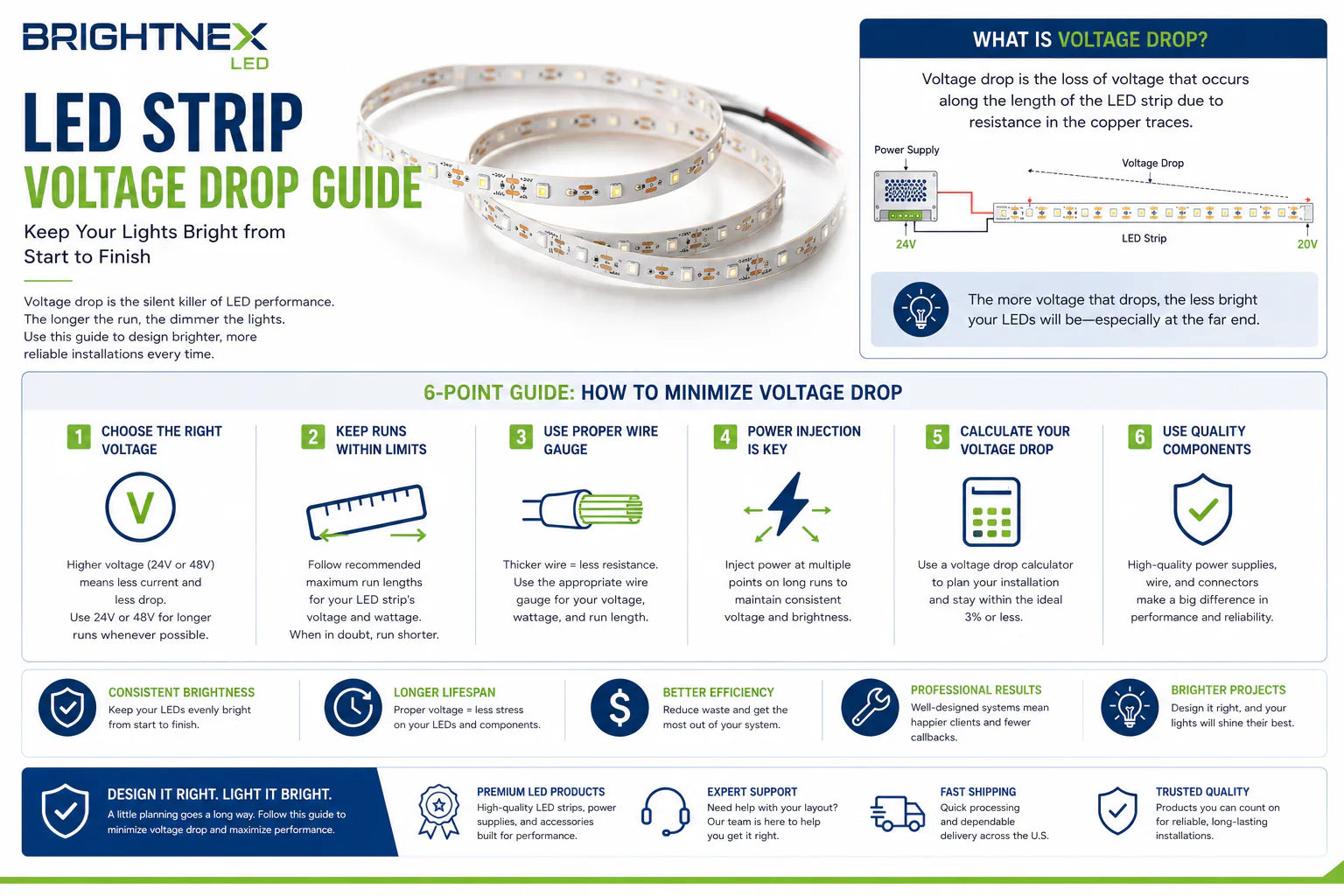
Voltage drop occurs when electrical resistance causes voltage to decrease as power travels through conductors.
In LED strip systems, voltage loss occurs in:
• The LED strip itself
• Low-voltage supply wiring
• Connectors and terminations
As voltage decreases, the strip may receive less power than intended, leading to visible performance changes.
The longer the distance power must travel, the greater the potential voltage loss.
What Voltage Drop Looks Like on the Jobsite
Most installers notice voltage drop visually before measuring it electrically.
Common symptoms include:
• Reduced brightness at the end of a run
• Uneven illumination
• Color temperature shifts
• Flickering during dimming
• Inconsistent RGB or RGBW color output
These issues are especially noticeable in:
• Under-cabinet lighting
• Cove lighting
• Architectural millwork
• Floating vanities
• Long linear installations
In premium residential projects, clients often notice these differences immediately.
Why 12V Systems Experience More Voltage Drop
Voltage drop affects both 12V and 24V systems, but 12V installations are generally more sensitive.
For the same wattage load:
• 12V systems require higher current
• Higher current creates greater voltage loss
• Longer runs become more challenging
This is why many professional buyers prefer 24V LED strip lighting for architectural and extended-run applications.
The Key Factors That Affect Voltage Drop
Several variables determine how much voltage loss occurs in an installation.
System Voltage
Higher voltage systems typically perform better over longer distances.
24V strips often provide:
• Longer practical run lengths
• Improved brightness consistency
• Reduced voltage loss
• Greater installation flexibility
Strip Wattage
Higher-output strips draw more current.
Examples include:
• 5W per foot strips
• 10W per foot strips
• 16W per foot strips
As wattage increases, voltage drop becomes more significant.
Copper Quality
Copper thickness affects current-carrying capability.
Important factors include:
• PCB copper weight
• Strip construction quality
• Supply wire gauge
Higher-quality products often deliver better electrical performance across longer runs.
Feed Method
Power feed location significantly impacts performance.
Common feed strategies include:
• Single-end feed
• Center feed
• Dual-end feed
• Parallel feeds
The correct approach depends on run length and system load.
Why 24V Is Often the Better Choice
For professional installations, 24V systems frequently provide the best balance between performance and installation simplicity.
Benefits include:
• Lower current draw
• Reduced voltage drop
• Longer feed distances
• Improved uniformity
This is particularly important for:
• Cove lighting
• Cabinet lighting
• Long architectural runs
• Luxury residential projects
While 12V systems still have their place, 24V often delivers greater flexibility for larger installations.
How to Prevent Voltage Drop Before Installation
The best solution is proper planning.
Before ordering materials, buyers should evaluate:
• Total run length
• System voltage
• Watts per foot
• Driver location
• Wire sizing
• Feed strategy
Calculating load requirements early helps identify potential issues before installation begins.
Respect Maximum Recommended Run Lengths
Every LED strip has practical limitations.
Manufacturers provide maximum recommended feed lengths to maintain consistent performance.
Exceeding those limits can result in:
• Uneven brightness
• Color inconsistency
• Reduced efficiency
• Increased service calls
Professional installers should treat these recommendations as performance guidelines rather than theoretical maximums.
Feed Methods That Improve Performance
Single-End Feed
Single-end feed is common for:
• Short runs
• Lower wattage installations
• Simple applications
It is often the fastest and most economical solution when run lengths remain moderate.
Center Feed
Center feeding places power near the middle of the run.
Benefits include:
• Reduced voltage loss
• Improved brightness consistency
• Better performance on longer runs
This method works particularly well in continuous architectural lighting applications.
Dual-End Feed
Powering both ends of a strip helps reduce voltage loss along the run.
This approach is frequently used for:
• Long cove lighting runs
• Large under-cabinet systems
• Architectural accents
Dual-end feeding often eliminates visible brightness differences between ends of the strip.
Parallel Feed Design
Larger installations often perform best when divided into multiple independently powered sections.
Advantages include:
• Better performance consistency
• Easier troubleshooting
• Improved scalability
• Reduced electrical stress
This is often the preferred approach for commercial and luxury residential projects.
Why Wire Size Matters
Voltage drop does not occur only within the strip.
Supply wire can also contribute significantly to power loss.
Factors that influence wiring performance include:
• Wire length
• Wire gauge
• Current draw
• Installation conditions
Keeping drivers close to the load and using appropriately sized conductors helps reduce unnecessary losses.
Driver Placement Is Important
The distance between the driver and the strip affects performance.
Whenever possible:
• Minimize wire runs
• Locate drivers strategically
• Use proper conductor sizing
• Allow adequate wattage headroom
Good driver placement improves efficiency and reduces troubleshooting later.
Special Considerations for RGB, RGBW, and CCT Systems
Color-changing systems require additional planning.
Products such as:
• RGB strips
• RGBW strips
• CCT tunable white strips
• IC RGB strips
can experience color shift when voltage drop affects channels unevenly.
This makes proper power distribution even more important in color-changing installations.
COB and SCOB Strips Still Require Planning
COB and SCOB technology provide excellent visual performance, but they are not immune to voltage drop.
Professional buyers should verify:
• Recommended feed lengths
• Wattage requirements
• Driver compatibility
• Installation method
Proper planning remains essential regardless of strip technology.
Design for Consistency, Not Maximum Distance
One of the most common mistakes is designing systems right at the edge of the maximum recommended run length.
A better approach is to design with margin.
Benefits include:
• More consistent brightness
• Better dimming performance
• Improved reliability
• Fewer service issues
A small increase in planning effort often prevents expensive corrections later.
Conclusion
Voltage drop is one of the most important factors affecting LED strip lighting performance. While it may not be immediately visible during planning, it often becomes obvious after installation through brightness loss, color shifts, and inconsistent dimming.
By selecting appropriate voltages, sizing conductors correctly, using proper feed methods, and designing with performance margins, contractors and project buyers can deliver more reliable lighting systems and avoid costly callbacks.
FAQ
What causes voltage drop in LED strip lights?
Voltage drop occurs when electrical resistance reduces voltage as power travels through the strip and wiring.
Why are 24V LED strips better for long runs?
24V systems draw less current than 12V systems, which helps reduce voltage loss over distance.
How can I reduce voltage drop in an LED strip installation?
Use shorter runs, larger wire, multiple feed points, or a 24V system when appropriate.
Can voltage drop cause color changes?
Yes. RGB, RGBW, and CCT strips may experience visible color shifts when voltage drop affects channels unevenly.
What is the best feed method for long LED strip runs?
Center feeding, dual-end feeding, or parallel feeding multiple sections often provide the most consistent results.