
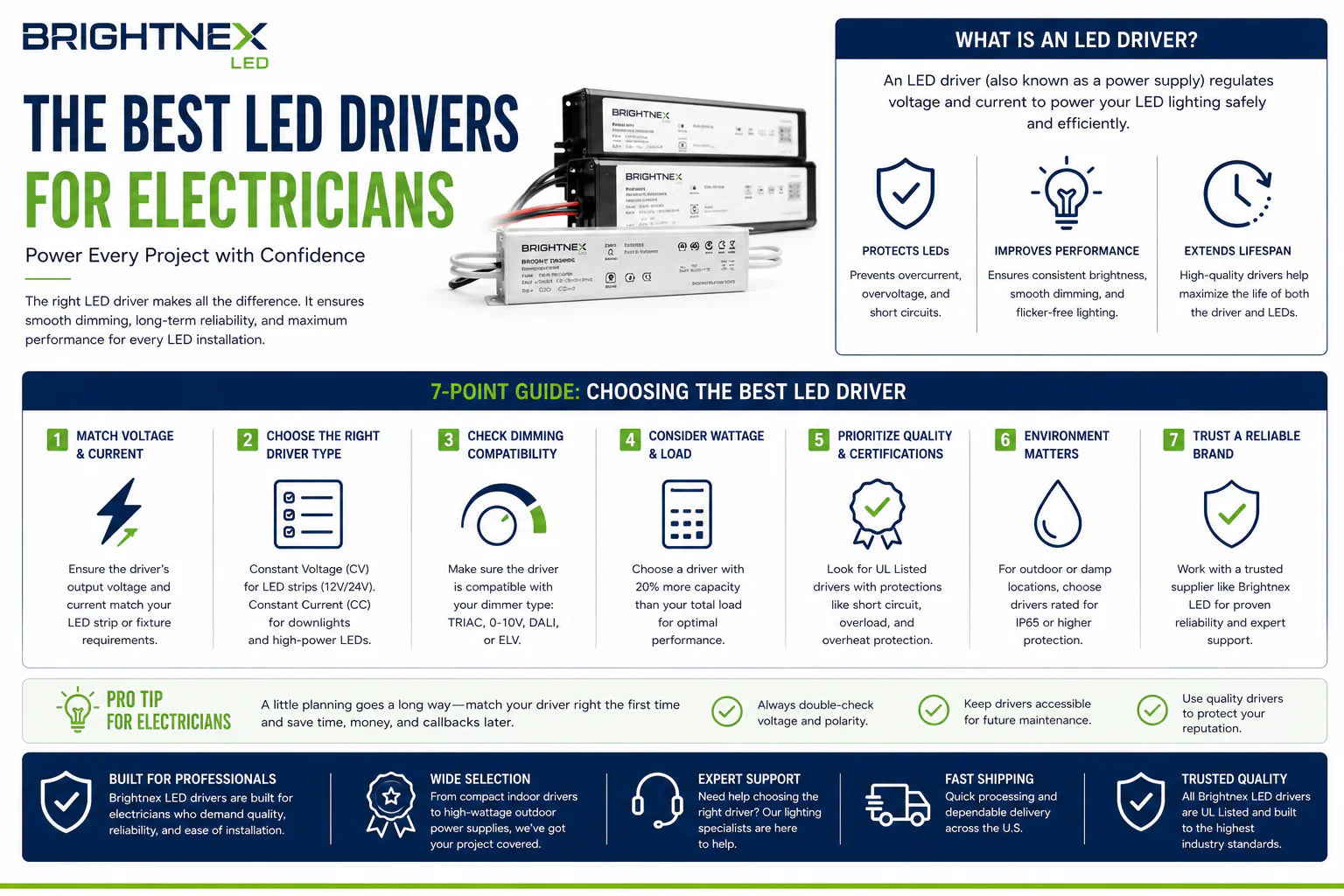
Why LED Driver Selection Matters
Many LED lighting problems are blamed on fixtures, strip lights, or dimmers when the real issue is the driver. Flicker, buzzing, inconsistent dimming, premature failure, and voltage instability often trace back to driver selection.
For electricians, contractors, lighting dealers, and project buyers, choosing the right driver helps reduce callbacks, improve installation quality, and support long-term reliability.
Whether the project involves luxury residential lighting, commercial spaces, hospitality environments, or architectural LED strip systems, driver selection plays a critical role in overall performance.
What Makes the Best LED Drivers for Electricians?
The best LED drivers are not defined by brand alone. They are defined by how well they match the application.
Professional-grade drivers should provide:
• Stable output voltage
• Reliable dimming performance
• UL certification
• Proper environmental ratings
• Adequate load capacity
• Practical installation features
When all these factors align, installations tend to perform more consistently and require less troubleshooting after completion.
UL Certification Should Be the First Filter
For professional installations, certification is one of the most important considerations.
UL-certified LED drivers help provide:
• Greater inspection confidence
• Improved safety assurance
• Better documentation support
• Reduced project risk
Trade buyers frequently prioritize certified products because they simplify project approval and support long-term reliability expectations.
Start With the Dimming Method
Many driver issues begin when buyers focus only on wattage while overlooking dimming compatibility.
The control method should be identified before selecting the driver.
TRIAC Dimmable Drivers
TRIAC dimming remains common in residential projects because it works with many traditional wall dimmers.
Typical applications include:
• Under-cabinet lighting
• Cove lighting
• Toe-kick lighting
• Residential remodels
• General architectural lighting
When properly matched, TRIAC drivers provide a straightforward dimming solution for many projects.
ELV Dimmable Drivers
ELV dimming is often preferred in higher-end residential applications where smoother low-end dimming performance is important.
Benefits may include:
• Better low-level dimming
• Reduced audible noise
• Improved compatibility with premium controls
Luxury residential projects frequently benefit from ELV-compatible systems.
0-10V Drivers
Commercial lighting projects often utilize 0-10V dimming because it scales well across larger systems.
Common applications include:
• Office buildings
• Hospitality projects
• Retail environments
• Commercial renovations
0-10V systems require additional control wiring but often provide predictable and consistent performance.
Non-Dimmable Drivers
Not every application requires dimming.
Non-dimmable drivers remain practical for:
• Utility rooms
• Storage areas
• Signage
• Back-of-house spaces
• Simple switched circuits
When dimming is not needed, non-dimmable drivers can simplify installations and reduce costs.
Proper Load Sizing Improves Reliability
One of the most common mistakes is selecting a driver with almost no reserve capacity.
While a driver may technically support the calculated load, operating near maximum capacity can reduce performance and longevity.
Professional installers typically leave headroom between the actual load and driver capacity.
Benefits include:
• Better thermal performance
• Improved dimming behavior
• Longer driver life
• Reduced stress on components
This becomes especially important on premium LED strip lighting systems and long architectural runs.
Environmental Rating Matters
Drivers should always match the installation environment.
Common ratings include:
• Dry location
• Damp location
• Wet location
Selecting the wrong rating can create inspection issues and reduce long-term reliability.
Bathrooms, garages, covered patios, outdoor applications, and moisture-prone spaces often require additional attention during specification.
Junction Box Drivers Offer Practical Advantages
Many electricians prefer drivers with integrated junction boxes because they simplify wiring and improve installation consistency.
Advantages may include:
• Protected line-voltage connections
• Cleaner installation appearance
• Improved code compliance
• Reduced installation time
For projects involving multiple environmental conditions, integrated driver and junction box assemblies often provide additional flexibility.
Heat and Accessibility Should Not Be Ignored
A high-quality driver can still fail prematurely if it is installed in a location with poor ventilation or difficult service access.
Before installation, consider:
• Ambient temperature
• Airflow
• Future maintenance access
• Cabinet and ceiling space limitations
Planning driver placement early helps avoid service complications later.
Features That Matter on the Jobsite
Electricians benefit most from features that improve installation efficiency.
Useful features include:
• Clear labeling
• Compact dimensions
• Secure terminal connections
• Consistent output specifications
• Easy-access wiring compartments
Practical design often matters more than marketing-driven specifications.
Best LED Drivers by Application
Different projects require different driver solutions.
Luxury Residential Lighting
Recommended priorities:
• TRIAC or ELV dimming
• Smooth low-end performance
• Quiet operation
• UL certification
• Class 2 output when appropriate
Applications include:
• Kitchen lighting
• Cove lighting
• Stair lighting
• Cabinet lighting
• Architectural accents
Commercial Lighting Systems
Recommended priorities:
• 0-10V compatibility
• Reliable performance
• Scalability
• Easy maintenance
These drivers work well in larger lighting control systems where multiple zones require coordinated operation.
Basic On-Off Applications
Recommended priorities:
• Stable output
• Appropriate wattage
• UL certification
• Cost efficiency
Non-dimmable drivers remain effective when lighting control is not required.
Wet and Damp Location Installations
Recommended priorities:
• Proper environmental ratings
• Protected enclosures
• Junction box integration
• Reliable sealing and protection
Environmental suitability should always be verified before purchase.
Questions Electricians Should Ask Before Buying
Before purchasing drivers for inventory or project use, consider:
• Is the driver UL certified?
• What dimming methods are supported?
• Is it rated for the intended environment?
• Does it provide adequate load capacity?
• Will it be accessible for future service?
• Can it be reordered consistently?
These questions help identify products that are better suited for professional use.
Why Consistency Matters for Wholesale Buyers
Contractors and lighting dealers frequently work across multiple projects and phases.
Reliable inventory offers:
• Consistent specifications
• Easier troubleshooting
• Simplified purchasing
• Better customer confidence
A driver that performs well on one project should remain available and consistent for future work.
The Cost of Choosing the Wrong Driver
Saving a few dollars on a driver can become expensive quickly.
Common consequences include:
• Flicker
• Dimming issues
• Driver replacement
• Additional labor
• Customer complaints
• Project delays
The true cost of a driver includes installation, service, and long-term performance—not just the purchase price.
Conclusion
The best LED drivers for electricians are the ones that deliver stable output, reliable dimming, proper certification, and long-term dependability in real-world installations.
By selecting drivers based on dimming compatibility, environmental requirements, load sizing, and installation conditions, professionals can reduce callbacks, improve project quality, and protect profitability.
A quality driver may never be seen after installation, but it often determines how well the entire lighting system performs.
FAQ
What is the most important factor when choosing an LED driver?
Dimming compatibility is often the most important consideration because mismatched controls are a common cause of lighting issues.
Should LED drivers be UL certified?
Yes. UL certification helps support safety, inspections, and long-term reliability.
Is ELV better than TRIAC dimming?
Not always. ELV often provides smoother low-end dimming, but the best choice depends on the project and control system.
How much headroom should an LED driver have?
Professional installers typically leave extra capacity rather than operating the driver at its maximum rated load.
Do all projects need dimmable LED drivers?
No. Utility spaces and basic switched applications often perform well with non-dimmable drivers.