
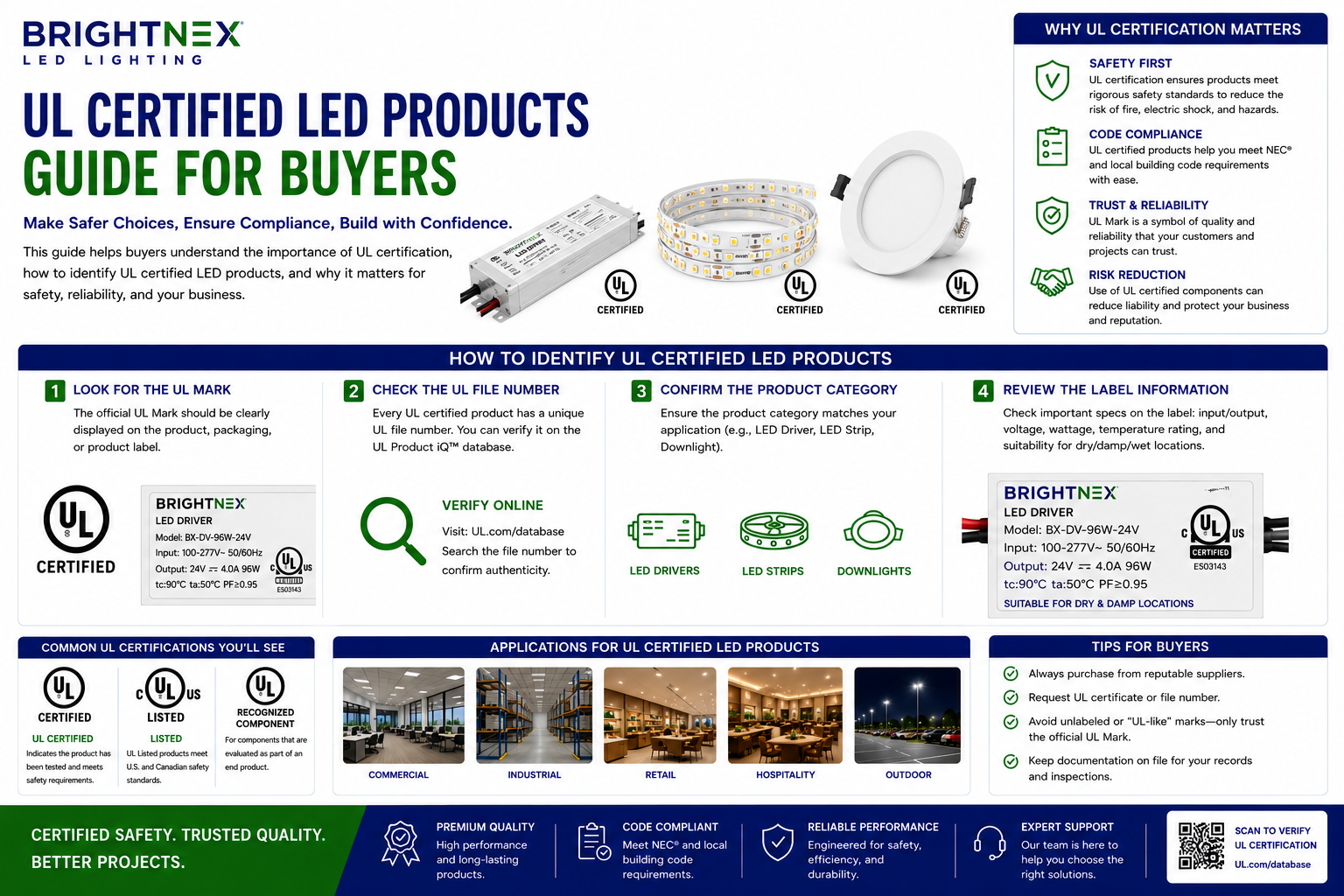
A strip light that looks premium on the reel can still create problems at inspection, during dimming setup, or six months after install. That is why a real UL certified LED products guide matters for trade buyers. If you are sourcing for custom homes, retail inventory, hospitality upgrades, or large residential jobs, UL is not just a label - it is part of risk control, product consistency, and jobsite credibility.
For electricians, lighting stores, contractors, and project buyers, the question is rarely whether UL matters. The real question is what exactly is certified, how far that certification goes, and whether the full system you are buying will hold up in the field. A fixture can be UL listed while a driver, connector, or strip in the same install creates the weak point. That is where careful purchasing separates clean installs from callbacks.
What This UL Certified LED Products Guide Covers
UL certification helps confirm that a product has been evaluated for safety under defined conditions. In LED lighting, that can apply to finished fixtures, strip lights, drivers, transformers, and related components. But certification does not mean every product is interchangeable, and it does not remove the need to match voltage, load, dimming type, wire gauge, mounting conditions, or location rating.
That distinction matters on professional jobs. A luxury kitchen with under-cabinet COB strips, an outdoor bar with wet-location drivers, and a recessed downlight package for a high-end remodel all have different demands. The UL mark supports confidence, but only when the product is used within its intended application.
Trade buyers should also remember that UL status affects more than safety. It can influence permit approval, inspection outcomes, insurance considerations, and the confidence your client has in the finished system. In premium residential work, especially in markets where design standards are high, the details behind the spec matter.
Why UL Matters More in Professional LED Projects
Cheap LED products often fail in predictable ways. Drivers flicker under dimming load, strip light adhesives give out near heat, voltage drop ruins long runs, and non-rated components end up installed in damp or wet environments. These are not minor quality issues. They cost labor, delay completion, and damage your reputation.
UL certification helps reduce that risk because it signals that the product has been evaluated against established safety standards. For wholesalers and installers, that means fewer unknowns. It does not guarantee perfect performance in every setup, but it gives buyers a stronger baseline than unverified imports or vague compliance claims.
For project suppliers working in upscale residential environments, UL also supports the sales process. Homeowners, builders, and designers may not ask technical questions about Class 2 output or driver housing, but they do care that the system is safe, dependable, and appropriate for the space. When a product carries clear certification and is built for professional use, it is easier to stand behind the quote.
How to Read UL Certification on LED Products
Not every UL mark tells the same story. Some products are UL listed as standalone finished goods. Others may be recognized components intended for integration into a larger assembly. That difference matters when you are combining strips, drivers, channels, controls, and connectors into one installed system.
Start with the product category. LED strip lights, downlights, drivers, and transformers are evaluated differently because they perform different roles. Then verify the environmental rating. Dry location, damp location, and wet location are not interchangeable terms, and this is where spec errors often begin. A driver with a junction box built for wet, damp, or dry locations gives more flexibility, but it still has to be installed correctly.
Next, check electrical compatibility. UL certification does not solve mismatched dimming protocols. If the project requires TRIAC, ELV, MLV, or 0-10V dimming, the driver and control method still need to be matched to the load. A certified driver that is wrong for the dimmer will still create flicker, drop-out, or poor low-end performance.
Finally, look at marking consistency. Professional-grade strip lights should have clear labeling, and serious suppliers provide transparent certification information rather than vague claims. In the wholesale market, that clarity saves time for purchasing teams and installers alike.
Key Products to Verify Before You Buy
LED strip lights deserve the closest attention because they are often part of custom assemblies. COB, SCOB, RGB, RGBW, CCT, and IC RGB options all serve different project goals, but they need more than good light output. Width matters for profile compatibility, and trade buyers sourcing 6.5mm, 8mm, 10mm, or 12mm tape need to confirm fit before ordering volume. Certification, printed markings, wattage, voltage, and application rating should all be checked before the material reaches the jobsite.
Drivers and transformers are just as important. This is where many field issues begin, especially on dimmable systems. A premium strip paired with a low-grade or poorly matched driver can ruin an otherwise clean install. Buyers should verify output class, dimming method, environmental rating, enclosure style, and whether junction box integration supports code-compliant installation. For wet or damp applications, this is not optional.
Recessed downlights and integrated fixtures bring another layer of review. Beam quality, trim style, driver design, and dimming behavior all matter in finished spaces. On high-end residential jobs, performance at low dim levels is often as important as maximum brightness. Certification supports safety, but the buyer still has to judge whether the fixture is built for the quality level the project requires.
Accessories also deserve attention. Connectors, controllers, remotes, wire, and aluminum profiles may seem secondary, but poor accessory choices can compromise an entire installation. Mechanical fit, thermal management, and control compatibility should all be considered as part of the system, not as afterthoughts.
A Practical UL Certified LED Products Guide for Wholesale Purchasing
For trade buyers, the best purchasing process is simple. First, define the installation environment and control method before comparing pricing. Second, confirm that the core components - strip or fixture, driver, and controls - are compatible as one system. Third, verify certification and rating details at the product level, not just at the catalog level.
After that, evaluate serviceability. Can your team reorder the same spec consistently? Will lead times support phased jobs? Is the supplier focused on professional inventory rather than consumer-style mixed stock? Those questions matter because consistency is part of value. A low price on the first order means less if the second order arrives with spec changes or weak packaging.
This is where a focused wholesale supplier has an advantage. BrightNex LED is built around professional categories that contractors and lighting resellers actually need, from UL-marked strip lights to dimmable drivers, transformers, recessed downlights, aluminum channels, and installation accessories. That kind of catalog structure helps buyers move faster because it reduces guesswork.
Common Buying Mistakes This Guide Can Help You Avoid
The most common mistake is assuming the UL mark alone answers every technical question. It does not. Buyers still need to check wattage loading, run length, dimmer compatibility, profile fit, and location rating. A safe product can still be the wrong product.
Another mistake is focusing only on fixture cost while overlooking labor exposure. A cheaper driver, weaker connector, or inconsistent strip adhesive can create expensive service calls later. In trade purchasing, the true cost is material plus installation time plus replacement risk.
A third mistake is mixing product classes across suppliers without confirming system behavior. That can work in some basic applications, but it becomes risky on premium dimming projects, color-changing systems, and custom millwork installs. The tighter the finish expectations, the less room there is for incompatible parts.
How Trade Buyers Should Judge Value
Value in LED wholesale is not just price per foot or price per fixture. It is the combination of certification, finish quality, dimming reliability, packaging consistency, and reorder confidence. For lighting stores and contractors, the best inventory is inventory you can recommend without hesitation.
That matters even more in luxury residential work. Clients may never see the driver tucked above a cabinet or inside a junction box, but they will notice flicker, uneven color, poor dimming, or early failure. A properly certified and well-matched system protects both the installation and the relationship behind it.
The strongest buying decisions usually come from suppliers that understand trade conditions, not just product specs on paper. When the catalog is built for professionals, the result is cleaner ordering, fewer compatibility issues, and better margin protection across repeated jobs.
UL certification should not be treated as a marketing extra. It is part of how serious buyers reduce risk, support inspections, and deliver dependable lighting systems in homes and commercial spaces that expect better. The right source is the one that helps you buy once, install once, and move on to the next project with confidence.