
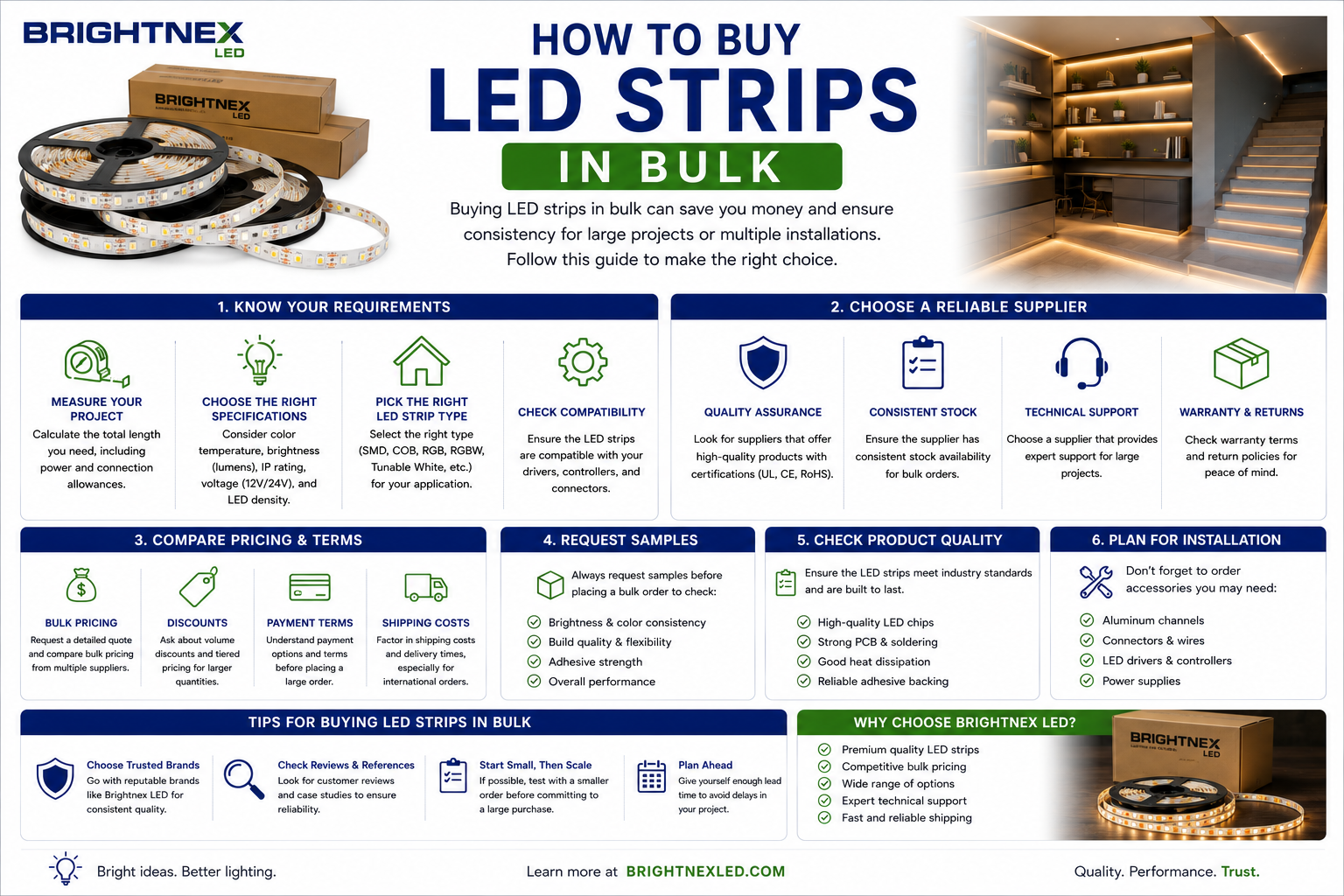
A bulk LED strip order can either protect your margin for months or create callbacks, delays, and compatibility problems across multiple jobs. That is why knowing how to buy LED strips in bulk is not just a purchasing task - it is a specification decision that affects labor, safety, dimming performance, and long-term reliability.
For trade buyers, the cheapest reel is rarely the lowest-cost option. Electricians, lighting stores, contractors, and project suppliers need strip lighting that installs cleanly, performs consistently, and meets US compliance requirements. If you are sourcing for luxury residential work, retail displays, hospitality, or general architectural lighting, the buying process starts with matching the strip to the application rather than chasing the lowest quote.
How to buy LED strips in bulk without costly mistakes
The first step is defining the job type. Not every strip should be treated as interchangeable. A high-end kitchen cove, a bathroom vanity, a retail shelving run, and an outdoor accent application all demand different performance levels. Before comparing wholesale prices, confirm the core requirements: voltage, color temperature or color-changing type, lumen output, PCB width, cut interval, IP rating, and dimming method.
In professional buying, compatibility matters as much as brightness. A strip may look acceptable on paper, but if it does not match the driver, the control system, the aluminum profile, or the installation environment, it becomes expensive fast. Bulk buyers should always evaluate the full system, including connectors, wire leads, controllers, transformers, remotes, and mounting channels.
Start with the strip category
The category determines the rest of the order. COB strip lights are popular for premium projects because they deliver a smooth, dot-free line of light that works well in luxury interiors. They are especially effective where the strip is visible or reflected on polished surfaces. For buyers serving upscale residential markets, this finish matters.
Standard strip formats still make sense in many projects, especially when budget and output are the priority. Color-changing options such as RGB, RGBW, CCT, and IC RGB are also project-driven choices. If the customer wants tunable white for living spaces, dramatic color scenes for entertainment areas, or programmable effects, the strip selection needs to support that control strategy from the start.
Width matters too. Professional buyers often need exact PCB dimensions to fit a profile or channel already specified on the project. Common widths like 6.5 mm, 8 mm, 10 mm, and 12 mm can determine whether the product integrates cleanly or creates a field adjustment problem.
Confirm certification before price
For US buyers, certification should never be an afterthought. UL-listed or UL-recognized strip lighting helps reduce risk for contractors, distributors, and project managers. It supports code compliance, inspection confidence, and buyer trust. On larger projects or premium residential jobs, uncertified product can create serious liability and reputation issues.
This is one of the clearest differences between commodity imports and professional wholesale supply. A low per-foot price may look attractive until the project requires documented safety certification, marked components, and consistent traceability. When you are buying in volume, the safer path is to source product designed for the US market and supported by proper documentation.
Match drivers and controls before placing the order
One of the most common bulk buying mistakes is ordering strips first and figuring out drivers later. That approach often leads to dimming issues, voltage drop complaints, or mismatched control systems. The strip, driver, and dimmer should be treated as one package.
If the project calls for TRIAC, ELV, MLV, or 0-10V dimming, verify compatibility at the quote stage. The same applies to wet, damp, or dry location use. Drivers with junction boxes for these environments save time in the field and reduce installation uncertainty. That matters even more when you are ordering for multiple jobs and need consistency across crews.
Bulk buyers should also confirm load calculations. Ordering the correct driver wattage is not just about meeting minimum power demand. You need proper headroom for stable performance and product life. When strips run long distances, voltage drop becomes another planning issue. In those cases, 24V systems are often preferred over 12V for cleaner performance across longer runs, though the right choice still depends on the layout.
Think in systems, not reels
A profitable strip lighting order usually includes more than strip lights. Aluminum profiles, diffusers, connectors, extension wire, controllers, and remotes are often part of the same project. Buying these parts together improves compatibility and reduces install friction.
This is especially important for contractors and lighting retailers serving high-end homes. Clean finish details matter. A premium strip inside the wrong profile or paired with unreliable accessories can weaken the result. On custom residential work, aesthetics and serviceability carry equal weight.
What to check when comparing wholesale suppliers
Not all wholesalers support professional buyers the same way. If you are evaluating suppliers, look beyond the line-item cost and review how well they support repeat purchasing. The strongest wholesale partner offers consistent inventory, technical clarity, certification, and dependable shipping across the US.
Product consistency is critical. In bulk purchasing, you do not want color shift between batches, output variation from reel to reel, or accessory changes that force on-site workarounds. Ask about bin consistency, lead times, packaging, and whether the supplier maintains a focused catalog built for trade use rather than a broad consumer assortment.
For many buyers, support around dimmable drivers is also a deciding factor. A supplier that understands low-voltage dimming compatibility, wet and damp location requirements, and premium residential applications can prevent problems before they reach the field. That is one reason many professional buyers prefer specialized wholesale suppliers over general online marketplaces.
Ask these practical questions before a bulk order
A serious supplier should be ready to answer a few direct questions. Is the strip UL certified for the intended use? What widths and output levels are available? Which drivers and controls are recommended? Are color-changing options available in RGB, RGBW, CCT, or IC RGB? Can the supplier support repeat orders with the same specifications?
You should also ask about the target application. Some strips are better suited for under-cabinet runs, some for cove lighting, and some for outdoor or wet-location installations. If your work includes luxury residential spaces, ask whether the product line is being used in high-end homes and whether the finish quality supports visible-light applications.
How to buy LED strips in bulk for better margins
Margin protection starts with reducing hidden costs. A strip with stable output, clear certification, and reliable compatibility may cost more upfront, but it often saves labor and replacement expense later. That is especially true when buying for resale, repeat installations, or builder programs where consistency matters more than one-time savings.
Bulk buyers should pay attention to packaging quantities, reel lengths, and project staging. Ordering in a format that matches your install flow can reduce waste and speed up handling. If your team repeatedly uses the same color temperatures, profile sizes, and driver types, standardizing those SKUs can improve both purchasing efficiency and field productivity.
For lighting retailers and distributors, a focused assortment is usually smarter than a huge assortment. Stock the specifications your customers actually request: dependable white strip options, premium COB lines, certified drivers, and the right accessories. Depth in the right products beats width in random inventory.
A specialized supplier like BrightNex LED can be a better fit for trade buyers because the catalog is built around professional demand: UL-marked strip lighting, multiple COB widths, color-changing formats, driver options for real-world dimming requirements, and nationwide wholesale supply. That kind of alignment matters when your customers expect reliable performance and fast decisions.
Bulk LED strip buying gets easier when you treat it like a system purchase instead of a commodity order. Start with the application, lock in certification, match the driver and controls, and buy from a supplier that understands trade work. When the product arrives ready for the job, your crew moves faster, your customer sees the difference, and your margin stays where it should be.