
A 24V tape light run looks perfect on the bench, then starts failing in the field after the wrong driver gets paired with it. That is usually where the real conversation about constant voltage versus constant current begins - not in theory, but on jobs where compatibility, dimming performance, and long-term reliability matter.
For trade buyers, this is not a small spec-sheet detail. The difference between the two affects strip light performance, fixture lifespan, voltage drop behavior, thermal control, dimming results, and even whether a product is practical to service later. If you supply or install LED systems in high-end homes, retail environments, or commercial spaces, choosing the correct power method protects both your labor and your margin.
What constant voltage versus constant current really means
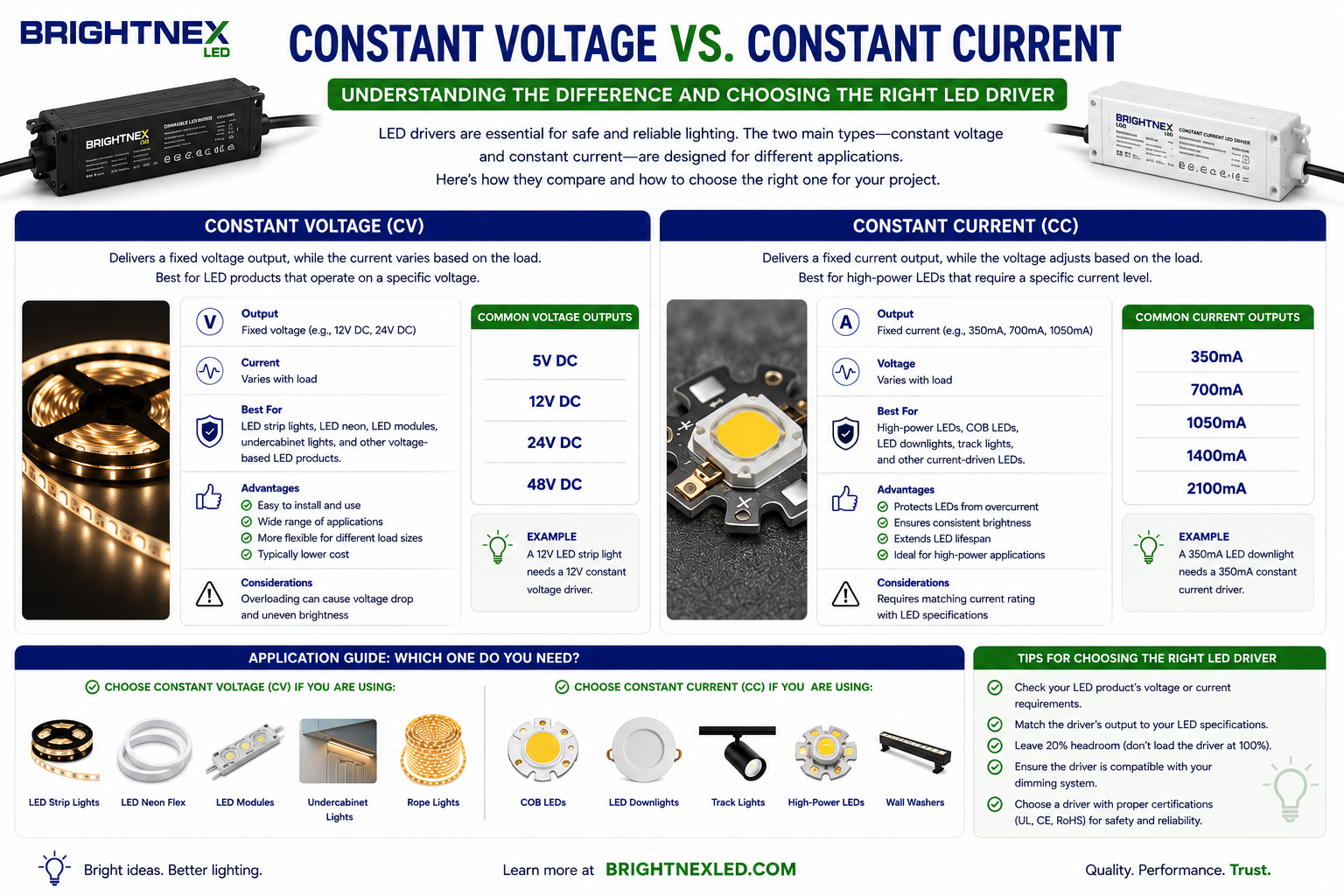
Constant voltage drivers supply a fixed output voltage, usually 12V or 24V DC in LED strip lighting applications. The connected LED product then draws the current it needs based on its own circuit design. This is why most LED strip lights, including COB, RGB, RGBW, CCT, and many architectural linear products, are built around constant voltage platforms. The driver stays at a stable voltage, and the load determines current draw.
Constant current drivers work differently. They deliver a fixed current, such as 350mA, 700mA, or 1050mA, while the output voltage adjusts within a rated range to match the load. This is common in integrated LED fixtures, downlights, and some high-power modules where the LEDs are designed to operate at a precise current for controlled output and thermal stability.
That basic distinction sounds simple, but the application decides everything. A contractor ordering flexible strip for under-cabinet lighting, cove lighting, or millwork illumination is usually in constant voltage territory. A buyer sourcing certain recessed fixtures or specialty LED engines may be dealing with constant current instead.
Why most LED strip projects use constant voltage
In practical field work, constant voltage is often the easier and more flexible choice for strip lighting systems. It supports cuttable lengths, straightforward parallel wiring, and easier replacement when a section needs service. On a large residential project, that matters. If a 24V strip light section needs to be swapped, the installer can generally replace the matching tape without redesigning the whole power scheme.
It also fits the way many professional jobs are built. Cabinet lighting, toe-kick lighting, shelf lighting, and accent runs are often laid out in multiple segments. Constant voltage drivers make it easier to distribute power across those segments as long as wattage, run length, and voltage drop are handled correctly.
This is one reason wholesale buyers often standardize on 24V systems for premium installs. They offer better run performance than 12V in many cases, reduce visible voltage drop across longer sections, and pair well with dimmable driver options used in luxury residential work.
Where constant current makes more sense
Constant current is often the better choice when the LED load is designed around a specific current for performance consistency. Many downlights, linear fixtures, and COB modules are engineered this way because controlling current directly helps maintain predictable light output and manage heat more effectively.
For fixtures that come as a complete system, constant current can simplify internal design and improve LED longevity. But from a replacement and sourcing standpoint, it can be less forgiving. The driver and light engine need to match properly, and substitutions are not as flexible as they are with common constant voltage strip systems.
That is the trade-off. Constant current can be excellent in engineered fixtures, but it is usually not the first choice for modular strip-based installations where customization, field cutting, and easier servicing are priorities.
Constant voltage versus constant current in real LED jobs
If the project involves LED strip lights, the question is usually not which system is better in general. The real question is which system matches the product category and install method.
For example, standard and COB strip lights sold in trade channels are typically designed for constant voltage drivers. The strip includes onboard resistors or regulation methods that allow each segment to operate at the rated input voltage. That makes them practical for custom lengths and multi-zone layouts.
By contrast, a dedicated recessed downlight with an external driver may require a constant current output because the LED board inside the fixture is engineered for that current. Using a constant voltage driver there is not a workaround. It is a mismatch.
This is where procurement mistakes happen. Buyers sometimes focus on wattage and overlook output type. A 60W driver is not automatically compatible just because the wattage looks sufficient. Output voltage or output current must match the LED load design first.
How to choose the right driver
Start with the LED product specification, not the driver shelf. If the strip or fixture is labeled 24V DC, it needs a constant voltage driver with the correct output voltage. If the fixture calls for 700mA constant current, that is the requirement, and the driver must provide that current within the needed voltage range.
Then calculate total load correctly. For constant voltage strip lighting, add the wattage of all connected runs and leave headroom. Many professionals prefer not to load a driver to its absolute maximum, especially on dimmable systems or enclosed installations where heat can build up.
For constant current fixtures, verify both the rated current and the forward voltage range of the LED load. If the load voltage falls outside the driver's operating window, performance will be unstable or the fixture may not power at all.
Dimming adds another layer. TRIAC, ELV, MLV, and 0-10V dimming require a driver designed for that control method. A correctly matched constant voltage or constant current output still will not dim properly if the dimming protocol is wrong.
The common mistakes that cause callbacks
The first mistake is mixing driver types. A constant current fixture cannot be fed by a constant voltage driver just because the installer has one in the van. The reverse is also true.
The second is ignoring voltage drop in constant voltage strip systems. A 24V strip may be a constant voltage product, but long runs still need smart power distribution. Feed points, wire gauge, and total distance all affect visible consistency.
The third is assuming all dimmable drivers behave the same. They do not. Driver quality, dimmer compatibility, and low-end dimming performance vary widely, especially on premium residential projects where clients notice flicker, pop-on, or uneven fade.
The fourth is treating certifications as optional. On professional jobs, especially in the US market, UL-listed components and properly rated drivers are not just a selling point. They support inspection compliance, reduce risk, and signal better manufacturing control.
Which option is better for high-end residential lighting
In luxury homes, the answer often comes down to application. For custom strip lighting in ceilings, millwork, stairs, vanities, and outdoor-adjacent dry or damp areas, constant voltage systems are usually the more practical choice. They are easier to scale, easier to service, and widely available in premium strip formats.
For integrated architectural fixtures or certain recessed products, constant current may deliver excellent performance because the fixture was engineered as a complete package. That can be the right move where the design intent is fixed and the system is not meant to be modified in the field.
Professionals working in this segment usually care less about abstract preference and more about predictable results. They want clean dimming, stable color output, dependable driver performance, and products that hold up after drywall, paint, cabinetry, and final punch. That is why experienced buyers stay disciplined about matching the power platform to the product category.
A practical way to think about constant voltage versus constant current
If the product is modular, cuttable, and designed for flexible layout, constant voltage is usually the correct path. If the product is an engineered LED module or fixture that specifies a set operating current, constant current is usually non-negotiable.
Neither system is automatically superior. Each is built for a different job. The better choice is the one that aligns with the LED product design, the dimming method, the install environment, and the service expectations after turnover.
For wholesalers and contractors, that is the standard that matters. Good lighting starts with good components, but reliable lighting starts with the right electrical match. On jobs where reputation rides on performance, that decision should never be guessed.