
A strip light job usually goes off track for the same reason - the product looked right on paper, but the specification did not match the install. The right LED strip light specification guide helps contractors, lighting dealers, and project buyers avoid callbacks, dimming issues, voltage drop, and code-related headaches before material ever reaches the site.
For trade buyers, specs are not filler. They determine whether a strip will fit the channel, whether the driver will dim correctly, whether the run length is realistic, and whether the finish level meets the expectations of a luxury residential client. If you are sourcing for high-end kitchens, coves, millwork, vanities, bars, or exterior accent areas, the details matter.
What an LED strip light specification guide should cover
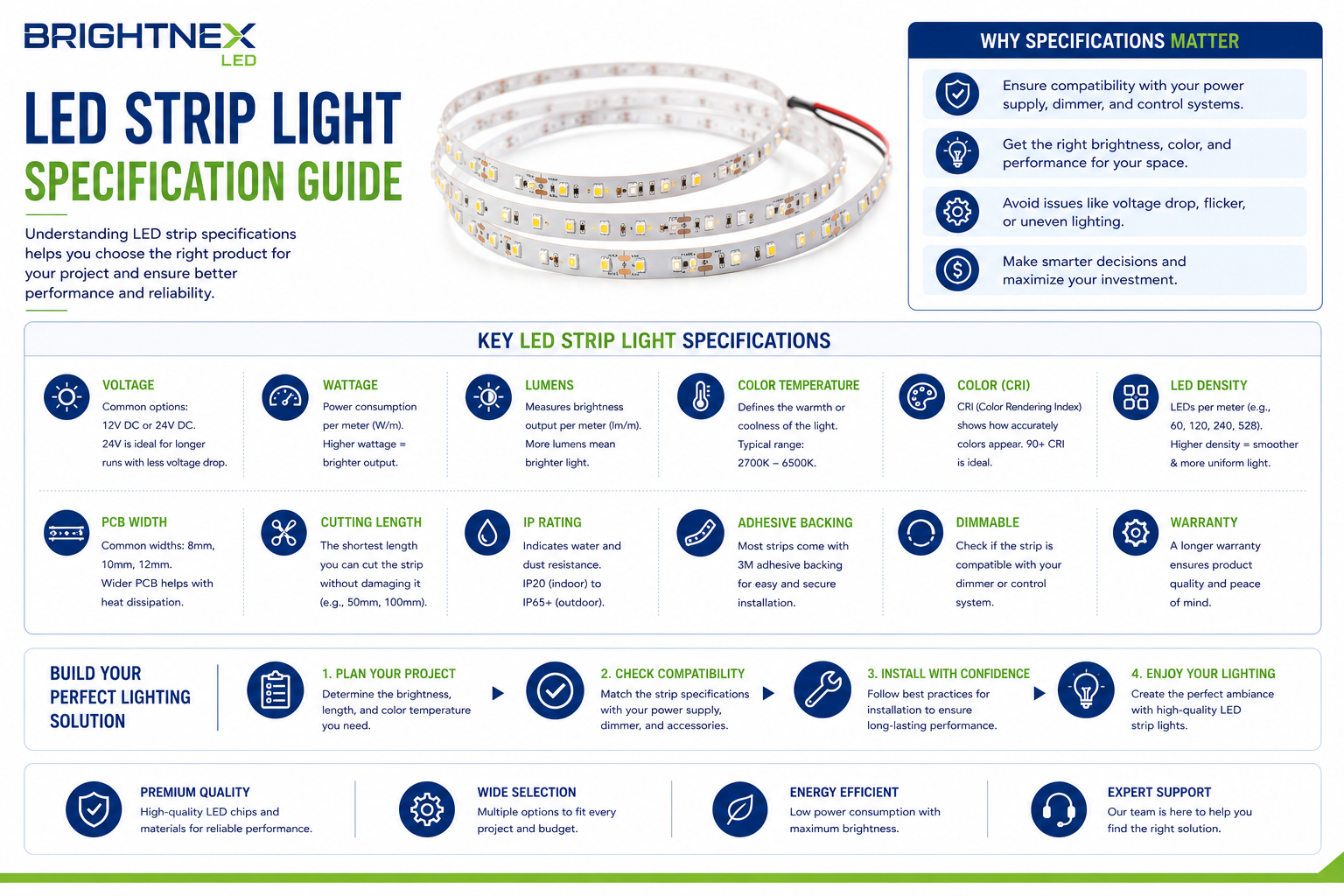
A useful LED strip light specification guide starts with the electrical basics, but it should not stop there. Professional buyers need to evaluate voltage, wattage per foot or meter, lumen output, color quality, strip width, cut length, IP rating, and dimming compatibility as one complete system.
Looking at only one line item can create expensive mistakes. A strip with strong lumen output may run hotter than the application allows. A narrow PCB may fit the profile but limit output or available control options. A wet-location install may require more than just a silicone-coated tape - it may also change your connector, driver enclosure, and mounting choices.
Start with voltage and run length
Voltage is usually the first filter because it affects run length, driver selection, and installation layout. In most projects, 12V and 24V low-voltage strips are the standard choice for clean architectural lighting, while 110V strip lights may make more sense for longer linear runs where remote driver placement is not practical.
For residential millwork, undercabinet, and recessed profile applications, 24V often gives the best balance of efficiency and reduced voltage drop. That matters when the designer wants long, continuous lines with fewer feed points. Twelve-volt can still be useful when short runs and tighter cut intervals matter more than maximum continuous length.
There is no universal winner here. The right choice depends on run distance, control method, and how much room the installer has for power supplies and wire routing.
Why voltage drop still gets underestimated
Even experienced installers can run into trouble when a strip is technically within rated length but installed in a way that pushes the limits. Long home runs, undersized wire, and ambitious single-end feeds can all reduce consistency from one end of the strip to the other.
On premium residential projects, uneven brightness is immediately visible. If the application demands uniform output, feed strategy should be treated as part of the spec, not as an afterthought.
Wattage, lumens, and efficacy are a package deal
Higher wattage is not automatically better. It usually means higher output, but it also means more heat and a greater demand on the driver. The better question is whether the strip is delivering the lumen level the space actually needs.
Accent lighting in coves and toe kicks may need a softer output. Task lighting under cabinets and in work areas usually needs stronger performance. Retail display, bar shelving, and bathroom mirror applications often sit somewhere in the middle, depending on distance to the surface and reflectivity of surrounding materials.
Efficacy matters because it tells you how efficiently the strip turns power into usable light. But in real projects, efficacy is only one part of the buying decision. Many high-end residential buyers will accept slightly lower efficiency if it gives them better color rendering, smoother diffusion, or a cleaner dot-free appearance.
Color temperature and color consistency
Color temperature should match the project intent, not just a standard stock preference. Warm white works well in hospitality-style residential interiors, especially in Los Angeles luxury homes where layered, softer ambient lighting is often part of the design language. Neutral and cooler whites may fit task-driven or more contemporary spaces better.
Consistency is just as important as the Kelvin rating itself. A 3000K strip that shifts noticeably from reel to reel can create major finish issues on large projects. Trade buyers should look for stable binning and dependable batch consistency, especially when ordering in volume for phased installs.
Single color, CCT, RGB, RGBW, and IC RGB
Specification gets more nuanced when the project calls for tunable or dynamic lighting. CCT strips are ideal when the client wants warm-to-cool adjustment without moving into full color effects. RGB handles decorative color, but RGBW is often the better architectural choice because it adds a dedicated white channel for cleaner everyday lighting.
IC RGB becomes relevant when pixel control and programmed effects are part of the design. That can work well in entertainment zones, hospitality-inspired residential features, or specialty commercial applications, but it increases controller requirements and setup complexity. If the client really needs refined white light most of the time, RGB alone is usually not enough.
CRI and visual quality
CRI remains one of the most useful shortcuts for judging light quality, especially in residential and display environments. If cabinetry, stone, fabrics, wood finishes, and paint color all need to look right, low-CRI strip lighting can undercut an otherwise premium install.
For upscale projects, higher CRI is usually the safer specification. It supports better material rendering and helps the finished space feel intentional rather than overly harsh or flat. That is one reason professional buyers tend to favor premium-grade strips for luxury homes instead of treating strip lighting as a commodity item.
PCB width and profile fit
Strip width gets overlooked until install day. Then the profile is already ordered, the channel is routed, or the recess is too narrow. Common widths such as 6.5mm, 8mm, 10mm, and 12mm each solve different installation constraints.
A narrow strip can be critical for slim aluminum profiles, tight cabinetry details, and compact architectural reveals. Wider boards may support different LED packages, stronger output, or more advanced channel configurations, but they need the physical space to match. This is where specification needs to connect directly to the mounting system, diffuser, and site conditions.
COB and SCOB strips deserve special attention here. They are often selected for smoother visual lines and reduced diode spotting, especially where the light source may be visible. That cleaner appearance is valuable in premium residential work, but buyers still need to confirm heat management, driver compatibility, and profile dimensions.
IP rating and environment
Indoor dry locations are only one part of the market. Vanity lighting, covered outdoor areas, bars, spas, landscape accents, and exterior architectural details all raise the stakes on environmental protection.
An IP rating should be matched to the actual exposure level. Damp and wet are not interchangeable conditions, and neither one tells the full story without considering driver location, connector sealing, and mounting method. A strip may be suitable for a wet area, but the system can still fail if the accessories and power components are not rated accordingly.
For professional buyers, this is where certified components matter. Safety, enclosure type, and location rating should all line up, especially when the installation is going into inspected residential or commercial work.
Dimming and control compatibility
Few issues create more frustration than a strip and driver that technically power on but do not dim correctly. Flicker, drop-out, dead travel, and limited dimming range are still common when components are mixed without checking the dimming protocol.
TRIAC, ELV, MLV, and 0-10V are not interchangeable. The strip, driver, and wall control need to be specified as one system. This matters even more on luxury homes where clients expect smooth low-end dimming in kitchens, coves, theaters, and primary bath applications.
A good supplier should be able to match strip wattage, load capacity, and dimming type without forcing the installer into trial and error. That is especially important when using dimmable drivers with junction boxes for dry, damp, or wet location requirements.
Certification, labeling, and buying confidence
For trade buyers, certification is not a marketing extra. It supports inspection readiness, jobsite confidence, and long-term reliability. UL-listed or UL-recognized components can simplify decision-making because they show the product was built with compliance in mind.
That matters when you are supplying electricians, reselling to lighting stores, or bidding projects where submittals and documentation affect approval. It also matters when the client is paying for a premium finish and expects the hidden components to meet the same standard as the visible design.
BrightNex LED focuses on this part of the equation because professional buyers need more than attractive product photos. They need strip systems, dimmable drivers, profiles, and accessories that work together, ship reliably across the US, and hold up in the field.
How to read the spec sheet like a buyer, not just an installer
The fastest way to compare strip lights is to read the spec sheet in the order that affects risk. Start with voltage, wattage, and max run length. Then verify color temperature or control type, CRI, PCB width, and IP rating. After that, confirm dimming method, driver sizing, and whether the mounting profile and accessories match the application.
Price still matters, especially in wholesale purchasing, but low unit cost rarely stays low if it creates returns, labor overruns, or visible inconsistencies. For trade professionals, the best specification is the one that protects margin after installation, not just at purchase.
When the strip, driver, controls, profile, and environment all align, the job moves faster and the finished result looks more expensive. That is the kind of detail clients notice, even when they cannot name the spec behind it.