
A dimming problem on a finished project usually starts long before trim-out. It starts when the wrong 0-10v dimmable led driver gets specified for the fixture, the control system, or the jobsite environment. For electricians, lighting suppliers, and contractors, that mistake costs time, callbacks, and margin.
A 0-10V system is straightforward on paper. The control signal tells the driver how much output to deliver, usually from full brightness down to a low-end dimming threshold. In the field, though, performance depends on more than the dimming protocol. Driver quality, load matching, UL certification, junction box design, location rating, and strip light compatibility all affect the result.
What a 0-10V dimmable LED driver actually does
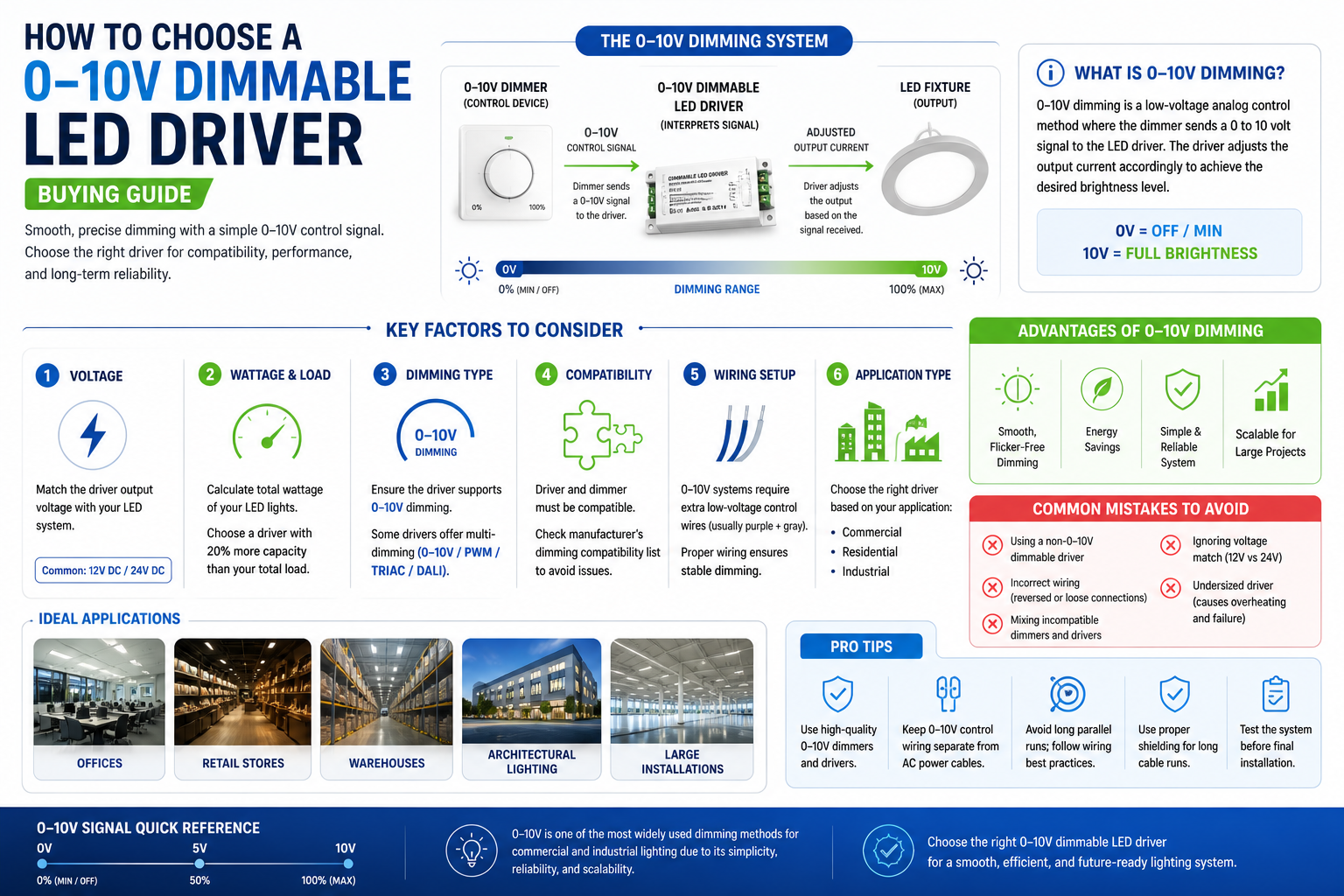
A 0-10V dimmable LED driver converts incoming line voltage into the low-voltage DC power your LED load needs, while also accepting a separate low-voltage dimming signal. That signal adjusts light output without relying on phase-cut dimming methods like TRIAC or ELV. For many commercial applications and high-end residential systems, this gives installers more predictable control and cleaner performance across longer runs and larger layouts.
The appeal is simple. A good 0-10V driver gives smooth dimming, stable output, and easier integration with lighting control systems. It is especially useful when projects include architectural strip lighting, recessed applications, cove lighting, under-cabinet runs, and custom millwork where visible flicker or uneven dimming will not be tolerated.
That does not mean every 0-10V driver behaves the same way. Low-end dimming range, startup behavior, compatibility with controls, and thermal performance can vary significantly by model.
Where 0-10V drivers make the most sense
0-10V dimming is common in commercial spaces, but it also shows up in luxury residential work where designers and homeowners want precise control without sacrificing fixture performance. In high-end homes, especially large custom builds, lighting scenes often depend on stable dimming across multiple zones. That is where a dedicated 0-10V driver can be a better choice than phase-dimmable alternatives.
It is also a strong fit for LED strip lighting systems. Long linear runs, COB strip lights, RGBW applications, CCT installations, and premium accent lighting all benefit from a driver that delivers consistent power and dependable dimming behavior. If the job includes premium finishes, custom cabinetry, or recessed channels, the driver matters just as much as the strip itself.
For trade buyers, the question is less about whether 0-10V works and more about whether it fits the rest of the system. The controller, wire runs, load size, installation location, and LED product type all need to align.
How to choose the right 0-10V dimmable LED driver
The first step is matching voltage. Most low-voltage LED products are built around either 12V or 24V DC. The driver output must match the LED load exactly. A mismatch is not a small issue - it can damage product, shorten lifespan, or create immediate performance failure.
Next is wattage. Add the total wattage of the connected LED load and leave headroom. Many professionals target around 80 percent of rated capacity for better thermal management and long-term reliability. On paper, a fully loaded driver may seem efficient. In real installations, some breathing room reduces stress and helps maintain stable output.
Dimming compatibility comes after that. A 0-10V driver needs to work with the control device being used, whether that is a wall-mounted dimmer, a lighting panel, or an integrated smart control system. If the controls are designed for another dimming type, the project can turn into a troubleshooting exercise no installer wants.
Location rating also matters. Drivers with integrated junction boxes and coverage for wet, damp, and dry locations simplify planning and help keep installations code-conscious. That is especially relevant in kitchens, bathrooms, outdoor-adjacent spaces, and mixed-use residential projects where environmental exposure may vary from one zone to the next.
Key specifications that deserve attention
Not every spec line deserves equal weight, but a few should always be reviewed before purchasing. UL certification is at the top of the list. For trade buyers, certified components are not optional. They support inspection, reduce risk, and signal that the product is built for professional use in the US market.
Low-end dimming performance is another major factor. Some drivers dim smoothly to 10 percent. Others reach 1 percent or lower under the right conditions. If the project includes luxury residential lighting, hospitality-style scenes, or premium architectural effects, that dimming floor can change the final result dramatically.
You should also look at enclosure and wiring design. Drivers with practical junction box construction make installation cleaner and faster. That matters on jobs where multiple zones, remote mounting, or service access are part of the layout. A technically capable driver that is awkward to install can still hurt labor efficiency.
Thermal behavior should not be overlooked, either. Drivers installed in tight cabinetry, millwork cavities, or enclosed areas need to dissipate heat properly. A better-built unit protects both performance and product life.
Common mistakes when specifying a 0-10V dimmable LED driver
One of the most common mistakes is assuming all dimming issues come from the dimmer. In reality, the problem may be load size, wire distance, incompatible controls, or a driver that was undersized from the start. A flicker complaint is often a system problem, not a single-component problem.
Another mistake is choosing based on wattage alone. A driver may have enough output on paper but still be wrong for the application if it lacks the proper rating, certification, or dimming behavior. Wholesale buyers who serve contractors know this well - replacing a failed or incompatible driver costs more than buying the right one the first time.
There is also the issue of mixing premium LED strips with commodity power supplies. High-quality COB, RGB, RGBW, CCT, or narrow-width strip lights deserve a driver that can support stable performance. If the strip is specified for an upscale installation, the driver should meet that same standard.
0-10V drivers for strip lighting projects
Strip lighting projects put extra pressure on driver selection because the visual standard is high. Uneven dimming, dead spots, or startup inconsistency become obvious fast when the light source is linear and exposed through channels, millwork reveals, or under-cabinet applications.
A properly selected 0-10V dimmable LED driver supports better results with COB strip lights, including 6.5mm, 8mm, 10mm, and 12mm formats, as well as single-color, tunable white, and color-changing systems. The more refined the installation, the less tolerance there is for inconsistent output.
This is one reason professional buyers tend to source strips, drivers, and accessories from suppliers who understand compatibility as a system issue, not just a product category issue. BrightNex LED is built around that trade requirement, with a catalog focused on premium strip lighting, UL-certified drivers, and dependable wholesale supply for projects that cannot afford field surprises.
Why trade buyers prioritize certification and supply stability
For wholesale customers, buying a driver is not just about technical fit. It is also about whether the product can be sourced consistently across multiple jobs and whether it supports smooth approvals, inspections, and installation timelines. A strong spec means very little if stock is unreliable or documentation is weak.
That is why UL-listed, contractor-ready driver solutions hold their value. They reduce uncertainty. They also help lighting stores, electricians, and project suppliers protect their reputation with clients who expect performance to match the finish level of the space.
In the Los Angeles luxury market and across the broader US trade channel, that expectation is only getting higher. The driver is hidden, but the consequences of choosing the wrong one are not.
When you are specifying a 0-10V system, think beyond dimming type. Look at output match, control compatibility, location rating, certification, and installation practicality as one package. That is how you get cleaner installs, fewer callbacks, and lighting that performs the way the project was sold.