
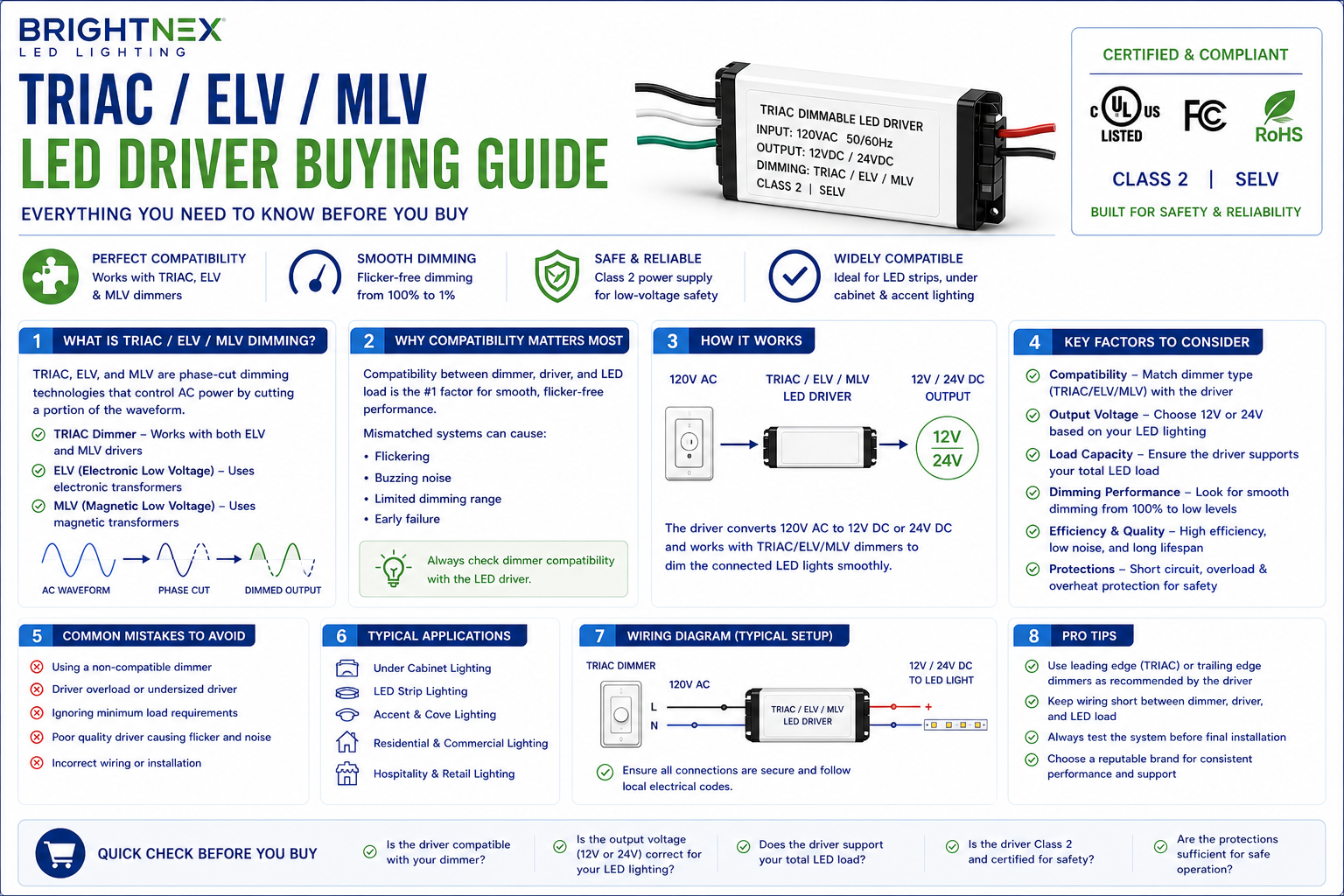
A dimmer that buzzes, drops out at low levels, or flickers on a premium LED install usually points to one thing - the wrong driver-dimmer match. That is why the triac elv mlv led driver conversation matters so much for electricians, lighting dealers, and project buyers. On paper, these dimming types can look interchangeable. In the field, they are not.
For trade buyers, the real issue is not just whether a driver dims. It is whether it dims cleanly with the existing wall control, whether it holds performance over time, and whether it is rated correctly for the environment. In luxury residential work especially, dimming problems get noticed immediately. A high-end kitchen, media room, stair detail, or cove application can look flawless at full brightness and still fail the job if the low-end dimming is unstable.
What a TRIAC ELV MLV LED driver actually means
When buyers search for a TRIAC ELV MLV LED driver, they are usually trying to solve one of two jobs. Either they need a driver that works with legacy phase-cut dimmers already on the wall, or they need a dimmable power supply that can support a clean residential dimming experience without moving to a separate control system.
TRIAC dimming typically refers to forward-phase dimming. It is common in many residential retrofits because older incandescent-style dimmers were based on this method. MLV stands for magnetic low voltage and is often associated with forward-phase controls. ELV stands for electronic low voltage and usually refers to reverse-phase dimming. In LED applications, these labels are often used as shorthand for dimmer compatibility rather than strict transformer type alone.
That is where confusion starts. Some LED drivers are designed to work with TRIAC dimmers only. Some support both TRIAC and ELV style controls. Some are marketed around MLV compatibility, but performance still depends on the actual dimmer model, load, and fixture design. The label matters, but the compatibility details matter more.
Why compatibility matters more than the label
A driver can be technically dimmable and still perform poorly on the wrong phase-cut control. Contractors know this from experience. The issue is rarely just on or off operation. The issue is how the system behaves from 100 percent down to the lower end.
A good dimming setup should turn on consistently, dim smoothly, avoid shimmer, and stay quiet. It should also recover cleanly when dimmed back up. If the driver, dimmer, and LED load are not matched, common problems show up fast: dead travel at the top of the dimmer, sudden drop-off near the bottom, flicker, audible noise, or complete dropout.
This is especially important with LED strips, recessed lighting, and custom architectural details where the light source is continuous and the eye catches every inconsistency. In premium homes, poor dimming stands out more than almost any other electrical issue because the customer interacts with it daily.
TRIAC and MLV in retrofit-heavy jobs
TRIAC and MLV-compatible drivers are often the practical choice when the project already has standard wall dimmers in place. In remodel work, that can save labor, reduce wall work, and simplify approvals. If the dimmers are known, tested, and within the load range, a compatible phase-cut driver can be the fastest path.
The trade-off is that not every older dimmer behaves well with LED loads. Even when a driver says TRIAC dimmable, results can vary depending on minimum load requirements and the quality of the dimmer. On smaller LED loads, performance can become less predictable if the dimmer was originally designed for incandescent wattage.
ELV in high-end residential dimming
ELV-compatible drivers are often favored for smoother low-end dimming and better performance in upscale residential environments. Reverse-phase dimming can be gentler on electronic loads, and many installers find it performs better with premium LED fixtures and strip systems.
That does not mean ELV is always the right answer. ELV dimmers usually cost more, and if the project already has forward-phase controls throughout, upgrading every location may not make sense. The right choice depends on whether the buyer is optimizing for retrofit convenience, dimming quality, budget, or all three.
How to choose the right triac elv mlv led driver
Start with the dimmer that will actually be on the wall. That sounds obvious, but it is the step most likely to get skipped during quoting. If the dimmer brand and model are known, driver selection becomes much more accurate. If they are not known, there is more risk in the install.
Next, confirm the load type and total wattage. LED strip systems, downlights, and specialty fixtures behave differently. A driver running near its maximum capacity may dim differently than one with healthy headroom. Most professionals prefer to avoid loading a driver to its limit, especially on projects where dimming quality matters as much as output.
Then verify voltage and class requirements. For low-voltage LED strips, the driver has to match the strip voltage exactly, usually 12V or 24V DC. Class 2 requirements, enclosure design, and junction box configuration also matter for inspection and installation efficiency.
Environmental rating is another major point. If the driver is going into a damp or wet location application, that rating cannot be treated as an afterthought. Professional buyers should also look for UL certification and a properly built housing that supports real-world jobsite conditions, not just bench testing.
What professional buyers should look for
For wholesale and project purchasing, the best driver is not the cheapest line item. It is the one that reduces callbacks and protects margin. That usually means prioritizing certification, dimming stability, and install readiness.
A quality dimmable driver should offer dependable performance across a realistic dimming range, not just basic compatibility language on a spec sheet. It should be UL certified, clearly labeled for application type, and built for consistent output. Junction-box style drivers can also be a major advantage in residential and mixed-environment installs because they simplify code-compliant wiring and help keep the install clean.
This is one reason many trade buyers prefer sourcing from suppliers that focus heavily on dimmable systems rather than treating drivers as accessories. BrightNex LED, for example, centers much of its offering around professional-grade dimmable drivers and strip lighting systems built for reliable field compatibility, including projects in high-end homes where dimming quality is non-negotiable.
Common mistakes when specifying phase-cut dimmable drivers
One common mistake is assuming every phase-cut dimmer will work the same way. It will not. Even within the same brand, performance can vary by model and load type.
Another mistake is underestimating the effect of very small loads. LED systems draw far less power than legacy incandescent fixtures, and some dimmers struggle when the connected load is too light. That can create ghosting, inconsistent startup, or poor low-end control.
A third issue is treating the driver separately from the LED product. In reality, the strip, fixture, driver, wiring length, and dimmer all interact. A premium COB strip paired with the wrong driver can still produce disappointing dimming behavior. Good system design matters.
Best-fit applications for TRIAC, ELV, and MLV drivers
TRIAC-compatible drivers are often a strong fit for residential retrofits, straightforward remodels, and jobs where the existing dimmer infrastructure needs to stay in place. They can be cost-effective and practical when the dimmer match is known.
ELV-compatible drivers are often the better fit for luxury homes, custom millwork lighting, undercabinet runs, and architectural strip applications where smoother low-end dimming is worth the added control cost. They are especially appealing where the client expects refined performance and quiet operation.
MLV-oriented compatibility matters most when the control strategy or installed dimmer family points in that direction. In many LED projects, MLV language appears because buyers are trying to maintain compatibility with existing forward-phase systems. The key is to validate real driver-dimmer performance rather than buying off terminology alone.
The buying decision for wholesale LED projects
For distributors, contractors, and lighting stores, a triac elv mlv led driver should be evaluated as part of the full installation path. Ask whether the dimmer is existing or new, whether the space is standard residential or luxury residential, whether the driver needs a junction box, and whether the load is a short decorative run or a larger architectural lighting system.
The right answer is not always the most advanced driver. Sometimes the right answer is the one that works cleanly with the installed controls and keeps the job on schedule. Other times, especially in premium residential work, upgrading to the better-matched dimming method is the smarter long-term move.
A good driver should protect performance, inspection readiness, and reputation all at once. When you are bidding or stocking for professional installs, that is the difference between a product that simply powers LEDs and one that supports a better project outcome. Choose with the dimmer, the environment, and the end-user experience in mind, and the install will usually reward you for it.