
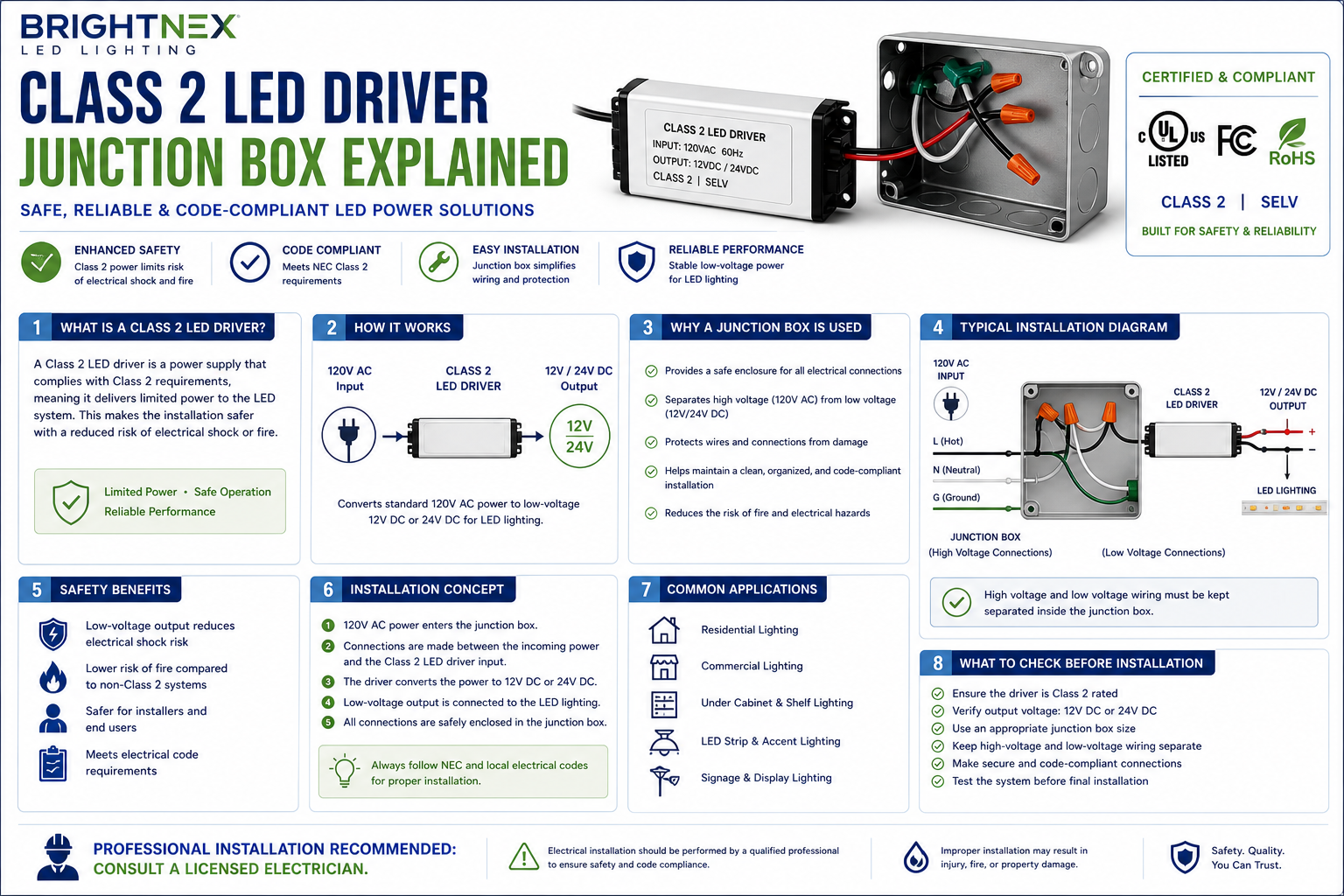
A failed rough-in usually does not start with the LED tape. It starts when the driver, enclosure, wiring method, and inspection requirements were treated like separate decisions. In real jobs, they are tied together. A class 2 led driver junction box matters because it affects safety compliance, access, splice protection, location rating, and how clean the final installation looks behind drywall, millwork, or cabinetry.
For electricians, lighting dealers, and project buyers, the issue is not whether a junction box sounds useful. The real question is which type of driver-and-box combination will pass inspection, fit the application, support the load, and hold up in a premium install. That is especially true in luxury residential work, where dimming performance and a clean finish carry just as much weight as price.
What a class 2 LED driver junction box actually does
At the most practical level, the junction box provides a protected space for line-voltage input connections and strain relief while the driver converts incoming power to the low-voltage output your LED load needs. In many professional-grade products, the driver and junction box are integrated into one UL-listed assembly. That saves time in the field and reduces guesswork about compatibility between the driver, enclosure, and wiring method.
The Class 2 part is just as important as the box. A Class 2 driver is designed so its output stays within power limits defined for reduced fire and shock risk. For LED strip lighting and many low-voltage fixture applications, that matters because it simplifies downstream wiring decisions and supports safer installation practices. It does not remove the need for proper installation, but it does change the risk profile compared with higher-power non-Class 2 systems.
In trade terms, a class 2 led driver junction box is often the cleanest answer when you need line-voltage splices contained correctly, low-voltage output managed properly, and a listed product that supports damp, dry, or in some cases wet-location use depending on the model.
Why Class 2 matters in real installations
There is a reason Class 2 drivers show up so often in LED strip projects, recessed applications, and architectural accent lighting. They make life easier on jobs where the system needs to be safe, compact, and straightforward to inspect.
The first advantage is reduced complexity on the output side. Because the driver output is limited, many low-voltage lighting runs are easier to plan and easier to service later. The second advantage is broad suitability for residential and light commercial work, especially where electricians are integrating dimmable strip systems into cabinets, toe-kicks, coves, vanities, and custom millwork.
There are trade-offs. Class 2 output limits also mean wattage limits per driver. If the run is long or the load is high, you may need multiple drivers instead of one larger unit. That can increase equipment count and require better planning for placement, ventilation, and access. For high-end homes, that planning is usually worth it because it keeps the install cleaner and more serviceable.
Where a class 2 LED driver junction box is most useful
This setup is especially common in jobs where the driver cannot just be left exposed or loosely placed in a cavity. Under-cabinet lighting is a good example. So are closet systems, floating vanities, display shelving, and recessed architectural details where line-voltage connections must be enclosed and the finished space leaves little room for error.
In premium residential work, integrated junction box drivers are often preferred because they support a more polished result. You get a purpose-built enclosure, predictable connections, and a neater handoff from branch circuit wiring to low-voltage output. That matters when the install is visible to clients, designers, inspectors, and future service technicians.
Environment also matters. Not every driver-and-box assembly is rated for every location. Some are intended for dry locations only. Others are suitable for damp or wet environments when installed according to listing and manufacturer instructions. If the project includes bathrooms, exterior soffits, covered patios, or other moisture-prone areas, the location rating needs to be verified before purchase, not after rough-in.
How to choose the right class 2 led driver junction box
Start with load and dimming. A driver should not be chosen by wattage alone. You need the correct voltage for the LED product, enough capacity for the connected load, and the right dimming protocol for the control system. TRIAC, ELV, MLV, and 0-10V each have their place, and mismatch is one of the fastest ways to create callbacks.
Then look at the enclosure itself. Is the junction box integrated and UL listed as part of the assembly? Does it provide adequate space for input conductors and splices? Are knockouts, strain relief, and access practical for the way your crew actually installs? On paper, many products look similar. In the field, enclosure design makes a real difference.
Physical size should be reviewed early. The driver may fit electrically but still create problems inside a cabinet chase, above millwork, or in a service cavity with limited airflow. For remodel work, this becomes even more important because existing framing and finishes leave less room for adjustment.
The last filter is application quality. Professional buyers usually want more than a basic driver that turns lights on. They want stable dimming, low noise, dependable output, and listing confidence. In higher-end homes, buzzing, flicker, or a bulky improvised enclosure will not be accepted, even if the lights technically work.
Check certification before price alone
Price always matters, especially in volume purchasing, but certification should come first. A UL-listed driver with an integrated junction box gives buyers and installers stronger footing on safety and inspection. That is one reason trade buyers often standardize around certified product families instead of mixing low-cost parts from different sources.
For wholesalers and installers serving demanding markets, dependable certification also protects margins. The cheapest component becomes expensive when it causes an inspection issue, dimming complaint, or premature replacement.
Match the driver to the LED system
The driver should be selected as part of the full system, not as an afterthought. Output voltage must match the strip or fixture. Wattage should include sensible headroom. Dimming compatibility must line up with both the control and the driver. If the LED product is premium COB, SCOB, RGB, RGBW, CCT, or IC RGB tape, the supporting power components should meet the same standard.
That system-level thinking is where experienced suppliers add value. BrightNex LED focuses on professional-grade dimmable drivers and UL-certified strip lighting systems because trade buyers need parts that work together, not just parts that ship in the same box.
Common mistakes that create problems later
One of the most common mistakes is assuming every enclosed driver is the same. It is not. Some products provide a true integrated junction box intended for line-voltage terminations. Others are simply enclosed housings and still require a separate approach to meet code and listing requirements.
Another mistake is underestimating dimming variables. A Class 2 driver may be electrically correct and still perform poorly if paired with the wrong dimmer type or incompatible load characteristics. That issue shows up often in residential remodels where existing controls are kept in place.
The third mistake is poor placement. Drivers need accessible locations consistent with code and service needs. Hiding them in an inaccessible cavity may solve a visual problem today and create a repair problem tomorrow. On custom projects, clean design and serviceability need to work together.
What trade buyers should expect from a supplier
If you are buying in volume, a supplier should be able to provide more than a spec sheet. You should expect clear information on location rating, dimming type, enclosure style, certification, input voltage, output voltage, and compatibility with the intended LED load. That saves time for estimators, purchasers, and installers.
You should also expect inventory reliability. A class 2 led driver junction box is rarely a one-off purchase. It is usually part of a repeatable package across multiple homes, units, or retail jobs. Consistency matters because it supports standardization in the field and reduces the chance of crews mixing incompatible components.
For lighting stores and contractors serving upscale residential work, this is even more important. Clients are paying for a refined result, and that means the power side of the system needs to be just as dependable as the visible lighting.
A good class 2 led driver junction box does not draw attention when the project is finished. That is the point. It keeps the install safe, listed, tidy, and compatible with the lighting design you sold. When you choose the right one early, the rest of the system tends to go a lot smoother.