
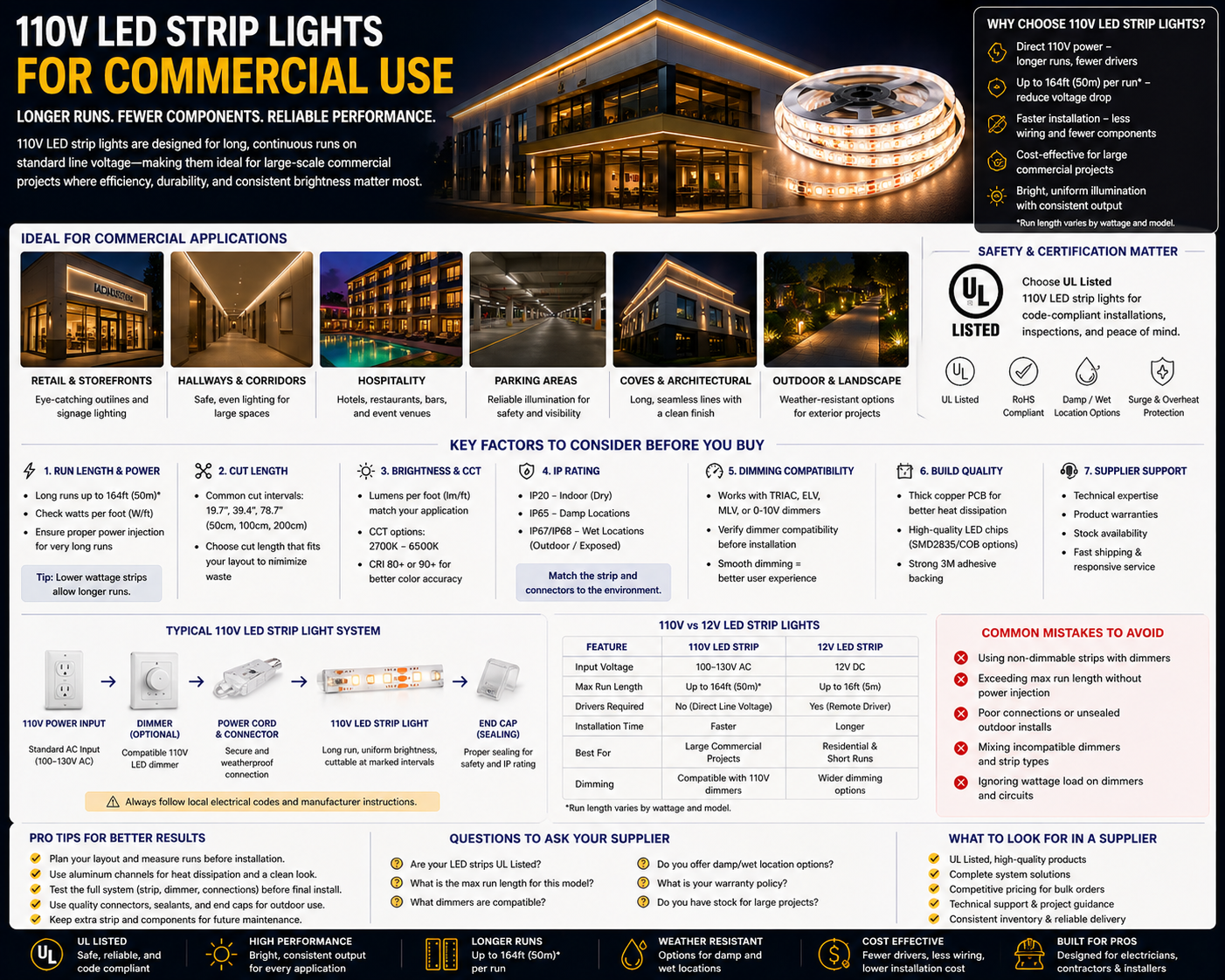
When a project calls for long linear lighting without a maze of power supplies, 110v led strip lights commercial buyers usually move to the top of the spec sheet fast. For contractors, lighting stores, and project suppliers, the appeal is simple - longer run capability, fewer drivers, faster installation, and cleaner planning for large spaces where downtime and callbacks cost real money.
That does not mean every 110V strip is automatically the right fit. In commercial work, the difference between a strip that performs well and one that becomes a service issue usually comes down to certification, cut length, brightness consistency, ingress protection, and how well the system matches the jobsite conditions.
Why 110V LED strip lights commercial projects often prefer
Low-voltage strip lights still have a strong place in millwork, detail lighting, and tight control applications. But commercial environments often involve long corridors, storefront outlines, parking structures, hospitality exteriors, cove lighting, and large perimeter runs. In those cases, 110V strip lighting solves a basic installation problem: distance.
Because the strip runs directly from line voltage, installers can cover much longer lengths with fewer connection points. That reduces voltage drop concerns and eliminates the need to place multiple remote drivers throughout the job. On a retail rollout or hospitality renovation, that can make a meaningful difference in labor planning.
There is also a practical inventory advantage for trade buyers. Fewer accessory dependencies can simplify purchasing, staging, and replacement planning. Instead of matching every zone with a separate low-voltage driver strategy, buyers can standardize around a line-voltage strip system for the right applications.
The trade-off is control flexibility. If a project needs very short cut increments, highly customized dimming logic, or integrated smart color scenes in premium residential detailing, low-voltage systems often provide more precision. Commercial buyers should choose 110V strips because the application fits, not because the run length looks convenient on paper.
Where 110V LED strip lights commercial installations make sense
The best use cases are the ones where long, continuous runs matter more than micro-level customization. Retail facades, canopy edges, hallways, warehouse pathways, coves in large lobbies, and outdoor building accents are all common examples. In these environments, labor efficiency and reliable illumination usually carry more weight than ultra-short cutting flexibility.
Hospitality is another strong category. Hotels, restaurants, bars, and event venues often need consistent linear lighting over long architectural lines. A 110V strip can reduce the amount of hidden equipment required behind finished surfaces, which matters when installation space is limited or access after completion is difficult.
Commercial-residential crossover projects also deserve attention. High-end multifamily amenities and luxury common areas often want the clean look of strip lighting with the practical installation benefits of line voltage. This is where product quality becomes especially visible. Cheap strips tend to show uneven output, poor color consistency, and premature yellowing, all of which stand out in upscale spaces.
What professional buyers should check before ordering
UL certification should be near the top of the list. On a commercial project, certification is not a marketing extra. It affects inspection, liability, and buyer confidence. Products with clear UL marking and documented compliance are easier to specify and easier to defend when projects are reviewed by contractors, GCs, or local authorities.
Next comes environment rating. A dry-location interior cove needs a different construction than an exterior run exposed to weather, dust, or washdown. Buyers should confirm whether the strip and all related connections are suitable for dry, damp, or wet locations. The weakest point in a strip system is often not the LED tape itself, but the splice, end cap, connector, or field termination.
Cut length matters more than many buyers expect. Some 110V strips are designed for long interval cutting, which is acceptable for perimeter lighting but frustrating in detailed architectural layouts. Before placing a volume order, check whether the project can work cleanly with the available cut points. If not, material waste and install delays can eat into the margin.
Brightness and color temperature also need to match the application, not just the fixture schedule. For retail, bright and crisp light may support merchandising. For hospitality, warmer tones often create a more controlled atmosphere. If the lighting will be visible rather than concealed, output uniformity and dot visibility become more important.
Installation advantages and the limits to know
From a labor standpoint, 110V strip lighting can be efficient. Longer runs mean fewer power injection points and fewer remote components to mount, wire, and troubleshoot. On large commercial jobs, that can shorten install time and reduce coordination across trades.
That said, line-voltage products require disciplined handling. Installers need to follow code, use the proper accessories, and maintain the integrity of the system across connections and terminations. If the strip is going into a wet or damp environment, the field assembly details become even more important. A fast install is only valuable if it stays trouble-free after turnover.
Dimming is another area where assumptions cause problems. Not every 110V strip supports the same dimming method, and not every dimmer on site will play nicely with every strip configuration. Commercial buyers should verify dimming compatibility upfront instead of leaving it to field trial and error. That is especially true on projects using mixed lighting loads or retrofit controls.
Commercial spec priorities that protect margins
For wholesalers, contractors, and project buyers, the purchase decision is never just about fixture cost. A lower unit price can lose its appeal quickly if the strip fails inspection, installs slowly, or creates service calls six months after occupancy.
A better buying framework is to evaluate total project impact. Does the strip carry recognized certification? Is the output stable and consistent across the full run? Are the accessories matched and available in dependable supply? Can your crews install it without improvising around missing components or unclear compatibility?
This is where premium wholesale supply has real value. A focused supplier can help trade buyers source the strip, compatible accessories, and supporting components in a way that reduces friction. For firms handling multiple jobs across states, consistent availability matters almost as much as performance. A product that tests well but disappears from inventory is not a strong commercial solution.
Buyers working in upscale environments should also look at finish quality, jacket durability, and color consistency from reel to reel. In luxury retail and high-end residential common areas, visual defects get noticed immediately. BrightNex LED serves this part of the market with professional-grade strip lighting systems built for buyers who need UL-certified reliability, strong compatibility, and wholesale pricing that still supports premium projects.
When low voltage is still the better call
Not every commercial strip-lighting job should move to 110V. If the design includes short custom segments, tight cabinet integration, advanced RGB or RGBW controls, or highly refined dimming behavior, low-voltage systems often remain the smarter specification. They can offer better flexibility for detailed layouts and more options for controls integration.
That does not weaken the case for 110V strips. It just keeps the decision grounded in application reality. Long runs, simpler power planning, and installation efficiency are the strengths. Fine-grain customization is usually not.
For mixed-use projects, some buyers do best with both. A line-voltage strip may cover exterior architectural runs and long corridors, while low-voltage COB or color-changing strip handles millwork, niches, and premium interior details. The right approach is often a system strategy, not a single product strategy.
Choosing a supplier for 110V LED strip lights commercial demand
Commercial lighting buyers need more than a catalog page. They need a supplier that understands certification, inventory consistency, accessory compatibility, and how products behave in the field. That means clear specs, stable quality, and practical support for the kind of jobs where delays affect schedules across multiple trades.
A strong supplier should also understand the difference between selling a strip light and supporting a commercial installation. Contractors want to know if the product is suitable for the location, whether dimming is compatible, how the strip should be terminated, and what accessories are required to complete the run correctly. Those details protect labor hours and reduce risk.
The best 110V strip lighting choice is not the cheapest reel in the market. It is the one that installs efficiently, passes inspection, performs consistently, and holds up in real commercial conditions. If the product can do all of that while preserving your margin, it belongs on your next quote.
The job usually tells you whether 110V strip lighting is the right tool. If the run is long, the schedule is tight, and reliability matters more than over-customization, that answer is often straightforward.