
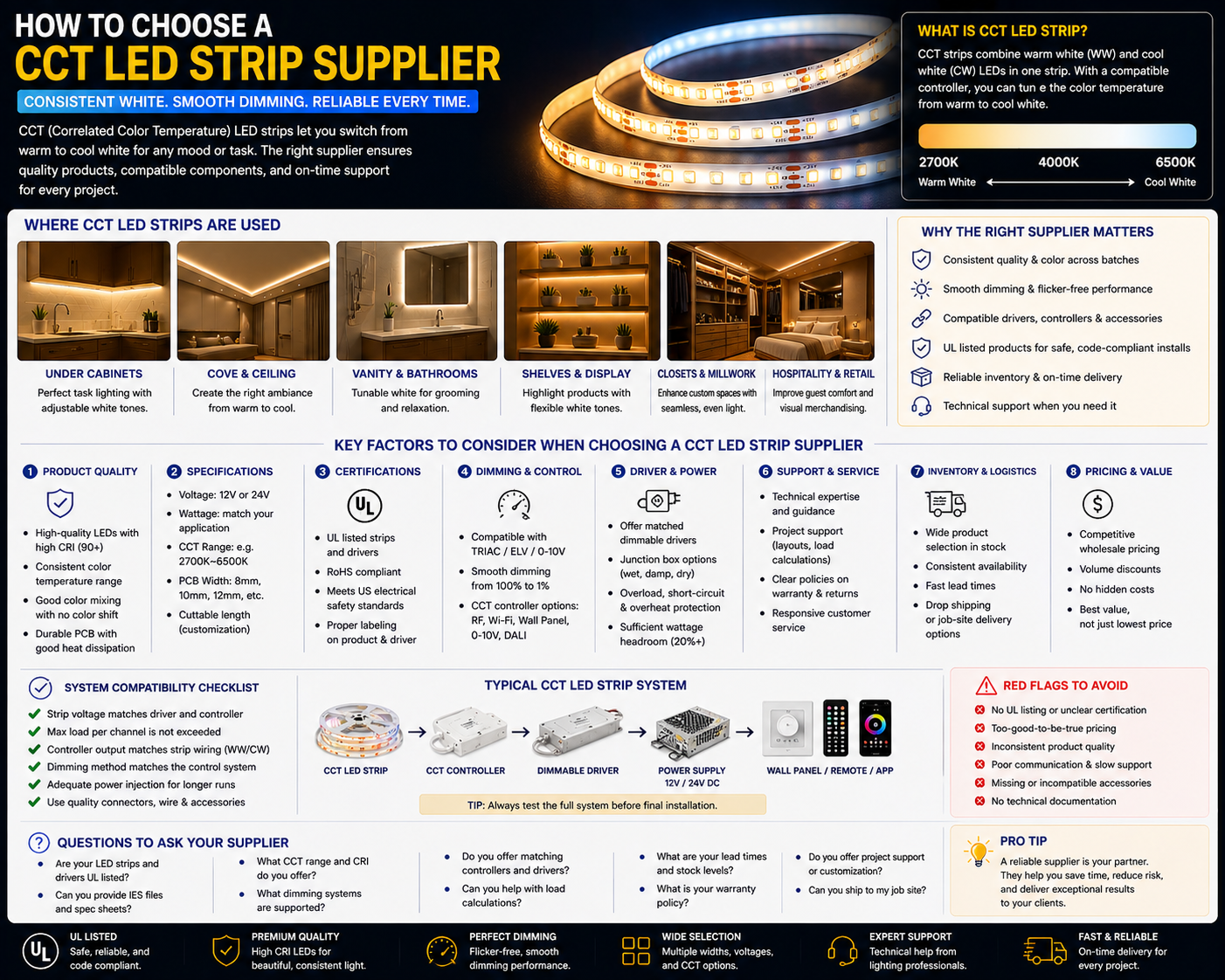
When a lighting package looks perfect on paper but fails at trim-out, the problem is often not the fixture design. It is the supply chain behind it. Choosing the right cct led strip supplier matters because tunable white projects depend on more than just flexible tape - they depend on color consistency, dimming behavior, UL compliance, driver matching, and inventory you can actually reorder.
For electricians, lighting dealers, remodelers, and project buyers, CCT strip lights are usually specified to give end users control over warm and cool white tones in one system. That sounds simple until the strip, controller, driver, and installation environment start working against each other. A supplier that understands trade requirements will help you avoid call-backs, mismatched accessories, and costly substitutions late in the job.
What a cct led strip supplier should actually provide
At the trade level, you are not just buying a reel of LED tape. You are buying system reliability. A serious supplier should be able to support the strip itself, the correct driver options, compatible controls, aluminum profiles, connectors, wire, and practical installation guidance for dry, damp, or wet locations where applicable.
That matters even more with CCT products because tunable white strips introduce another layer of coordination. You need stable output across both color temperature channels, dependable dimming, and a controller setup that does not create flicker, uneven blending, or failure at low-end dim levels. If your supplier only knows the strip and not the full power and control path, you are left solving the compatibility problem in the field.
Professional buyers should also expect transparent specifications. That includes PCB width, wattage, cut points, IP rating, color temperature range, UL status, driver requirements, and recommended accessories. If those details are vague, the product may still work for a small one-off application, but it is not a strong fit for repeatable project work.
UL listing is not optional for professional jobs
For many US projects, certification is one of the first screens that separates usable inventory from risky inventory. A dependable cct led strip supplier should offer products with clear UL status and matching components that support code-conscious installations.
This is especially relevant in luxury residential work, retail environments, and any project where the electrician, inspector, builder, or owner expects documentation to be in order. A strip light with the UL mark on the product itself gives buyers more confidence than vague claims on a product sheet. The same goes for drivers and transformers. If the power supply side is not properly built for the environment, your install quality is only as good as the weakest component.
For trade buyers, that means checking whether the supplier can provide dimmable drivers with practical installation features, not just electrical output. Junction box integration for wet, damp, and dry locations can make a real difference in labor efficiency and inspection readiness.
CCT performance is about consistency, not just color range
Many listings emphasize that a strip can shift from warm white to cool white. That is basic. What matters on a real job is whether the strip maintains smooth blending, stable output, and consistent appearance from reel to reel.
A low-grade CCT strip may technically change color temperature but still produce uneven whites, visible diode spacing, or a patchy effect in reflective millwork and under-cabinet applications. In high-end homes, those flaws show immediately. They are even more noticeable in kitchens, coves, shelving, and vanity installations where premium finishes reflect every detail.
That is why experienced buyers look at strip construction, LED density, PCB quality, and channel uniformity. In some projects, standard SMD-based CCT strips are perfectly adequate. In others, especially where dot-free appearance or shallow profile installation matters, COB options are the better fit. The right supplier should not push one format for every job. They should help you match strip type to application, budget, and finish standard.
Driver and dimming compatibility can make or break the job
Most field issues with LED strip systems are not caused by the strip alone. They come from poor pairing between strip, driver, and dimming method. That is where a wholesale supplier earns its value.
If you are working with TRIAC, ELV, MLV, or 0-10V controls, you need a supplier that understands which dimmable driver family belongs with which project condition. A strip may look great on a bench test and still fail in the actual installation because the dimmer curve is wrong, the load is unstable, or the driver does not behave well at the low end.
This is also where project type matters. A custom residence in Los Angeles may prioritize smooth dimming, quiet performance, and flawless visual output in architectural details. A retail build may prioritize fast deployment, available stock, and straightforward replacement planning. The strip can be similar, but the driver strategy may not be.
A good supplier will ask the right questions early. What control system is being used? What voltage is preferred? Is the location dry, damp, or wet? Is the strip going into an aluminum profile? Is low-profile installation required? Those details prevent expensive changes later.
Inventory depth matters more than sample quality
Almost every supplier can send a clean sample. The real test is whether they can support the full order, the change order, and the repeat order. Trade buyers need a cct led strip supplier with dependable inventory across the supporting parts, not just the hero product.
That includes multiple strip widths, driver options, controllers, connectors, wiring accessories, and mounting solutions. Width is a practical issue, not a catalog detail. If your project needs 8 mm, 10 mm, 6.5 mm, or 12 mm strip formats to fit a specific channel or design constraint, you need a supplier that can cover those requirements without forcing a redesign.
This is one reason focused wholesale suppliers tend to outperform general marketplaces for professional work. They understand that a late accessory shortage can hold up an install just as easily as a strip shortage. For project buyers, the advantage is not just product availability. It is the ability to source a coordinated package from one place and reduce compatibility risk.
What trade buyers should ask before opening an account
Before you commit to a supplier, look at how they answer practical questions. Can they clearly confirm UL certification? Can they explain dimming options without sending you to guess from a generic chart? Do they stock accessories that match the strips they sell? Can they support premium residential applications where finish quality matters?
You should also ask about consistency between batches, shipping coverage, and whether the supplier is built for wholesale relationships rather than one-off consumer sales. That distinction matters. B2B buyers need pricing that protects margins, product support that respects jobsite realities, and availability that works for schedules, not just for online browsing.
For professionals sourcing across the US, nationwide fulfillment matters too. A supplier may have strong product quality but still create headaches if distribution is slow, fragmented, or unreliable. The best partner is one that combines certification, technical support, and repeatable supply under one roof.
Why premium projects demand a better supplier
In entry-level work, buyers sometimes accept a little variation if the price is low enough. In premium residential and architectural projects, that tolerance disappears. Cabinet lighting, toe-kick lighting, shelf lighting, and cove details are not background elements anymore. They are part of the design language.
That is why professional installers and lighting dealers working in upscale markets tend to be stricter about strip quality, dimming stability, and finish integration. The cost of a callback in a luxury home is much higher than the initial savings from buying cheaper material. A reliable supplier helps protect both your margin and your reputation.
BrightNex LED is positioned around exactly that trade reality - professional-grade strip systems, UL-focused product selection, compatible dimmable drivers, and wholesale supply built for electricians, lighting stores, and project buyers across the US.
The right supplier should make your work easier, not force you to troubleshoot basic compatibility after the product arrives. If a cct led strip supplier can back up quality with certification, technical clarity, and dependable inventory, you are not just buying material. You are buying fewer surprises on the jobsite.