
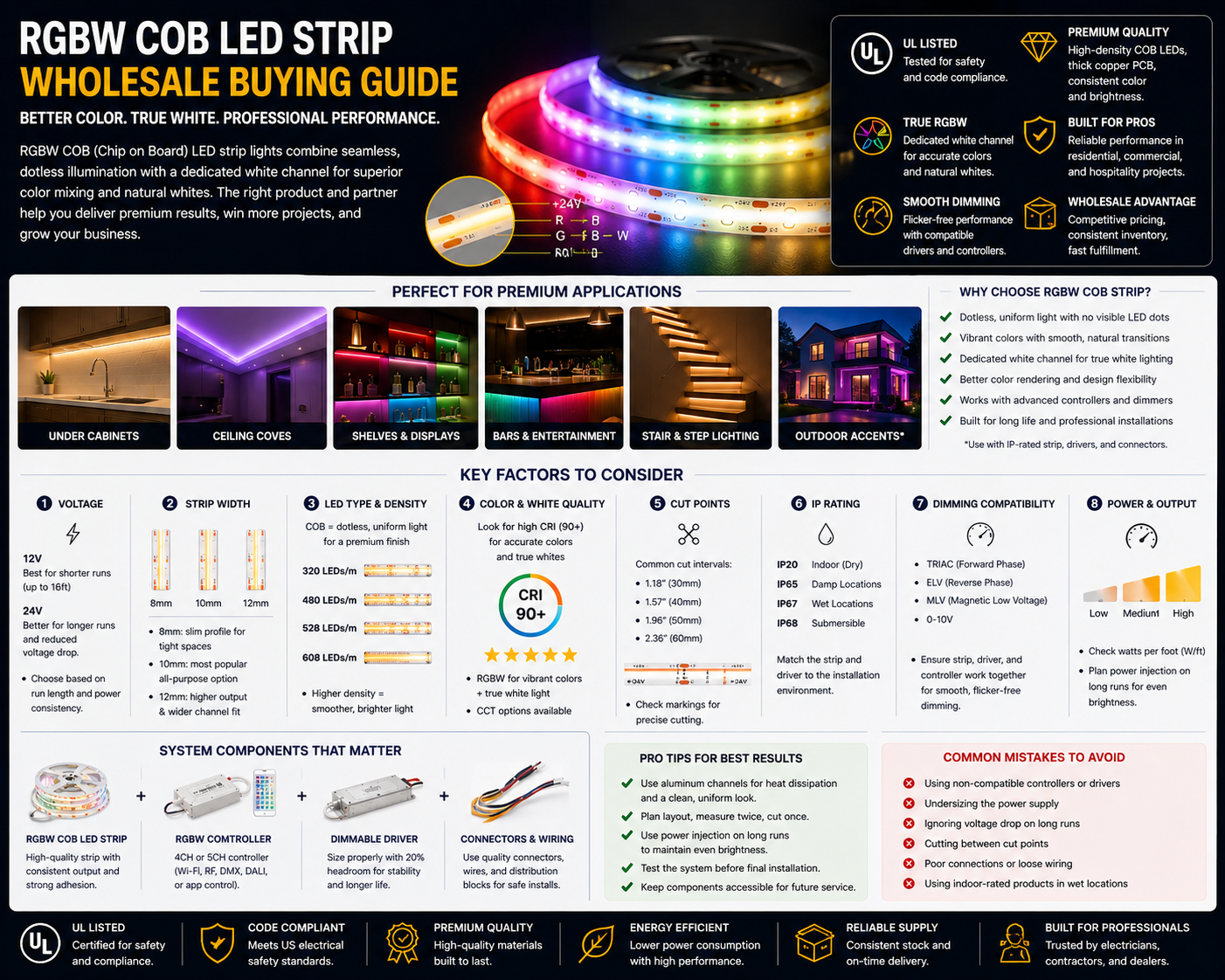
A color-changing strip can look impressive on a sample board and still become a problem on a real job. The difference usually comes down to sourcing. If you are buying rgbw led strip wholesale for electricians, retail inventory, or high-end residential projects, the real questions are not just about color output. They are about UL listing, PCB width, controller compatibility, voltage drop, inventory consistency, and whether the product will hold up once it is installed behind millwork, under cabinets, or inside premium architectural details.
For trade buyers, RGBW means more than RGB with an added white channel. It means better scene control, cleaner whites when the project needs practical illumination, and more flexibility in luxury spaces where clients want both decorative color and usable task lighting. That is why RGBW strip lights continue to gain traction in upscale homes, hospitality settings, and custom remodels. But wholesale purchasing only makes sense when the product line is built for professional installations.
What matters most in rgbw led strip wholesale
At the wholesale level, consistency matters as much as brightness. One reel that performs well is not enough. Contractors and lighting suppliers need repeatable quality across batches, because the second phase of a project has to match the first. If the LED density changes, the white tone shifts, or the PCB quality drops, callbacks become expensive fast.
UL certification is one of the first filters serious buyers should apply. For the US market, that is not a minor detail. It affects inspection confidence, resale confidence, and jobsite credibility. When strip lights carry the UL mark directly on the product, it gives installers and purchasing teams clearer assurance that the product was built for code-conscious professional use.
The white channel also deserves a closer look. Some RGBW products add white as an afterthought, resulting in weak output or poor balance compared to the RGB channels. Better wholesale-grade strips use the white channel as a true functional feature, giving designers and installers a way to deliver clean ambient or task lighting without relying on mixed RGB approximations.
RGBW strip selection starts with the installation
Not every RGBW strip is right for every project. A low-profile cove detail, a long undercabinet run, and a backlit stone feature all place different demands on the strip, power supply, and control system.
PCB width matters more than many buyers expect. In millwork and aluminum channels, a few millimeters can decide whether a product fits cleanly or causes delays in the field. Professional buyers often need options such as 8 mm, 10 mm, or 12 mm widths to match different profiles, diffusion requirements, and installation spaces. If a supplier only carries one format, the buyer ends up adjusting the project around the product instead of the other way around.
Voltage and run length are just as important. Short decorative sections may perform well on standard low-voltage layouts, but longer runs require planning around voltage drop, feed points, and driver capacity. If your customers are working on large homes or long linear applications, wholesale supply should include strips and power solutions that support clean, predictable performance across the full installation.
Why premium homes demand better RGBW products
Luxury residential lighting is less forgiving than many commercial applications. In high-end homes, LED strips are often installed where every shadow line, color shift, and dimming issue is easy to notice. Clients expect warm, even white light for everyday use and smooth color transitions for entertaining. They also expect systems to work reliably with premium controls.
That is where better rgbw led strip wholesale programs separate themselves from commodity supply. Premium-grade strips should deliver stable color output, dependable adhesion, quality copper construction, and compatibility with professional controllers and dimmable power systems. Cheap reels may lower the initial purchase price, but they often create labor waste, replacements, and customer dissatisfaction that erase any margin advantage.
This is especially true in markets like Los Angeles, where lighting details are part of the design language of the home. Hidden strip lighting in stair treads, bars, floating vanities, ceiling coves, and custom cabinetry has to perform without visible hotspots or failures. Trade buyers serving these projects need inventory they can specify with confidence.
Controllers, drivers, and compatibility are part of the sale
A strip light does not perform in isolation. Wholesale buyers should evaluate the complete system, including controllers, drivers, connectors, wire options, and mounting accessories. Many field issues blamed on strip quality actually start with mismatched power or control components.
RGBW installations often require more careful driver sizing because the added white channel changes load calculations. Dimming behavior can also vary depending on the control method and how the project is designed. Professional buyers should look for suppliers who understand TRIAC, ELV, MLV, and 0-10V environments, and who can support the right driver pairing for the intended application.
For projects in wet, damp, or dry locations, enclosure and junction box details matter too. Drivers with appropriate junction box configurations help simplify code-compliant installations and reduce guesswork on the jobsite. That level of system readiness is valuable to electricians and project managers who do not want to source half the package from one vendor and the rest from another.
Inventory reliability affects profit
Wholesale pricing gets attention first, but supply reliability often has a bigger impact on profitability. If a supplier cannot maintain stock, keep specifications consistent, or support repeat orders, project schedules suffer. That is a serious issue for contractors, lighting stores, and procurement teams managing phased jobs or multiple active projects.
A dependable wholesale partner should offer more than a good per-foot price. They should be able to support volume orders, maintain stable product specifications, and ship across the US without turning every reorder into a negotiation. For trade buyers, that predictability protects labor schedules and customer relationships.
This is one reason many professionals prefer focused suppliers over general import catalogs. A specialized LED wholesaler is more likely to understand strip-to-driver compatibility, profile fitment, color-changing control needs, and the certification standards that matter in the field. That technical alignment reduces purchasing risk.
How to evaluate an RGBW strip before you buy in volume
The fastest way to avoid wholesale mistakes is to review the product as an installed system, not just as a reel in a box. Ask how the strip performs in a channel with a diffuser. Ask how the white channel compares to a dedicated white strip in practical use. Ask whether the UL marking is present on the product itself and whether the matching driver and control options are available from the same source.
It also helps to consider the end market. A lighting retailer may need broad SKU coverage and dependable shelf replenishment. An electrician may need field-ready components with fast compatibility checks. A contractor on a luxury residential project may care most about dimming smoothness, finish quality, and long-term reliability. The right wholesale choice depends on who you are serving and how expensive a failure would be.
BrightNex LED is built around that trade reality, with professional-grade strip lighting, UL-certified products, compatible dimmable driver solutions, and a wholesale catalog designed for US installers, resellers, and project buyers who need dependable inventory rather than retail-grade guesswork.
When lower pricing is not really lower cost
There is always pressure to buy cheaper, especially on large-volume strip lighting packages. But experienced buyers know that low reel pricing can hide higher total cost. If strips fail early, colors vary between batches, adhesive backing lifts, or control compatibility becomes a field issue, the labor cost will dwarf the savings.
The better approach is to look at cost through the full job cycle. Can the strip be installed efficiently? Will it pass inspection without drama? Can it be reordered months later with matching performance? Will the driver and controller combination work the first time? If the answer is yes, then the product is protecting margin, not just reducing upfront spend.
That is the standard professional buyers should apply to rgbw led strip wholesale. The goal is not simply to buy more reels. It is to buy a system you can specify, stock, and install with confidence across real projects, from luxury residential work to retail lighting programs.
When the strip light disappears into the architecture and the lighting simply works, that is when the sourcing decision proved itself.