
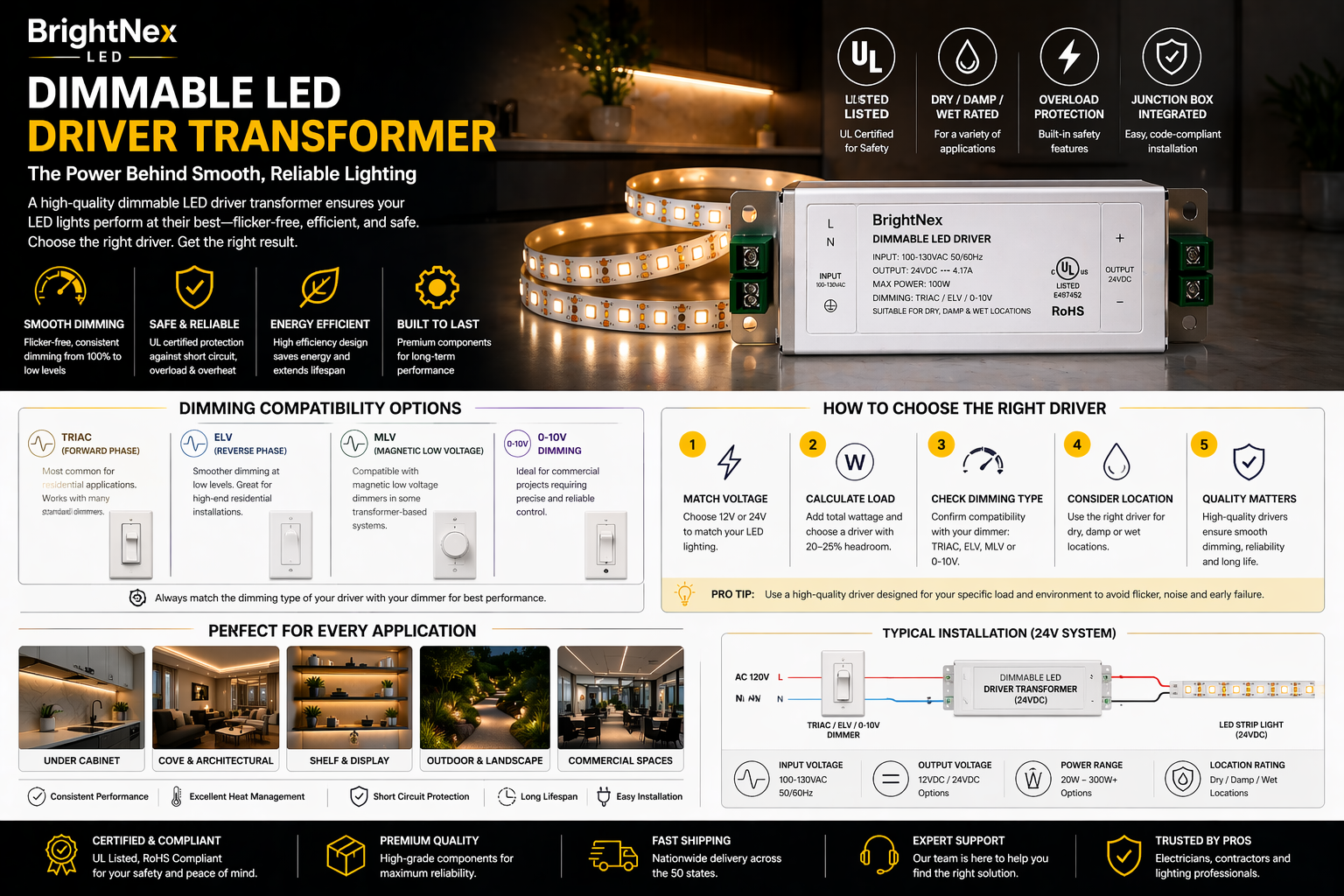
A dimmable LED driver transformer is often the part that decides whether a lighting job feels premium or turns into a callback. The strips may look great on paper, and the fixture may be specified correctly, but if the power supply and dimming method do not match the load, the result is familiar - flicker, drop-off at low dim levels, buzzing, or dead zones on the wall control. For electricians, lighting stores, and project buyers, this is not a small detail. It is the difference between a clean install and a problem site.
In professional LED systems, the driver is doing more than supplying power. It is converting incoming line voltage to the low-voltage DC output your strips or fixtures need, while also managing how that output responds to the dimmer. That is why the phrase dimmable LED driver transformer gets used so often in the field, even though the exact product may technically be an LED driver, a low-voltage power supply, or a driver with an enclosed junction box. What matters on the job is compatibility, safety listing, and stable dimming performance.
What a dimmable LED driver transformer actually does
For most strip lighting and low-voltage architectural installs, the driver takes 120V input and converts it to a regulated low-voltage output, typically 12VDC or 24VDC. In a dimmable version, it also accepts a dimming signal or works with a phase-cut dimmer so the connected LEDs can fade smoothly.
This sounds simple until you look at real-world installations. A luxury kitchen cove light, a toe-kick run, and a backlit vanity may all use LED tape, but the dimming hardware behind them may be completely different. One project might call for TRIAC because it is tying into existing residential dimmers. Another may need 0-10V for a commercial control package. A third may use ELV because the dimming range and stability are better for that load. The right driver depends on the system around it, not just the wattage.
How to choose a dimmable LED driver transformer
The first checkpoint is output voltage. If the LED strip or fixture is 24V, the driver must be 24V. If the load is 12V, the driver must be 12V. Mixing these is not a small mismatch - it can damage product or cause immediate failure.
The second is wattage. Add the total load and leave headroom. Most trade buyers already do this, but it still matters because dimming performance can degrade when a driver is pushed too close to its maximum. A practical target is to size the driver above the actual connected load rather than right on top of it. That helps thermal performance and long-term reliability.
The third is dimming type. This is where many compatibility issues start.
TRIAC, ELV, MLV, and 0-10V are not interchangeable
TRIAC dimming is common in residential projects because it often works with standard wall dimmers already used in homes. It is a familiar option for remodels and custom houses, especially where low-voltage strip lighting is being added without a full control system upgrade. The trade-off is that not every TRIAC dimmer behaves the same, and low-end dimmers can produce inconsistent results at the bottom end.
ELV dimming is often a better fit where smoother low-end dimming is required. In higher-end homes, this can be the preferred route when clients expect soft fade performance in kitchens, living areas, and accent lighting applications. The hardware cost may be higher, but the dimming result is often cleaner.
MLV is still relevant in some legacy applications, but it is less common for modern LED strip systems. If a project calls for MLV compatibility, verify it directly rather than assuming any phase-dimmable driver will work.
0-10V is standard on many commercial jobs and some large residential systems. It provides a separate low-voltage control signal and is typically a strong choice when the controls package has already been defined by the electrical or lighting plan. It is dependable, scalable, and easier to standardize across bigger projects.
Environment rating matters more than many buyers think
A driver may be electrically correct and still be wrong for the installation environment. Damp, dry, and wet-location considerations need to be matched from the start, especially for under-cabinet lighting near sinks, outdoor architectural accents, bathroom details, and pool-adjacent applications.
Enclosed drivers with junction boxes help streamline code-compliant installs and protect connections. For professionals working across different jobsite conditions, this matters because it reduces improvisation in the field. A driver rated and enclosed for the intended environment can save time during rough-in and final trim while improving inspection readiness.
Why dimmable LED driver transformer quality shows up on finished jobs
The easiest way to spot a poor driver is at low dim levels. That is where flicker, stepping, and instability usually appear. On a spec sheet, many products can claim dimming capability. On a finished wall, only a well-matched system delivers the quiet, smooth response expected in a premium home or polished commercial space.
This is especially important in high-end residential work. Cove lighting, cabinetry, stair details, and recessed millwork all expose the quality of the dimming curve. If the client sees shimmer on warm accent light in a custom kitchen, they will not blame the driver specification. They will blame the contractor or supplier.
That is why serious buyers look for more than price per unit. UL certification, stable dimming performance, reliable output, and field-proven compatibility protect labor and reputation. A cheaper driver that creates one service call can erase any savings from the purchase order.
Matching the driver to LED strips and fixtures
Strip selection affects driver choice. COB and SCOB strips, RGB, RGBW, CCT, and IC RGB systems all create different planning requirements. Single-color white tape may only need the correct voltage, wattage, and dimming method. Tunable white and color-changing systems add controllers, signal coordination, and more complex load planning.
Width and form factor matter too, especially when projects are being built around aluminum profiles or tight channels. Professional buyers sourcing 6.5mm, 8mm, 10mm, or 12mm strip systems are usually looking at the full assembly, not just the tape. The driver has to support the electrical load while fitting the installation strategy, control method, and environment.
This is one reason wholesale buyers prefer a focused supplier over a general catalog house. The fewer assumptions you need to make between strip, driver, control, and certification, the smoother the job goes.
What trade buyers should confirm before ordering
Before placing a volume order, confirm five things: output voltage, total wattage, dimming protocol, location rating, and listing requirements. If the project is in California or in a high-end residential market like Los Angeles, expectations are usually higher on dimming quality and finish consistency. That makes driver selection even more visible.
It also helps to verify whether the system needs Class 2 configuration and whether the driver enclosure supports your installation method. For wholesalers, retailers, and contractors managing repeat jobs, consistency across inventory matters as much as performance on a single site. Standardizing on dependable dimmable drivers reduces compatibility surprises and makes reorders easier.
BrightNex LED focuses heavily on this part of the category because trade buyers need more than generic low-voltage power. They need UL-certified dimmable driver solutions that pair cleanly with professional strip lighting systems, support wet, damp, and dry location use where required, and hold up in demanding residential and commercial applications.
The real cost of getting it wrong
When a driver is undersized, poorly matched, or not truly compatible with the dimmer, the problem usually shows up after installation. That is the expensive stage. By then, the tape is mounted, cabinetry may be closed, and the client is walking the site.
Replacing a failed or unstable driver is rarely just a parts issue. It can mean troubleshooting hours, finish protection, return scheduling, and tension with the GC or homeowner. For lighting retailers, it can also mean product returns that were caused by system mismatch rather than actual defect. That is why experienced buyers treat the dimmable LED driver transformer as a core component, not an accessory.
If the goal is a professional result, buy the driver the same way you buy the lighting itself - by specification, certification, and jobsite fit. Good dimming is not an upgrade after the fact. It starts with the power supply you choose.