
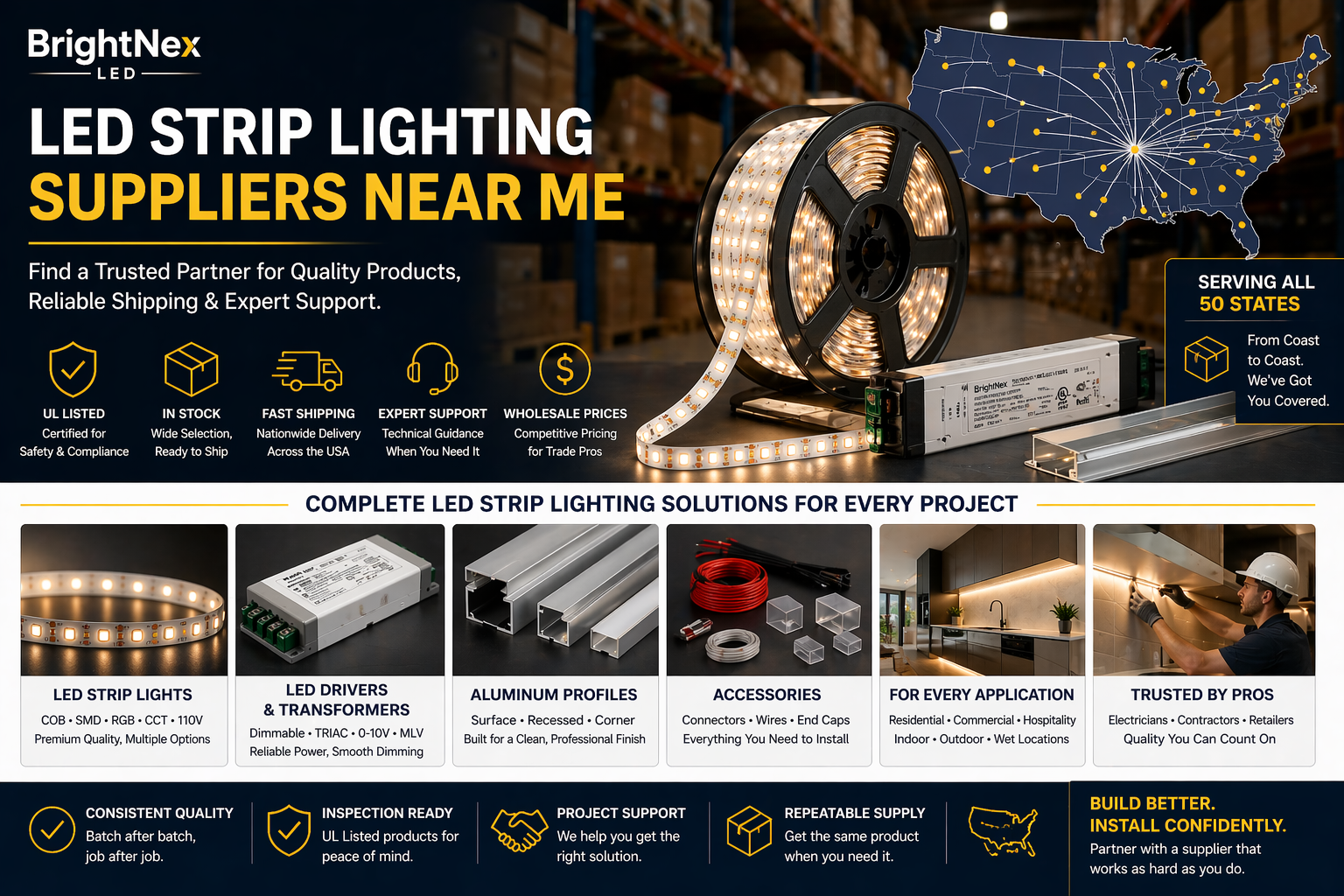
If you are searching for led strip lighting suppliers near me, you are probably not looking for a decorative impulse buy. You need a supplier that can quote quickly, ship reliably, and deliver strip lights, drivers, profiles, and accessories that work together on the first install. For electricians, lighting stores, contractors, and project buyers, the real question is not who is closest on a map. It is who can support your job with certified products, consistent inventory, and technical compatibility.
That distinction matters more with LED strip lighting than many buyers expect. A strip may look similar in a product photo, but the field result depends on tape width, voltage drop, dimming method, mounting profile, wire runs, wet or damp location requirements, and driver quality. A local seller with shallow stock can slow a project down fast. A professional wholesale supplier with nationwide fulfillment can often serve the job better, even if they are not in your ZIP code.
What to look for in LED strip lighting suppliers near me
For trade buyers, supplier selection starts with safety. UL-listed strip lights and power components are not a marketing extra. They are part of reducing inspection issues, callbacks, and liability. If you are working in high-end homes, retail environments, hospitality spaces, or custom millwork, the expectation is clear - premium appearance must be backed by compliant components.
The next factor is system compatibility. Strip lighting is never just the strip. You need the right driver, dimming performance that matches the control strategy, connectors or soldering options that make sense for the field condition, and aluminum channels that manage heat and finish the installation properly. A supplier that only sells tape lights without a complete supporting catalog creates more work for your team.
Inventory depth also deserves close attention. Many projects need more than one strip format. You may need 8 mm COB for a tight architectural reveal, 10 mm or 12 mm options for higher output or different mounting conditions, RGBW for a feature zone, CCT for tunable white applications, or 110V strip for longer runs. A serious supplier should be able to support those variations without pushing you into mixed brands and questionable compatibility.
Price matters, but trade buyers know how to read price correctly. The lowest unit cost can become the most expensive choice if dimming is unstable, adhesive fails, color consistency shifts between batches, or replacement stock is unavailable halfway through the job. Wholesale value means dependable performance at pricing that protects your margin.
Why local is not always the best filter
The phrase led strip lighting suppliers near me makes sense when you need material fast. But for B2B purchasing, proximity is only one variable. A nearby counter supplier may be convenient for basic stock, yet many do not specialize in premium strip systems. They may have a few SKUs on the shelf, limited profile options, and little support for advanced dimming or luxury residential applications.
A wholesale supplier serving all 50 states can be a stronger fit if they maintain focused inventory, understand strip-to-driver pairing, and can support repeat orders with the same specifications. That is especially important for builders, remodelers, and lighting retailers managing multiple phases or future service needs. Consistency across jobs has real value.
This is where many professional buyers shift from a local search mindset to a supply partner mindset. The best supplier is the one that helps you standardize quality, reduce troubleshooting, and keep premium installs moving.
The product details that separate strong suppliers from weak ones
A professional supplier should be able to speak clearly about strip construction, not just color temperature and wattage. COB and SCOB products are often selected for smoother dot-free illumination, especially in luxury millwork, under-cabinet lighting, toe-kick details, and cove applications. If your client expects a clean line of light, the strip type matters.
Tape width is another practical checkpoint. Not every job has room for the same board size, and not every aluminum channel accepts every strip. Availability in 6.5 mm, 8 mm, 10 mm, and 12 mm formats gives installers and specifiers more flexibility. It also reduces the common field problem of trying to force a strip into a profile it was not meant to fit.
Color control options should be equally clear. Some projects call for standard single-color white. Others need RGB, RGBW, CCT, or IC RGB depending on the design brief and control plan. A supplier should not just carry those categories. They should help buyers understand driver needs, controller pairing, and installation limitations before material is ordered.
Then there is driver quality. This is where many strip lighting systems fail in real-world use. Dimmable performance has to match the control method, whether the application calls for TRIAC, ELV, MLV, or 0-10V. Wet, damp, and dry location requirements must also be addressed correctly. Drivers with proper junction box integration can simplify installation and improve code compliance in demanding environments.
Wholesale buyers should ask these questions early
When evaluating led strip lighting suppliers near me, the fastest way to avoid bad purchasing decisions is to ask better questions upfront. Ask whether the strip lights are UL listed and whether the marking is on the product itself. Ask what dimming methods are supported and which drivers are recommended for each strip family. Ask whether the supplier stocks aluminum profiles, lenses, connectors, wire, remotes, and controllers that are intended to work together.
You should also ask about repeatability. Can they supply the same specification later for a second phase, punch list, or future project? Do they serve trade buyers directly, or are they built around small retail orders? Can they support luxury residential work where finish quality, color consistency, and dimming behavior are under more scrutiny than in a basic utility application?
A supplier that answers these questions directly is usually easier to work with throughout the project. Vague answers at the quotation stage often become expensive answers in the field.
Choosing a supplier for luxury residential and specification work
High-end residential strip lighting is a different category from basic decorative LED tape. The visual standard is higher, and so is the expectation for reliability. In premium homes, the strip often disappears while the light effect becomes part of the architecture. That means no visible hotspots, no flicker, no cheap-looking profiles, and no mismatched color from one room to the next.
For that reason, many professionals prioritize suppliers with strong COB offerings, dependable dimmable driver solutions, and accessories suited for clean installation details. Luxury work also tends to involve multiple environmental conditions, from dry millwork to damp bathroom areas and exterior-adjacent locations. A supplier that understands those distinctions will save time during planning and inspection.
BrightNex LED is built around that trade requirement - professional-grade strip lighting systems, UL-certified components, dimmable driver options, and wholesale supply that supports electricians, lighting stores, and contractors across the US.
A practical way to narrow your options
Start by filtering out any seller that is not truly B2B focused. If they are mainly serving homeowners, they are less likely to understand project staging, specification consistency, and margin-sensitive wholesale pricing. Next, review whether they carry a complete strip system rather than isolated parts. Then verify certification, dimming support, available widths, and shipping capability.
After that, compare how well each supplier fits the type of work you actually do. If your projects are design-driven residential installs, product finish and light quality should carry more weight. If your work involves larger commercial runs, inventory depth and logistics may matter more. If you support lighting stores or repeat contractor accounts, consistency and reorder availability become critical.
The best supplier is rarely the one with the widest generic catalog. It is usually the one with a focused range of professional products that solve the same installation problems you face every week.
Searching for led strip lighting suppliers near me is a useful starting point, but serious buyers should look past distance and judge the full supply package - certification, compatibility, dimming, profile support, inventory, and trade pricing. When those pieces are right, installs go faster, premium spaces look better, and your next reorder is much easier than the first.