
A hot spot on a finished millwork detail is the kind of mistake clients notice immediately. That is why dotless COB LED tape light has become the preferred choice for contractors, lighting dealers, and spec buyers working on luxury homes, retail displays, and architectural accents where the light line itself is part of the design.
For trade buyers, the appeal is not just aesthetics. COB strip technology changes how projects are specified, installed, and maintained. When the diode spacing disappears behind a continuous beam, you can use shallower channels, tighter reveals, and more visible installations without fighting the dotted look common with older SMD strips. But not every COB strip performs the same, and not every project needs the same width, voltage, color control, or dimming setup.
What makes dotless COB LED tape light different
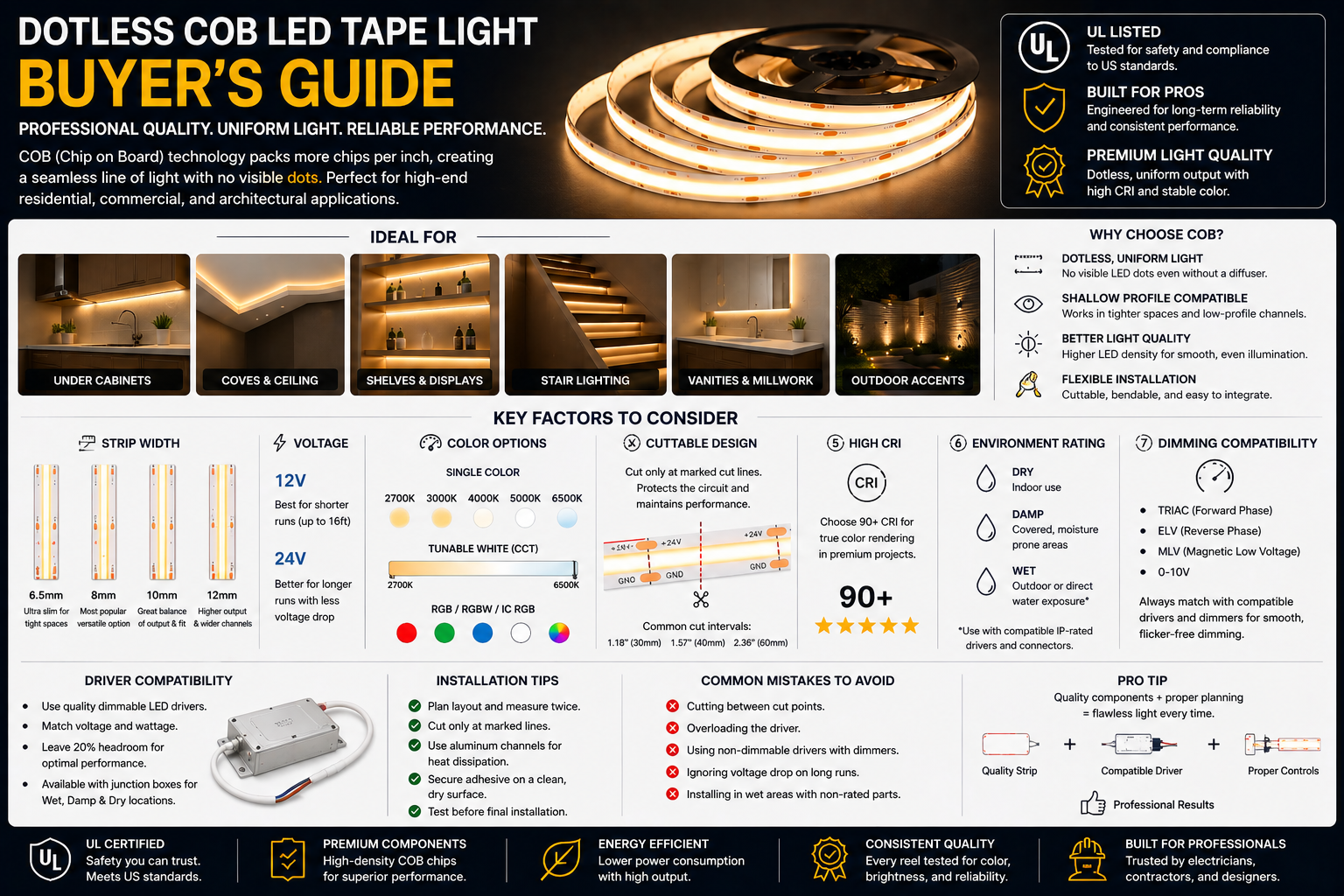
The term COB refers to chip-on-board construction, where many small LED chips are packed closely together on the strip surface. In practical terms, that density is what creates the smooth, uninterrupted line of light. Instead of seeing individual points through a diffuser or on a reflective surface, you get a more uniform appearance.
That matters most in premium applications. Under-cabinet lighting in a painted kitchen, toe-kick accents in a modern residence, open shelf lighting, cove details, and illuminated millwork all expose strip quality. In those settings, a standard strip can still work, but it often needs a deeper aluminum profile or heavier diffusion to hide the dot pattern. COB strips reduce that limitation.
There is also a specification advantage. For professionals sourcing for multiple jobs, dotless output simplifies decision-making when the strip will be directly visible. You spend less time trying to balance LED density, lens choice, mounting depth, and sightline issues.
Where COB tape light performs best
The strongest use case is any application where the strip light will be seen either directly or through a thin diffuser. High-end residential projects in Los Angeles and other design-driven markets often call for that kind of clean finish. Designers want the architectural line, not the LED hardware.
In cabinetry, closets, floating vanities, and stair details, COB strips help deliver that refined look even in compact channels. In retail shelving and display lighting, they also help present products more evenly, which can improve perceived quality. The same applies to hospitality, bars, and reception areas where reflective surfaces can exaggerate diode spotting.
That said, it depends on the job. If the strip will be buried in a deep cove with no direct view of the LEDs, standard high-density strip may be sufficient and sometimes more cost-effective. A good buyer does not choose COB because it is trendy. They choose it when the visual finish justifies the spec.
How to evaluate a dotless COB LED tape light
The first checkpoint is certification. For professional installations in the US market, UL listing is not a side note. It affects inspection, liability, and buyer confidence. A strip built for trade use should support clean project documentation, especially in residential remodels, commercial spaces, and jobs with strict electrical review.
Next comes strip width and physical fit. Not every project gives you the same channel allowance. Narrow options such as 6.5 mm or 8 mm can be valuable when you are working in slim cabinetry details or compact aluminum profiles. Wider formats like 10 mm or 12 mm can make more sense when higher output, broader compatibility, or certain control options are needed.
Voltage is another decision point. Your layout length, driver strategy, and voltage drop tolerance will influence whether you choose one format over another. On longer runs, you need to think beyond brightness alone and plan for consistent output from end to end.
Then there is color configuration. Single-color COB strips cover many warm white and neutral white applications, but a lot of current projects require more flexibility. CCT adjustable, RGB, RGBW, and IC RGB options make sense when the project includes scene setting, entertainment zones, hospitality lighting, or layered residential controls. The right answer depends on whether the client wants architectural white light, decorative color, or both.
Dimming and driver compatibility matter more than most buyers expect
A strip can look excellent on the bench and still become a problem in the field if the dimming package is wrong. Contractors already know this, but it is worth repeating because tape light issues are often blamed on the strip when the driver or control method is the real weak point.
Before you buy, match the strip and driver to the dimming environment. TRIAC, ELV, MLV, and 0-10V all have their place, but they are not interchangeable in practice. A luxury residential project with centralized controls may need a different approach than a retail build-out or a single-room remodel. Driver enclosure requirements also matter. Wet, damp, and dry location planning should be handled early, not after trim-out.
This is where a focused wholesale supplier adds value. BrightNex LED serves trade buyers who need professional-grade strip lighting and dimmable driver solutions that are built for real installations, including drivers with junction boxes suited for wet, damp, and dry locations. That reduces sourcing friction and helps maintain compatibility across the full system.
Common trade-offs buyers should consider
COB strip lighting offers a premium visual result, but there are trade-offs. One is cost. A dotless COB LED tape light usually carries a higher product cost than basic strip options. For premium homes, custom millwork, and visible architectural details, that premium is often easy to justify. For hidden utility lighting, it may not be.
Another trade-off is service strategy. Some installers prefer highly standardized strip platforms across all jobs to simplify stocking and replacements. If COB becomes your premium line while SMD remains your value line, your team needs to stay organized on connectors, profiles, controllers, and drivers.
Thermal management still matters too. A smooth beam does not remove the need for proper mounting surfaces and aluminum channels where appropriate. If the installation traps heat or ignores load planning, lifespan and consistency can suffer. Good-looking light should still be treated like electrical equipment, not decorative trim.
Choosing the right specification for your project
For under-cabinet and task lighting, prioritize consistent white output, dimming compatibility, and channel fit. In most cases, clients care more about smooth illumination and clean cabinetry lines than color effects. Warm white and tunable white options are usually the practical winners here.
For luxury residential accents, especially in coves, niches, and floating architectural details, output and color rendering both matter. The strip has to look refined when on, but it also has to flatter materials like stone, wood veneer, paint, and metal. Cheap tape light can make expensive finishes look flat.
For retail and commercial displays, think about viewing distance and reflected glare. Dotless COB strips can improve shelf presentation and reduce visual distraction, but beam quality should be balanced against maintenance planning and control needs. If a display changes frequently, connector strategy and accessible driver placement become more important.
For color-changing applications, do not assume every client needs full RGB performance. Sometimes CCT gives the user exactly what they need with less system complexity. RGBW and IC RGB make sense when the lighting is part of the experience, not just the architecture.
Why wholesale buyers are moving toward COB for premium jobs
The market has shifted because project expectations have shifted. Homeowners, designers, and developers have seen cleaner lighting details in luxury spaces, and now they expect that finish in their own projects. A visible dotted strip reads as lower grade, especially in custom installations where every reveal and profile line has been carefully planned.
For lighting stores, electricians, and project suppliers, dotless COB products also help support an upscale sales position. They give you a better answer when the customer asks why one strip costs more than another. The difference is visible. That makes the product easier to specify, present, and defend.
At the same time, buyers still need margin protection. The best wholesale value is not the lowest upfront price. It is the product that installs cleanly, passes inspection, dims correctly, avoids callbacks, and supports the level of finish the project demands.
Final buying advice for professionals
If the strip will be visible, reflected, or installed in a shallow profile, start with COB. If the project is specification-sensitive, confirm UL listing, strip width, dimming method, and environmental rating before release. And if the job is a premium residential or architectural application, do not treat tape light as a low-priority accessory. It is often the detail that makes the whole installation look expensive - or not.
The right dotless COB LED tape light does more than remove spotting. It gives your project a cleaner finish, a stronger specification, and fewer compromises where clients are most likely to notice.