
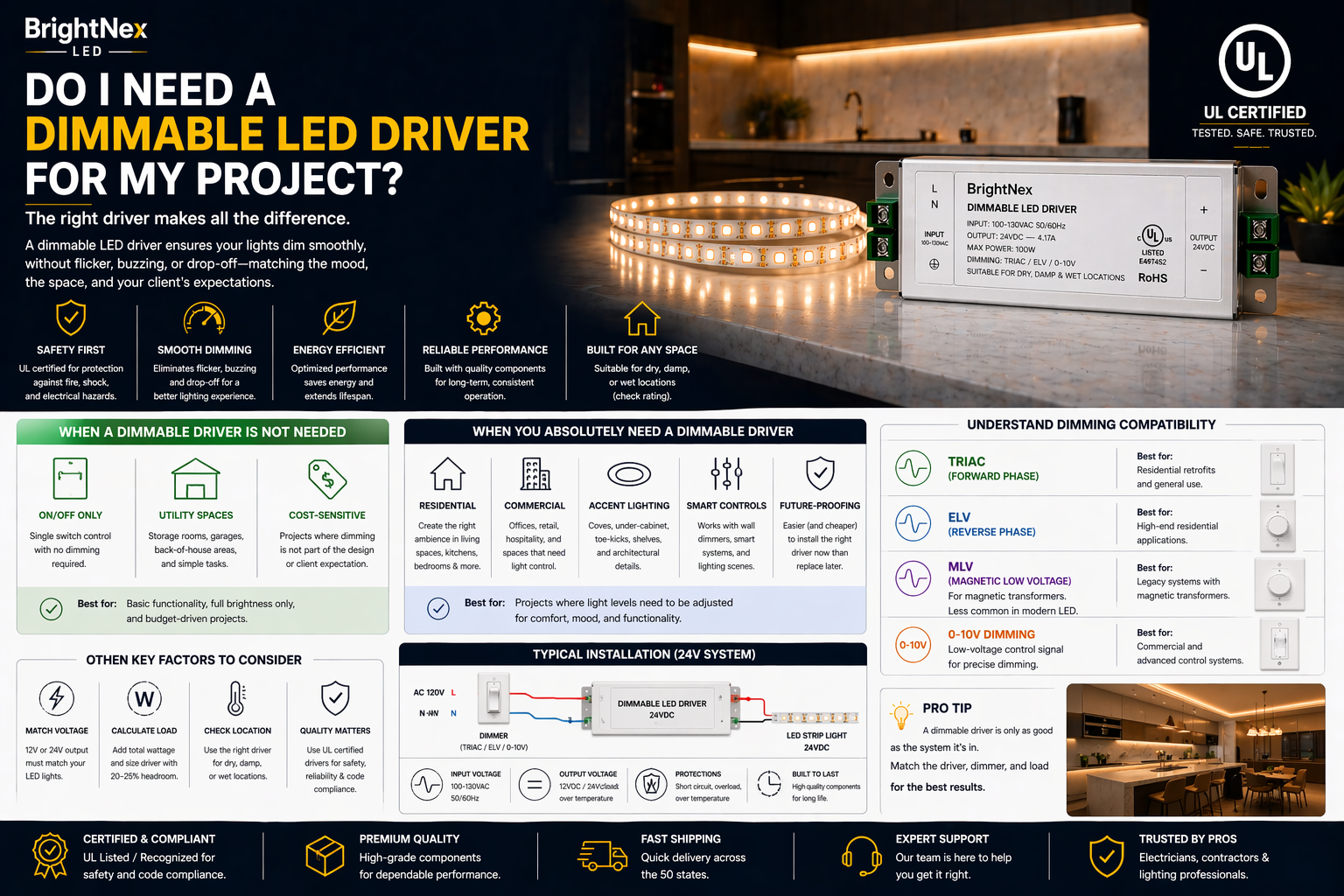
A lighting plan can look perfect on paper and still fail at the wall switch. That usually happens when someone asks too late, do I need a dimmable LED driver, after the fixtures are installed, the controls are picked, and the homeowner expects smooth, silent dimming. If the driver and dimmer are not matched from the start, you can end up with flicker, drop-off, limited dimming range, or a system that simply will not dim at all.
For trade buyers, this is not a small spec detail. The driver determines how the LEDs receive power, how they respond to controls, and whether the installation performs the way the client expects. In high-end residential work, especially with strip lighting, cove lighting, under-cabinet runs, and recessed applications, dimming performance is part of the finished look. Poor dimming does not feel premium.
Do I Need a Dimmable LED Driver for My Project?
The short answer is simple. You need a dimmable LED driver if the lights are expected to dim. If the lighting will only ever run at full output from a standard on-off switch, a non-dimmable driver is usually fine.
That said, the real answer depends on the control method, the fixture type, and the expectations of the project. A luxury home, restaurant, hospitality space, or layered residential remodel almost always benefits from dimming. In those jobs, using the correct dimmable driver is less of an upgrade and more of a requirement.
A dimmable driver is designed to reduce light output in response to a compatible control signal. A standard driver is not. Even if the LEDs themselves are technically dimmable, they still need a driver built for that function. The strip light, module, or fixture cannot make up for the wrong power supply.
When a Non-Dimmable Driver Is Enough
There are jobs where dimming adds no value. Utility areas, basic signage, storage rooms, back-of-house applications, and simple task lighting sometimes only need reliable full-output performance. If the circuit is controlled by a standard switch and no dimmer will be installed now or later, a non-dimmable driver can be the more economical choice.
This is often true in cost-sensitive commercial packages where lighting scenes are not part of the design. In those cases, the priority is stable output, code compliance, and long-term reliability. Paying for dimming capability that will never be used does not help margins.
Still, installers should be careful with future-proofing. If there is any chance the end user will request dimming later, it is usually smarter to specify the dimmable option up front. Replacing drivers after finish work is complete costs far more than the difference in component price.
When You Absolutely Need a Dimmable Driver
If a wall dimmer, smart control, low-voltage controller, or lighting automation system is part of the scope, then yes, you need a dimmable LED driver. There is no workaround that delivers professional results.
This matters most in applications where lighting is expected to create mood, visual comfort, or architectural depth. Think toe-kick lighting, ceiling coves, floating vanities, under-cabinet strips, wine displays, and accent shelving. Full brightness all the time can make these spaces feel harsh. Smooth dimming lets the lighting match the room instead of overpowering it.
It also matters when local specs or client standards call for lighting control integration. Electricians and lighting suppliers working in premium residential projects know this well. If the home includes Lutron-style wall controls, scene setting, or multi-zone dimming, driver selection has to be handled carefully from the beginning.
The Bigger Question Is Compatibility
Most field problems come from asking only whether the driver is dimmable. The more useful question is whether the driver is dimmable in the same way the control system dims.
That distinction matters because dimmable LED drivers are not all the same. Common dimming methods include TRIAC, ELV, MLV, and 0-10V. Each one is designed for a specific control approach. A mismatch between dimmer and driver can cause buzzing, flashing, dead travel, or poor low-end performance.
TRIAC and ELV
TRIAC dimming is common in residential retrofit work because it works with many standard wall dimmers. ELV is also common in premium residential applications and often delivers better low-end performance with compatible electronic low-voltage controls. If the project uses traditional in-wall dimmers, these are usually the first driver types to review.
0-10V
0-10V is more common in commercial and some higher-end residential control environments. It gives predictable control but requires the right wiring and control setup. It is not a plug-and-play substitute for a wallbox dimmer.
PWM and Other Specialized Control Methods
Some LED systems use dedicated controllers rather than standard wall dimmers, especially for RGB, RGBW, CCT, or IC RGB strip lighting. In those systems, the driver and controller must be specified together. The dimming function may come from the controller, but the driver still needs to support the load and voltage requirements properly.
Voltage, Load, and Driver Type Still Matter
Even if you choose a dimmable driver, the job is not done. You still need the correct output voltage, enough wattage capacity, and the right driver classification for the environment.
Most LED strip lighting systems are constant voltage, typically 12V or 24V. Many LED modules and certain fixtures may require constant current instead. Using the wrong type will create performance issues or damage components. Dimming capability does not override basic electrical compatibility.
Load size also affects dimming performance. If the connected load is too small or too close to the driver limit, dimming may become unstable. Good practice is to leave headroom rather than sizing the driver exactly to the calculated wattage. Professionals already know this protects lifespan, but it also helps dimming consistency.
Environmental rating matters too. In kitchens, bathrooms, outdoor-adjacent areas, and other damp or wet locations, the driver enclosure and junction box arrangement must match the installation conditions. This is especially important for inspections and long-term reliability.
What Happens If You Use the Wrong Driver
The most common symptom is flicker, especially at lower dim levels. You may also see lights that turn off suddenly before reaching a low setting, uneven brightness across strip runs, delayed startup, or audible noise from the dimmer or driver.
In premium projects, these issues create callbacks fast. The homeowner may not care whether the problem is the dimmer, the load, or the driver. They only see lighting that feels cheap. That is why experienced buyers focus on certified components, tested compatibility, and dependable inventory rather than chasing the lowest possible piece price.
A proper dimmable driver does more than allow the light to dim. It helps the entire system behave correctly under real operating conditions.
How to Decide Before You Order
Start with the control method. If the plans show wall dimmers, automation, scene controls, or tunable lighting, specify a dimmable driver that matches that exact system. Then confirm voltage, wattage, fixture type, and installation environment.
Next, consider the project standard. In a basic utility application, non-dimmable may be appropriate. In a custom home, showroom, hospitality space, or premium remodel, dimming is often expected even when the plans are not perfectly detailed early on.
Finally, think about risk. A non-dimmable driver may save money on paper, but one mismatch can erase that savings through labor, replacement, and schedule delays. For trade buyers managing reputation as well as margin, the safer decision is often the one that reduces field problems.
BrightNex LED works with professionals who need that level of confidence, especially on strip lighting and dimmable driver packages used in high-end residential environments across the US.
The Right Answer Depends on the End Use
So, do I need a dimmable LED driver? If the lights need to dim, if the client expects scene control, or if the project calls for a refined architectural result, the answer is yes. If the circuit is strictly on-off with no future dimming requirement, the answer may be no.
The key is not treating the driver like an afterthought. In LED systems, the driver is part of the performance package. Get it right early, and the install looks clean, dims smoothly, and stays off your callback list.