
Why Dimming Problems Usually Start Before Wiring
Many dimming issues are blamed on wiring mistakes, but most problems begin with incompatible components. A dimmer, driver, and LED load must all be designed to work together before any wire is connected.
For electricians, contractors, and lighting professionals, compatibility is often more important than the actual wiring process. Flickering lights, limited dimming range, buzzing, and inconsistent performance are usually caused by mismatched dimming methods rather than faulty products.
In premium residential and architectural lighting projects, smooth dimming is part of the finished experience. Getting the system right from the start helps avoid costly troubleshooting later.
Start with the Driver, Not the Dimmer
Before connecting any dimmer, verify what type of dimming the LED driver supports.
The driver specification should clearly identify the dimming protocol. Common options include:
• TRIAC (Forward Phase)
• ELV (Reverse Phase)
• MLV
• 0-10V
The dimmer and driver must support the same control method. Using incompatible products can prevent dimming entirely or create unstable performance.
Driver selection should also account for:
• Input voltage
• Output voltage
• Total wattage load
• Installation environment
• Fixture or strip light requirements
A properly selected driver creates the foundation for reliable dimming performance.
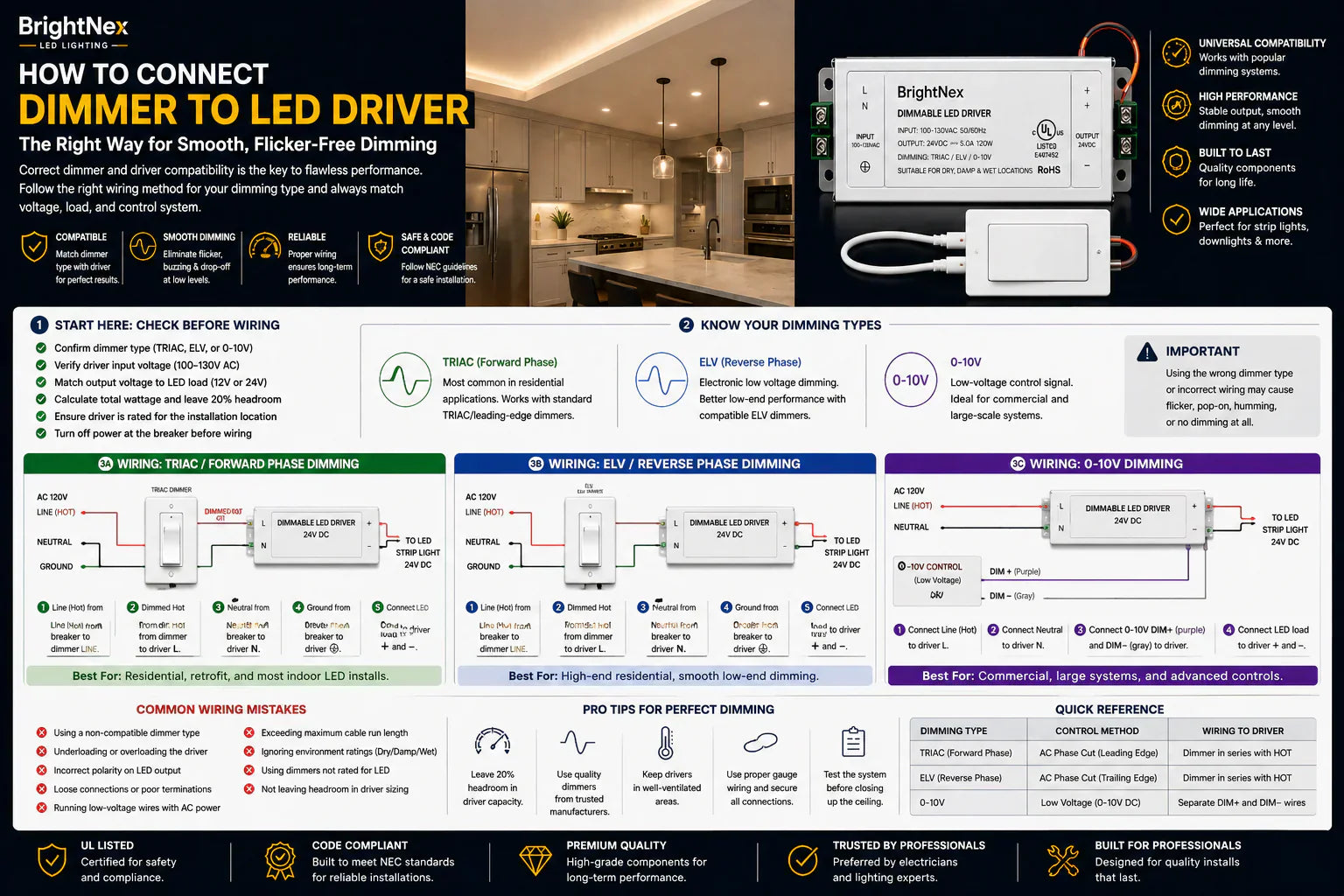
Understanding TRIAC and ELV Dimming Connections
TRIAC and ELV dimming are among the most common control methods used in residential lighting projects.
In these systems, the wall dimmer is installed on the AC input side of the driver. The dimmer controls the incoming power before it reaches the driver.
The typical sequence is:
Line Power → Wall Dimmer → LED Driver → LED Load
The LED strip or fixture does not connect directly to the dimmer. Instead, the dimmer controls the driver, and the driver regulates power to the LEDs.
TRIAC is frequently used in retrofit applications because it works with many existing wall dimmers. ELV is often preferred for higher-end installations where smoother low-level dimming is important.
How 0-10V Dimming Works
0-10V dimming operates differently from TRIAC and ELV systems.
The driver receives constant line-voltage power while a separate low-voltage control pair manages dimming.
Most 0-10V drivers include dedicated dimming terminals commonly labeled:
• DIM+
• DIM-
The control signal tells the driver how much light output to produce.
Because dimming is handled through separate control wiring, 0-10V systems are often used in commercial projects and larger lighting control environments where multiple zones need predictable performance.
Why Compatibility Is More Important Than Wiring
The physical wiring process is usually straightforward. The challenge comes from selecting compatible components.
Before installation, verify:
• Driver dimming method
• Dimmer compatibility
• Voltage requirements
• Wattage requirements
• Environmental ratings
• LED load type
Even perfectly installed wiring cannot compensate for incompatible dimming technologies.
A driver designed for TRIAC dimming will not perform correctly with a 0-10V control system, and vice versa.
Why Proper Driver Sizing Matters
Dimming performance is influenced by more than control compatibility.
The driver must also be properly sized for the connected load.
When a driver operates too close to maximum capacity, performance and longevity may suffer. On the other hand, extremely light loads can sometimes create dimming inconsistencies depending on the driver design.
Professional installers typically leave wattage headroom to improve reliability and support smoother operation.
This becomes especially important in luxury residential applications where clients expect flawless dimming behavior.
Common Dimming Problems and Their Causes
Many dimming complaints follow similar patterns.
Flickering at Low Levels
Often caused by dimmer-driver incompatibility or incorrect load sizing.
Lights Suddenly Turning Off
May indicate that the driver and dimmer combination cannot maintain operation at lower output levels.
Buzzing Sounds
Usually point to incompatible dimming components or operation outside the recommended load range.
Uneven Brightness
Can be caused by voltage drop, wiring issues, or improper system design.
Identifying these symptoms early can help prevent service calls after installation is complete.
Special Considerations for LED Strip Lighting
LED strip lighting introduces additional design considerations.
Single-color strip lights often use a straightforward dimmable driver setup. However, RGB, RGBW, tunable white, and addressable lighting systems frequently require dedicated controllers in addition to the driver.
In these installations, compatibility between the driver, controller, and LED strip becomes essential.
Applications such as:
• Under-cabinet lighting
• Cove lighting
• Floating vanities
• Display shelving
• Architectural details
often place dimming performance under close scrutiny because the lighting itself becomes part of the design.
Best Practices Before Powering the System
Before energizing the installation:
• Verify input voltage at the driver
• Confirm output voltage matches the LED load
• Check polarity on low-voltage connections
• Confirm dimmer compatibility
• Verify load calculations
• Review manufacturer instructions
Once power is applied, test the full dimming range slowly and watch for flicker, dropouts, buzzing, or uneven brightness.
Finding issues before project completion is far easier than correcting them after occupancy.
Why System Design Matters More Than Individual Components
The most reliable dimming systems are designed as complete systems rather than collections of individual products.
Successful installations begin with selecting compatible drivers, controls, and LED products that are intended to work together.
This approach reduces troubleshooting, improves installation efficiency, and helps create the smooth dimming performance clients expect.
Conclusion
Learning how to connect a dimmer to an LED driver involves more than making electrical connections. The real key is ensuring compatibility between the dimmer, driver, and LED load before installation begins.
By selecting the correct dimming method, properly sizing the driver, and verifying system compatibility, contractors and installers can avoid common dimming problems and deliver reliable lighting performance on every project.
FAQ
Can any dimmer work with any LED driver?
No. The dimmer and driver must support the same dimming protocol.
What is the most common dimming method for residential projects?
TRIAC dimming is one of the most commonly used residential dimming methods.
Can I connect a dimmer directly to an LED strip?
No. The dimmer controls the driver, and the driver powers the LED strip.
Why do LED lights flicker when dimmed?
Flickering is usually caused by incompatible dimming components or incorrect load sizing.
Is 0-10V dimming the same as TRIAC dimming?
No. 0-10V uses a separate low-voltage control signal, while TRIAC controls dimming through the AC input power.