
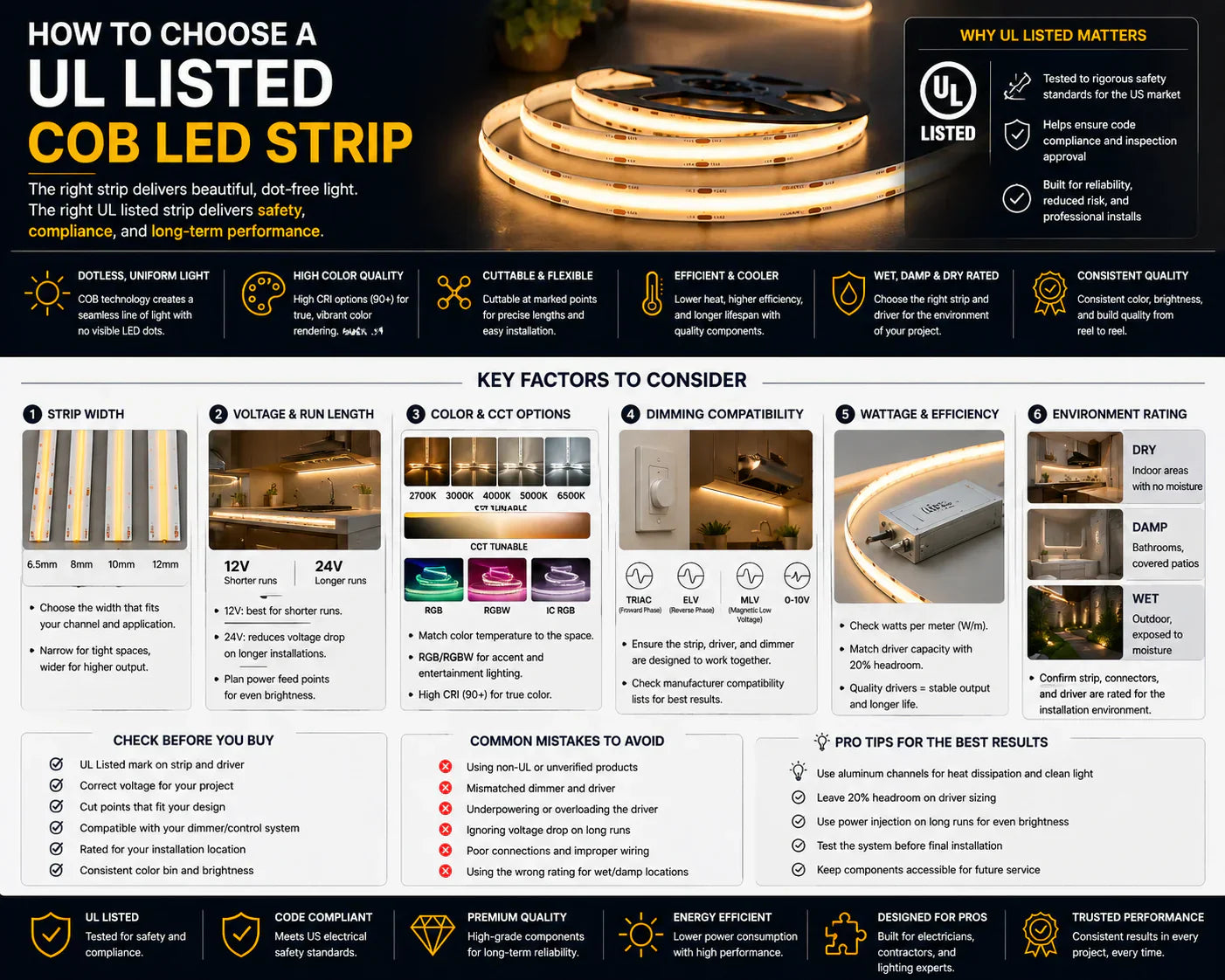
Why UL Listed COB LED Strip Lighting Matters
COB LED strip lighting has become a preferred choice for architects, electricians, lighting designers, and contractors because it delivers a continuous, dot-free line of light. Compared to traditional SMD strips, COB technology creates a cleaner appearance that works particularly well in visible architectural applications.
However, appearance alone is not enough for professional projects. Certification, compatibility, and long-term reliability are equally important. A UL listed COB LED strip provides additional confidence that the product has been evaluated to recognized safety standards, helping simplify inspections and support code-compliant installations.
For luxury residential, hospitality, retail, and commercial projects, certified products help reduce risk while maintaining the high-quality finish clients expect.
What Makes COB LED Strip Lighting Different?
COB (Chip on Board) LED technology places a large number of LED chips directly onto the circuit board, creating a uniform light output with minimal visible spotting.
This makes COB strips especially popular for:
• Under-cabinet lighting
• Cove lighting
• Floating vanities
• Stair lighting
• Display shelving
• Closet lighting
• Architectural reveals
Because the light source appears smoother and more continuous, COB strips are often selected for projects where aesthetics play a major role in the overall design.
Why Certification Matters for Professional Installations
For professional buyers, certification is about more than compliance paperwork.
UL-listed products can help:
• Support inspection requirements
• Reduce project liability concerns
• Improve confidence in product quality
• Simplify specification approval processes
Builders, designers, and property owners increasingly expect certified lighting products, especially in premium residential and commercial environments.
When purchasing LED strip lighting in volume, certification should be considered a core requirement rather than an optional feature.
Choosing the Right COB Strip Width
One of the most overlooked specifications is strip width.
Different projects require different PCB sizes depending on available space, channel dimensions, and lighting requirements.
Common options include:
• 6.5mm COB strips for narrow installations
• 8mm COB strips for general architectural lighting
• 10mm COB strips for broader compatibility
• 12mm COB strips for higher-output or specialized applications
Selecting the correct width helps ensure compatibility with aluminum channels, millwork details, and installation requirements.
Even small dimensional differences can affect project outcomes when working with custom cabinetry or architectural profiles.
Why Dimming Compatibility Is Critical
A premium COB strip can still perform poorly if the dimming system is not properly matched.
Many lighting complaints originate from incompatibility between the strip, driver, and control system rather than the strip itself.
Professional buyers should verify support for:
• TRIAC dimming
• ELV dimming
• MLV dimming
• 0-10V dimming
The goal is to specify a complete lighting system where every component works together consistently.
Smooth dimming performance is especially important in luxury residential applications where lighting quality is closely scrutinized.
The Importance of Choosing the Right Driver
The driver plays a major role in system performance.
Selecting the correct driver requires consideration of:
• Voltage requirements
• Total wattage load
• Dimming protocol
• Installation environment
• Future maintenance requirements
Most COB LED strip installations use constant voltage drivers, typically 12V or 24V.
Choosing the wrong driver can lead to flickering, inconsistent brightness, shortened lifespan, and customer complaints.
For professional projects, the strip and driver should always be specified together.
Wet, Damp, and Dry Location Considerations
Environmental conditions significantly affect long-term reliability.
A strip lighting system installed inside dry cabinetry faces very different conditions than one used near outdoor living spaces, bathrooms, or moisture-prone environments.
When specifying a system, buyers should evaluate:
• Strip location rating
• Driver location rating
• Connector suitability
• Enclosure protection
• Heat management requirements
Every component should be suitable for the installation environment, not just the LED strip itself.
How Professional Buyers Compare COB LED Strips
Experienced buyers typically evaluate products based on practical project requirements rather than marketing claims.
Key questions often include:
• Is the strip UL listed?
• Does it fit the specified profile?
• Is the color output consistent?
• Does it dim properly?
• Can it be reordered later?
• Is inventory stable?
• Are compatible drivers available?
Answering these questions early helps reduce project risk while improving purchasing efficiency.
Why COB LED Strip Lighting Is Popular in Luxury Homes
Luxury residential projects place a higher demand on lighting quality.
Homeowners and designers may never ask about PCB construction or certification details, but they immediately notice lighting performance.
Uneven illumination, visible hotspots, poor dimming, and color inconsistency can negatively impact the finished appearance of the space.
COB LED strips are commonly used in:
• High-end kitchens
• Custom closets
• Floating cabinetry
• Stair details
• Cove ceilings
• Display shelving
• Architectural millwork
Because lighting becomes part of the design, reliability and appearance are equally important.
Wholesale Value Goes Beyond Price
Professional buyers understand that the lowest-cost product is not always the best value.
The true cost of a lighting system includes:
• Installation labor
• Service calls
• Replacement costs
• Project delays
• Inspection issues
• Customer satisfaction
A UL listed COB LED strip that offers consistent performance, dependable inventory, and compatibility with professional drivers often delivers significantly better long-term value than a lower-priced alternative.
Conclusion
Choosing the right UL listed COB LED strip involves much more than comparing brightness or cost per foot.
Certification, dimming compatibility, strip width, driver selection, environmental ratings, and supplier consistency all contribute to project success.
For contractors, electricians, lighting dealers, and project buyers, the best product is the one that installs cleanly, performs reliably, passes inspection, and maintains a premium appearance long after the project is complete.
FAQ
What is a COB LED strip?
A COB LED strip uses closely packed LED chips to create a smooth, dot-free line of light.
Why is UL listing important for LED strip lighting?
UL listing helps support safety compliance and can simplify inspections.
Which COB strip width should I choose?
The best width depends on the profile, available space, and lighting requirements of the project.
Can COB LED strips be dimmed?
Yes, when paired with a compatible dimmable driver and control system.
Are COB LED strips good for luxury residential projects?
Yes. Their smooth light output makes them a popular choice for premium architectural and residential applications.