
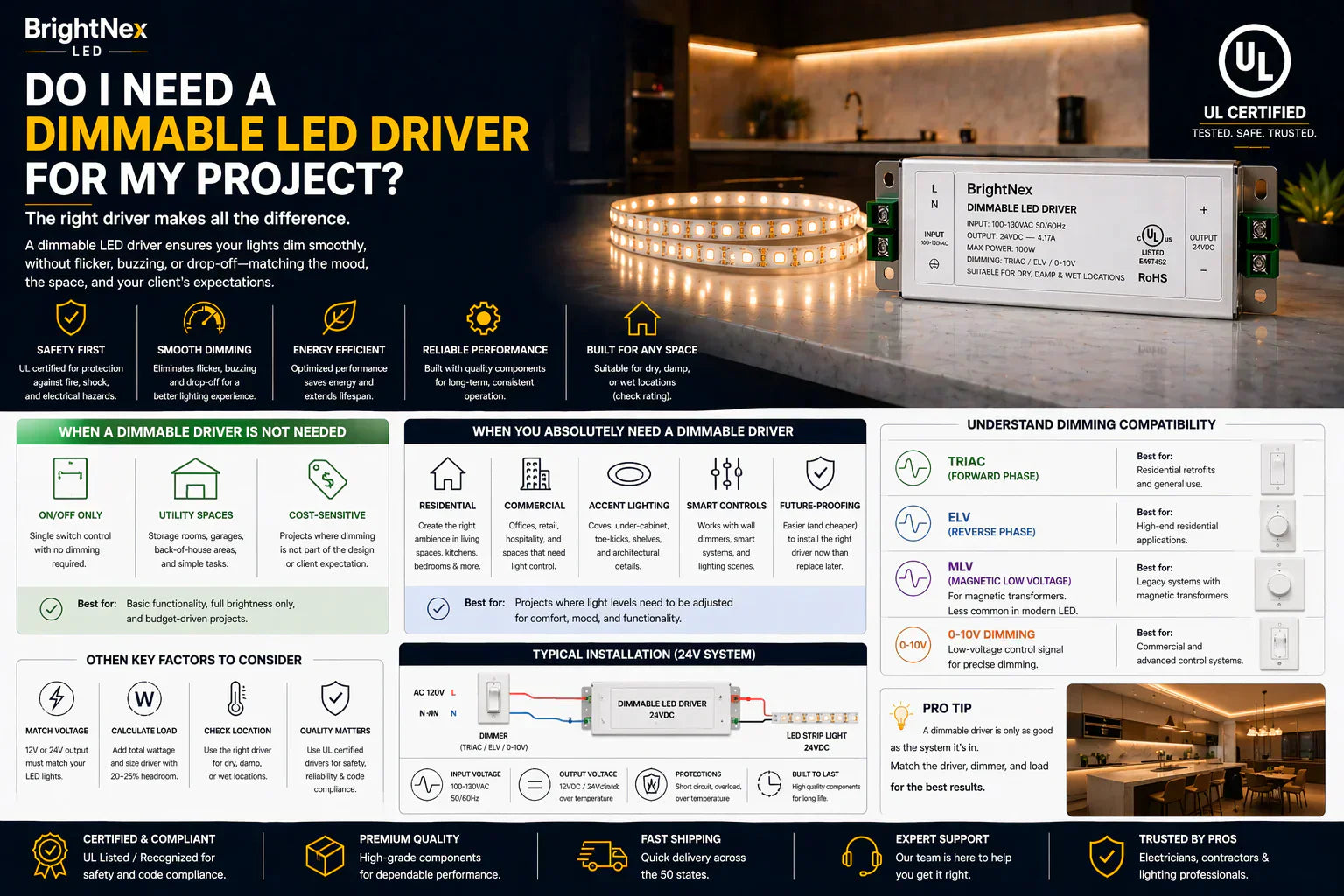
Why the LED Driver Matters More Than Most People Think
Many lighting problems begin long before the lights are switched on. A project may have premium fixtures, high-quality LED strips, and modern controls, but if the wrong driver is selected, the system may never perform as expected.
For contractors, electricians, lighting stores, and project buyers, the LED driver plays a critical role in determining how lighting behaves. It controls how power is delivered to the LEDs and whether the system can respond properly to dimming controls.
In residential, hospitality, and architectural lighting projects, dimming quality directly affects the finished appearance of the space. Smooth dimming feels professional. Flickering and unstable performance do not.
Do You Actually Need a Dimmable LED Driver?
The answer depends on how the lighting will be controlled.
If the lights will always operate from a standard on-off switch at full brightness, a non-dimmable driver is usually sufficient. However, if the lighting needs to dim, respond to a smart control system, or integrate with automation, a dimmable driver is required.
Many modern residential and commercial projects include some level of lighting control. Under-cabinet lighting, cove lighting, floating vanities, shelving, accent lighting, and decorative installations often benefit from adjustable brightness.
In these situations, using a dimmable driver is not simply an upgrade—it is a necessary part of the lighting system.
When a Non-Dimmable Driver Makes Sense
Not every project requires dimming capability.
Applications such as storage rooms, utility areas, equipment spaces, warehouses, and certain commercial environments often operate at full brightness whenever the lights are on.
In these installations, a non-dimmable driver can provide reliable performance while reducing project costs.
However, future plans should always be considered. If there is any possibility that dimming may be added later, choosing a dimmable driver from the start can prevent costly upgrades after the project is completed.
When a Dimmable Driver Is the Better Choice
Any project that includes lighting controls should use a compatible dimmable driver.
This includes applications such as:
• Under-cabinet lighting
• Cove lighting
• Floating vanities
• Display shelving
• Accent lighting
• Hospitality lighting
• Luxury residential projects
• Smart home systems
These installations are often designed to create atmosphere, improve comfort, and enhance architectural details. Running them at full brightness all the time can reduce the visual impact of the design.
A properly matched dimmable driver allows lighting to adapt to the needs of the space while providing a more refined user experience.
Compatibility Is More Important Than the Word "Dimmable"
One of the most common mistakes is assuming that any dimmable driver will work with any dimmer.
In reality, dimming systems use different technologies that must be matched correctly.
Common dimming methods include:
• TRIAC
• ELV
• MLV
• 0-10V
Each method is designed for specific control systems and installation requirements.
Selecting a dimmable driver is only the first step. The driver must also support the same dimming protocol as the controls being used.
When compatibility is overlooked, problems such as flickering, buzzing, limited dimming range, or sudden shutoff can occur.
Understanding Common Dimming Methods
TRIAC and ELV Dimming
TRIAC and ELV dimming are widely used in residential applications because they work with many wall-mounted dimmers.
TRIAC is often used in retrofit projects, while ELV is commonly selected for premium residential installations where smoother low-end dimming performance is desired.
0-10V Dimming
0-10V dimming is frequently used in commercial and larger controlled lighting systems.
Because it uses a dedicated low-voltage control signal, it often provides more predictable performance across multiple lighting zones.
Controller-Based Dimming Systems
RGB, RGBW, tunable white, and addressable lighting systems frequently use dedicated controllers rather than traditional wall dimmers.
In these applications, the driver, controller, and LED load must all be selected together to ensure proper performance.
Choosing the Right Voltage and Driver Type
Dimming capability alone does not guarantee compatibility.
The driver must also match the electrical requirements of the LED product being powered.
Most LED strip lighting systems use constant voltage drivers, typically 12V or 24V. Other fixtures and modules may require constant current drivers instead.
Selecting the wrong driver type can lead to performance issues or equipment failure regardless of whether the driver is dimmable.
Voltage, wattage capacity, and load requirements should always be verified before purchasing.
Why Driver Sizing Affects Performance
Proper sizing helps ensure both reliability and dimming quality.
A driver that is too small may overheat or fail prematurely. A driver that is significantly oversized may also create dimming issues depending on the connected load and control system.
Professional installers typically allow additional wattage capacity while keeping the load within the driver's recommended operating range.
This approach improves reliability and often produces smoother dimming performance.
What Happens When the Wrong Driver Is Used?
Driver selection problems often appear after installation is complete.
Common symptoms include:
• Flickering at low brightness levels
• Limited dimming range
• Sudden shutoff while dimming
• Uneven brightness
• Delayed startup
• Audible buzzing
These issues can lead to service calls, project delays, and customer complaints.
For premium residential and architectural projects, lighting quality becomes part of the overall perception of craftsmanship. Poor dimming performance can undermine an otherwise excellent installation.
How to Make the Right Choice Before Ordering
The easiest way to choose the correct driver is to start with the control method.
If the project includes wall dimmers, automation systems, smart controls, scene lighting, or tunable lighting, identify the control technology first and select a compatible driver.
Next, verify:
• Voltage requirements
• Total wattage load
• Driver type
• Environmental rating
• Installation location
Taking these steps early in the design process helps avoid compatibility issues later.
Why Professional Buyers Prioritize Quality Drivers
Experienced contractors understand that drivers influence more than just power delivery.
They affect installation efficiency, dimming performance, customer satisfaction, and long-term reliability.
A quality driver can help prevent troubleshooting, reduce callbacks, and support smoother project completion.
That is why many professionals focus on proven compatibility, certified products, and reliable inventory rather than simply choosing the lowest-cost option.
Conclusion
So, do you need a dimmable LED driver?
If the lighting will be controlled by a dimmer, automation system, smart controller, or scene-setting device, the answer is yes. If the lights will only operate at full brightness from a standard switch, a non-dimmable driver may be sufficient.
The most important factor is matching the driver to the lighting system from the beginning. When voltage, load, controls, and dimming technology all work together, the result is smoother performance, fewer callbacks, and a better overall lighting experience.
FAQ
Can I use a regular LED driver with a dimmer switch?
No. A standard non-dimmable driver is not designed to work with dimming controls.
Do LED strip lights need a dimmable driver?
Only if you want to control brightness using a dimmer, smart control, or automation system.
What is the most common dimming method for homes?
TRIAC dimming is one of the most common options for residential lighting projects.
Will the wrong driver cause LED flickering?
Yes. Driver and dimmer incompatibility is one of the most common causes of flickering.
Is a dimmable driver worth the extra cost?
For projects that require lighting control or may need dimming in the future, the added flexibility is often worth the investment.