
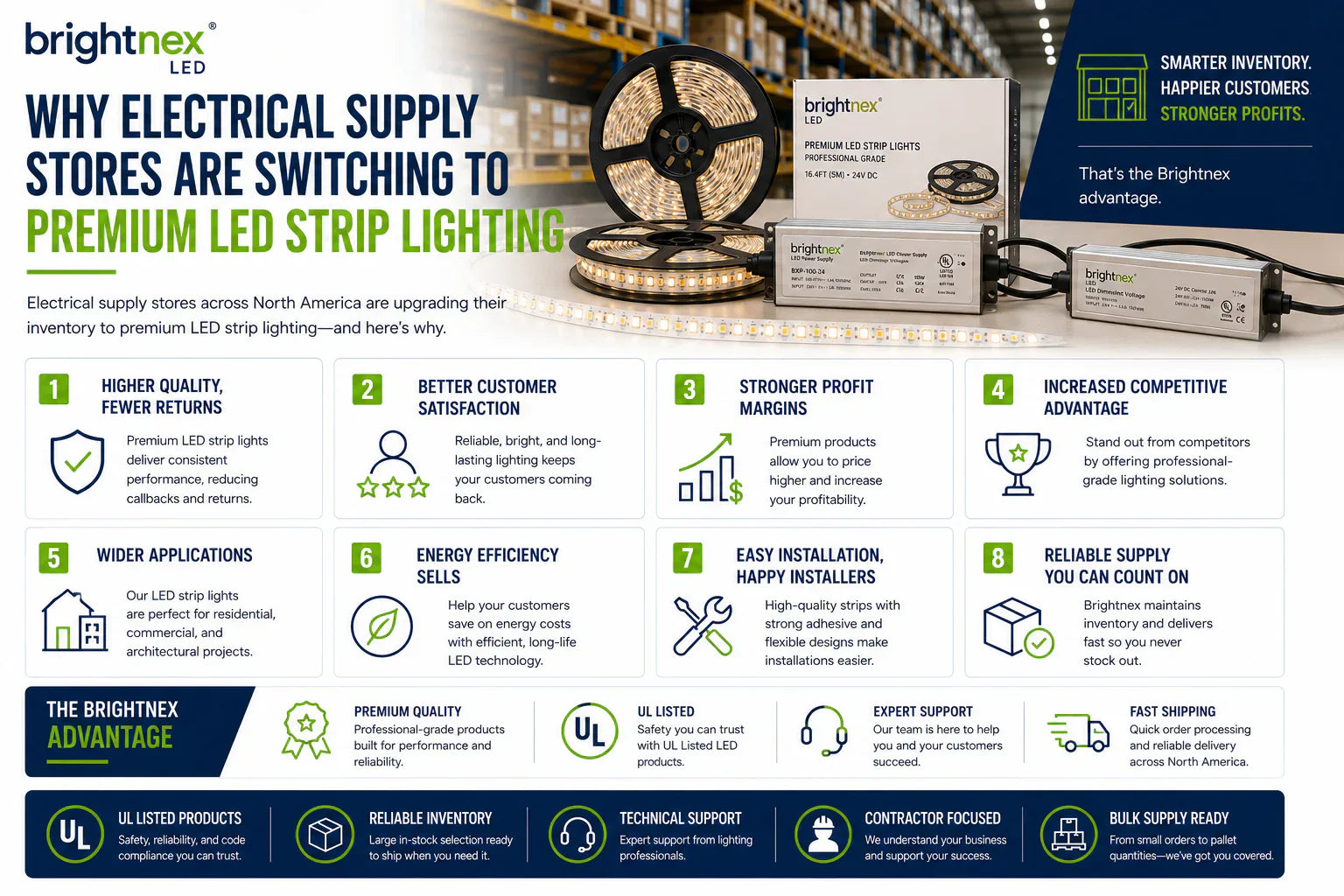
Why electrical supply stores are switching to premium LED strip lighting
At the wholesale level, product decisions are rarely based on appearance alone. Supply stores look at return rates, certification, compatibility, inventory confidence, and whether installers ask for the same item again after the first job. Premium LED strip lighting performs better across all of those categories.
The old problem with low-grade strip lighting was never just short lifespan. It was inconsistency. One reel might look acceptable on the bench, then show visible dotting, uneven color temperature, adhesive failure, voltage drop, dimming issues, or premature driver problems in the field. Every one of those issues costs someone money. If it reaches a finished kitchen, a luxury closet, a stair detail, or millwork in a high-end home, the cost goes up fast.
That is why better supply stores are narrowing their assortment and giving more shelf space to premium strip lighting systems. They want products that reduce guesswork for the contractor and reduce headaches for the counter team.
Premium strips fit the projects buyers are actually quoting
There is a clear market shift toward cleaner, more architectural lighting. Homeowners want under-cabinet runs with no spotting. Designers want cove lighting that looks uniform from end to end. Builders want dimming that works the first time. Remodelers want compact solutions for tight channels and detailed applications.
Basic strip lights can still fill a price-point role, but many electrical supply stores are seeing their professional buyers move toward premium options because the jobs themselves demand more. COB and SCOB strip lights, slimmer width formats like 6.5mm or 8mm, and color-tunable or RGBW options are not niche anymore. They are standard requests on better residential and light commercial work.
For stores serving luxury residential markets, especially in design-heavy regions like Los Angeles, that demand is even stronger. High-end homes are not forgiving environments for cheap lighting. A visible hot spot under stone counters or a dimming mismatch in a custom media wall can damage the installer's reputation as much as the product itself.
Better light quality sells itself at the counter
Electrical supply stores know that contractors come back for products that make them look good. Premium strip lighting gives them tighter color consistency, smoother output, and a more finished appearance in aluminum profiles, toe-kicks, niches, shelves, and coves.
That matters because strip lighting is now visible lighting, not hidden utility lighting. Once the tape is part of the visual design, performance standards go up. The cheapest reel on the rack stops being the safe choice.
Width and application flexibility matter more than ever
Supply stores also benefit from carrying premium lines because they can serve more applications without forcing buyers into workarounds. Narrow 6.5mm and 8mm COB strips help in slim channels and detailed millwork. 10mm and 12mm options support higher output or broader use cases. RGB, RGBW, CCT, and IC RGB formats let stores meet the needs of both straightforward white-light installs and more advanced control packages.
That kind of assortment helps a wholesaler become a solution source instead of just a box mover.
UL certification is not optional anymore
One of the biggest reasons electrical supply stores are upgrading their strip lighting inventory is simple: risk. Trade buyers are more careful about safety, inspections, and long-term liability than they were a decade ago. Products with recognized certification carry real weight at the counter.
Premium LED strip lighting that is properly UL listed or UL recognized gives distributors and installers more confidence, especially when it is paired with compatible drivers, connectors, and accessories designed to work as a system. If the strip itself carries the UL marking and the supporting components are built for damp, dry, or wet locations as required, the supply house is in a stronger position.
Cheap imported strip lighting often creates a chain reaction of uncertainty. Is the output consistent? Is the adhesive stable? Is the driver actually compatible with the dimmer? Will an inspector question the install? A serious supply store does not want those conversations tied to its name.
System compatibility reduces expensive callbacks
Strip lighting is not one product. It is a system. The tape, driver, transformer, control method, channel, wire, connector, and installation environment all matter. Premium suppliers understand that, which is one reason supply stores are moving away from random low-cost options and toward curated systems.
Dimming compatibility is a major factor here. TRIAC, ELV, MLV, and 0-10V applications all have their place, but they are not interchangeable. A premium wholesale line with dimmable drivers engineered for those control types saves time at the sales counter and on the jobsite. Drivers with junction boxes for wet, damp, and dry locations also make the package more practical for professional installation.
When stores can recommend a strip and driver combination with confidence, they protect the contractor's labor and their own reputation.
Fewer returns, stronger margins
A low purchase price does not always mean better profit. Supply stores have learned that cheap LED strip lighting can carry hidden costs: returns, damaged customer trust, staff time spent troubleshooting, and replacement claims that wipe out the original margin.
Premium strip lighting usually supports healthier margins because it sells on value, not just price. Contractors understand the difference between a reel that might fail and a reel that supports a smooth closeout. They may still compare numbers, but they also calculate labor risk. If a premium product helps avoid one callback, it can be the cheaper option on the job.
From the distributor side, that makes premium inventory easier to defend. It attracts repeat professional buyers who prioritize reliability and technical support over the lowest line item.
Stores want products that support repeat business
The strongest wholesale relationships are built on consistency. An electrician who installs the same premium strip line across kitchens, vanities, bars, staircases, and display shelving does not want surprises from batch to batch. A lighting retailer does not want color mismatch between restocks. A contractor bidding multiple homes wants confidence that inventory will be available and specs will stay stable.
Premium wholesale LED suppliers are better equipped to deliver that consistency. For electrical supply stores, that translates directly into repeat orders and fewer one-time buyers.
The shift is also about customer mix
Not every supply store serves the same buyer. Some are heavily contractor-driven. Some support lighting showrooms. Some focus on multifamily, hospitality, retail, or high-end residential. But across those segments, premium strip lighting gives stores a stronger answer for buyers who want professional-grade solutions.
This is especially true as more projects blend aesthetics with performance. Under-cabinet lighting is no longer just task lighting. Cove lighting is no longer just accent. Shelving, millwork, mudrooms, wine rooms, and bathroom niches are all places where poor strip performance gets noticed quickly.
Stores that continue stocking mostly entry-level strip products may still capture low-budget jobs, but they risk losing higher-value accounts that need dependable systems. The market is rewarding suppliers that can support specification-level expectations.
Why this matters for wholesalers and trade buyers
For the trade, the move toward premium strip lighting is a practical correction. Better light output, better safety confidence, better dimming performance, and better installation support all reduce friction. Electrical supply stores are responding to what professional buyers have already figured out in the field.
That does not mean every job requires the most expensive strip available. Utility applications, simple signage, and budget-sensitive projects may still justify a lower-tier option. But for architectural details, luxury homes, remodels, retail displays, and any installation where finish quality matters, premium products are becoming the standard choice.
A focused supplier can make that transition easier by offering professional-grade strip widths, COB and SCOB options, RGB and white-light configurations, UL-marked products, and compatible dimmable drivers that are built for real installation conditions. That is one reason BrightNex LED continues to gain attention with contractors, lighting stores, and project buyers who need dependable wholesale supply across the US.
Electrical supply stores do not switch product categories because of marketing language. They switch when the better product protects labor, supports inspections, improves results, and keeps customers coming back. Premium LED strip lighting is doing all four, and that is why the change is sticking.
FAQ
Why are electrical supply stores switching to premium LED strip lighting?
Electrical supply stores are switching because premium LED strip lighting offers better reliability, fewer returns, improved dimming performance, stronger certifications, and higher customer satisfaction.
What are the benefits of premium LED strip lighting for contractors?
Premium LED strips provide better color consistency, smoother dimming, reduced voltage drop, improved installation compatibility, and fewer callbacks.
Why is UL certification important for LED strip lighting?
UL certification helps support code compliance, safety requirements, inspection approval, and long-term reliability for residential and commercial projects.
Do premium LED strip lights improve profit margins?
Yes. Although they often cost more upfront, premium strips reduce labor issues, warranty claims, troubleshooting, and replacement costs, helping protect project margins.
What types of premium LED strip lights are most in demand?
COB, SCOB, RGBW, CCT tunable white, IC RGB, and narrow-width strip lights such as 6.5mm, 8mm, 10mm, and 12mm formats are increasingly popular for residential and commercial applications.