
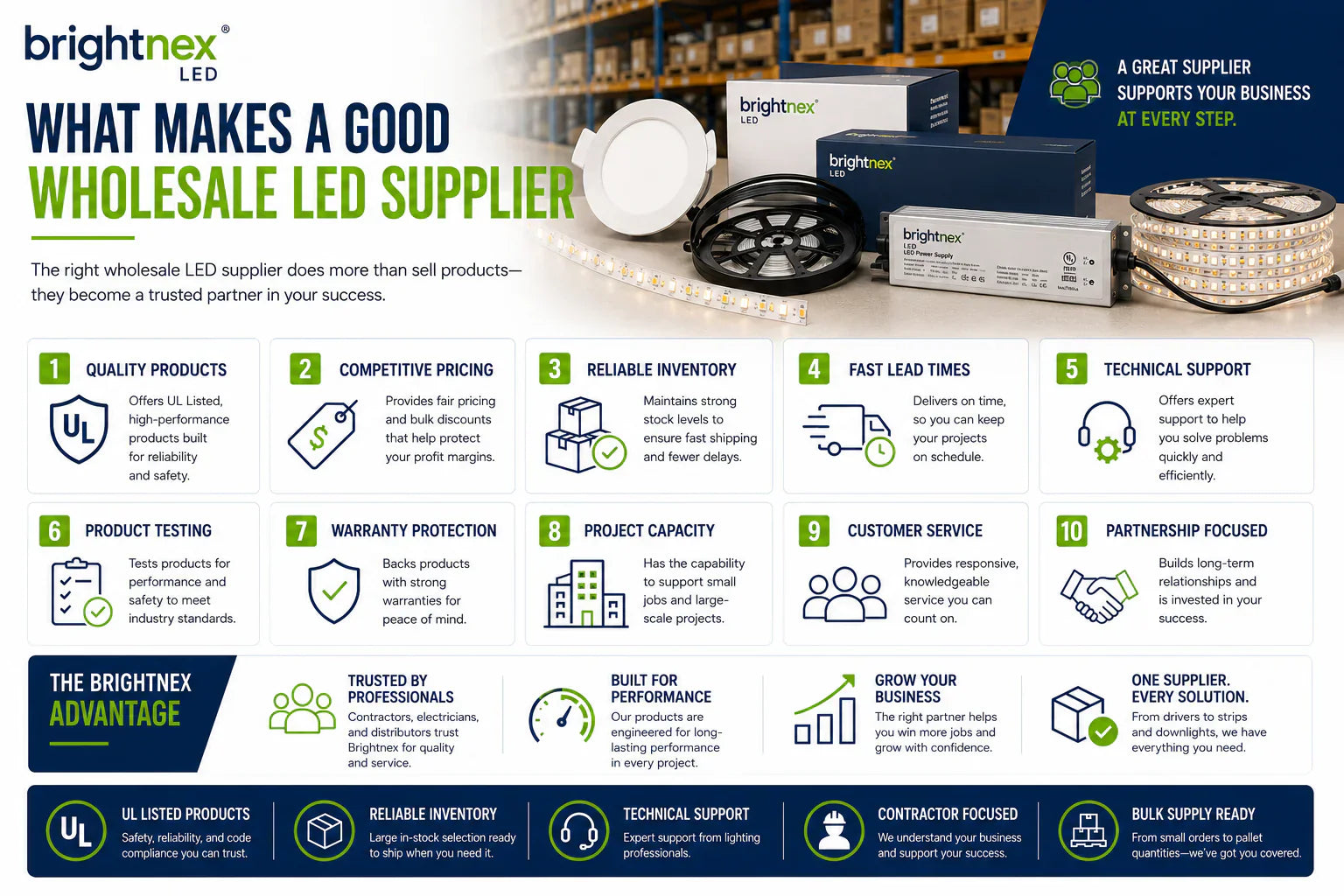
What Makes a Good Wholesale LED Supplier for Trade Buyers
A good wholesale LED supplier starts with certified, dependable products. In the US market, that means taking UL listing seriously, not treating it like a marketing extra. When you are sourcing strip lights, drivers, transformers, downlights, aluminum channels, controllers, or connectors, certification matters because your customer, your inspector, and your reputation all depend on it.
It also means the products should be built for real-world applications, not just online specs. Strip lights should maintain consistent color and output. Drivers should perform properly with the dimming systems used in the field. Components should be clearly rated for dry, damp, or wet locations where applicable. If a supplier cannot speak confidently about these details, they are not set up for professional buyers.
The next factor is catalog focus. A supplier does not need to carry every lighting product on the market. In many cases, a tighter catalog is better because it shows specialization. If you buy premium strip lighting systems, dimmable drivers, COB strip lights, RGBW products, recessed downlights, and installation accessories, you want a source that understands how those parts work together. That saves time and reduces mismatch problems.
Certification Is Not Optional
For trade professionals, certification is one of the first filters. A supplier offering LED products into the US market should be able to provide products that meet recognized safety standards and are properly labeled. That is especially important on strip lighting and power components, where low-quality imports often create problems later.
A reliable supplier does not hide from technical questions. They can tell you whether a driver is Class 2, whether it supports TRIAC, ELV, MLV, or 0-10V dimming, and whether it is suitable for dry, damp, or wet locations. They can also explain how the product should be installed so you are not forced to figure out compatibility issues after the material arrives.
There is a practical side to this beyond compliance. Certified products reduce callbacks. They reduce risk in luxury homes and commercial spaces where expectations are higher. They also make it easier for lighting stores and contractors to sell with confidence.
Product Compatibility Matters More Than Big Catalogs
A common mistake in wholesale buying is choosing a supplier based on range instead of fit. A massive catalog can look impressive, but if the driver does not dim correctly with the strip light or the connector does not match the tape width, that size does not help you.
A good supplier offers systems that make sense together. If you need 6.5mm, 8mm, 10mm, or 12mm COB strip lights, the matching profiles, connectors, power supplies, and controls should be available from the same source. If you are buying RGB, RGBW, CCT, or IC RGB products, the controller options should be clear and the technical pairing should not be guesswork.
This is where professional buyers save money without always noticing it. Better compatibility means fewer substitutions, fewer field modifications, and fewer delays. On custom residential projects, especially in high-end homes, clean integration matters just as much as the fixture itself.
Inventory Depth and Consistency Win Jobs
Wholesale buyers do not just buy products. They buy supply confidence. If a supplier cannot maintain inventory on core items, your labor schedule and client commitments take the hit.
The better supplier has stable stock on the products professionals reorder most often. That includes core strip light formats, dimmable drivers, recessed fixtures, aluminum profiles, wire, connectors, and controls. They also keep product consistency from batch to batch. That matters for color temperature, light output, and finish continuity, especially when you are returning to later phases of a project.
Backorders happen in every supply chain, so this is not about promising perfection. It is about how the supplier manages availability, communicates lead times, and helps you plan. A supplier that understands wholesale business gives straight answers instead of vague estimates.
Good Pricing Has to Protect Margins
Every buyer cares about price. But experienced buyers look beyond the unit price and ask what the total project cost will be after freight, failures, replacements, and labor.
A good wholesale LED supplier offers pricing that is competitive enough to support resale and project margins while still delivering professional-grade quality. If pricing is far below the market, there is usually a reason. It may show up in inconsistent chips, weak adhesive, poor dimming performance, thin copper, unstable drivers, or missing certifications.
The strongest wholesale value sits in the middle of performance and cost. You want pricing that helps you win jobs and stock shelves, but not at the expense of reliability. For trade buyers serving premium residential work, especially luxury installations, the lowest-cost product is often the wrong product.
Technical Support Should Be Practical, Not Scripted
Trade buyers do not need generic customer service. They need answers that help them complete a job correctly. If a contractor asks whether a dimmable driver with junction box can be used in a damp location, or whether a COB strip will fit a certain profile, the response needs to be specific and fast.
A good supplier understands installation conditions and can guide buyers toward the right products for each application. That includes helping with dimming method selection, strip width, output level, profile choice, and control options. It also includes warning the buyer when a product is not the right fit.
There is a trade-off here. Some suppliers try to sell through every objection instead of protecting the project. The better supplier is willing to say, this setup needs a different driver, this strip is better for that location, or this product is not intended for that use. That kind of guidance builds repeat business because it saves the buyer from field problems.
What Makes a Good Wholesale LED Supplier in Luxury Projects
Luxury residential and high-visibility commercial work place more pressure on every product choice. In those settings, small issues stand out. Inconsistent dimming, visible diode spacing, poor color rendering, flimsy channels, or controller failures can undermine the whole install.
That is why premium projects usually demand a higher standard from the supplier. COB and SCOB strip lighting, quality recessed downlights, clean aluminum profiles, dependable controls, and dimmable drivers with proper enclosure options all matter more when the finish level is high. A supplier serving this segment should understand both performance and presentation.
This is also where specialized wholesalers stand out. BrightNex LED, for example, focuses on professional-grade strip lighting systems, UL-certified products, and dimmable driver solutions suited for demanding installations across the US, including high-end Los Angeles homes. That kind of product focus is more useful to trade buyers than a random broad catalog.
Speed, Shipping, and Business Fit
A supplier can have the right products and still be the wrong partner if the business model does not match wholesale needs. Trade buyers need clear ordering, responsive communication, and shipping that supports jobs across multiple states.
For B2B customers, that also means understanding case quantities, repeat order patterns, and the difference between selling to professionals and selling to end users. A true wholesale LED supplier is structured around business buyers. They know that electricians, retailers, and contractors need consistency, documentation, and dependable restocking more than retail-style promotion.
This matters even more when you operate nationwide. Shipping capability across all US states, along with stable support for trade accounts, gives buyers the confidence to standardize purchases instead of constantly sourcing from multiple vendors.
The Best Supplier Helps You Sell Better
A good wholesale LED supplier does more than fill orders. They make it easier for you to quote, specify, install, and stand behind the work. That may come from better product labeling, clearer compatibility, stronger certification, or simply fewer quality surprises.
If you are evaluating suppliers, look at what happens after the first invoice. Do the products arrive as expected? Are the specs accurate? Does the dimming work the way it should? Can you reorder the same item later without chasing changes? Can the supplier support a premium install without forcing compromises?
That is the real test. A good supplier helps you stay efficient and look professional in front of your customer. In this market, the best wholesale relationship is the one that keeps your jobs moving and your standards intact.
FAQ
What makes a good wholesale LED supplier?
A good wholesale LED supplier offers certified products, reliable inventory, technical expertise, compatibility support, competitive pricing, and dependable customer service for trade buyers.
Why is product compatibility important when buying LED lighting wholesale?
Compatibility between strip lights, drivers, dimmers, controllers, and accessories helps prevent installation issues, flickering, voltage drop, and costly callbacks.
Should wholesale LED suppliers provide UL-certified products?
Yes. UL-certified products support code compliance, inspection approval, safety requirements, and buyer confidence in residential and commercial installations.
How important is inventory consistency for contractors?
Very important. Consistent inventory and product specifications help contractors complete projects on schedule and ensure future orders match previous installations.
Why do contractors prefer specialized LED wholesalers?
Specialized wholesalers typically offer better technical support, stronger product knowledge, more reliable compatibility guidance, and products specifically designed for professional installation environments.