
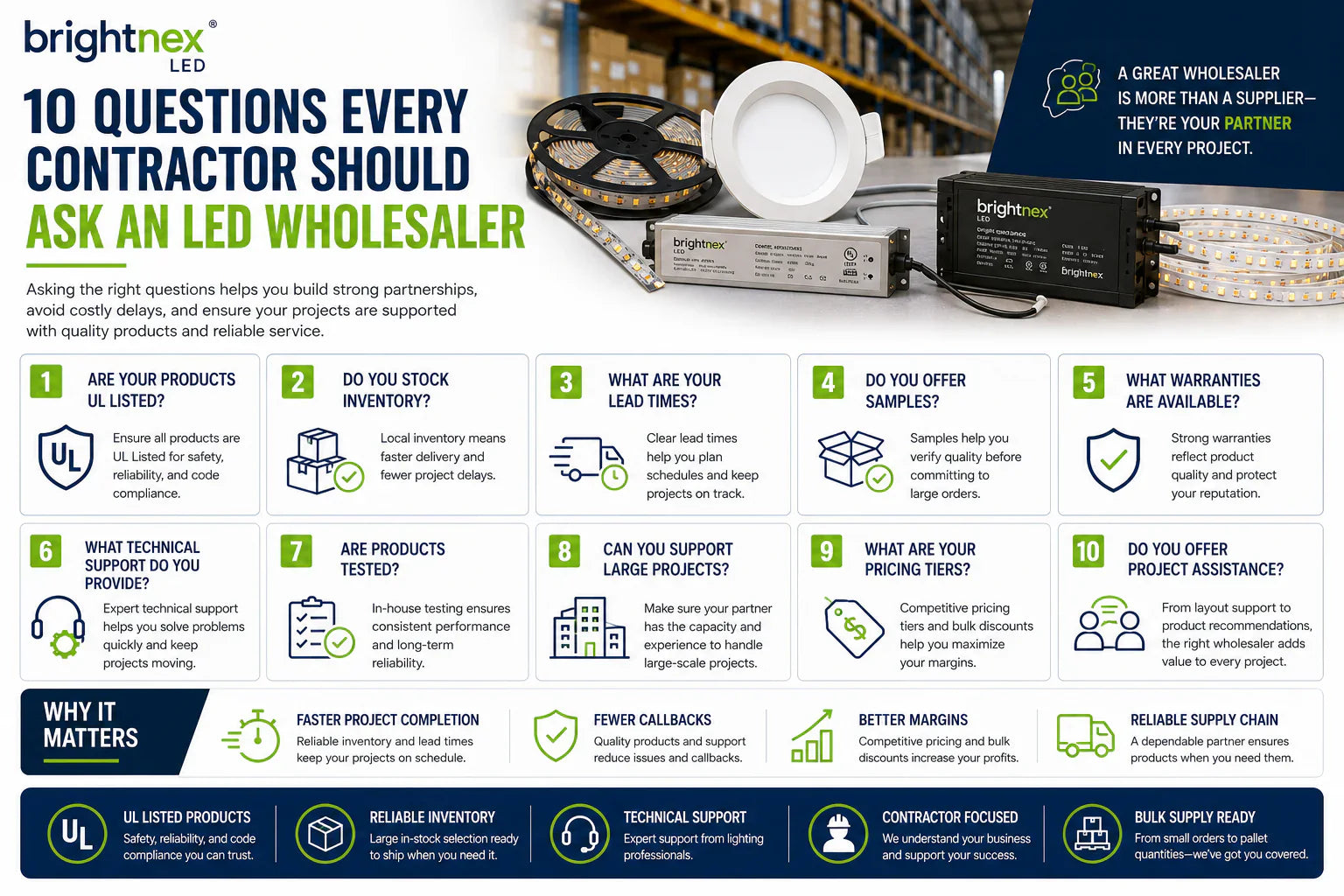
Why these 10 questions every contractor should ask an LED wholesaler matter
Contractors do not lose money only on material cost. They lose money on mismatch, delay, and rework. A low quote means very little if the LED driver flickers with the specified dimmer, the strip is not rated for the environment, or the connectors fail in the field.
A strong wholesale partner should help you confirm compatibility before the order ships. That matters even more on luxury residential work, custom millwork, and architectural lighting packages where tape light, recessed downlights, aluminum profiles, and controls all need to work together cleanly. In higher-end homes, clients notice everything — color consistency, dimming performance, hotspot control, and finish quality.
1. Are your products actually UL certified for the intended use?
This should be the first filter, not a late-stage check. Ask whether the strip lights, drivers, transformers, and related components are UL listed or recognized where applicable, and whether the certification matches the use case. A product can be safe in one application and wrong for another.
For example, a driver with an integrated junction box may be suitable for wet, damp, or dry locations depending on the exact model and rating. That distinction matters on outdoor features, bathrooms, covered patios, and under-cabinet installations near moisture. If a wholesaler gives vague answers here, keep looking.
2. Which dimming protocols are supported, and what has been tested together?
This is where many install problems start. Ask whether the wholesaler offers TRIAC, ELV, MLV, or 0-10V solutions, and more importantly, which strips, drivers, and dimmers have been tested together.
A driver may be labeled dimmable, but that does not guarantee smooth low-end performance across every control system. On a premium project, a dimming curve that drops out early or flickers at low levels is not acceptable. You want tested combinations, not assumptions.
3. What strip widths, output levels, and configurations do you stock?
Not all tape light jobs are interchangeable. Some projects need narrow tape for tight channels. Others need higher output or COB technology for smoother diffusion and reduced dotting. Ask what widths are stocked and available consistently.
This is especially relevant when you are coordinating with millwork, drywall reveals, or shallow aluminum profiles. A supplier carrying multiple options such as 6.5mm, 8mm, 10mm, and 12mm COB strip lights gives you more room to match the physical install without compromising appearance.
4. Do you carry the color options and control types this project needs?
If the spec includes RGB, RGBW, CCT tunable white, or IC RGB, confirm all related components at the same time. Contractors should ask whether compatible controllers, remotes, receivers, and power solutions are available from the same source.
The trade-off is simple. A basic single-color system is easier to price and install, but custom homes and hospitality-style residential spaces often demand more. Once color-changing or tunable systems enter the scope, compatibility becomes the job. The more pieces involved, the more valuable a focused wholesaler becomes.
5. What is the real lead time, and do you stock inventory in volume?
Every wholesaler says they can supply the job. The better question is whether they can supply it on your schedule and in repeat quantities. Ask what is physically stocked, what is built to order, and what happens if you need a second release or replacement material mid-project.
This matters for contractors managing phased installs, punch-list returns, and change orders. If the supplier cannot maintain consistency from batch to batch or cannot replenish fast, your labor costs can climb even if the initial buy looked competitive.
6. Can you help match the strip, driver, profile, and accessories as one system?
A professional installation depends on system thinking. Ask whether the wholesaler can help you pair the LED strip with the correct wattage driver, aluminum profile, lens, wire, connector, and control gear.
This is not hand-holding. It is procurement efficiency. A trade supplier that understands how the components work together can reduce the chance of voltage drop issues, overloaded drivers, wrong profile fitment, or field-made workarounds that slow your crew down. On larger homes and detailed remodels, that support has real value.
7. What are the location ratings for dry, damp, and wet applications?
Never assume the same material package works across every area of the property. Ask exactly which products are rated for dry, damp, and wet locations, and whether any additional housing, channel, or sealing method is required to maintain compliance and performance.
Outdoor kitchens, showers, vanity lighting, soffits, and landscape-adjacent details all create different conditions. The right answer may depend on direct exposure, ventilation, and how the fixture is mounted. A good wholesaler should be precise here, not general.
8. How consistent is the light quality from run to run?
On luxury projects, color consistency is not a small detail. Ask about color temperature accuracy, binning consistency, and whether repeat orders will visually match previous shipments. This matters on long projects and future service calls where sections may need to be replaced later.
Contractors working in high-end Los Angeles homes and similar markets already know the issue. A kitchen cove that looks slightly warmer than the adjacent hallway reveal will get noticed. Premium jobs require premium consistency.
9. What does your warranty cover, and how are claims handled?
Warranty length matters, but warranty process matters more. Ask how claims are handled, what documentation is required, and whether the wholesaler can quickly identify replacement equivalents if a product revision occurs later.
A long warranty with slow support can still cost you money. If a supplier cannot respond fast when there is a field issue, the burden shifts to your team. The practical goal is not just coverage. It is reduced downtime and fewer unpaid return trips.
10. Are your wholesale prices competitive without sacrificing product quality?
Price always matters, but contractors should ask how the price is achieved. Is the value coming from efficient wholesale distribution and focused product selection, or from cutting corners on certification, driver quality, copper content, adhesive backing, or consistency?
This is where experienced buyers separate usable value from false economy. The cheapest strip on the quote sheet can become the most expensive line item once labor, troubleshooting, and replacement are factored in. The right wholesaler gives you a price that protects margin and a product that protects reputation.
What strong answers from an LED wholesaler sound like
A credible wholesaler should answer with specifics. They should know whether a driver is Class 2, what dimming type it supports, what environment it is rated for, what strip widths fit which profiles, and which accessories belong with each system. They should also understand that contractors buy reliability, not just parts.
That is especially true in B2B supply. Professional buyers need a supplier that ships nationwide, understands commercial and residential code expectations, and can support repeat ordering with consistent SKUs. If the supplier serves electricians, retailers, and installers every day, their answers are usually sharper and more useful in the field.
One example is BrightNex LED, which focuses on professional-grade strip lighting systems, UL-marked products, dimmable driver solutions, and wholesale supply built for trade buyers rather than individual consumers. That kind of specialization is often more useful than a broad catalog with weak technical support.
The mistake contractors make most often
The most common mistake is asking only for a quote. A quote tells you the cost of material. It does not tell you whether the dimming will be stable, the finish will look premium, the location rating is correct, or the second shipment will match the first.
A better buying process starts with technical fit, then inventory confidence, then pricing. That order may feel slower up front, but it usually saves time once the install begins. In this category, speed without verification often creates the delay you were trying to avoid.
The next time you evaluate a supplier, treat the conversation like a pre-install check, not a price check. The right answers can save you from the kind of problems that only show up when the walls are closed, the schedule is tight, and the client expects flawless light.
FAQ
What should contractors ask an LED wholesaler before buying?
Contractors should ask about UL certifications, dimming compatibility, strip widths, inventory availability, location ratings, warranty support, and system compatibility.
Why is dimming compatibility important when purchasing LED products?
Incorrect dimmer and driver combinations can cause flickering, poor low-end dimming, dropout, and costly callbacks after installation.
What certifications should LED wholesalers provide?
Professional wholesalers should provide clear documentation for UL-listed or UL-recognized products and explain where those products are approved for use.
Why should contractors buy complete LED systems instead of individual parts?
Complete systems improve compatibility between strips, drivers, profiles, connectors, and controls, reducing installation issues and troubleshooting time.
How can contractors identify a reliable LED wholesaler?
Reliable wholesalers provide technical support, maintain consistent inventory, offer certified products, understand trade applications, and can recommend complete lighting solutions rather than individual products.