
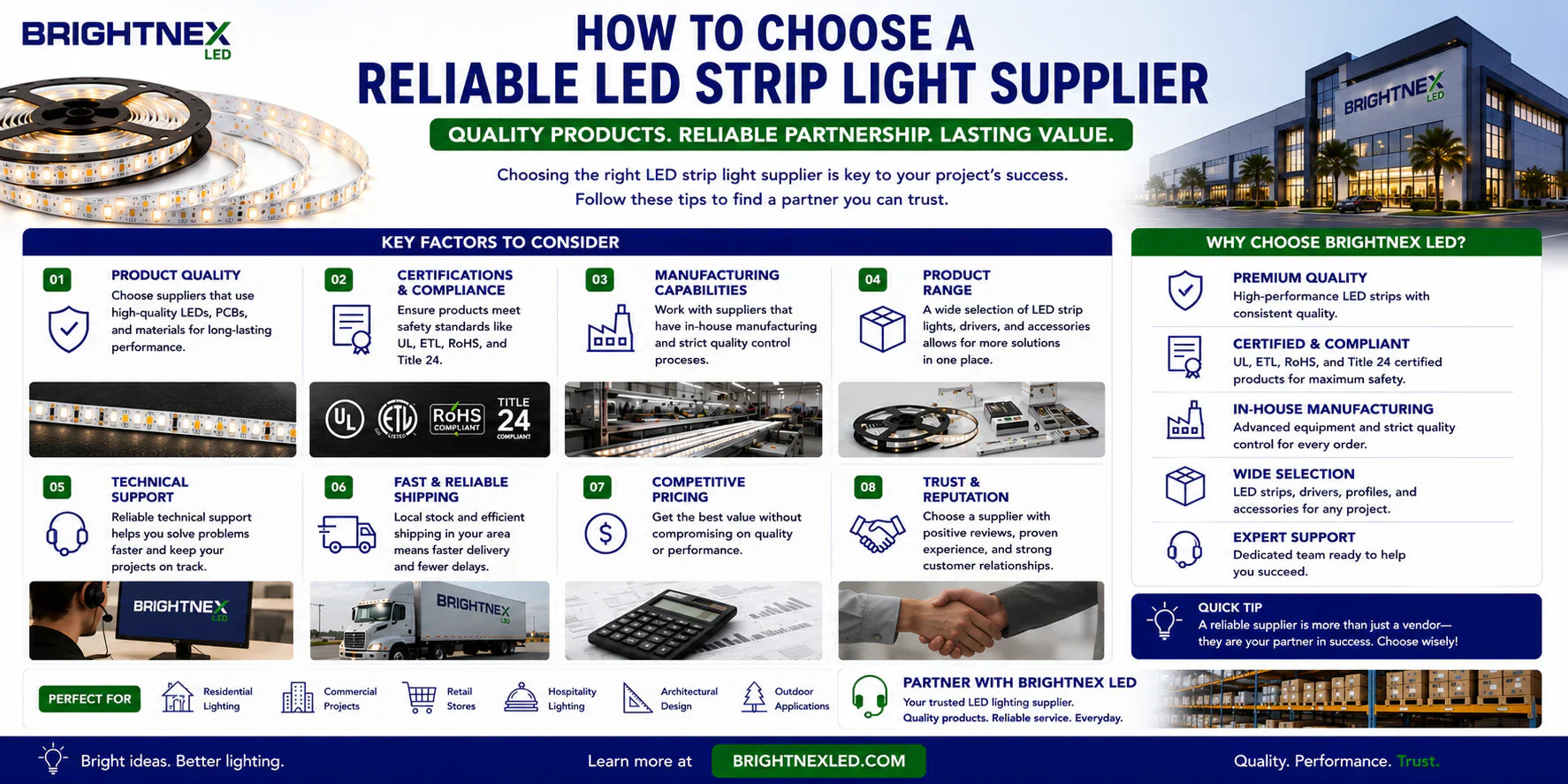
How to choose a reliable LED strip light supplier in California
Start with certification, because everything else depends on it. If a supplier cannot clearly document UL listing or equivalent compliance for the products you are buying, that is an immediate risk. This is especially true for strip lighting, drivers, transformers, and accessories that will be installed in finished residential spaces, retail environments, or custom millwork. A professional supplier should be able to tell you not only that a product is certified, but which components are certified, how they are labeled, and where they are suitable to install.
That point sounds basic, but many sourcing problems begin here. Some sellers advertise premium LED strips yet provide unclear paperwork, generic labels, or inconsistent markings from batch to batch. For California trade work, that creates problems during specification review, inspection, and long-term service. A dependable supplier makes certification visible and consistent, not vague.
The next test is product specialization. A supplier that treats LED strips as a side category usually cannot support professional installations well. Strip lighting is not one SKU. It is a system. Tape width, wattage, color temperature, lumen output, IP rating, driver pairing, dimming protocol, aluminum channel fit, connector type, and run length all affect job performance. If the supplier cannot speak in those terms, they are likely reselling rather than supporting.
A strong California supplier should be comfortable discussing 8mm, 10mm, 6.5mm, and 12mm COB strip formats, along with RGB, RGBW, CCT, and IC RGB options. They should understand the difference between decorative accent applications and primary task lighting, and they should know when 110V strip lights make sense versus low-voltage systems. That depth matters because the wrong recommendation does not just create inconvenience — it can force rework.
Reliability is inventory plus compatibility
Many buyers focus on sample quality first, which makes sense. But inventory reliability is what determines whether your project finishes on time. A supplier may send an excellent sample kit and still fail when you need repeat orders with matching output and quick turnaround. In California, especially in Los Angeles luxury residential work, delays are expensive and design revisions happen late. You need a supplier with stable stock, repeatable specifications, and nationwide shipping support if your projects extend beyond one market.
Compatibility is the other half of reliability. LED strips fail in the field less often because of the diode tape itself and more often because the full system was not matched correctly. Dimmers, drivers, transformers, controllers, remotes, connectors, and profiles all need to work together. If a supplier only sells strip lights but cannot support the driver and control side, you are carrying the engineering burden yourself.
This is where serious trade suppliers stand apart. They can explain whether a project needs TRIAC, ELV, MLV, or 0-10V dimming. They can advise on Class 2 requirements, junction box configurations, and whether a driver is appropriate for wet, damp, or dry locations. They understand that a luxury under-cabinet install and an outdoor architectural reveal do not use the same support hardware, even if both start with LED tape.
A good buying question is simple: can this supplier recommend the full bill of materials without guessing? If the answer is no, keep looking.
Evaluate the supplier like a project partner
Price matters. For wholesale buyers, it always will. But low pricing only helps if the products arrive consistent, certified, and ready to install. If a supplier offers aggressive pricing on paper but creates callbacks, dimming issues, or replacement labor, the real cost is higher.
The better approach is to evaluate total trade value. Look at product quality, driver compatibility, packaging consistency, lead times, and technical response speed. Ask whether they support repeatable wholesale ordering, whether the same SKU will perform the same way next month, and whether they can help when a spec changes mid-project. Those answers tell you more than a price sheet.
You should also pay attention to how the supplier communicates. Reliable suppliers answer technical questions directly. They do not hide behind vague marketing language. They can tell you where the product works best, where it does not, and what the trade-offs are. For example, COB strip lights offer a cleaner dot-free appearance that is excellent for high-end homes, but the right choice still depends on channel depth, diffuser selection, output target, and dimming setup. Straight answers like that are a strong sign.
What California buyers should verify before opening an account
Ask for product certification details, not just a general claim of compliance. Confirm whether the strip lights themselves carry clear UL marking and whether the drivers are properly rated for the intended environment. Review available widths, color options, and control types so you know the supplier can cover more than a narrow slice of your demand.
Then verify support on the accessory side. A serious strip light supplier should also have aluminum profiles, connectors, wiring accessories, controllers, remotes, and dimmable power solutions that match the system. When those parts come from scattered sources, compatibility problems increase fast.
Finally, ask about their real customer base. If they primarily serve homeowners and one-off buyers, they may not be built for wholesale needs. Trade buyers need case quantities, spec consistency, dependable restocking, and people who understand installation conditions. A B2B supplier should sound like one.
Why luxury residential work raises the standard
High-end California homes expose weak products quickly. In budget work, minor inconsistency may go unnoticed. In luxury kitchens, floating vanities, wine rooms, stair details, and custom cove lighting, every defect is visible. Uneven diffusion, poor dimming, color mismatch, and voltage drop show up immediately.
That is why many professionals sourcing for premium homes prioritize suppliers that focus on professional-grade strip systems instead of low-cost consumer kits. The finish level is different, and so is the expectation after handoff. Products used in high-end Los Angeles homes need to perform well both technically and visually.
This is one area where a focused wholesale supplier has an advantage. BrightNex LED, for example, is built around trade demand rather than retail convenience, which is the right model for electricians, lighting stores, and contractors who need certified strip lights, compatible dimmable drivers, and wholesale pricing that holds up across repeat orders.
Red flags when choosing an LED strip light supplier in California
If the supplier cannot clearly explain dimming options, that is a problem. If they cannot provide a consistent catalog of strip widths, control options, and mounting accessories, that is another. If certification language is unclear, if lead times shift without explanation, or if technical support disappears after the first order, those are all signs you may be buying from a broker rather than a dependable supply partner.
Another red flag is overselling one product as a fit for every application. Good suppliers know that it depends. RGBW may be ideal in one architectural setting, while tunable white CCT is the better answer in another. A wet-location driver with junction box protection may be necessary for one installation and unnecessary cost for another. Reliable suppliers guide the choice based on application, not on whatever they need to move this week.
The best supplier is usually the one that makes your purchasing process less risky
They help you specify correctly, order confidently, and install without surprises. In California, that means certified products, strong system compatibility, professional support, and pricing that works at wholesale volume. If a supplier can deliver all four consistently, you are not just buying LED strips — you are buying fewer problems on every job that follows.
FAQ
What should I look for in an LED strip light supplier in California?
Look for UL-certified products, stable inventory, technical support, compatible drivers and accessories, and experience serving contractors and wholesale buyers.
Why is UL certification important for LED strip lights?
UL certification supports safety compliance, inspection approval, and buyer confidence while reducing installation and liability risks.
Should an LED strip supplier also provide drivers and controllers?
Yes. A supplier that supports the complete lighting system can help ensure compatibility between strips, drivers, dimmers, controllers, and accessories.
How can I verify if a supplier is suitable for wholesale purchasing?
Ask about inventory availability, repeat-order consistency, technical support, lead times, and whether they regularly serve contractors, distributors, and lighting retailers.
Why does supplier reliability matter for luxury residential projects?
High-end projects demand consistent color quality, smooth dimming, certified components, and dependable product availability. Poor supplier performance can lead to costly callbacks and project delays.