
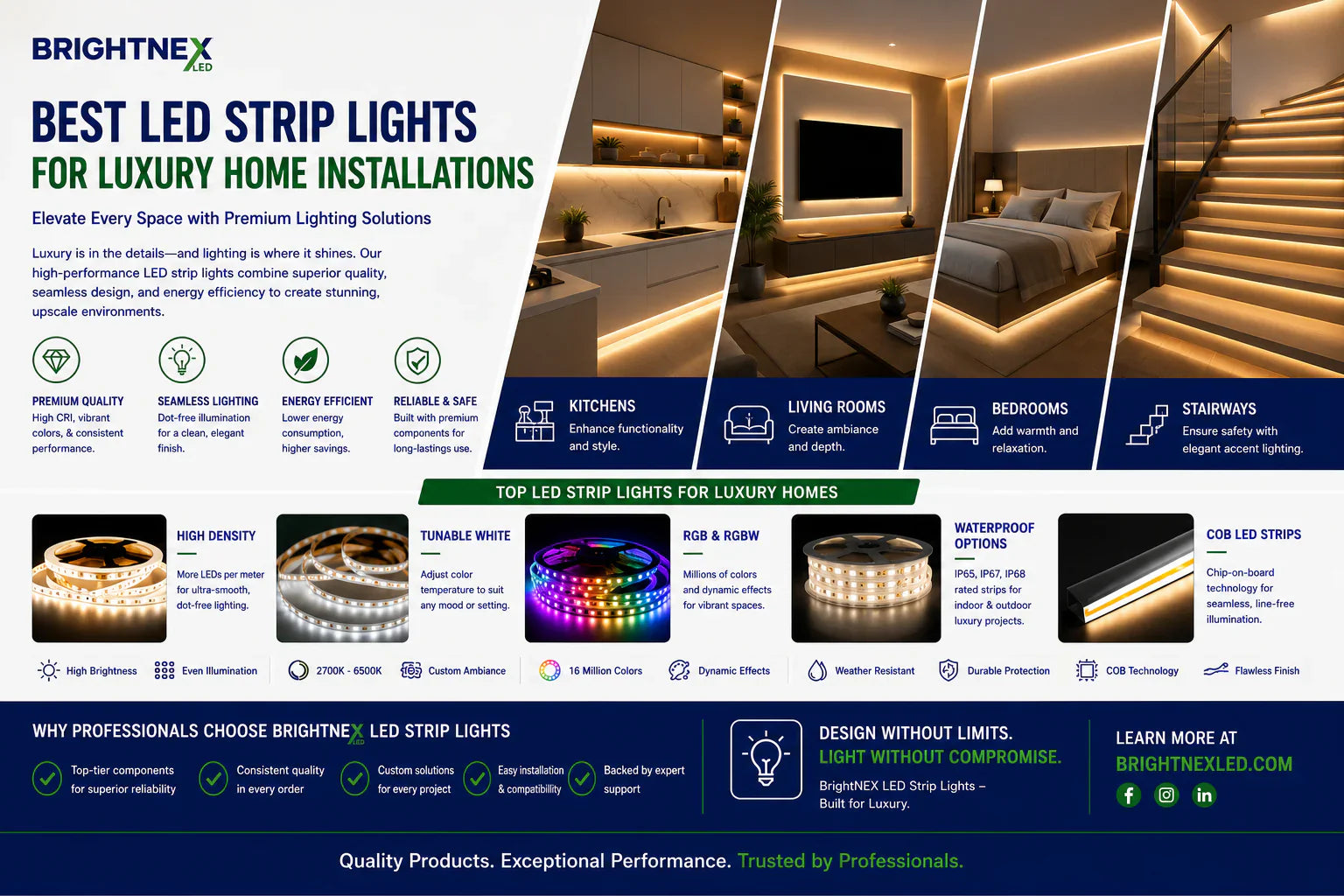
What makes the best LED strip lights for luxury home installations
Luxury projects demand more than output. The strip has to deliver visual quality. That starts with dot-free or near dot-free appearance, strong CRI, stable color temperature, and dimming performance that does not flicker at low levels. In a premium residence, poor dimming is noticed immediately, especially in primary suites, media rooms, and dining areas.
Build quality matters just as much. Trade buyers should look for strips with dependable PCB construction, consistent adhesive backing, and widths that fit the profile and layout requirements of the installation. UL-listed products are not optional in this category. They support inspection, reduce liability, and give specifiers and installers confidence that the system was built for real project conditions.
The driver is part of the decision, not an accessory. A luxury installation can be ruined by pairing a good strip with an incompatible dimmable power supply. TRIAC, ELV, MLV, and 0-10V all have their place, but they must match the control method and load. For damp, dry, or wet location requirements, enclosure and junction box details also matter.
COB strip lights are the first choice for premium interiors
If the goal is refined architectural light, COB strip lights usually lead the field. They create a continuous line of light with minimal visible pixelation, which makes them ideal for floating shelves, under-cabinet runs, toe kicks, cove lighting, and recessed profile applications. In luxury homes, that cleaner visual finish is often the difference between decorative lighting and a custom integrated lighting effect.
COB also helps in low-profile installs where diffuser depth is limited. Traditional SMD tape can still show diode spotting in shallow channels, while COB can maintain a smoother line. That said, output, heat management, and driver sizing still need attention. Dot-free appearance does not eliminate electrical planning.
Widths matter here. Professional buyers often need 6.5mm, 8mm, 10mm, or 12mm tape depending on channel selection, run length, and available recess dimensions. A narrow tape may solve a millwork constraint, while a wider board may support stronger thermal behavior or higher output in a cove. The right answer depends on the fixture build, not just the cut sheet.
RGB, RGBW, CCT, and IC RGB in luxury applications
Not every high-end residence wants static white only. Color-changing systems are common in bars, theaters, outdoor entertainment zones, gaming rooms, and statement coves. But luxury projects usually need restraint. Specifying RGB simply because it offers color can leave the white light looking weak or unrefined. In most upscale interiors, RGBW is the better fit because it adds a dedicated white channel for more usable everyday lighting.
CCT tunable white is another strong option for luxury homes. It gives designers and homeowners the ability to shift between warm and cool white tones based on time of day, mood, or room function without turning the space into a nightclub. For kitchens, bathrooms, and living spaces that need a premium but livable result, CCT often provides more practical value than full color.
IC RGB is best reserved for projects that specifically call for animated effects, segmented control, or more advanced visual scenes. It can create an impressive statement in media rooms or custom feature walls, but it also introduces more control complexity. In a luxury home, extra complexity is only worth it when the design intent clearly supports it.
Static white still wins in most architectural installs
Despite the interest in smart color systems, static white remains the foundation of most luxury residential strip lighting. Warm white selections are especially common in high-end homes where wood finishes, plaster textures, and natural stone need flattering light. The quality of that white light is what separates premium installations from average ones.
High CRI is essential. A luxury kitchen with expensive cabinetry and natural marble will expose poor color rendering immediately. The same is true in dressing rooms, art niches, and bathroom mirror applications. Consistent color temperature from reel to reel also matters, particularly on long projects with multiple rooms and phases.
When static white is specified correctly, it tends to age better stylistically than trend-driven color effects. It gives the space a permanent architectural quality, which is exactly what many luxury clients expect.
Driver and dimming choices are where many projects go wrong
The strip gets attention, but the driver determines whether the system behaves like a premium lighting product. Luxury homeowners expect smooth dimming from bright task levels down to soft ambient light. If the dimming curve is abrupt, if the strip drops out early, or if flicker appears at lower percentages, the installation feels cheap no matter how good the millwork looks.
TRIAC and ELV dimming are common in residential work, but they are not interchangeable. Load type, control hardware, and minimum load behavior all have to be checked. For larger systems or integrated control environments, 0-10V may make more sense. Class 2 considerations, voltage drop, and total wattage should be planned at the system level, especially on longer runs.
For wet, damp, and dry locations, the driver enclosure matters too. A professional-grade driver with an appropriate junction box supports cleaner inspection outcomes and better long-term reliability. In premium homes, exterior details, spa areas, steam-adjacent rooms, and covered outdoor transitions often require that extra level of planning.
Profiles, lenses, and finish details matter more than many buyers expect
In luxury work, strip light is rarely left exposed. The aluminum profile, diffuser, recess depth, and lens quality all affect the finished result. A strong strip in the wrong channel can create glare, visible spotting, or uneven wash. A weaker strip in the right profile can often look more expensive because the light is controlled better.
Recessed channels are especially common in custom millwork and gypsum details. Surface channels still have a place in closets, display shelving, and retrofit conditions, but they need to look intentional. Diffuser choice also affects output and visual softness. Frosted lenses reduce pixel visibility, though they can cut light slightly. Clear lenses preserve more output but may expose the diode structure if the strip is not COB or the profile is too shallow.
This is why experienced buyers source systems, not loose parts. Strip, driver, controls, connectors, wire, and channel should be selected as a compatible package.
How trade buyers should choose the best LED strip lights for luxury home installations
Start with the application. Under-cabinet lighting needs different output and glare control than a ceiling cove or staircase reveal. Then confirm the environment - dry, damp, or wet. After that, choose voltage, strip width, and profile style based on run length, mounting detail, and finish expectations.
Next, match the strip to the control method. If the project uses wall dimmers, verify dimming protocol and driver compatibility before ordering. If the design calls for tunable white or color changing, specify the controller and wiring path early. Luxury jobs often have limited tolerance for field improvisation, especially when cabinetry and finish trades are already scheduled.
Finally, stay with UL-listed products from a trade-focused supplier that understands real project requirements. BrightNex LED is trusted in high-end Los Angeles homes for exactly that reason - professional-grade strip lights, dimmable driver solutions, certified safety, and wholesale pricing that works for installers and resellers across the US.
Where premium strip lighting delivers the most value
The biggest return usually comes from spaces where the light source stays hidden but the effect is constantly visible. Kitchen under-cabinet lighting, island reveals, cove perimeters, bathroom vanities, closets, bars, wine displays, and stair details all benefit from premium strip systems. These are not novelty locations. They are daily-use architectural features that shape how the home feels after sunset.
That is why experienced professionals avoid one-size-fits-all tape light on luxury projects. Better results come from specifying each zone correctly, protecting dimming performance, and using components built for inspection, finish quality, and long-term reliability. In this category, the cheapest strip is rarely the lowest-cost decision once callbacks and replacement labor are part of the equation.
If you are buying for a high-end residence, think less about tape light as a product and more about it as part of the finished architecture. That is usually where the best decisions get made.
FAQ
What are the best LED strip lights for luxury homes?
COB LED strip lights are often considered the best choice for luxury homes because they provide smooth, dot-free illumination, excellent aesthetics, and premium architectural lighting effects.
Is COB better than SMD for luxury residential lighting?
In most visible applications, yes. COB strips create a continuous line of light with minimal spotting, making them ideal for under-cabinet lighting, coves, shelves, and recessed channels.
Should luxury homes use RGBW or tunable white LED strips?
RGBW is ideal for entertainment areas and accent lighting, while CCT tunable white is often preferred for kitchens, bathrooms, and living spaces where adjustable white light improves comfort and usability.
What color temperature is best for luxury home LED strip lighting?
Warm white temperatures, typically between 2700K and 3000K, are commonly used in luxury homes because they complement wood, stone, and premium interior finishes.
Why are dimmable drivers important for luxury LED strip lighting?
A high-quality dimmable driver ensures smooth, flicker-free dimming and helps create the refined lighting experience expected in premium residential installations.