
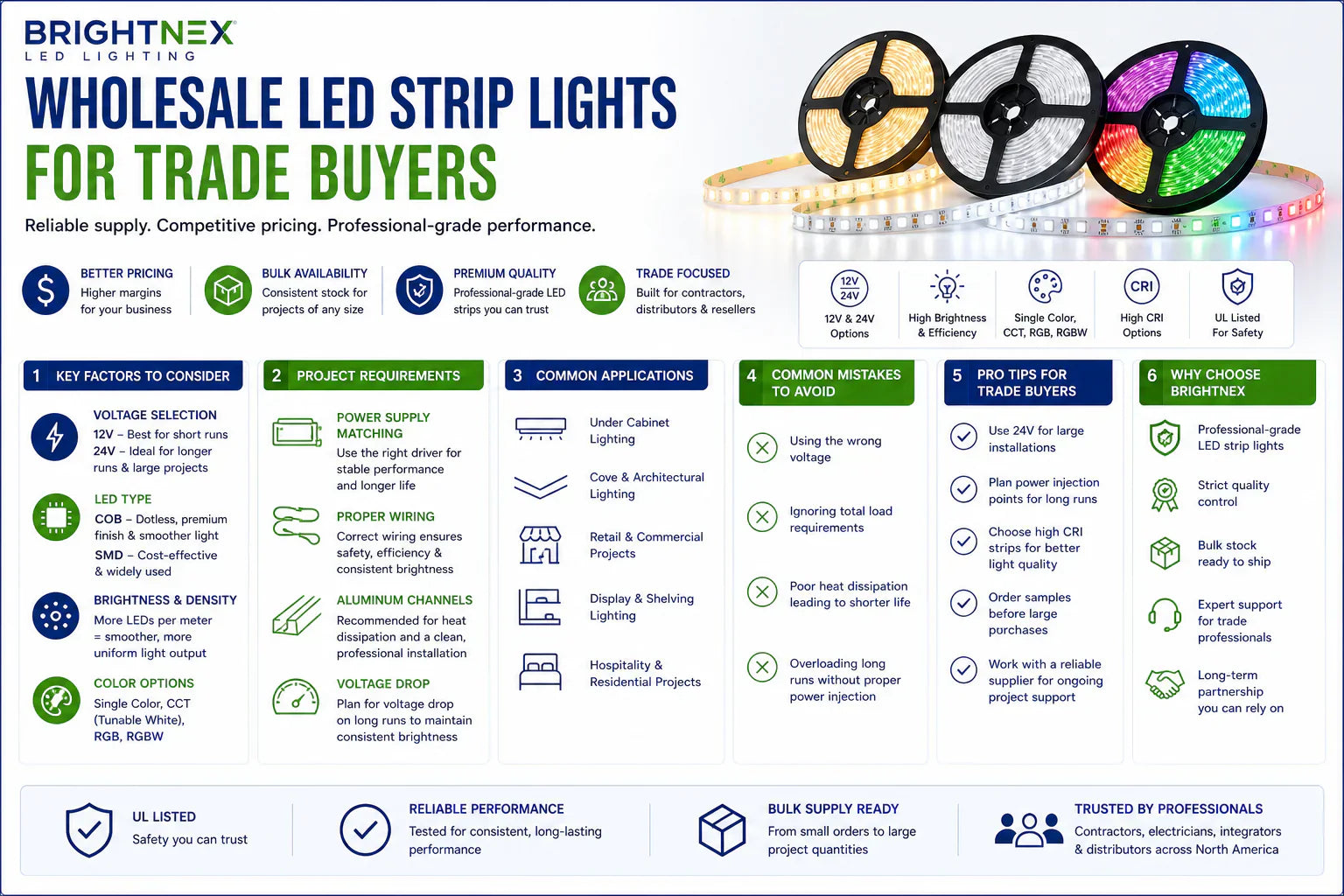
Why Wholesale LED Strip Lights Are More Than a Price Decision
A strip light may look impressive on a sample board but still create costly problems after installation. Issues such as flickering, voltage drop, poor dimming performance, adhesive failure, or inconsistent color output often appear only after the project is completed.
For electricians, lighting dealers, contractors, and project buyers, wholesale LED strip lights should be evaluated based on reliability, compatibility, certification, and long-term performance—not simply reel price.
Successful projects depend on selecting products that install efficiently, pass inspections, and continue performing as expected for years.
What Matters Most When Buying Wholesale LED Strip Lights
Professional buyers should evaluate LED strip lighting as a complete system.
That includes:
• LED strips
• Drivers
• Controllers
• Connectors
• Wiring accessories
• Aluminum channels
• Mounting hardware
Many installation issues occur because components are selected independently rather than as part of a coordinated lighting system.
A complete solution helps reduce compatibility problems while improving installation efficiency.
Why UL Certification Should Be a Priority
Certification is one of the most important considerations for professional buyers.
UL-listed products help support:
• Inspection approval
• Code compliance
• Project specifications
• Contractor confidence
For residential and commercial projects, certified products provide additional assurance that lighting systems meet recognized safety standards.
Professional buyers should verify certification for both the strip lighting and supporting power components.
Choosing the Right LED Strip Technology
Different projects require different strip types.
COB LED Strip Lights
COB (Chip on Board) strips create a smooth, dot-free line of light that works exceptionally well in visible architectural applications.
Popular uses include:
• Under-cabinet lighting
• Floating vanities
• Stair lighting
• Cove lighting
• Display shelving
• Architectural millwork
COB technology is often preferred for luxury residential projects where appearance is critical.
Standard LED Strip Lights
Traditional LED strip formats continue to serve many applications where output, flexibility, and budget considerations are priorities.
For larger commercial installations and general architectural lighting, standard strip formats often remain a practical solution.
RGB, RGBW, CCT, and IC RGB Options
Color-changing technologies allow buyers to match products to project requirements.
Common options include:
• RGB for decorative color effects
• RGBW for color plus dedicated white light
• CCT for tunable white applications
• IC RGB for addressable lighting effects
Each technology offers different benefits depending on the intended application.
Why PCB Width Matters
LED strip width affects profile compatibility and installation flexibility.
Common widths include:
• 6.5mm
• 8mm
• 10mm
• 12mm
Selecting the correct width helps ensure proper fit within aluminum channels, cabinetry details, and architectural elements.
This becomes especially important in custom residential projects where space is limited.
Why Dimming Compatibility Matters
Many LED lighting issues originate from improper driver selection rather than the strip itself.
Professional buyers should verify compatibility with:
• TRIAC dimming
• ELV dimming
• MLV dimming
• 0-10V dimming
The strip, driver, and dimmer should always be evaluated together as a complete system.
Ignoring compatibility can lead to:
• Flickering
• Buzzing
• Poor low-end dimming
• Reduced driver lifespan
Proper planning helps avoid expensive callbacks.
Why Driver Selection Should Happen Early
Drivers should never be treated as an afterthought.
Important considerations include:
• Voltage requirements
• Wattage capacity
• Dimming method
• Environmental rating
• Installation location
Properly sized drivers help maximize performance while improving long-term reliability.
Professional buyers often include driver selection during the initial quotation process rather than after products are ordered.
Environmental Ratings Should Match the Application
Not every project operates under the same conditions.
Installations may require products rated for:
• Dry locations
• Damp locations
• Wet locations
Bathrooms, outdoor kitchens, patios, and moisture-prone spaces require special attention to environmental ratings.
Drivers, connectors, and accessories should all be evaluated as part of the complete system.
Why Luxury Residential Projects Require Better Products
Luxury homes place greater demands on lighting systems.
Applications such as:
• Custom kitchens
• Floating vanities
• Ceiling coves
• Closets
• Shelving systems
• Stair lighting
make every lighting detail visible.
Homeowners and designers expect:
• Smooth illumination
• Consistent color temperature
• Reliable dimming
• Clean installation details
For these projects, premium strip systems often deliver significantly better results than entry-level alternatives.
How Resellers and Contractors Buy Differently
Lighting dealers and distributors often focus on inventory management and product versatility.
Contractors typically prioritize:
• Installation speed
• Product reliability
• System compatibility
• Serviceability
Understanding the end user helps determine which product categories deserve priority within a wholesale purchasing strategy.
Many successful suppliers support both approaches through focused product selection and dependable inventory.
How to Evaluate a Wholesale Supplier
Price is important, but experienced buyers evaluate much more than cost.
Key factors include:
• Product certification
• Inventory consistency
• Technical support
• Driver compatibility
• Accessory availability
• Shipping reliability
A supplier that understands complete lighting systems can often help reduce installation issues while improving project efficiency.
Common Wholesale Buying Mistakes
Several mistakes repeatedly create problems in LED strip lighting projects.
These include:
• Buying strips before selecting drivers
• Assuming all white strips perform the same
• Ignoring environmental ratings
• Overlooking dimming compatibility
• Failing to plan for future serviceability
Avoiding these issues can significantly improve project outcomes and reduce long-term costs.
Why Long-Term Value Matters More Than Reel Price
The true cost of a lighting system extends far beyond the initial purchase price.
Professional buyers should consider:
• Installation labor
• Service calls
• Product replacements
• Project delays
• Customer satisfaction
Products that install correctly and perform consistently often deliver greater value than lower-cost alternatives that create problems later.
Conclusion
Wholesale LED strip lights should be selected based on system performance, certification, compatibility, and long-term reliability rather than price alone.
By evaluating the complete lighting package—including strips, drivers, controllers, and accessories—contractors and project buyers can reduce installation risk, improve project quality, and deliver better results for their customers.
FAQ
What should I look for when buying wholesale LED strip lights?
Focus on certification, compatibility, dimming performance, inventory reliability, and overall system quality.
Are COB LED strips better than standard LED strips?
COB strips provide a smoother, dot-free appearance and are often preferred for visible architectural lighting.
Why is UL certification important?
UL certification helps support safety compliance and inspection approval for professional projects.
Do LED strip lights require specific drivers?
Yes. Drivers must match the voltage, wattage, and dimming requirements of the LED strip.
What is the advantage of buying from a specialized supplier?
Specialized suppliers often provide better compatibility, technical support, inventory consistency, and system integration.