
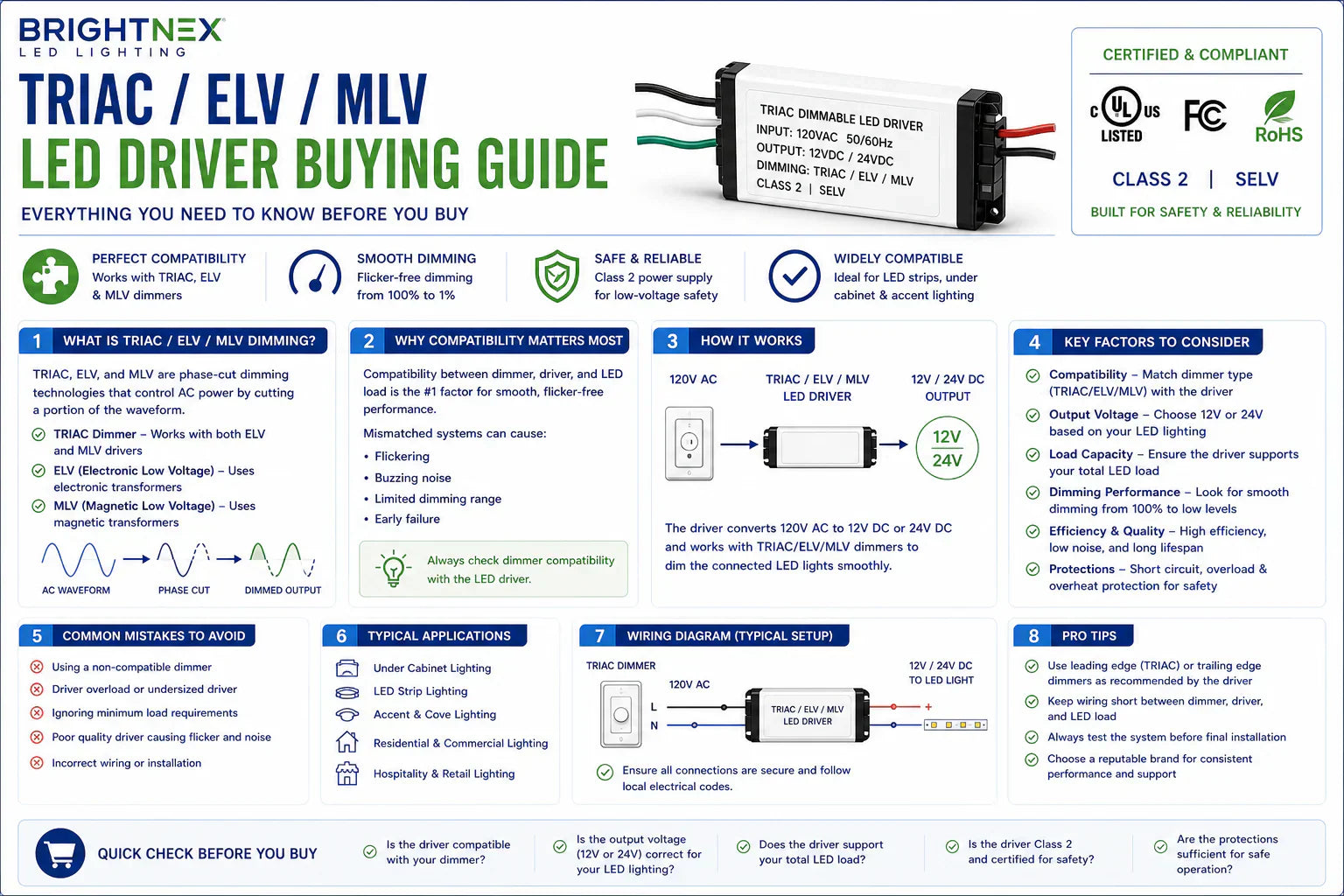
Why Driver Selection Matters for LED Dimming
A lighting system can look perfect at full brightness and still disappoint the client when the dimmer is used. Flickering, buzzing, uneven dimming, and sudden drop-offs are often caused by poor compatibility between the dimmer and the driver rather than the lighting fixture itself.
For contractors, electricians, lighting dealers, and project buyers, selecting the correct TRIAC, ELV, or MLV LED driver is one of the most important decisions in any dimmable lighting project.
In luxury residential environments especially, dimming performance becomes part of the overall user experience. Homeowners notice poor dimming immediately, particularly in kitchens, media rooms, stair lighting, cove lighting, and architectural accent applications.
What Is a TRIAC ELV MLV LED Driver?
The terms TRIAC, ELV, and MLV refer to different phase-cut dimming methods used to control LED drivers.
These drivers are designed to work with specific dimmer technologies and control approaches.
The three most common categories are:
• TRIAC (Forward Phase)
• ELV (Electronic Low Voltage / Reverse Phase)
• MLV (Magnetic Low Voltage / Forward Phase)
Although they may appear similar on specification sheets, they often behave very differently in real-world installations.
Understanding those differences helps buyers avoid compatibility problems and improve overall dimming performance.
Understanding TRIAC Dimming
TRIAC dimming remains one of the most common dimming methods used in residential projects.
Because many existing homes already contain TRIAC-compatible wall dimmers, this approach is frequently chosen for retrofit and remodeling projects.
Advantages include:
• Wide availability
• Lower installation costs
• Compatibility with many existing controls
• Simple retrofit applications
However, not every TRIAC dimmer performs equally well with LED loads. Older dimmers originally designed for incandescent lighting can sometimes create dimming issues when paired with modern LED systems.
Careful compatibility verification remains important.
Understanding ELV Dimming
ELV (Electronic Low Voltage) dimming uses reverse-phase control and is often considered the premium option for many LED installations.
Many lighting professionals prefer ELV dimming because it can deliver:
• Smoother low-end dimming
• Reduced flickering
• Quieter operation
• Better performance with electronic LED loads
These benefits make ELV particularly attractive in luxury residential environments where lighting quality is highly visible.
The trade-off is that ELV controls typically cost more than standard TRIAC dimmers.
Understanding MLV Dimming
MLV (Magnetic Low Voltage) dimming is traditionally associated with magnetic transformers and forward-phase control systems.
While less common in many modern LED installations, MLV compatibility may still be important when existing infrastructure or project requirements dictate its use.
In many cases, MLV enters the conversation because contractors need compatibility with existing dimming systems already installed in the building.
As with TRIAC and ELV, actual performance depends on the complete system rather than the label alone.
Why Compatibility Matters More Than Marketing Labels
A driver labeled "dimmable" only tells part of the story.
The real question is whether the driver is compatible with:
• The dimmer
• The LED load
• The wiring configuration
• The installation environment
When these components are not properly matched, common issues include:
• Flickering
• Buzzing
• Dead travel on the dimmer
• Sudden shutoff at low levels
• Inconsistent startup behavior
Professional buyers should always evaluate the complete lighting system rather than focusing on a single component.
How to Choose the Right TRIAC ELV MLV LED Driver
The first step is identifying the dimmer that will control the system.
If the dimmer model is already known, driver selection becomes much easier.
Next, verify:
• LED load type
• Total wattage requirements
• Driver voltage requirements
• Dimming method
• Installation environment
Most LED strip systems require either 12V or 24V constant voltage drivers. Selecting the correct voltage remains just as important as selecting the correct dimming method.
Why Load Size Affects Dimming Performance
Load size has a significant impact on dimming quality.
Drivers operating very close to maximum capacity can experience reduced performance and shortened lifespan.
Similarly, some dimmers perform poorly when the connected LED load is extremely small.
Professional installers typically allow reasonable wattage headroom to help improve reliability and maintain consistent dimming performance.
Environmental Ratings Should Match the Application
Driver selection should always account for the installation environment.
Depending on the project, products may be required for:
• Dry locations
• Damp locations
• Wet locations
Projects involving bathrooms, outdoor living areas, covered patios, or moisture-prone spaces should receive additional attention during specification.
Environmental compatibility is just as important as dimming compatibility.
Why UL Certification Matters
UL certification remains a key requirement for many residential and commercial projects.
Certified drivers help support:
• Inspection approval
• Safety compliance
• Professional specifications
• Contractor confidence
For trade buyers, certified products often reduce risk while simplifying purchasing decisions.
Common Mistakes When Specifying Dimmable Drivers
Several common mistakes continue to create dimming problems in the field.
These include:
• Assuming all phase-cut dimmers work the same way
• Ignoring actual dimmer model compatibility
• Loading drivers too heavily
• Treating the driver separately from the LED load
• Overlooking environmental requirements
Successful installations depend on evaluating the entire system rather than focusing solely on individual product specifications.
Best Applications for Each Driver Type
TRIAC drivers are often ideal for:
• Residential retrofits
• Remodel projects
• Existing wall dimmer installations
ELV drivers are commonly preferred for:
• Luxury homes
• Architectural lighting
• Premium LED strip installations
• Projects requiring smoother low-end dimming
MLV compatibility is often important for:
• Existing magnetic low-voltage systems
• Legacy control environments
• Specific retrofit applications
The best choice depends on project requirements rather than any single technology being universally better.
Why Professional Buyers Focus on Total System Performance
Experienced buyers understand that dimming quality affects customer satisfaction, labor costs, and project profitability.
A driver should provide:
• Stable dimming
• Reliable startup
• Quiet operation
• Consistent output
• Long-term reliability
Products that deliver these characteristics often provide significantly greater value than lower-cost alternatives that create troubleshooting and service calls.
Conclusion
Choosing the right TRIAC ELV MLV LED driver requires more than selecting a dimmable power supply. Successful projects depend on compatibility between the driver, dimmer, LED load, and installation environment.
By evaluating the complete system early in the design process, contractors and project buyers can improve dimming performance, reduce callbacks, and create lighting installations that meet the expectations of both clients and inspectors.
FAQ
What is the difference between TRIAC and ELV dimming?
TRIAC uses forward-phase dimming, while ELV uses reverse-phase dimming and often provides smoother low-end LED performance.
Is ELV better than TRIAC for LED lighting?
ELV often delivers better dimming performance, but the best choice depends on the project and existing controls.
Can one LED driver support TRIAC, ELV, and MLV dimming?
Some drivers support multiple dimming methods, but compatibility should always be verified with the manufacturer.
Why do LED lights flicker when dimmed?
Flickering is often caused by incompatibility between the dimmer, driver, and LED load.
Do TRIAC drivers work with LED strip lights?
Yes. Many LED strip lighting systems use TRIAC-compatible drivers when paired with compatible dimmers.