
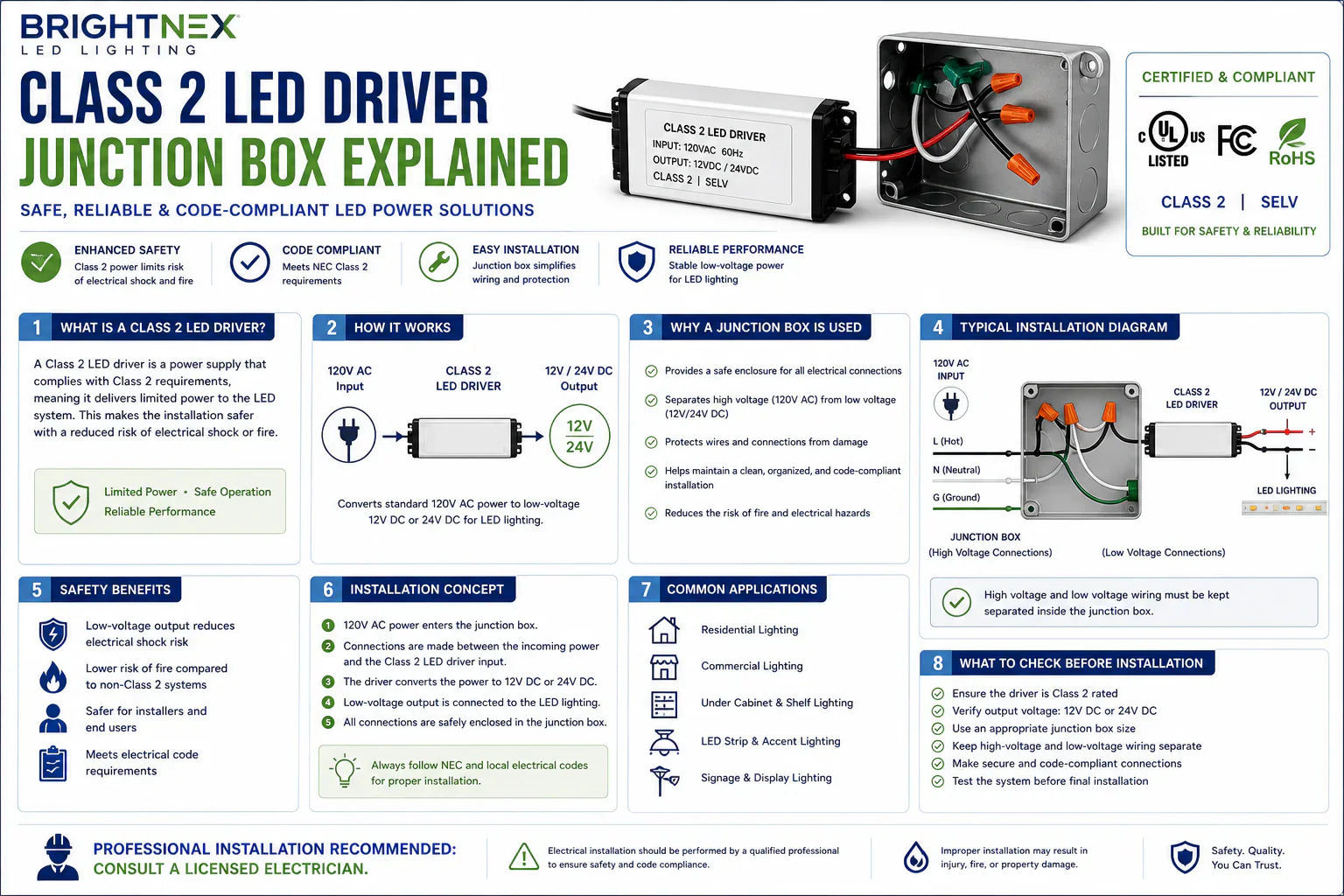
What Is a Class 2 LED Driver Junction Box?
A Class 2 LED driver junction box combines an LED driver and a protected wiring enclosure into a single assembly. The junction box provides a secure location for line-voltage connections while the driver converts incoming power into the low-voltage output required by LED lighting systems.
Many professional-grade products integrate both components into a UL-listed assembly, helping simplify installation and improve consistency on the jobsite.
For electricians and contractors, this means fewer components to coordinate and a cleaner transition between branch circuit wiring and low-voltage lighting.
Why Class 2 Matters
Class 2 drivers are designed to operate within output limits intended to reduce fire and shock risks. This makes them a popular choice for LED strip lighting, architectural accents, under-cabinet lighting, and many other low-voltage applications.
The benefits often include:
• Simpler low-voltage wiring strategies
• Improved installation flexibility
• Stronger safety compliance
• Easier serviceability
However, Class 2 output limits also restrict the amount of power available from a single driver. Larger lighting systems may require multiple drivers to support the total load.
For most residential and light commercial applications, the advantages often outweigh this limitation.
Where Class 2 LED Driver Junction Boxes Are Commonly Used
These products are frequently specified anywhere a clean, protected installation is required.
Common applications include:
• Under-cabinet lighting
• Floating vanities
• Closet lighting
• Display shelving
• Cove lighting
• Architectural millwork
• Accent lighting systems
Because line-voltage connections must be properly enclosed, integrated junction box designs often help simplify installation while creating a more professional finished result.
Why Luxury Residential Projects Prefer Integrated Solutions
High-end residential projects place greater attention on both appearance and serviceability.
Designers and homeowners expect lighting systems to perform reliably while remaining hidden from view. At the same time, electricians need safe and code-compliant wiring methods.
Integrated Class 2 driver junction box assemblies help address both requirements by providing:
• Protected wiring connections
• Compact installation options
• Cleaner layouts
• Improved service access
This makes them particularly popular in custom homes where lighting is built into cabinetry, closets, vanities, and architectural details.
How to Choose the Right Driver
Driver selection involves more than matching wattage.
Before specifying a Class 2 LED driver junction box, verify:
• Output voltage
• Total wattage load
• Dimming requirements
• Installation environment
• Available installation space
The driver should provide enough capacity for the connected load while maintaining reasonable headroom for long-term performance.
Choosing the correct voltage is equally important, especially for LED strip lighting systems that typically operate at 12V or 24V.
Why Dimming Compatibility Is Critical
Many installation issues are caused by mismatched dimming components.
Professional buyers should confirm compatibility with the intended control method, including:
• TRIAC dimming
• ELV dimming
• MLV dimming
• 0-10V dimming
A driver may be electrically correct but still produce flickering, buzzing, or poor low-end dimming if it is paired with the wrong control system.
Verifying compatibility before installation helps reduce callbacks and troubleshooting.
Location Ratings Should Match the Environment
Not all Class 2 driver junction box assemblies are designed for the same conditions.
Depending on the project, products may be required for:
• Dry locations
• Damp locations
• Wet locations
Bathrooms, covered patios, exterior architectural features, and moisture-prone spaces often require additional attention to environmental ratings.
Reviewing location requirements early helps avoid installation changes later in the project.
Physical Size Matters More Than Many Buyers Expect
Even when electrical specifications are correct, physical dimensions can create challenges.
Drivers installed above cabinetry, within millwork cavities, or inside remodel spaces often face tight clearance limitations.
Before ordering, buyers should verify:
• Driver dimensions
• Junction box dimensions
• Airflow requirements
• Accessibility requirements
Planning around physical space early helps prevent field modifications and installation delays.
Common Mistakes to Avoid
Several common mistakes continue to create problems on LED lighting projects.
One is assuming every enclosed driver includes a true integrated junction box suitable for line-voltage terminations.
Another is focusing only on wattage while overlooking dimming compatibility and installation conditions.
Poor placement is also a frequent issue. Drivers should remain accessible for future service rather than being hidden in inaccessible locations.
Addressing these factors during design helps improve long-term reliability.
Why Certification Should Come Before Price
Cost is always a factor, especially on larger projects, but certification should remain a priority.
UL-listed Class 2 driver junction box assemblies help support:
• Inspection approval
• Code compliance
• Safety requirements
• Professional project standards
For contractors, lighting stores, and project buyers, certified products often reduce risk and improve confidence throughout the project lifecycle.
The lowest-cost component rarely provides the best value if it creates inspection delays or future service issues.
Why the Driver Should Be Part of the Lighting System
The driver should never be treated as an isolated component.
Successful lighting systems require compatibility between:
• LED strips or fixtures
• Drivers
• Dimmers
• Controllers
• Installation environments
When these elements are selected together, installations typically perform better and require less troubleshooting.
This system-based approach is one reason professional buyers often standardize around proven product families for repeat projects.
Conclusion
A Class 2 LED driver junction box plays a critical role in the safety, performance, and serviceability of modern LED lighting systems.
By combining protected line-voltage connections with low-voltage power conversion, these products help simplify installations while supporting code-compliant project requirements.
For contractors, electricians, lighting dealers, and project buyers, selecting the right driver means evaluating certification, dimming compatibility, environmental ratings, installation space, and long-term reliability. When those factors are addressed early, the entire lighting system tends to perform more smoothly from rough-in to final inspection.
FAQ
What is a Class 2 LED driver?
A Class 2 LED driver limits output power to help reduce fire and shock risks.
Why use an integrated junction box?
It provides a protected location for line-voltage wiring while simplifying installation.
Can Class 2 drivers be dimmed?
Yes. Many models support TRIAC, ELV, MLV, or 0-10V dimming.
Are Class 2 drivers suitable for LED strip lighting?
Yes. They are commonly used for low-voltage LED strip lighting applications.
Do all Class 2 drivers include a junction box?
No. Some models require a separate junction box, so specifications should always be verified.